Hypertrophic Cardiomyopathy Genetic Screening: How It Works, Results and What to Expect

Genetic testing can identify an inherited cause of HCM, but a negative result does not completely rule out the condition. Testing is often most informative when it begins with a family member who has confirmed HCM.
Key Takeaways
- Genetic testing can identify an inherited cause of HCM, but a negative result does not completely rule out the condition.
- Testing is often most informative when it begins with a family member who has confirmed HCM.
- A positive result may allow targeted testing and appropriate follow-up for close biological relatives.
- Results may be positive, negative or uncertain, and should be discussed with a cardiologist and genetics professional.
- HCM can occur at any age, so relatives may need repeat heart screening even when an early evaluation is normal.
<a href="https://acibademinternational.com/diseases/hypertrophic-cardiomyopathy/”>Hypertrophic cardiomyopathy genetic screening is a blood or saliva test that searches for inherited genetic variants linked with hypertrophic cardiomyopathy (HCM). It is most useful when interpreted alongside heart imaging, family history and genetic counselling, particularly for people with HCM and their close relatives.
Overview: what hypertrophic cardiomyopathy genetic screening involves
Hypertrophic cardiomyopathy genetic screening is used to look for inherited changes in genes associated with hypertrophic cardiomyopathy (HCM), a condition in which the heart muscle becomes abnormally thick. The test is usually performed using a small blood sample or saliva sample. It does not replace heart tests, but it can help clarify whether HCM in a family may have a genetic cause and who may benefit from ongoing evaluation.
HCM is commonly inherited in an autosomal dominant pattern. This means a person with a disease-causing genetic variant may have a 50% chance of passing it to each child. However, inheritance is not always straightforward: family members with the same variant can have different degrees of heart muscle thickening, different symptoms or no detectable changes for many years.
Genetic screening is generally part of a wider assessment that may include an electrocardiogram (ECG), echocardiogram, cardiac MRI, exercise testing and a detailed three-generation family history. People who have already been diagnosed with HCM can learn more about the condition through hypertrophic cardiomyopathy information.
Who may be a candidate for HCM genetic testing?
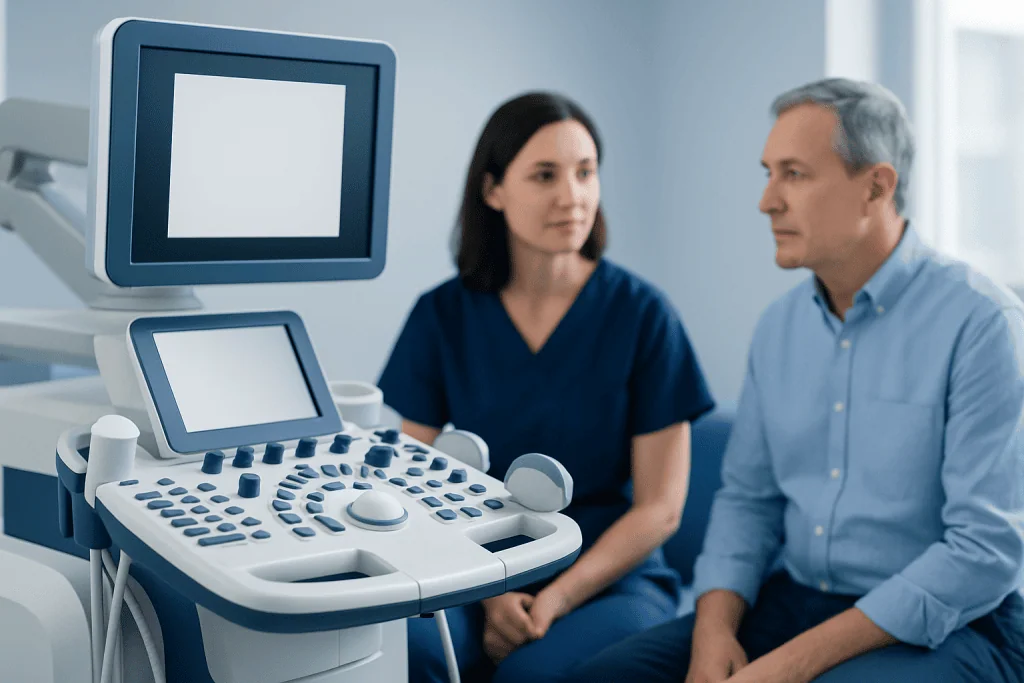
Genetic testing is most often considered for a person with a confirmed or strongly suspected diagnosis of HCM. Testing the affected person first gives the family the best chance of finding a meaningful variant. If a disease-causing variant is identified, relatives can have a focused test for that specific familial variant rather than a broader, less informative panel.
Close biological relatives of a person with HCM may be candidates for genetic counselling and either genetic testing or regular clinical heart screening. First-degree relatives include parents, siblings and children. More distant relatives may also need advice when a familial variant is identified or when there is a strong history of HCM, unexplained sudden death or serious rhythm problems.
Testing may also be discussed when heart muscle thickening is found at a young age, when there is a family history of cardiomyopathy, or when the diagnosis is uncertain. A specialist may consider other inherited heart conditions and non-genetic causes of increased wall thickness before recommending a specific testing strategy.
How the procedure works: from counselling to results

Before testing, a cardiologist, genetic counsellor or trained healthcare professional explains what the test can and cannot show. The discussion usually covers possible results, implications for relatives, privacy considerations and how results might affect follow-up. This step helps the person make an informed decision and identify family members who may need support.
The sample collection itself is simple. A healthcare professional may take blood from a vein, or the laboratory may provide a saliva collection kit. The sample is sent to a laboratory that examines a panel of genes known to be associated with HCM and related inherited cardiomyopathies. The laboratory compares the genetic sequence with established reference data and classifies relevant findings.
Results can take several weeks, depending on the laboratory and whether additional analysis is needed. The clinician reviews the findings in the context of symptoms, ECG and imaging results, rather than relying on the genetic report alone. A specialist evaluation may include cardiology assessment and follow-up to ensure screening and management plans fit the individual and their family.
Understanding positive, negative and uncertain results
A positive result means the laboratory has found a pathogenic or likely pathogenic variant associated with HCM. It supports an inherited explanation for the condition, but it cannot reliably predict exactly when HCM will appear, how severe it will become or whether complications will occur. The result may be used to offer targeted testing to relatives.
A negative result means no disease-causing variant was identified with the current test. This does not exclude HCM, especially if the person has clear findings on imaging. Some genetic causes are not yet known, and some variants may not be detectable with a particular testing method. Clinical follow-up remains important for the affected person and may still be recommended for relatives.
A variant of uncertain significance, often called a VUS, is a genetic change whose clinical meaning is not yet clear. It should not usually be used alone to diagnose HCM or make predictive testing decisions for relatives. Over time, as scientific evidence develops, the laboratory may reclassify some uncertain variants. Keeping contact details current with the clinical team can help families receive relevant updates.
How accurate is genetic testing for HCM?
Genetic testing for HCM is highly accurate at detecting the gene variants included in a laboratory’s test panel. However, the test has limits in determining whether a person has HCM or will develop it. In people with clinically confirmed HCM, a disease-causing or likely disease-causing variant is found in only a proportion of cases, particularly when there is no known family history.
For this reason, a negative genetic test does not rule out HCM, and a positive result does not establish how the condition will affect an individual. The most dependable interpretation combines genetic findings with a cardiology evaluation, heart imaging and family history. Genetic counselling is especially valuable when the result is uncertain or when family screening decisions are being made.
When a clearly disease-causing familial variant is known, testing relatives for that exact variant is generally very reliable. A relative who does not carry the known familial variant may often avoid repeated HCM screening, although their own clinician should confirm this based on the family’s full history and the original diagnosis.
Benefits, limitations, risks and recovery timeline
The main benefit of testing is that it may provide useful information for the whole family. A confirmed familial variant can identify relatives who need regular cardiac surveillance and reassure relatives who do not carry that specific variant. It may also support more informed discussions about family planning, although personal decisions should be made with appropriate specialist guidance.
The physical risks are minimal. A blood draw can cause brief discomfort, bruising, light-headedness or, rarely, infection at the needle site. Saliva testing has no meaningful physical recovery period. Most people can return to normal activities immediately after giving a sample.
Emotional and practical effects can be more significant than the sample collection. Some people feel anxious while waiting for results or concerned about what the result could mean for children and relatives. Pre-test and post-test counselling can help address these concerns, explain confidentiality and support communication within families. A result does not require immediate treatment; it guides the need for appropriate monitoring and care.
What are the warning signs of hypertrophic cardiomyopathy?
Many people with HCM have no symptoms, particularly early in the condition. When symptoms occur, they can include shortness of breath during activity, chest discomfort, palpitations, fatigue, dizziness or fainting. Symptoms can vary over time and may have causes other than HCM, so they should be assessed rather than self-diagnosed.
Fainting during or soon after exercise, new chest pain, rapid or irregular heartbeats, or unexplained breathlessness deserve prompt medical attention. A clinician may assess the heart rhythm and structure with tests such as ECG, echocardiography and cardiac MRI. The aim is to identify the cause of symptoms and assess any need for treatment or activity guidance.
People with a close relative who has HCM should not wait for symptoms before seeking advice about screening. Regular evaluation can detect changes before symptoms begin and can be adapted according to age, family history and genetic test results.
What can be mistaken for hypertrophic cardiomyopathy?
Several conditions can cause increased heart muscle thickness or symptoms that resemble HCM. Long-standing high blood pressure can thicken the heart’s main pumping chamber. Intensive athletic training may also cause physiological heart enlargement or thickening, sometimes called athlete’s heart, which usually has features that differ from HCM on specialist assessment.
Other possibilities include aortic valve narrowing, infiltrative conditions such as amyloidosis, storage disorders, metabolic conditions and some neuromuscular or genetic syndromes. In children and younger adults, the pattern of thickening and the wider medical history can be particularly important. Cardiac MRI and specialist review can help distinguish among these possibilities.
Because the causes and treatments differ, it is important not to assume that all thickened heart muscle is HCM. Genetic testing may help in selected cases, but it is interpreted alongside clinical findings and imaging rather than used as a stand-alone diagnostic test.
At what age is HCM usually diagnosed?
HCM can be diagnosed at any age. It may be found in childhood, adolescence or adulthood, and some people are not diagnosed until later life. In inherited HCM, heart muscle thickening may become apparent during teenage years or early adulthood, but the timing varies considerably between individuals and families.
A normal heart assessment at one point in life does not always mean HCM will never develop. For this reason, relatives at risk may be advised to have periodic ECG and echocardiogram screening, with the timing tailored to their age, family history, symptoms and genetic status. Children in affected families should be assessed through a clinician experienced in inherited cardiac conditions.
Adults may be diagnosed after an incidental heart murmur, an abnormal ECG, symptoms during exercise or assessment of a family history. Earlier identification allows clinicians to discuss appropriate monitoring, lifestyle considerations and treatment if needed.
When to seek medical care
Anyone with unexplained fainting, chest pain, severe shortness of breath, persistent palpitations or a fast irregular heartbeat should seek urgent medical assessment, particularly if symptoms occur with exertion. Emergency services should be contacted for severe chest pain, collapse, major breathing difficulty or symptoms that do not settle quickly.
Non-urgent cardiology advice is appropriate for people with a parent, sibling or child diagnosed with HCM, a family history of unexplained sudden death, or an abnormal ECG or echocardiogram. A clinician can explain whether genetic counselling, genetic testing or scheduled heart screening is most suitable.
Management often involves cardiologists, imaging specialists, rhythm specialists, genetic counsellors and, when appropriate, paediatric teams. Acibadem International’s multidisciplinary specialists and JCI-accredited hospitals support diagnosis and care for international patients with inherited cardiac conditions.
Frequently asked questions
Should all relatives of someone with HCM have genetic testing?
Not necessarily. The most informative approach is usually to test the family member with confirmed HCM first. If a pathogenic familial variant is found, close relatives can be offered targeted testing; if no informative variant is found, clinical heart screening may still be recommended.
Can a person have an HCM gene variant but normal heart tests?
Yes. A person may carry a disease-causing variant and have no detectable heart muscle thickening at the time of assessment. They may need periodic follow-up because HCM can develop later, although not every carrier will develop clinically apparent disease.
Does a positive HCM genetic test mean a person needs treatment?
No. A positive result identifies an inherited risk but does not by itself determine treatment. Treatment decisions depend on symptoms, heart structure, heart rhythm findings, obstruction of blood flow and overall risk assessment.
Can genetic testing diagnose HCM without an echocardiogram?
Genetic testing alone is not usually enough to diagnose HCM. Echocardiography, ECG and sometimes cardiac MRI are needed to assess the heart and confirm whether HCM is present. Genetic results add useful information about inherited risk and family screening.
What happens if an HCM genetic test finds a variant of uncertain significance?
An uncertain variant means there is not enough evidence to know whether the genetic change causes disease. It should not usually be used for predictive testing of relatives or to make major medical decisions. The clinical team may recommend ongoing heart screening based on family history and may review the variant again if new evidence becomes available.
Can children be screened for hypertrophic cardiomyopathy?
Yes. Children with a close family history of HCM may need clinical screening, and targeted genetic testing may be considered if a disease-causing familial variant is known. The schedule should be individualized by a paediatric cardiology or inherited heart disease team.
References
- American Heart Association
- American College of Cardiology
- European Society of Cardiology
- Heart Failure Society of America
- National Society of Genetic Counselors
This article is for general information only and is not a substitute for professional medical advice. Please consult a qualified doctor about your individual situation.
Explore treatments in Turkey — costs, top hospitals & a free quote
JCI-accredited · board-certified surgeons · reply within 24h
Add us as a Preferred Source to see more of our trusted health content across Google Search, AI Overviews and Discover.