Jc Disease: Early Signs, Risk Factors, and How It Is Treated

jc disease most often means PML, a rare infection of the brain caused by JC virus reactivation. It mainly affects people with weakened immune systems, such as those with HIV, cancer, organ transplants, or certain immune-modifying medicines.
Key Takeaways
- jc disease most often means PML, a rare infection of the brain caused by JC virus reactivation.
- It mainly affects people with weakened immune systems, such as those with HIV, cancer, organ transplants, or certain immune-modifying medicines.
- Symptoms often develop over days to weeks and may include weakness, confusion, vision changes, speech problems, and poor balance.
- Diagnosis usually involves brain MRI, neurological assessment, and testing of spinal fluid for JC virus.
- There is no single antiviral cure; treatment focuses on improving immune function and stopping or changing contributing medications.
- Prompt medical evaluation is important if new neurological symptoms appear.
jc disease usually refers to progressive multifocal leukoencephalopathy, or PML, a rare but serious brain infection caused by reactivation of the JC virus in people with weakened immune systems. Early signs can include changes in thinking, vision, speech, strength, or coordination, and treatment focuses on restoring immune function and addressing the underlying cause.
What jc disease is
jc disease most commonly refers to progressive multifocal leukoencephalopathy, often shortened to PML. PML is a rare infection that affects the brain’s white matter, the part of the nervous system that helps signals travel efficiently. It is caused by the JC virus, a very common virus that usually remains inactive in healthy people and causes no symptoms.
In most cases, the immune system keeps the virus under control for life. Problems can begin when the immune system becomes significantly weakened. In that setting, the virus may reactivate, enter the brain, and damage myelin, the protective covering around nerve fibers. This can interfere with communication between different parts of the brain and lead to neurological symptoms.
Because PML can affect different areas of the brain, symptoms vary from person to person. Some people first notice subtle changes in coordination or concentration, while others develop more obvious weakness, visual problems, or speech difficulties. The condition is uncommon, but it is medically important because early recognition can help guide urgent evaluation and treatment planning.
Early signs and symptoms
The early signs of jc disease are often neurological and tend to worsen over days to weeks rather than appearing all at once. Symptoms depend on which part of the brain is affected. Unlike a stroke, which often starts suddenly, PML usually progresses more gradually, although the decline can still be rapid.
Common symptoms may include weakness on one side of the body, clumsiness, trouble walking, changes in speech, blurred vision, double vision, or loss of part of the visual field. Some people develop memory problems, difficulty concentrating, personality changes, or confusion. Seizures are less common but can occur, especially if lesions are near the brain’s surface.
A helpful way to think about the symptoms is that they often reflect loss of a specific neurological function. For example, damage in one area may affect movement, while damage elsewhere may affect language or judgment. This is one reason a careful neurological examination is so important.
- New or worsening weakness
- Difficulty with balance or coordination
- Speech or language changes
- Vision changes
- Confusion or slowed thinking
- Behavior or personality changes
Why it happens: causes and risk factors

The underlying cause of jc disease is reactivation of the JC virus. Many adults have been exposed to this virus in childhood or later in life, but it usually stays dormant in the kidneys, bone marrow, or other tissues. Reactivation is most likely when immune defenses are greatly reduced.
The most important risk factor is immunosuppression. This may occur in people living with advanced HIV infection, those receiving chemotherapy, people with blood cancers such as lymphoma or leukemia, organ transplant recipients, or patients taking medications that suppress or alter the immune system. Some therapies used for autoimmune and neurological conditions can also increase the risk of PML in selected patients.
Doctors also look at the overall immune context rather than a single risk factor alone. The degree and duration of immune suppression, a person’s underlying condition, prior infections, and the type of medication all matter. In some patients being monitored for inflammatory neurological disease, the risk of PML may be considered alongside conditions such as multiple sclerosis when deciding whether a treatment remains appropriate.
It is important to remember that most people who carry JC virus never develop PML. The disease is rare, and its presence usually signals a significant immune problem that needs thorough evaluation.
How doctors diagnose jc disease
Diagnosing jc disease involves combining a person’s symptoms, immune history, brain imaging, and laboratory testing. A doctor will begin with a detailed neurological examination and review of medications, medical conditions, and the timing of symptom progression. This helps distinguish PML from stroke, multiple sclerosis relapse, brain tumor, or other infections.
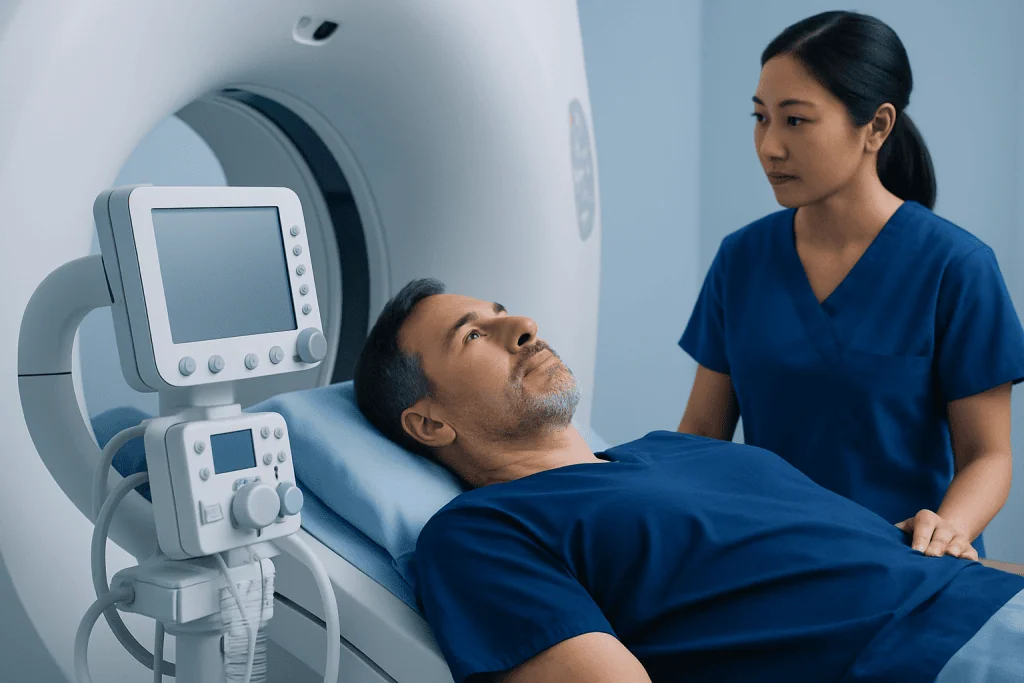
Magnetic resonance imaging, or MRI, is one of the most important tests. Brain MRI often shows characteristic white matter changes that raise suspicion for PML. These areas may appear in several parts of the brain and usually do not follow the pattern expected in a stroke or a mass lesion. In many cases, the imaging findings help narrow the diagnosis quickly. Imaging may be part of a broader evaluation using MRI scanning to assess changes in the brain.
Doctors often perform a lumbar puncture, also called a spinal tap, to analyze cerebrospinal fluid. This fluid can be tested for JC virus DNA using a molecular test such as PCR. A positive result in the right clinical setting strongly supports the diagnosis. However, a negative test does not always rule it out, especially early in the disease, so repeat testing or continued follow-up may be needed.
In uncertain cases, other tests may be used to rule out different conditions, and rarely a brain biopsy is considered. The goal is to reach the most accurate diagnosis as early as possible so that immune-related treatment decisions can be made without delay.
Treatment options and what care focuses on
There is no single proven antiviral medicine that reliably cures jc disease. Treatment mainly focuses on restoring or improving immune function and removing the factor that allowed the JC virus to reactivate. The exact plan depends on the person’s overall health and the reason the immune system is weakened.
If PML is linked to a medication that suppresses or changes immune activity, doctors may stop that drug or switch to another option when medically appropriate. In some situations, procedures may be used to help clear a medication from the body more quickly. If HIV infection is the cause, antiretroviral therapy is a key part of treatment. If a blood disorder, cancer, or transplant-related immunosuppression is involved, care is coordinated across specialties to balance infection control with the underlying condition. Some patients need inpatient monitoring, neurological rehabilitation, or supportive treatment depending on symptom severity. For people whose condition requires coordinated neurological assessment, supportive care may involve advanced neurology care.
One possible complication during treatment is immune reconstitution inflammatory syndrome, or IRIS. This happens when the recovering immune system creates inflammation in response to the infection. IRIS can sometimes temporarily worsen symptoms or MRI findings, and doctors may use anti-inflammatory treatment in selected cases while continuing to manage the underlying cause.
Recovery varies. Some people stabilize and regain part of their function, while others are left with lasting neurological deficits. Early diagnosis, prompt correction of immune suppression when possible, and rehabilitation can make an important difference in daily function and quality of life.
Living with jc disease: rehabilitation, monitoring, and self-care
Even after the initial diagnosis and treatment decisions, care does not end. Many people with jc disease need ongoing monitoring with neurological examinations and repeat MRI scans to see whether the brain lesions are stable, improving, or progressing. Follow-up also helps doctors assess for treatment complications such as IRIS.
Rehabilitation can play a major role in recovery. Depending on symptoms, this may include physical therapy for strength and walking, occupational therapy for day-to-day tasks, and speech therapy for communication or swallowing problems. Cognitive support may also help people manage attention, memory, or planning difficulties.
At home, practical safety steps can be useful. Families may need to reduce fall risks, organize medication schedules, and watch for changes in confusion, vision, or mobility. Because symptoms can affect independence, support from caregivers often becomes an important part of care planning.
Near the end of the care pathway, some international patients may seek evaluation in specialized centers. Acibadem International’s multidisciplinary specialists and JCI-accredited hospitals diagnose and treat complex neurological conditions for international patients, with access to imaging, laboratory testing, rehabilitation, and, when needed, neurosurgical evaluation for cases where another brain disorder must be excluded.
When to seek medical care
Medical care should be sought promptly if a person develops new neurological symptoms that cannot be explained, especially if they have a weakened immune system or take immune-modifying medication. Warning signs include new weakness, difficulty speaking, worsening balance, new visual changes, confusion, or rapid changes in behavior.
Urgent evaluation is also important when symptoms progress over days to weeks, even if they seem mild at first. Conditions affecting the brain can overlap in appearance, and only a clinician can determine whether the cause is PML, stroke, another infection, medication effect, or a different neurological problem such as a brain tumor.
If severe symptoms occur, such as sudden inability to walk, marked confusion, seizures, or loss of consciousness, emergency care is appropriate. Early assessment gives the best chance to identify the cause and begin the most appropriate treatment and supportive care.
Frequently asked questions
Is jc disease the same as JC virus?
Not exactly. JC virus is the common virus many people carry without symptoms, while jc disease usually refers to the illness caused when that virus reactivates and affects the brain. The most recognized form is progressive multifocal leukoencephalopathy, or PML.
Who is most at risk for jc disease?
People with significantly weakened immune systems are at greatest risk. This includes those with advanced HIV infection, certain cancers, organ transplants, or use of medications that suppress or modify the immune system.
Can jc disease be cured?
There is no single antiviral treatment proven to cure PML in all cases. Treatment focuses on improving immune function and addressing the underlying cause, which may help stop progression and allow partial recovery.
How fast do symptoms develop?
Symptoms often develop over days to weeks and gradually worsen. The pace can vary, but new neurological changes should not be ignored, especially in someone with immune suppression.
What tests are used to confirm jc disease?
Doctors usually rely on a neurological examination, brain MRI, and cerebrospinal fluid testing for JC virus. In more difficult cases, repeat testing or rarely a brain biopsy may be needed to confirm the diagnosis.
Can people recover from jc disease?
Some people stabilize and improve, especially if the immune problem can be corrected quickly. Others may have lasting effects such as weakness, balance problems, or cognitive changes, so rehabilitation and follow-up care are often important.
References
- National Institute of Neurological Disorders and Stroke
- National Institute of Allergy and Infectious Diseases
- Centers for Disease Control and Prevention
- National Multiple Sclerosis Society
- Merck Manual Professional Edition
This article is for general information only and is not a substitute for professional medical advice. Please consult a qualified doctor about your individual situation.
Explore treatments in Turkey — costs, top hospitals & a free quote
JCI-accredited · board-certified surgeons · reply within 24h
Add us as a Preferred Source to see more of our trusted health content across Google Search, AI Overviews and Discover.

More from the Health Library



Related Specialists

Dr. Pelin Nar
Neurology
Prof. Dr. Mustafa Seyhan
Orthopedic Surgery & Traumatology
Assoc. Prof. Dr. Sabri Berkem Ökten
Gynecology & Obstetrics
Dr. Sarp Özcan
Gynecology & Obstetrics