Joints and Their Types: Where They Are and How They Function

Joints connect bones and help the body move, balance, and bear weight. There are structural and functional ways to classify joints.
Key Takeaways
- Joints connect bones and help the body move, balance, and bear weight.
- There are structural and functional ways to classify joints.
- Synovial joints are the most mobile and include the knee, shoulder, hip, and fingers.
- Cartilage, ligaments, tendons, and synovial fluid all help joints work smoothly.
- Joint pain, swelling, stiffness, or reduced movement should be assessed if persistent.
Joints are the places where two or more bones meet, allowing the body to move, stay stable, and absorb everyday forces. Understanding joints and their types helps explain why some parts of the body are built for strength, while others are designed for flexibility and range of motion.
Overview: What Joints Are and Why They Matter
Joints are the meeting points between bones. They are essential to everyday life because they let the body bend, twist, reach, walk, sit, and maintain posture. Without joints, the skeleton would be a rigid framework with little practical use for movement.
Not all joints do the same job. Some are built mainly for stability, such as the joints between certain skull bones. Others are designed for a wide range of movement, such as the shoulder or hip. The structure of each joint reflects its role in the body, balancing mobility with support.
Joints also do more than simply connect bones. They help absorb shock, distribute body weight, and protect tissues during motion. Healthy joints rely on many supporting parts, including cartilage, ligaments, tendons, muscles, and in some cases a lubricating fluid called synovial fluid.
Learning about joints and their types can make it easier to understand common symptoms such as stiffness, swelling, clicking, or pain. It also helps explain why some joints are more vulnerable to injury or wear over time.
How Joints Are Classified
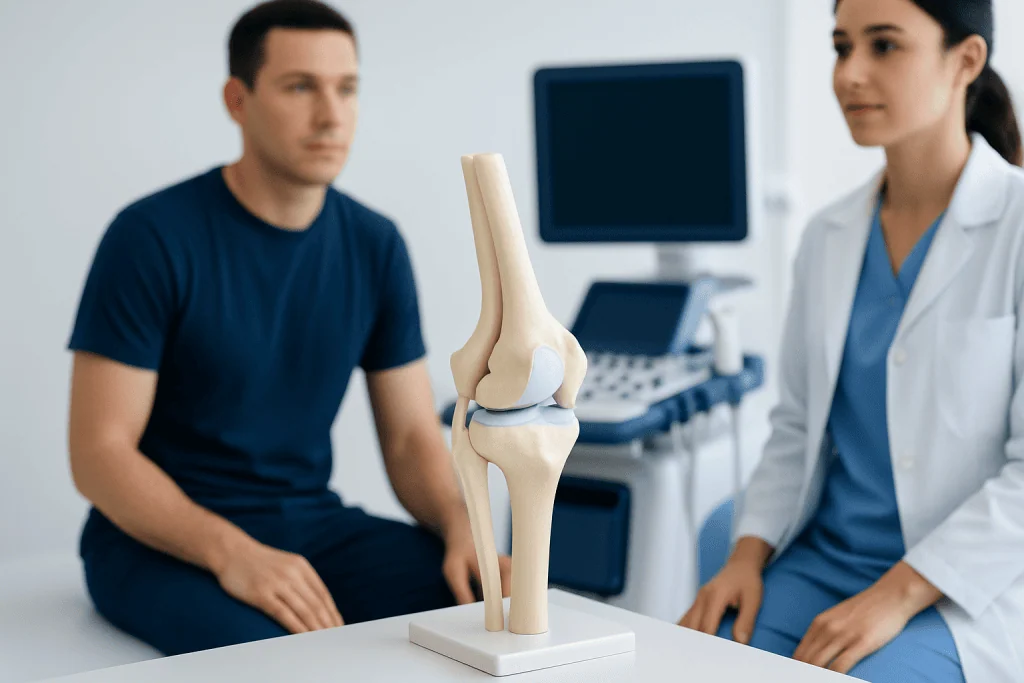
Joints can be classified in two main ways: by their structure and by how much movement they allow. Structural classification looks at what holds the bones together and whether a joint has a cavity. Functional classification focuses on whether the joint is immovable, slightly movable, or freely movable.
Structurally, the three main types are fibrous, cartilaginous, and synovial joints. Fibrous joints are connected by tough connective tissue and generally allow little or no movement. Cartilaginous joints are linked by cartilage and usually permit limited motion. Synovial joints have a joint cavity filled with fluid and allow the greatest range of movement.
Functionally, joints are often described as:
- Immovable joints: designed for protection and stability
- Slightly movable joints: allow small movements while providing support
- Freely movable joints: enable wider and more complex motion
These two systems overlap. For example, most synovial joints are freely movable, while most fibrous joints are immovable. This way of classifying joints helps explain why the skull, spine, fingers, and hips all behave so differently.
The Main Types of Joints and Where They Are Found
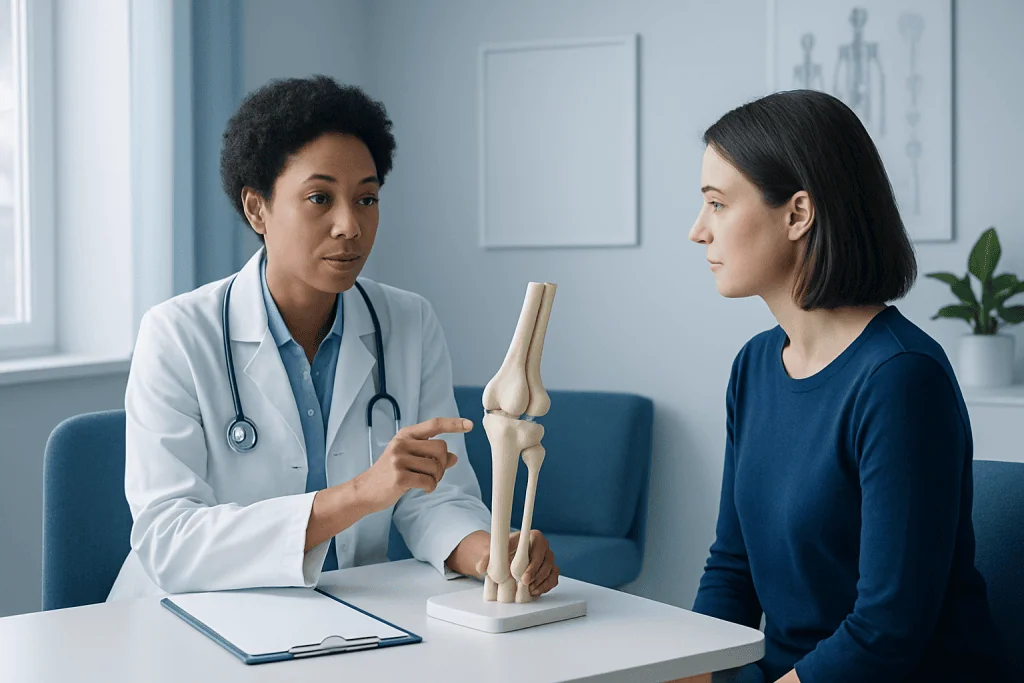
Fibrous joints are held together by dense connective tissue. A familiar example is the sutures of the skull, which lock the skull bones together to protect the brain. These joints do not normally move in adulthood. Another fibrous joint type is found between the teeth and jawbone, anchoring the teeth firmly in place.
Cartilaginous joints connect bones through cartilage. These joints allow a small amount of movement and help with shock absorption. Examples include the joints between the vertebrae of the spine and the pubic symphysis at the front of the pelvis. Their limited flexibility is important for both support and controlled motion.
Synovial joints are the most common and most mobile joints in the body. They include:
- Ball-and-socket joints: shoulder and hip, allowing movement in many directions
- Hinge joints: elbow, knee, fingers, and toes, mainly allowing bending and straightening
- Pivot joints: neck and forearm, allowing rotation
- Condyloid joints: wrist and base of fingers, allowing motion in two planes
- Saddle joints: base of the thumb, allowing flexible grasping movements
- Gliding joints: between small bones in the wrist and ankle, allowing sliding motion
Each of these synovial joint types serves a specific purpose. The shoulder sacrifices some stability for flexibility, while the knee supports body weight and repeated bending. This design difference helps explain why various joints develop different patterns of pain, strain, or degenerative change, including in conditions such as osteoarthritis.
How Joints Function in Movement and Stability
Joints work as part of a system. Bones provide structure, but muscles create movement by pulling on tendons, which attach muscles to bones. Ligaments connect bone to bone and help stabilize the joint, preventing excessive or abnormal movement. Cartilage covers the ends of many bones, reducing friction and helping the joint move smoothly.
In synovial joints, the bones do not rub directly against each other during normal movement. Instead, cartilage acts as a cushion, and synovial fluid lubricates the joint. This fluid helps reduce wear and supports low-friction movement, especially in frequently used joints like the knees, hips, and hands.
Some joints are optimized for fine motor control, such as the small joints in the fingers. Others are designed to carry weight and absorb impact, such as the hips, knees, ankles, and spine. The body constantly balances stability and mobility, and no joint can maximize both at the same time.
Joint function can be affected by age, overuse, injury, inflammation, poor posture, muscle weakness, or underlying disease. Problems in one part of the chain can also affect another. For example, weakness around the hip may influence the knee, and poor foot mechanics may contribute to ankle or knee strain.
Common Joint Problems and Their Symptoms
Joint symptoms are common and can arise from many different causes. These include injury, overuse, inflammation, infection, autoimmune disease, and age-related wear. A person may notice pain, swelling, stiffness, warmth, clicking, instability, or a reduced range of motion. Symptoms can affect a single joint or several joints at once.
Common joint conditions include sprains, strains around a joint, bursitis, tendon problems, inflammatory arthritis, and degenerative changes. Some joint concerns develop gradually, while others begin suddenly after trauma. For example, a twisted ankle may cause immediate swelling, while rheumatoid arthritis often leads to ongoing inflammation and stiffness over time.
Warning signs that deserve medical attention include severe pain after an injury, inability to bear weight, visible deformity, sudden major swelling, fever with joint symptoms, or redness and warmth that may suggest infection. Persistent morning stiffness or swelling in multiple joints may also need specialist assessment.
Not every joint sound or sensation means there is a serious problem. Popping or clicking can occur in healthy joints too. However, if noises are accompanied by pain, locking, weakness, or repeated swelling, it is sensible to seek medical advice.
How Joint Conditions Are Diagnosed
Diagnosis begins with a medical history and physical examination. A doctor will ask where the symptoms are located, how long they have been present, whether they followed an injury, and what makes them better or worse. They will also assess swelling, tenderness, joint stability, range of motion, and how the joint moves during normal activity.
Imaging tests can be helpful depending on the suspected problem. X-rays are often used to assess bone alignment, fractures, and signs of joint wear. Ultrasound or magnetic resonance imaging may help evaluate soft tissues such as ligaments, cartilage, tendons, or the joint lining. In some situations, blood tests may be used to look for inflammation, infection, or autoimmune causes.
If fluid builds up inside a joint, a doctor may recommend joint aspiration. This means removing a small amount of fluid with a needle for analysis. It can help detect infection, crystals, bleeding, or inflammation. The test is chosen carefully based on symptoms and the joint involved.
Early diagnosis can support better treatment planning, especially when symptoms affect daily function. If surgery is being considered for severe injury or damage, a specialist may discuss options ranging from knee replacement to hip replacement in carefully selected cases.
Treatment, Prevention, and Self-care for Healthy Joints
Treatment depends on the cause of the joint problem. Many mild or short-term symptoms improve with rest, activity modification, ice or heat, and guided exercise. Physical therapy is often an important part of care because it helps improve muscle support, mobility, balance, and joint mechanics. Medications may also be used to reduce pain or inflammation under medical guidance.
When structural damage is significant, more advanced treatment may be needed. This can include injections, repair procedures, or surgery. For severe arthritis or major joint damage, specialists may consider interventions such as robotic knee replacement surgery or other reconstructive approaches when appropriate. The best option depends on age, symptoms, activity level, imaging findings, and overall health.
Joint health can often be supported through everyday habits. Helpful measures include:
- Maintaining a healthy body weight to reduce stress on weight-bearing joints
- Staying physically active with low-impact exercise such as walking, swimming, or cycling
- Building muscle strength around major joints
- Using proper technique during sports and lifting
- Taking breaks from repetitive activities
- Wearing supportive footwear when needed
Good self-care also includes listening to the body. Persistent pain is not something to ignore. For international patients who need assessment or treatment, Acibadem International’s multidisciplinary specialists in JCI-accredited hospitals evaluate joint problems and offer personalized care plans.
When to See a Doctor
A doctor should be consulted if joint pain lasts more than a few days, keeps returning, or begins to limit normal activities. Medical advice is also important if there is swelling, stiffness that is worse in the morning, or a feeling that the joint may give way. Early evaluation may help prevent further damage and improve comfort.
Urgent medical attention is needed after major trauma, if a joint looks deformed, or if a person cannot move it or put weight on it. Fever, marked redness, or sudden severe swelling should also be assessed promptly, as these may point to infection or significant inflammation.
People with known autoimmune disease, prior joint surgery, or repeated dislocations should not delay follow-up if symptoms change. Ongoing symptoms in children, older adults, or athletes also deserve careful evaluation because their needs may differ.
Although many joint complaints are manageable, the right diagnosis matters. A qualified doctor can explain which type of joint is involved, what may be causing the symptoms, and which treatment or rehabilitation steps are most appropriate.
Frequently asked questions
What are the main types of joints in the body?
The main structural types of joints are fibrous, cartilaginous, and synovial joints. Synovial joints are the most mobile and include joints such as the shoulder, knee, hip, and fingers.
Which joints move the most?
Synovial joints allow the greatest range of motion. Among them, ball-and-socket joints like the shoulder and hip can move in multiple directions, while other synovial joints such as hinge joints allow more limited movement.
Why do some joints hurt more than others?
Different joints carry different loads and perform different tasks. Weight-bearing joints like the knees and hips experience repeated stress, while highly mobile joints like the shoulder may be more prone to instability or soft tissue injury.
What helps keep a joint healthy?
Healthy joints depend on strong muscles, flexible soft tissues, smooth cartilage, and good movement patterns. Regular exercise, a healthy weight, and avoiding repetitive strain can all support long-term joint health.
Are cracking or popping joints a problem?
Joint sounds are often harmless, especially when they happen without pain or swelling. However, if clicking or popping is paired with pain, locking, weakness, or reduced motion, a medical assessment is a good idea.
Can joint problems happen at any age?
Yes, joint problems can affect children, adults, and older people. Causes vary by age and may include injury, overuse, inflammation, congenital differences, or age-related wear.
References
- World Health Organization
- National Institute of Arthritis and Musculoskeletal and Skin Diseases
- American Academy of Orthopaedic Surgeons
- MedlinePlus
- NHS
This article is for general information only and is not a substitute for professional medical advice. Please consult a qualified doctor about your individual situation.
Joint and spine care in Turkey — expert assessment & treatment
JCI-accredited · board-certified surgeons · reply within 24h
Add us as a Preferred Source to see more of our trusted health content across Google Search, AI Overviews and Discover.