

Knee Ligaments: A Complete Medical Overview

The four main knee ligaments are the ACL, PCL, MCL, and LCL, each with a specific stabilizing role. Knee ligament injuries may cause pain, swelling, bruising, limited movement, or a sense of instability.
Key Takeaways
- The four main knee ligaments are the ACL, PCL, MCL, and LCL, each with a specific stabilizing role.
- Knee ligament injuries may cause pain, swelling, bruising, limited movement, or a sense of instability.
- Diagnosis usually combines a medical history, physical examination, and imaging such as MRI when needed.
- Treatment ranges from rest, bracing, and physical therapy to surgery for selected complete tears or complex injuries.
- Early assessment is important if the knee locks, gives way, swells quickly, or cannot bear weight.
Knee ligaments are strong bands of tissue that connect the bones around the knee and help keep the joint stable during walking, turning, jumping, and sudden stops. When one of these ligaments is stretched or torn, symptoms such as pain, swelling, and a feeling that the knee may give way can develop, and treatment depends on which ligament is affected and how severe the injury is.
Overview: what knee ligaments do
Knee ligaments are tough, flexible bands of connective tissue that link the thighbone, shinbone, and smaller supporting structures around the knee. Their main job is to guide motion and prevent the joint from moving too far in directions that could damage cartilage, menisci, or surrounding muscles. In simple terms, they help the knee bend and straighten safely while staying stable during daily activity and sports.
The four main knee ligaments are the anterior cruciate ligament, or ACL, the posterior cruciate ligament, or PCL, the medial collateral ligament, or MCL, and the lateral collateral ligament, or LCL. The ACL and PCL cross inside the joint and control forward and backward motion of the shinbone. The MCL and LCL sit on the inner and outer sides of the knee and resist side-to-side stress.
Because the knee carries body weight and changes direction often, these ligaments can be strained, partially torn, or completely torn. Some injuries happen suddenly during sports or falls, while others follow a twist or awkward landing in everyday life. The specific symptoms and recovery path depend on which ligament is involved, whether other structures are also injured, and the person’s activity level and general health.
Types of knee ligament injuries and common symptoms
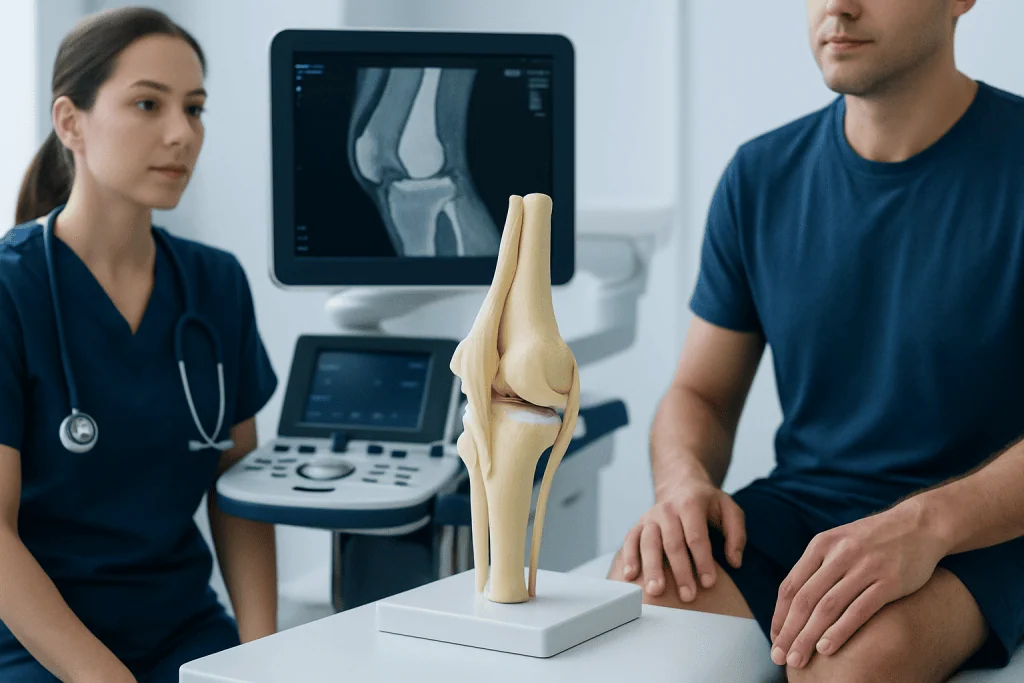
Knee ligament injuries are often described as sprains. A mild sprain means the ligament fibers are stretched but still intact. A moderate sprain involves a partial tear, and a severe sprain usually means a complete tear or a major loss of stability. Some people notice an immediate injury event, while others develop symptoms over several hours as swelling increases.
Common symptoms include pain, swelling, tenderness, bruising, reduced range of motion, and difficulty walking. Many people also report that the knee feels unstable, loose, or as if it may buckle. An ACL injury may occur with a sudden pivot or landing and is sometimes accompanied by a popping sensation. An MCL injury often follows a blow to the outside of the knee, while PCL injuries may occur when the shin is forced backward, such as in a dashboard injury or a hard fall onto a bent knee.
Symptoms vary by ligament and by severity. A partial tear may allow walking with discomfort, while a complete tear may make turning, descending stairs, or weight-bearing difficult. If the knee becomes locked, severely swollen, or cannot be straightened, there may also be associated damage to the meniscus or other structures, such as in a meniscus tear.
- ACL: instability during pivoting, swelling within hours, difficulty with cutting movements
- PCL: pain at the back of the knee, swelling, trouble going downstairs or kneeling
- MCL: pain and tenderness on the inner side of the knee, swelling after a side impact
- LCL: pain on the outer side of the knee, instability with side-to-side movement, often less common but sometimes more complex
Causes and risk factors
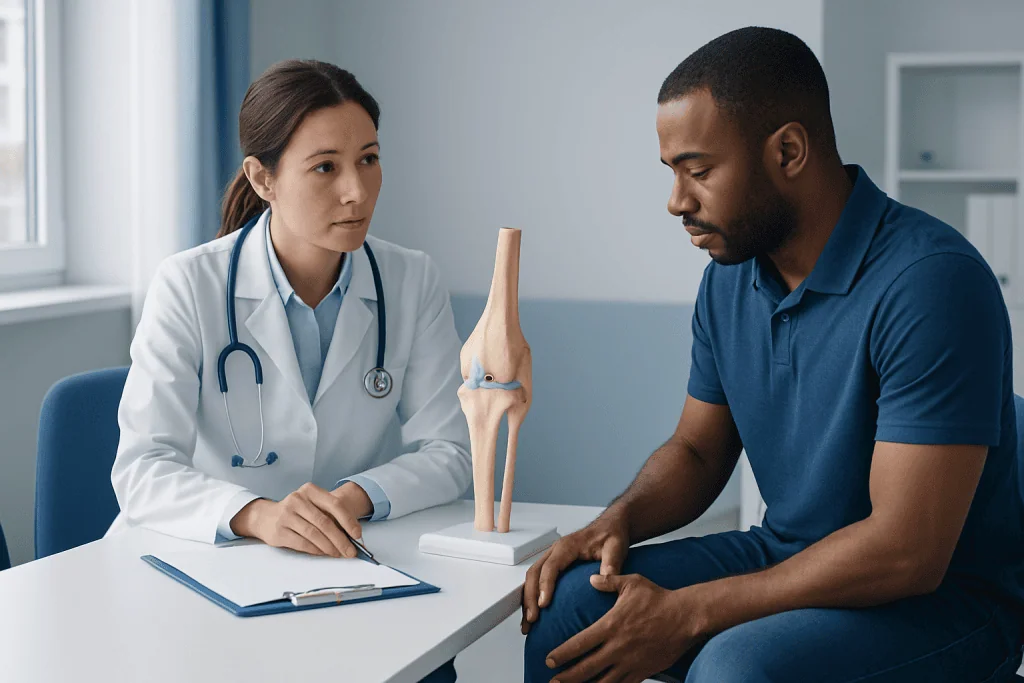
Knee ligaments can be injured during contact sports, non-contact sports, exercise, work activities, or routine daily movement. Sudden deceleration, rapid changes in direction, awkward landings from a jump, direct blows to the knee, and falls are common mechanisms. Skiing, football, basketball, soccer, tennis, and activities involving twisting are frequent settings, but ligament injuries are not limited to athletes.
Several factors can increase risk. Poor landing mechanics, weak hip and thigh muscles, fatigue, inadequate warm-up, previous knee injury, and certain training errors may all contribute. Uneven ground, slippery surfaces, and poorly fitting footwear can also raise the chance of a twist or fall. Some people have underlying joint laxity or alignment patterns that may affect knee stability, although these factors do not always lead to injury on their own.
Age and activity level also shape risk and recovery. Younger active adults may be more likely to sustain sports-related ACL injuries, while older adults may injure knee ligaments during a fall. In some cases, a ligament tear happens together with cartilage injury, bone bruising, or tendon problems, which can change the treatment plan. A careful medical evaluation helps identify the full pattern of injury rather than focusing on one structure alone.
How knee ligament problems are diagnosed
Diagnosis begins with a detailed history. A doctor will usually ask how the injury happened, whether there was a twist, collision, or fall, when swelling began, and whether the knee felt unstable or produced a pop. It also helps to know whether the person can walk, fully straighten the knee, or return to normal activities after the injury.
Physical examination is a key part of diagnosis. The doctor checks swelling, tenderness, range of motion, alignment, and stability using specific maneuvers designed to test each ligament. These tests can suggest whether the ACL, PCL, MCL, or LCL is involved, although pain and swelling soon after an injury can sometimes limit the exam.
Imaging may be used to confirm the diagnosis or look for related injuries. X-rays do not show ligaments directly, but they can help rule out fractures or certain alignment problems. MRI is often the most useful test when a significant ligament tear is suspected because it can show ligaments, cartilage, menisci, and bone bruising in detail. In more complex cases, orthopedic evaluation may also look for combined injuries such as an ACL tear or damage affecting the whole knee stabilizing system.
Treatment options: from rehabilitation to surgery
Treatment depends on the ligament involved, the severity of the tear, associated injuries, symptoms, and the person’s goals. Many mild and moderate ligament injuries improve with conservative care. This often includes short-term rest from aggravating activity, ice, compression, elevation, and guided pain management as advised by a clinician. A brace may be recommended to protect the knee while it heals.
Physical therapy is central to recovery for many knee ligament injuries. Rehabilitation focuses on restoring movement, reducing swelling, improving muscle strength, and retraining balance and movement patterns. Strong quadriceps, hamstrings, hips, and core muscles help support the knee and reduce the feeling of instability. A well-structured program is often important whether or not surgery is needed.
Surgery may be considered when there is a complete tear causing ongoing instability, when the person wants to return to high-demand pivoting sports, or when there are combined injuries affecting the meniscus, cartilage, or multiple ligaments. Procedures vary by injury and may include knee arthroscopy for diagnosis and treatment of associated damage or ACL surgery when reconstruction is appropriate. Some people with advanced joint damage or repeated instability may later need other orthopedic options such as knee replacement, but this is not the usual treatment for a simple ligament injury.
Recovery timelines differ widely. A mild sprain may improve over weeks, while rehabilitation after surgery can take months. The safest return to work or sport is usually based on strength, stability, movement quality, and medical clearance rather than on time alone.
Prevention and self-care for healthier knee ligaments
Not all knee ligament injuries can be prevented, but many can be reduced through conditioning and movement awareness. Strengthening the muscles around the knee and hip helps improve joint control. Balance training, landing practice, and sport-specific drills can teach the body to absorb force more safely during cutting, jumping, and turning.
Warm-up matters as well. Dynamic stretching and gradual preparation before exercise may improve readiness for movement. Wearing suitable footwear, checking playing surfaces, and avoiding sudden increases in training intensity can also be helpful. After a previous knee injury, completing rehabilitation fully is especially important before returning to demanding activity.
At home after a mild injury, it is generally sensible to rest the knee from painful activities, use ice for short periods, and elevate the leg when possible. However, prolonged self-treatment without diagnosis is not ideal if symptoms are significant. If pain persists, the knee repeatedly gives way, or swelling does not settle, a medical review is recommended to guide safe recovery.
When to seek medical care
Medical assessment is important if a knee injury causes rapid swelling, severe pain, visible deformity, inability to bear weight, or a feeling that the knee is unstable. Care should also be sought if the knee locks, cannot fully bend or straighten, or if symptoms do not improve after a short period of rest. These features can suggest a more significant ligament tear or an associated injury that needs timely treatment.
Urgent evaluation may be needed after high-energy trauma, a major twist with a pop followed by swelling, or when there is numbness, coldness in the leg, or concern about circulation. Children and older adults should also be assessed carefully because fractures and growth-related injuries can sometimes mimic ligament damage.
For ongoing symptoms, an orthopedic or sports medicine specialist can help clarify the diagnosis and tailor treatment. Acibadem International’s multidisciplinary specialists in JCI-accredited hospitals diagnose and treat knee ligament injuries for international patients, including rehabilitation and surgical care when appropriate.
Frequently asked questions
What are the four main knee ligaments?
The four main knee ligaments are the ACL, PCL, MCL, and LCL. Together, they help control forward, backward, and side-to-side motion so the knee stays stable during movement.
Can a knee ligament injury heal without surgery?
Yes, many knee ligament injuries can heal or improve with non-surgical treatment, especially mild sprains and some partial tears. Bracing, activity modification, and physical therapy are commonly used, but the best plan depends on the ligament involved and the degree of instability.
How can someone tell if a knee ligament is torn?
A torn knee ligament may cause pain, swelling, tenderness, and a feeling that the knee gives way. Some people hear or feel a pop at the time of injury, but a proper diagnosis usually requires a physical examination and sometimes MRI.
Is walking good for an injured knee ligament?
Gentle walking may be possible for some mild injuries, but it should not worsen pain or instability. If the knee is giving way, swelling quickly, or difficult to bear weight on, medical advice is important before continuing activity.
How long does recovery from a knee ligament injury take?
Recovery can range from a few weeks for a mild sprain to several months for a complete tear or surgery. Timing depends on the ligament, the severity of injury, associated damage, and how consistently rehabilitation is followed.
Do all ACL injuries need surgery?
No, not all ACL injuries require surgery. Some people do well with rehabilitation and activity modification, while others may benefit from reconstruction if they have persistent instability or want to return to pivoting sports.
References
- American Academy of Orthopaedic Surgeons
- National Institute of Arthritis and Musculoskeletal and Skin Diseases
- American College of Sports Medicine
- National Health Service
- Mayo Clinic
This article is for general information only and is not a substitute for professional medical advice. Please consult a qualified doctor about your individual situation.
Joint and spine care in Turkey — expert assessment & treatment
JCI-accredited · board-certified surgeons · reply within 24h
Add us as a Preferred Source to see more of our trusted health content across Google Search, AI Overviews and Discover.

More from the Health Library
Biophysical Profile — Explained by Medical Evidence, Not Myths

Futon: An Evidence-Based Guide for Patients

Stage 4 small cell lung cancer life expectancy with treatment: A Complete Medical Guide for Patients

Infrared Sauna: An Evidence-Based Guide for Patients

Lymphoscintigraphy: What Patients Need to Know

Water Around the Heart — Explained by Medical Evidence, Not Myths
Related Specialists

Dr. Zehra Elban
Acibadem Life Clinical Service
Assoc. Prof. Dr. Murad Gulıyev
Medical Oncology
Assoc. Prof. Dr. Zerrin Boyacı
Otorhinolaryngology
Dr. Asif Akyol
Emergency Service