Monocular Cues: What Patients Need to Know

Monocular cues help the brain judge space even when only one eye is providing information. Common monocular cues include relative size, overlap, motion parallax, light and shadow, texture, and perspective.
Key Takeaways
- Monocular cues help the brain judge space even when only one eye is providing information.
- Common monocular cues include relative size, overlap, motion parallax, light and shadow, texture, and perspective.
- Difficulty using monocular cues may be noticed as trouble judging distance, bumping into objects, or feeling unsafe while driving or walking.
- Eye disease, poor vision in one eye, neurological conditions, and some developmental issues can affect depth perception.
- An eye examination and, when needed, neurological assessment can help identify the cause of visual perception problems.
Monocular cues are visual signals that allow the brain to estimate depth, distance, and object size using input from just one eye. They are a normal part of how people navigate the world, but problems with vision, eye alignment, or brain processing can make these cues harder to use.
Overview: What monocular cues mean
Monocular cues are the visual clues the brain uses to understand depth, distance, and position from the view of one eye alone. In simple terms, they help a person decide whether an object is near or far, large or small, flat or three-dimensional, even without comparing the images from both eyes. These cues work together constantly during everyday activities such as walking down stairs, reaching for a cup, parking a car, or crossing a street.
People often hear about depth perception in relation to both eyes working together, which is called binocular vision. However, monocular cues are also essential because they continue to provide useful information when one eye is covered or when binocular depth signals are limited by distance. For example, a road narrowing into the horizon or a nearby object moving quickly across the field of view are both powerful one-eye clues about space.
Monocular cues are not a disease or diagnosis. They are part of normal visual processing. Still, when a person has trouble interpreting these cues, it may point to an eye problem, reduced vision in one eye, or a condition affecting how the brain processes visual information.
How monocular cues help with depth perception
The brain uses several types of monocular cues at the same time. Each cue provides a small piece of information, and together they build a practical understanding of the surrounding environment. This process happens quickly and usually without conscious effort.
Common monocular cues include:
- Relative size: if two objects are known to be similar in size, the one that appears smaller is usually farther away.
- Interposition or overlap: when one object blocks part of another, the blocking object is perceived as closer.
- Linear perspective: parallel lines, such as train tracks or the edges of a road, appear to come together in the distance.
- Texture gradient: surface details look clearer up close and smoother farther away.
- Light and shadow: shading helps the brain judge shape, depth, and contour.
- Height in the visual field: objects placed higher near the horizon often seem farther away.
- Motion parallax: during movement, nearby objects appear to pass faster than distant ones.
These cues are useful in both indoor and outdoor settings. They guide movement, support balance, and make reading space more efficient. In children, the ability to interpret visual cues develops gradually as the visual system matures and experience grows.
When monocular cues may become a health concern

Most people do not notice monocular cues unless something starts to feel different about their vision. A person may begin missing steps, reaching inaccurately for objects, struggling with sports, or feeling uncertain about distances when driving. Some may describe the problem more generally, saying that spaces feel “off,” objects seem unexpectedly close, or movement is hard to judge.
These difficulties can happen when one eye sees less clearly than the other, when the eyes are not aligned properly, or when the brain has trouble processing visual information. Examples include uncorrected refractive errors, cataracts, retinal disease, lazy eye, eye muscle imbalance, head injury, and certain neurological disorders. Problems with both binocular vision and monocular cues can overlap, making symptoms more noticeable.
Because visual perception depends on both healthy eyes and healthy brain processing, symptoms should not be dismissed if they are new, worsening, or interfering with daily life. In some cases, depth-perception complaints may be related to glaucoma, cataract, or another condition affecting clarity, contrast, or the visual field.
Symptoms and signs that may suggest a problem
Difficulty with monocular cues is not always easy to describe, but there are practical signs. A person may misjudge the distance to curbs, stairs, doorways, or furniture. Pouring liquids, catching objects, using tools, or navigating unfamiliar places may become more difficult. Some people notice more trouble in dim lighting, on patterned surfaces, or in crowded areas with a lot of visual information.
Children may show different signs than adults. They may avoid ball sports, hesitate on stairs, sit very close to screens, cover one eye, or seem clumsy compared with peers. In school, visual-perceptual issues can sometimes affect reading comfort, copying from a board, or understanding diagrams.
Other symptoms that can appear alongside depth-perception problems include blurred vision, double vision, headaches, eye strain, poor night vision, loss of side vision, or dizziness. When these symptoms are present, the issue may involve more than normal variation in visual perception and deserves medical evaluation.
Causes, risk factors, and related conditions
There are many reasons a person may have trouble using monocular cues effectively. One common reason is reduced image quality from one or both eyes. This can happen with refractive errors, corneal problems, cataracts, retinal disorders, or optic nerve disease. If the visual input is blurred, dim, distorted, or incomplete, the brain has less reliable information to interpret depth and distance.
Eye alignment and childhood visual development also matter. Conditions such as strabismus and amblyopia can reduce visual efficiency and affect how spatial information is processed. In adults, changes in the lens, retina, or optic nerve may alter contrast, detail, or peripheral awareness. A full eye assessment may include testing for conditions such as retinal detachment when symptoms suggest an urgent retinal problem.
Neurological factors are another important cause. Brain injury, stroke, neurodegenerative disease, migraine with visual symptoms, and disorders affecting visual pathways can all interfere with interpretation of spatial cues. In these situations, the eyes may appear structurally healthy while visual processing remains impaired. Depending on symptoms, doctors may recommend further evaluation, including neurological rehabilitation or specialist testing.
How doctors evaluate depth and visual perception
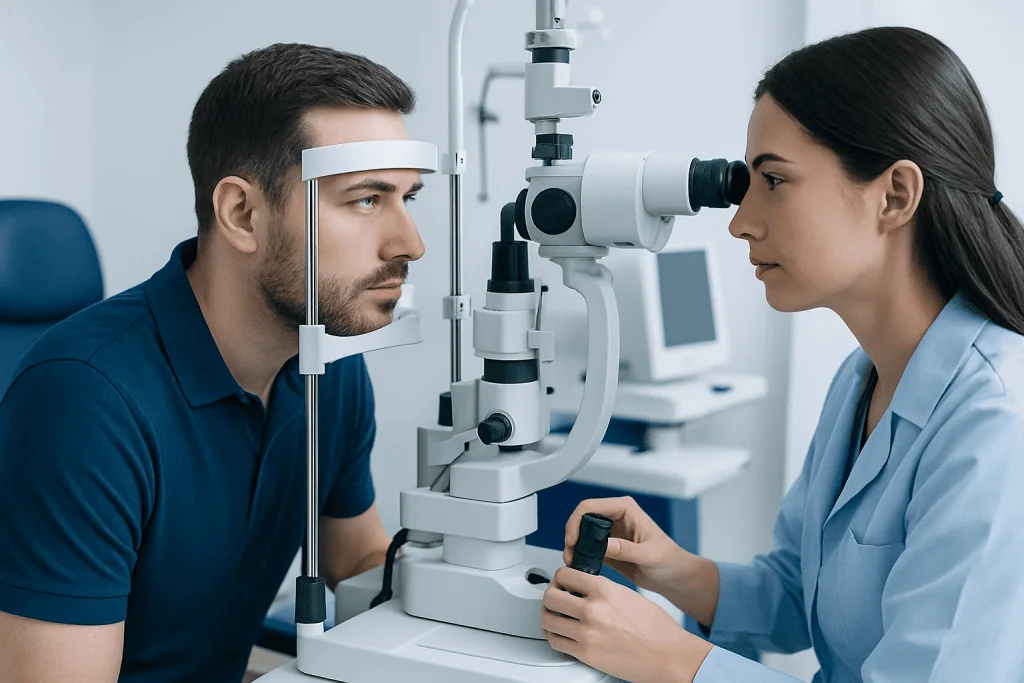
Assessment usually begins with a medical history and eye examination. The doctor may ask when symptoms started, whether they affect one or both eyes, and whether the person has had trauma, headaches, double vision, or difficulty with driving, work, or balance. Vision testing often includes visual acuity, refraction, eye movement assessment, alignment testing, and evaluation of the pupils and visual fields.
If depth-perception problems are suspected, additional tests may be used to assess stereopsis, contrast sensitivity, peripheral vision, and retinal or optic nerve health. The goal is not only to measure how clearly a person sees, but also to understand how visual information is being integrated. This may involve a dilated eye examination and imaging of the retina or optic nerve.
When symptoms suggest a structural eye problem, treatment planning may involve specialist care such as laser eye surgery for selected refractive issues or cataract surgery if lens clouding is affecting visual function. If the pattern of symptoms points to brain-based processing difficulty, a neurologist or neuro-ophthalmologist may be involved. Near the end of the evaluation pathway, multidisciplinary specialists at Acibadem International and its JCI-accredited hospitals also assess and treat vision-related conditions for international patients.
Treatment, practical support, and self-care
Treatment depends on the cause rather than the cue itself. If poor visual clarity is the main issue, updating glasses or contact lenses may improve function. Cataracts, retinal disease, glaucoma, or corneal disorders may need condition-specific treatment. If eye alignment is contributing, management can include vision therapy approaches, prism correction, or surgical treatment in selected cases. Some patients may also benefit from smart lens options when lens replacement is appropriate and recommended by their surgeon.
For neurological or visual-perceptual causes, rehabilitation may help a person adapt and improve safety. Strategies can include environmental adjustments, balance support, occupational therapy, and training to scan surroundings more effectively. The aim is often to improve day-to-day performance rather than to target a single visual test result.
Self-care measures can also make a difference. Good lighting, reducing clutter, using handrails on stairs, pausing before stepping off curbs, and avoiding driving if distance judgment feels unreliable are sensible precautions. Regular eye exams are especially important for children, older adults, and anyone with diabetes, prior eye disease, or sudden changes in vision.
When to seek medical care
A routine appointment is appropriate if a person has ongoing trouble judging distances, increased clumsiness, frequent eye strain, or changes in reading, driving, or balance. Children should be assessed if they show persistent visual difficulties, unusual head posture, squinting, or avoidance of activities that require accurate depth judgment.
Urgent medical care is needed for sudden vision loss, a curtain-like shadow over part of the vision, new double vision, eye pain, flashes of light, many new floaters, or symptoms after a head injury. These features can signal a serious eye or neurological problem and should be evaluated promptly.
Even when symptoms seem mild, it is reasonable to seek professional advice if they are new, worsening, or interfering with confidence and safety. Early assessment can help identify treatable causes and provide practical steps to protect vision and independence.
Frequently asked questions
What are monocular cues in simple terms?
Monocular cues are clues that help the brain judge depth and distance using one eye alone. They include things like overlap, perspective, shadows, and the way nearby objects seem to move faster than faraway ones.
Are monocular cues the same as binocular vision?
No. Binocular vision depends on both eyes working together, while monocular cues can be used from the image seen by one eye. Both systems support depth perception, but they do so in different ways.
Can people with vision in only one eye still judge depth?
Yes, many people with vision in one eye can still judge depth reasonably well by relying more on monocular cues. However, some tasks, especially those requiring very precise distance judgment, may be more challenging.
What problems can affect the use of monocular cues?
Anything that reduces image quality or visual processing can interfere with monocular cues. Examples include blurred vision, cataracts, glaucoma, retinal disease, eye misalignment, and certain neurological conditions.
How do doctors test for depth-perception problems?
Doctors usually start with a complete eye examination and questions about symptoms in daily life. They may also check eye alignment, visual fields, retinal health, and other aspects of visual perception to find the underlying cause.
When should a person worry about changes in depth perception?
A person should seek medical advice if distance judgment becomes noticeably worse, starts affecting safety, or comes with blurred vision, double vision, headaches, or balance problems. Sudden changes, especially with flashes, floaters, pain, or vision loss, need prompt attention.
References
- American Academy of Ophthalmology
- National Eye Institute
- American Optometric Association
- National Institute of Neurological Disorders and Stroke
- Mayo Clinic
This article is for general information only and is not a substitute for professional medical advice. Please consult a qualified doctor about your individual situation.
Explore treatments in Turkey — costs, top hospitals & a free quote
JCI-accredited · board-certified surgeons · reply within 24h
Add us as a Preferred Source to see more of our trusted health content across Google Search, AI Overviews and Discover.