Neurointervention in Turkey: How to Choose the Right Hospital for Complex Brain Vessel Care

Neurointervention treats certain brain vessel problems through tiny catheters rather than open surgery. The best hospital choice depends on team expertise, 24/7 emergency capability, imaging technology, and intensive care support.
Key Takeaways
- Neurointervention treats certain brain vessel problems through tiny catheters rather than open surgery.
- The best hospital choice depends on team expertise, 24/7 emergency capability, imaging technology, and intensive care support.
- Patients should ask about experience with stroke, aneurysm, AVM, and carotid or intracranial vessel procedures.
- Clear communication, treatment planning, and follow-up are especially important for international patients.
- A second opinion can help patients understand whether a procedure is urgent, elective, or best managed another way.
Neurointervention in Turkey refers to minimally invasive, image-guided treatment for complex blood vessel conditions affecting the brain, head, and neck. Choosing the right hospital matters because outcomes often depend on specialist experience, rapid diagnosis, advanced imaging, and coordinated emergency care.
Overview: What Neurointervention Means
Neurointervention, also called interventional neuroradiology or endovascular neurosurgery in some settings, is a group of minimally invasive procedures used to diagnose and treat blood vessel disorders of the brain, spine, head, and neck. Instead of making a large incision, the specialist usually guides a very thin catheter through a blood vessel, often starting at the wrist or groin, and navigates it to the area that needs treatment using real-time imaging.
These procedures may be used in emergencies, such as a blocked brain artery causing stroke, or in planned care for conditions such as aneurysms, arteriovenous malformations, fistulas, or narrowed arteries. For many patients, neurointervention can reduce the need for open surgery, shorten hospital stay, and support faster recovery, although the best option always depends on the exact diagnosis.
When people research neurointervention in Turkey, they are often looking not only for treatment but also for a hospital that can safely manage complex brain vessel disease. This is important because these conditions may require rapid decisions, highly specialized skills, and close teamwork between neurologists, neurosurgeons, interventional neuroradiologists, anesthesiologists, and intensive care teams.
Which Conditions May Need Complex Brain Vessel Care
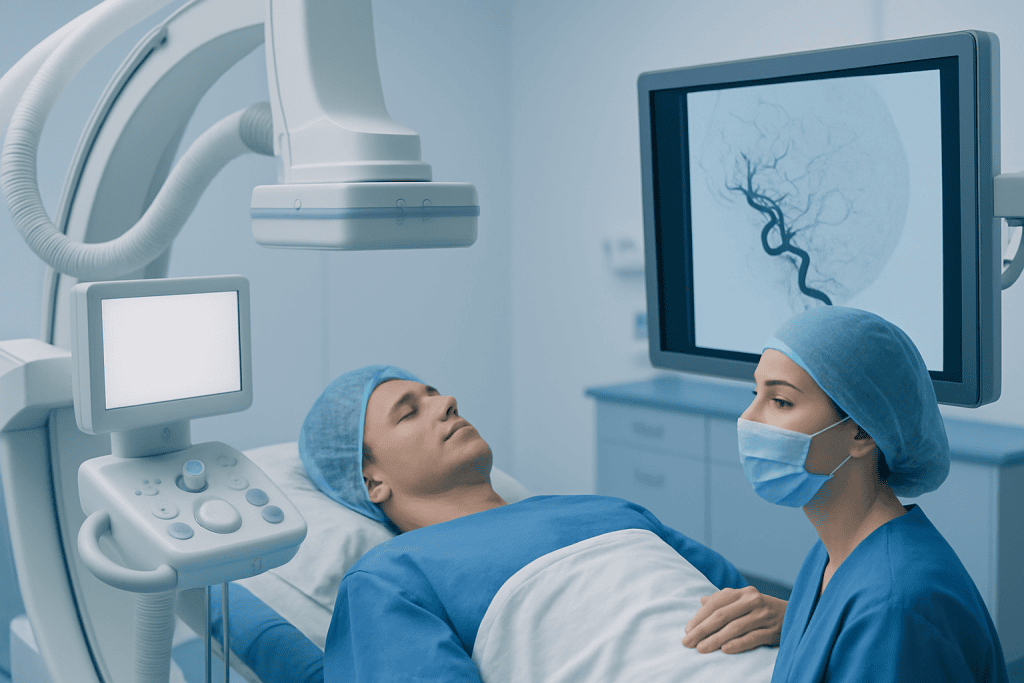
Complex brain vessel care may be needed for several different conditions. One common emergency is acute ischemic stroke caused by a large artery blockage, where mechanical clot removal may restore blood flow in selected patients. Another important condition is a brain aneurysm, a weakened area in a blood vessel wall that may need coiling, flow diversion, or another endovascular approach to lower the risk of bleeding.
Neurointervention may also be considered for arteriovenous malformations and dural arteriovenous fistulas, which are abnormal connections between arteries and veins. In other cases, care focuses on narrowing of the carotid or intracranial arteries, bleeding from vascular malformations, tumors with a rich blood supply, or spinal vascular disorders. The precise plan depends on where the lesion is, how it behaves, and whether symptoms are present.
Because these disorders can overlap with other neurological problems, accurate diagnosis is essential. A patient may initially be evaluated for stroke, severe headache, vision changes, weakness, seizures, or unexplained bleeding. In some people, a vascular problem is found incidentally during imaging done for another reason, and treatment decisions are then based on long-term risk, current symptoms, and overall health.
What to Look for When Choosing a Hospital
The most important factor is a dedicated, experienced neurovascular team. Patients should look for a hospital where interventional neuroradiologists work closely with stroke neurologists, neurosurgeons, vascular neurologists, neuroanesthesiologists, and neuro-intensive care specialists. Complex decisions are often best made in a multidisciplinary setting, especially when there is more than one possible treatment path.
Round-the-clock emergency capability is also essential. Brain vessel emergencies do not follow office hours, and treatment delays can affect recovery. A strong hospital should be able to provide 24/7 access to advanced brain imaging, catheter-based intervention, operating room backup when needed, intensive care monitoring, and rehabilitation planning after treatment.
Technology and infrastructure matter as well. Patients may ask whether the hospital has biplane angiography, modern CT and MRI systems, stroke pathways, and staff trained in neurocritical monitoring. It is also reasonable to ask how the team handles complications, whether they can rapidly convert from diagnosis to treatment, and how they coordinate care if both endovascular and surgical expertise are needed.
For international patients, practical support should not be overlooked. Clear communication in a familiar language, help with records review, transparent treatment planning, and coordinated follow-up can make a major difference. A well-organized international patient service can support travel timing, document sharing, and continuity of care after the patient returns home.
Questions Patients and Families Should Ask
Patients do not need to become medical experts before choosing a hospital, but asking a few focused questions can be very helpful. They can ask which specialist will lead the case, whether the hospital regularly treats the same condition, and whether treatment recommendations are discussed by a multidisciplinary board. This helps clarify both expertise and decision-making style.
It is also reasonable to ask what tests are needed before treatment, whether the procedure is urgent or elective, and what alternatives exist. In some situations, careful monitoring may be safer than immediate intervention. In others, a rapid procedure such as mechanical thrombectomy may be time-sensitive and should not be delayed.
Other useful questions include what type of anesthesia may be used, how long the hospital stay is usually expected to be, what short-term and long-term follow-up will involve, and which warning signs should prompt urgent review after discharge. Families may also ask how the team communicates during emergencies and whether rehabilitation, speech therapy, or neurological follow-up can be arranged if needed.
- Who is on the neurovascular team, and how do they work together?
- Is emergency neurointervention available 24/7?
- What imaging and intensive care support are on site?
- What are the expected benefits, limits, and possible risks of the proposed procedure?
- What follow-up plan will be needed after treatment?
Common Procedures and How Treatment Decisions Are Made
The exact procedure depends on the condition being treated. In acute stroke, the goal may be to reopen a blocked artery using catheter-based clot retrieval. For some aneurysms, the team may recommend endovascular aneurysm coiling or another embolization technique to seal the aneurysm from the inside. In selected cases, stents, balloons, flow-diverting devices, or embolic materials may be used.
Some vascular lesions are better treated with surgery, radiosurgery, medication, or observation rather than catheter-based intervention. That is why a careful review of brain imaging, symptoms, age, overall health, and bleeding or stroke risk is so important. The right hospital should be able to explain not only what it can do, but also why a specific option is the most appropriate for that patient.
Before treatment, the team usually reviews CT, MRI, and catheter angiography findings in detail. They also consider medicines such as blood thinners, other medical conditions, and how urgently the procedure must be done. In especially complex anatomy, further testing may be needed before a final plan is made.
Many patients benefit from care in centers that can offer the full range of options, including cerebral angiography for detailed vessel mapping and, when needed, open neurosurgical backup. This broad capability can be reassuring when a diagnosis is uncertain or when the safest treatment path may change after imaging is reviewed.
Safety, Recovery, and Follow-Up After Neurointervention
All medical procedures carry some risk, and neurointervention is no exception. Possible concerns vary by procedure but may include bleeding, vessel injury, stroke, contrast-related problems, or reactions linked to anesthesia. A trustworthy hospital should discuss these risks clearly and explain how the team works to reduce them through careful planning, imaging guidance, and close monitoring.
Recovery can differ widely. Some patients treated urgently for stroke may need several days in intensive or step-down care followed by rehabilitation, while others undergoing planned treatment for an aneurysm or vascular malformation may recover more quickly. The expected recovery timeline depends on the underlying condition, the complexity of the procedure, and whether any neurological symptoms were present beforehand.
Follow-up is an essential part of safe care. Some conditions require repeat scans, clinic review, or long-term monitoring to confirm that a vessel remains open or that an aneurysm or malformation remains sealed. Patients should leave the hospital with written instructions on medicines, activity, warning symptoms, and who to contact with concerns.
For international patients, it helps when the hospital provides a clear summary for doctors back home. Near the end of the care journey, a center such as Acibadem International may coordinate this process through its multidisciplinary specialists and JCI-accredited hospitals for patients seeking neurovascular diagnosis and treatment abroad.
When to Seek Urgent Help and When a Second Opinion Helps
Immediate medical attention is important for sudden neurological symptoms. These include face drooping, arm or leg weakness, trouble speaking, sudden vision loss, severe sudden headache, loss of balance, confusion, or seizure. These symptoms do not always mean a brain vessel emergency, but they should never be ignored because fast assessment can be critical.
A second opinion can be especially useful when treatment is complex, not clearly urgent, or presented with more than one reasonable option. Patients may seek another review if they have been told they need aneurysm treatment, embolization of a vascular malformation, or a procedure for narrowed arteries and want confirmation that the plan fits their individual risk.
Good hospitals welcome informed questions and careful decision-making. If records and images can be shared in advance, the specialist may be able to advise whether travel is appropriate, whether the case is an emergency, and whether additional tests are needed before a procedure is scheduled. This approach can help patients choose neurointervention in Turkey with greater confidence and better preparation.
Frequently asked questions
What is neurointervention?
Neurointervention is a minimally invasive way to diagnose and treat certain blood vessel conditions affecting the brain, spine, head, or neck. Doctors guide tiny catheters through blood vessels using imaging, often avoiding the need for open surgery in selected cases.
Which hospital features matter most for complex brain vessel care?
The strongest hospitals usually offer an experienced multidisciplinary neurovascular team, 24/7 emergency service, advanced imaging, and neuro-intensive care support. Clear communication, careful follow-up planning, and access to both endovascular and surgical options are also important.
Is neurointervention in Turkey only for emergency stroke?
No. Although emergency stroke treatment is a major part of neurointervention, it is also used for aneurysms, vascular malformations, fistulas, and some narrowed arteries. Some procedures are urgent, while others are planned after detailed imaging and specialist review.
How can a patient know whether a procedure is really necessary?
The best approach is to ask why the procedure is recommended, what alternatives exist, and what may happen if treatment is delayed or not performed. A second opinion can be helpful, especially for non-emergency conditions where observation, surgery, or another treatment may also be reasonable.
What tests are usually needed before neurointervention?
Doctors often use CT, MRI, and vascular imaging such as CT angiography, MR angiography, or catheter angiography. The exact tests depend on the suspected condition, the urgency, and whether treatment is being considered immediately.
What is recovery like after a neurointerventional procedure?
Recovery varies depending on the condition treated and whether it was an emergency or planned procedure. Some patients go home quickly, while others need intensive monitoring, rehabilitation, or longer neurological follow-up.
References
- World Health Organization
- American Heart Association
- American Stroke Association
- Society of NeuroInterventional Surgery
- European Stroke Organisation
This article is for general information only and is not a substitute for professional medical advice. Please consult a qualified doctor about your individual situation.
Joint and spine care in Turkey — expert assessment & treatment
JCI-accredited · board-certified surgeons · reply within 24h
Add us as a Preferred Source to see more of our trusted health content across Google Search, AI Overviews and Discover.

Neurosurgery
Surgical treatment of the brain, spine and nervous system, including minimally invasive and functional procedures.
72 specialists in this unit