Ovarian Cyst After Menopause: A Complete Clinical Guide for Patients

Most ovarian cysts found after menopause are not cancer, but all new or persistent cysts merit medical review. Transvaginal ultrasound is usually the main test used to describe a cyst and estimate its level of concern.
Key Takeaways
- Most ovarian cysts found after menopause are not cancer, but all new or persistent cysts merit medical review.
- Transvaginal ultrasound is usually the main test used to describe a cyst and estimate its level of concern.
- Simple cysts without symptoms may be safely monitored in selected patients, whereas complex or enlarging cysts may need specialist assessment.
- CA-125 is a helpful blood test in some situations, but it cannot diagnose ovarian cancer on its own.
- New persistent bloating, pelvic pain, feeling full quickly or postmenopausal bleeding should be discussed with a doctor promptly.
An ovarian cyst after menopause should be assessed by a clinician because ovarian cysts are less common after menstrual periods stop and require careful evaluation. Many cysts are benign and can be monitored, while others need further testing or treatment based on their scan appearance, size, symptoms and blood test results.
Overview: what an ovarian cyst after menopause means
An ovarian cyst after menopause is a fluid-filled or partly solid sac on or within an ovary in a person whose menstrual periods have permanently stopped. The finding is often made during an ultrasound performed for another reason, and it does not automatically mean cancer. However, because normal ovulation-related cysts are no longer expected after menopause, a new cyst should be evaluated carefully.
Assessment focuses on the cyst’s ultrasound features, size, whether it changes over time, and whether the person has symptoms or relevant medical history. A small, smooth-walled, fluid-filled “simple” cyst is commonly managed with planned follow-up. A cyst containing solid areas, thick internal partitions, papillary projections, or significant blood flow may need more urgent specialist investigation.
The ovaries continue to have a role after menopause, including producing small amounts of hormones. Benign cysts can still develop, and not every structure seen on an ultrasound is a true ovarian cyst. For example, a cyst near the ovary may arise from the fallopian tube or surrounding tissues, which is why accurate imaging interpretation is important.
How cysts may feel — and why symptoms matter
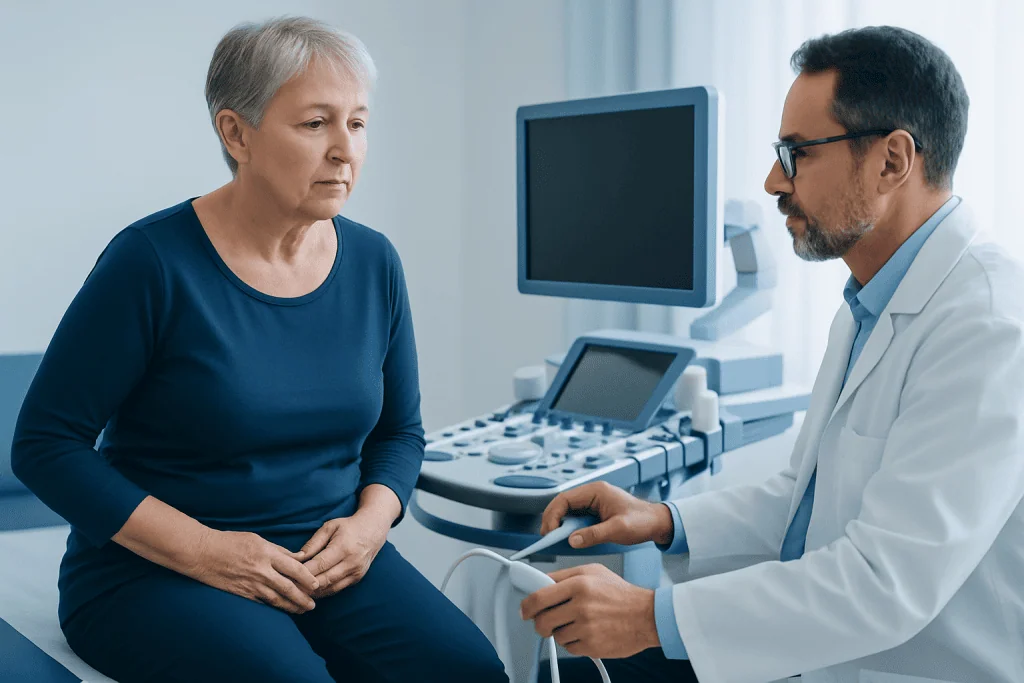
Many postmenopausal ovarian cysts cause no symptoms. When symptoms occur, they are often related to the cyst’s size, pressure on nearby organs, bleeding into a cyst, rupture, or rarely twisting of the ovary. Symptoms alone cannot identify the cause, but they help guide the urgency of assessment.
Possible symptoms include a persistent feeling of pelvic pressure or lower abdominal discomfort, bloating, increased abdominal size, needing to urinate more often, constipation, or discomfort during sexual activity. Some people notice reduced appetite or feeling full sooner than usual. These symptoms are common and can have many non-gynecological causes, but persistent or worsening symptoms should not be ignored.
Sudden severe pelvic or abdominal pain, especially with nausea or vomiting, can occasionally signal a complication such as ovarian torsion or cyst rupture. These symptoms need urgent medical assessment. Any vaginal bleeding after menopause should also be evaluated, even if an ovarian cyst has already been identified, because bleeding may have a separate cause involving the uterus or cervix.
Why ovarian cysts develop after menopause

Before menopause, many ovarian cysts are functional cysts linked to ovulation. After menopause, these are much less likely. Cysts found later in life may be simple inclusion cysts, benign growths such as cystadenomas, cysts arising from endometriosis that persisted from earlier years, or changes in tissues near the ovary.
Some cysts are associated with hormone use, including certain menopause hormone therapy regimens or medicines that influence ovulation. A family history of ovarian, breast, pancreatic, prostate, or colorectal cancer may also affect a clinician’s assessment, particularly when inherited cancer syndromes are suspected. Personal history of breast cancer or prior pelvic disease can be relevant as well.
It is important to remember that risk factors do not determine a diagnosis. Conversely, the absence of risk factors does not replace appropriate evaluation. The clinical team considers the whole picture: age, time since menopause, symptoms, examination findings, ultrasound characteristics, blood tests and any changes on follow-up imaging.
Clinical assessment and tests
A clinician will ask about symptoms, prior gynecological conditions, surgery, medications, family history and the timing of menopause. They may perform an abdominal and pelvic examination. An examination can identify tenderness or a pelvic mass, but it cannot reliably determine the nature of a cyst; imaging provides more detail.
Transvaginal ultrasound is usually the first-line scan. It can show whether a cyst is simple and unilocular, meaning it has one fluid-filled space, or whether it is complex. The report may describe its dimensions, wall thickness, internal partitions, solid components and blood flow patterns. A transabdominal ultrasound may be added when a cyst is large or not fully visible on the internal scan.
A doctor may recommend a CA-125 blood test, particularly for a complex cyst or when symptoms raise concern. CA-125 can be elevated in ovarian cancer, but it may also rise with many non-cancerous conditions and normal inflammatory processes. Therefore, it is interpreted alongside imaging and clinical findings rather than used as a screening or diagnostic test by itself.
When ultrasound does not provide a clear answer, magnetic resonance imaging (MRI) or computed tomography (CT) may be useful. If features suggest a meaningful possibility of cancer, referral to a gynecologic oncologist is appropriate. Further assessment may include additional imaging and planning for surgery that follows oncological principles if needed.
Monitoring, surgery and other treatment options
Management is individualized. If a cyst is small, simple, symptom-free and associated with reassuring test results, the clinician may recommend watchful waiting. This means repeat ultrasound, sometimes with repeat blood testing, at an interval chosen according to the scan findings and local clinical guidance. Monitoring can show whether the cyst remains stable, resolves, or develops changes that require a different plan.
Surgery may be recommended if a cyst is persistent and enlarging, causes significant symptoms, has complex or suspicious features, or cannot be characterized confidently. The operation may involve removal of the cyst, the affected ovary and fallopian tube, or both ovaries and tubes depending on the person’s health, the surgical findings and concern for malignancy. In many suitable cases, minimally invasive keyhole surgery can be considered.
If cancer is suspected or confirmed, treatment is planned by a gynecologic oncology team. This may include staging surgery and, in some cases, chemotherapy or other treatments. Patients can learn more about ovarian cancer as a separate condition, but an ovarian cyst alone is not a diagnosis of cancer.
At Acibadem International, multidisciplinary gynecology, radiology and oncology specialists at JCI-accredited hospitals can assess and treat ovarian conditions for international patients. The appropriate approach should always be based on an individual clinical review and shared decision-making.
Self-care while waiting for assessment or follow-up
There is no proven home remedy that can safely make a postmenopausal ovarian cyst disappear. It is best to avoid supplements or alternative products marketed as “cyst cures,” particularly if they could interact with prescribed medicines or delay evaluation. Keeping follow-up appointments is one of the most useful steps a patient can take.
For mild discomfort, a clinician or pharmacist can advise on suitable pain relief based on the person’s medical history, kidney function, stomach health and other medicines. Gentle activity, adequate fluids and attention to bowel regularity may also help with nonspecific pelvic discomfort. These measures treat symptoms only and do not replace assessment of the cyst.
Patients may find it helpful to note symptoms between visits, including when they began, how often they occur, what makes them better or worse, changes in appetite, bowel or bladder habits, and any vaginal bleeding. Bringing a list of medications and previous imaging reports can help the care team compare findings over time.
When to seek medical care
Anyone with a newly identified ovarian cyst after menopause should arrange a medical review, even when they feel well. The timing will depend on the ultrasound report and advice from the clinician who ordered the scan. A gynecologist may be involved when the cyst is complex, persistent, symptomatic or difficult to classify.
Prompt medical advice is advisable for persistent bloating, pelvic or abdominal pain, increasing abdominal swelling, reduced appetite, feeling full quickly, urinary urgency, unexplained weight change, or new fatigue. These symptoms often have causes other than ovarian cancer, but persistence is the key reason to seek assessment.
Emergency care is appropriate for sudden intense abdominal or pelvic pain, pain with fever, fainting, dizziness, vomiting, heavy bleeding, or a rapidly worsening condition. These symptoms can reflect several urgent problems and should be assessed without delay.
Frequently asked questions
Are ovarian cysts common after menopause?
Ovarian cysts are less common after menopause than during the reproductive years, but they can still occur. Many are found incidentally and are benign. Because ovulation-related cysts should no longer be common, a postmenopausal cyst should be reviewed by a clinician.
Can a simple ovarian cyst after menopause be harmless?
Yes. A simple cyst with reassuring ultrasound features and no concerning symptoms is often benign. Depending on its size and the patient’s individual risk assessment, a doctor may recommend repeat ultrasound rather than immediate surgery.
Does an elevated CA-125 mean ovarian cancer?
No. CA-125 can be raised for reasons other than ovarian cancer, and some ovarian cancers do not cause a high CA-125 level. Doctors interpret this test together with symptoms, examination findings and imaging results.
How long can a postmenopausal ovarian cyst be monitored?
The follow-up period depends on the cyst’s size, appearance, stability and the person’s symptoms and medical history. Some reassuring cysts need only limited repeat imaging, while others require longer surveillance or surgery. The treating clinician will explain the proposed schedule.
Do postmenopausal ovarian cysts go away on their own?
Some small simple cysts may resolve, while others remain unchanged for years. A cyst that persists is not necessarily dangerous, but persistent cysts are assessed according to their imaging features and any changes over time. Follow-up scans help guide decisions.
What is the difference between a cyst and ovarian cancer?
A cyst is a descriptive term for a fluid-filled or mixed structure in or near an ovary, and most cysts are not cancer. Ovarian cancer is a malignant growth that requires specialized assessment and treatment. Ultrasound findings, blood tests and sometimes surgery are used to distinguish between possible causes.
References
- American College of Obstetricians and Gynecologists
- Royal College of Obstetricians and Gynaecologists
- National Cancer Institute
- National Health Service
- Society of Radiologists in Ultrasound
This article is for general information only and is not a substitute for professional medical advice. Please consult a qualified doctor about your individual situation.
Ovarian Cyst in Turkey — costs, top hospitals & a free quote
JCI-accredited · board-certified surgeons · reply within 24h
Add us as a Preferred Source to see more of our trusted health content across Google Search, AI Overviews and Discover.
Check your numbers in seconds
BMI, calories, due date, blood pressure and 30+ more clinical calculators — free, instant, doctor-reviewed ranges.

Gynecology & Obstetrics
Women’s health across pregnancy, gynecologic surgery and high-risk pregnancy care.
186 specialists in this unit