Parts of the Ear: What Patients Need to Know

The ear has three main sections: outer ear, middle ear, and inner ear. The outer ear gathers sound, the middle ear transmits it, and the inner ear converts it into nerve signals.
Key Takeaways
- The ear has three main sections: outer ear, middle ear, and inner ear.
- The outer ear gathers sound, the middle ear transmits it, and the inner ear converts it into nerve signals.
- The inner ear also contains the balance organs that help with position and movement.
- Ear pain, hearing loss, ringing, drainage, or dizziness can point to different problems in different parts of the ear.
- Safe ear care includes avoiding cotton swabs inside the ear canal and seeking medical advice for persistent symptoms.
The parts of the ear are the outer ear, middle ear, and inner ear. Each section has specific structures that collect sound, transmit vibrations, and help the body maintain balance.
Overview: the three main parts of the ear
The parts of the ear are usually grouped into three sections: the outer ear, middle ear, and inner ear. Together, these structures allow a person to hear sounds and maintain balance. Although many people think of the ear as only the visible part on the side of the head, most of the ear is inside the skull and works through a carefully coordinated system.
The outer ear collects sound waves and guides them inward. The middle ear changes those sound waves into mechanical vibrations and passes them along. The inner ear converts those vibrations into electrical signals that travel to the brain, where sound is recognized. At the same time, nearby inner ear structures sense head motion and body position.
Understanding ear anatomy can help patients make sense of common symptoms such as fullness, pain, ringing, hearing changes, and dizziness. It can also clarify why different problems affect hearing in different ways. For example, wax buildup usually affects the outer ear, while infections may involve the outer or middle ear, and balance disorders more often involve the inner ear.
The outer ear: what it includes and what it does
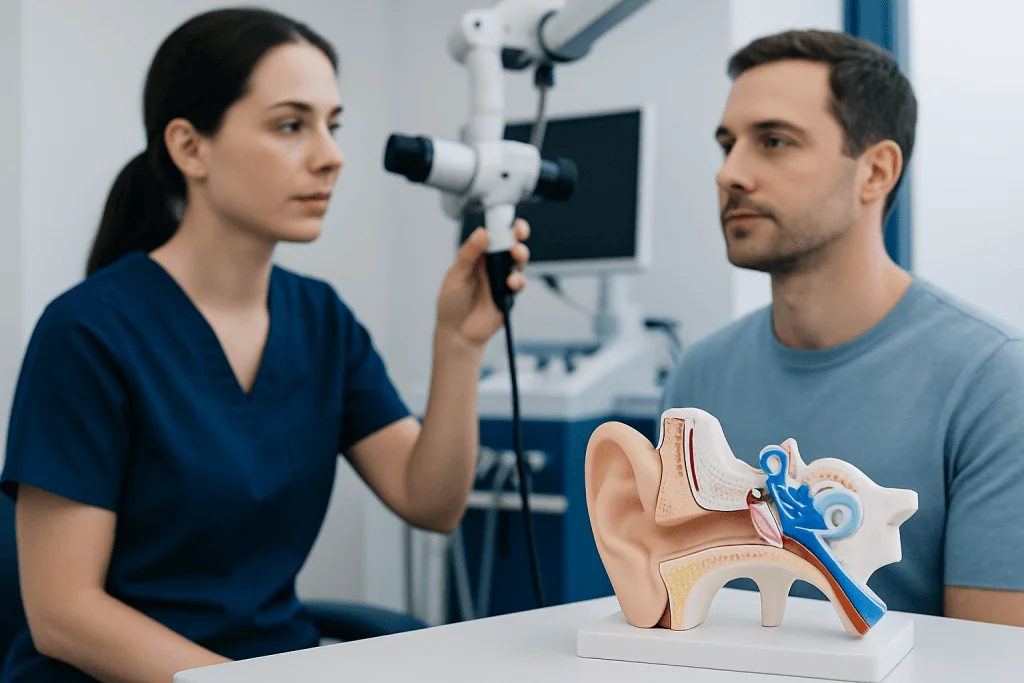
The outer ear includes the auricle, also called the pinna, and the ear canal. The pinna is the visible cartilage-covered structure on the side of the head. Its curved shape helps collect sound waves from the environment and funnel them into the ear canal.
The ear canal is a narrow passage lined with skin, tiny hairs, and glands that produce earwax. Earwax helps protect the canal by trapping dust and debris and by creating an environment that discourages infection. In most people, the ear is self-cleaning, and wax gradually moves outward on its own.
At the end of the ear canal sits the eardrum, also called the tympanic membrane. This thin membrane marks the boundary between the outer and middle ear. When sound waves reach the eardrum, it vibrates and begins the process of transmitting sound deeper into the ear.
- Main structures: pinna, ear canal, eardrum
- Main roles: collecting sound, protecting the canal, directing sound to the eardrum
- Common issues: wax blockage, swimmer’s ear, skin irritation, trauma
The middle ear: how sound is amplified and equalized

The middle ear is an air-filled space behind the eardrum. Its best-known structures are three tiny bones called the ossicles: the malleus, incus, and stapes. These are sometimes referred to as the hammer, anvil, and stirrup. They form a chain that carries vibrations from the eardrum to the inner ear.
These bones do more than simply pass sound along. They also amplify the vibrations so sound can move efficiently from air in the ear canal into the fluid-filled inner ear. Without this step, much of the sound energy would be lost. Small muscles in the middle ear also help protect the ear from very loud sounds, although they cannot prevent all noise-related damage.
The middle ear also contains the Eustachian tube, which connects the middle ear to the back of the nose and upper throat. This tube helps equalize pressure on both sides of the eardrum. That is why swallowing, yawning, or chewing can help relieve ear pressure during air travel or altitude changes.
Problems in this part of the ear can lead to muffled hearing, pressure, pain, or a feeling that the ear is blocked. Conditions such as middle ear infection or fluid behind the eardrum may need ENT evaluation, including care related to middle ear infection.
The inner ear: hearing, balance, and nerve signals
The inner ear contains the cochlea, vestibule, semicircular canals, and the auditory and vestibular nerves. The cochlea is a spiral-shaped, fluid-filled structure responsible for hearing. Inside it are delicate sensory hair cells that move in response to vibrations coming from the middle ear.
When these hair cells bend, they create electrical signals that travel through the auditory nerve to the brain. The brain then interprets those signals as speech, music, environmental sounds, and other auditory information. Damage to these sensory cells can cause permanent hearing loss because, in humans, they do not regenerate effectively.
The vestibule and semicircular canals make up the balance portion of the inner ear. These structures detect head position, rotation, and movement. They send information through the vestibular nerve to the brain, which combines it with visual and muscle-joint signals to help maintain posture and stable vision while moving.
Inner ear conditions may cause hearing loss, ringing in the ears, spinning sensations, or unsteadiness. Patients with persistent vertigo or balance symptoms may be assessed for causes such as vertigo, and hearing rehabilitation may sometimes involve cochlear implant evaluation when severe hearing loss is present.
How the parts of the ear work together
Hearing depends on a sequence of events that begins when sound enters the outer ear. The pinna gathers sound, the ear canal directs it inward, and the eardrum vibrates. These vibrations are then transmitted through the ossicles of the middle ear to the inner ear.
In the cochlea, movement of fluid stimulates sensory hair cells, which convert mechanical energy into nerve impulses. The auditory nerve carries those impulses to the brain, where they are interpreted. This process happens very quickly and continuously, allowing the brain to distinguish pitch, loudness, direction, and speech patterns.
Balance uses a related but separate system. The semicircular canals detect rotation of the head, while other inner ear organs sense gravity and straight-line movement. Signals from the vestibular system help coordinate eye movements and body position. That is why inner ear problems can cause both dizziness and nausea, even when hearing seems normal.
Because hearing and balance share nearby anatomy, a disorder in one area may affect more than one function. For example, an infection, inflammation, trauma, or nerve problem may lead to combinations of hearing change, pressure, ringing, and imbalance rather than a single isolated symptom.
Common problems that affect different parts of the ear
Symptoms often give clues about which part of the ear may be involved. Outer ear problems commonly include pain when touching the ear, itchiness, discharge, or a blocked feeling due to wax or inflammation. The condition often called swimmer’s ear affects the ear canal rather than the deeper parts of the ear.
Middle ear problems are more likely to cause pressure, pain, temporary hearing reduction, or popping sensations, especially during colds, sinus congestion, or altitude changes. Infection or fluid in the middle ear is common in children but can also affect adults. In some cases, repeated ear disease may require procedures such as ear tube insertion to improve drainage and ventilation.
Inner ear problems more often cause sensorineural hearing loss, tinnitus, dizziness, vertigo, or imbalance. Exposure to loud noise, aging, viral illness, certain medications, and other conditions can damage the cochlea or related nerves. For some patients with severe or mixed forms of hearing loss, specialists may evaluate options that include hearing loss treatment.
- Outer ear signs: itching, tenderness, wax blockage, canal discharge
- Middle ear signs: fullness, pain, popping, muffled hearing, fever with infection
- Inner ear signs: ringing, vertigo, imbalance, sudden hearing change
Diagnosis: how doctors examine the ear
Diagnosis begins with a medical history and a physical examination. A clinician will ask about pain, hearing changes, ringing, drainage, dizziness, recent infections, flying or diving, noise exposure, medications, and any injury. These details help narrow down whether symptoms are more likely to come from the outer, middle, or inner ear.
During the exam, the doctor may inspect the ear canal and eardrum with an otoscope. Additional tests may include hearing tests, tympanometry to assess eardrum movement, or balance testing when dizziness is a concern. If a structural problem is suspected, imaging may occasionally be used.
Sudden hearing loss, severe vertigo, facial weakness, persistent drainage, or symptoms after head trauma usually need prompt assessment. Quick evaluation is important because some causes are easier to treat when identified early. Patients should avoid self-diagnosing persistent ear symptoms, as different conditions can feel similar at first.
Prevention, self-care, and when to seek medical care
Simple ear care habits can help protect hearing and reduce irritation. It is generally best not to insert cotton swabs, hairpins, or other objects into the ear canal, as these can push wax deeper or injure the skin and eardrum. Keeping ears dry after swimming, using hearing protection in loud settings, and managing allergies or congestion when advised by a clinician may also help.
Patients should seek medical care if they have significant ear pain, fever, drainage, sudden hearing loss, new ringing in one ear, persistent fullness, dizziness, spinning sensations, or symptoms that do not improve. Children, older adults, and people with diabetes or weakened immunity may need earlier assessment. Ear symptoms after trauma or pressure injury, such as after diving or flying, also deserve attention.
Most ear conditions can be diagnosed with a focused examination and treated according to the part of the ear involved. Near the end of the care pathway, patients may benefit from multidisciplinary assessment by ENT, audiology, neurology, or imaging specialists. Acibadem International’s multidisciplinary specialists and JCI-accredited hospitals diagnose and treat ear conditions for international patients when more advanced evaluation is needed.
Frequently asked questions
What are the main parts of the ear?
The ear has three main parts: the outer ear, middle ear, and inner ear. Each part has its own structures and role in hearing, and the inner ear also helps control balance.
What is the difference between the outer, middle, and inner ear?
The outer ear collects sound and directs it to the eardrum. The middle ear passes and amplifies vibrations through tiny bones, while the inner ear turns those vibrations into nerve signals and helps the body sense movement and position.
Which part of the ear controls balance?
Balance is mainly controlled by the vestibular part of the inner ear, including the vestibule and semicircular canals. These structures send signals to the brain about head movement, gravity, and position.
Can earwax damage the ear?
Earwax is usually protective and normal. Problems arise when wax builds up and blocks the ear canal or when people try to remove it with objects that can push it deeper or injure the canal.
Why do ears pop on an airplane?
Ears pop because the Eustachian tube in the middle ear is adjusting pressure on both sides of the eardrum. Swallowing, yawning, or chewing can help the tube open and reduce pressure discomfort.
What symptoms suggest an inner ear problem?
Inner ear problems often cause dizziness, vertigo, ringing in the ears, imbalance, or hearing loss. These symptoms should be assessed by a doctor, especially if they are sudden, severe, or persistent.
When should someone see a doctor for ear symptoms?
Medical care is important for severe pain, drainage, fever, sudden hearing loss, ongoing fullness, or dizziness. Prompt evaluation is also recommended after head injury, diving-related pressure injury, or symptoms that keep returning.
This article is for general information only and is not a substitute for professional medical advice. Please consult a qualified doctor about your individual situation.
Explore treatments in Turkey — costs, top hospitals & a free quote
JCI-accredited · board-certified surgeons · reply within 24h
Add us as a Preferred Source to see more of our trusted health content across Google Search, AI Overviews and Discover.

More from the Health Library

Burning Sage: What Patients Need to Know

Co Sleeping: A Complete Medical Overview

Blood From a Miscarriage: What Patients Need to Know

Inverted Nipple — Explained by Medical Evidence, Not Myths

Nauseous with a cold: Symptoms, Causes, and Treatment — Complete Patient Guide

Molasses: A Complete Medical Overview
Otorhinolaryngology Specialists at Acibadem

Prof. Dr. Çetin Vural
Otorhinolaryngology
Prof. Dr. Çiğdem Kalaycık
Otorhinolaryngology
Dr. Cüneyt Altunay
Otorhinolaryngology
Prof. Dr. Deniz Tuna Edizer
Otorhinolaryngology