Pediatric Myopia: Slowing Nearsightedness Progression in Children
Pediatric myopia means a child sees nearby objects clearly but distant objects appear blurry. Myopia often progresses while the eyes are growing, especially between early school age and the teenage years.
Key Takeaways
- Pediatric myopia means a child sees nearby objects clearly but distant objects appear blurry.
- Myopia often progresses while the eyes are growing, especially between early school age and the teenage years.
- Regular comprehensive eye exams are essential because children may not always notice or report blurry distance vision.
- More outdoor time and balanced screen and near-work habits can support healthy eye development.
- Myopia control treatments, such as low-dose atropine, specialized contact lenses, orthokeratology, and certain spectacle lenses, should be guided by an eye care professional.
Pediatric myopia, or nearsightedness in children, is increasingly common and can progress during the school years. With early diagnosis, healthy visual habits, and evidence-based myopia control options, many children can reduce the speed of progression and protect long-term eye health.
Overview
Pediatric myopia is a common vision condition in which a child can usually see objects up close but has difficulty seeing things farther away, such as the classroom board, road signs, or a television across the room. It is often called nearsightedness. Myopia usually happens when the eye grows slightly too long from front to back, or when the cornea and lens focus light too strongly, causing images to focus in front of the retina instead of directly on it.
Childhood myopia matters because it can progress as a child grows. A stronger prescription may be needed over time, and higher levels of myopia are associated with an increased lifetime risk of eye conditions such as retinal problems, glaucoma, and myopic macular changes. This does not mean every child with myopia will develop complications, but it does make careful monitoring and prevention of rapid progression important.
The goal of modern pediatric myopia care is not only to help a child see clearly today, but also to slow the rate at which nearsightedness worsens. Glasses or standard contact lenses correct blurred vision, while myopia control strategies aim to influence eye growth. The best plan depends on the child’s age, prescription, eye health, lifestyle, maturity, and family preferences.
Symptoms and Signs Parents May Notice
Children do not always realize that their vision is blurry, especially if myopia develops gradually. Some children assume everyone sees the same way they do. For this reason, parents and teachers may notice behavior changes before the child clearly describes a vision problem.
Common signs of nearsightedness in children include squinting, sitting very close to the television, moving closer to the classroom board, holding books or digital devices unusually close, or having trouble recognizing people at a distance. A child may complain of headaches or eye strain, especially after school, although many children with myopia have no discomfort.
- Difficulty seeing the board or screen in class
- Frequent squinting or rubbing the eyes
- Closing one eye to see more clearly
- Loss of interest in sports or outdoor activities that require distance vision
- A drop in school performance related to visual tasks
Any of these signs should prompt a comprehensive eye examination. School vision screenings are helpful, but they do not replace a full eye exam performed by an ophthalmologist or optometrist, especially when a child has symptoms, a family history of myopia, or a prescription that is changing quickly.
Causes and Risk Factors
Pediatric myopia develops through a combination of genetic and environmental factors. A child is more likely to become nearsighted if one or both parents have myopia. However, genetics alone do not fully explain why childhood myopia has become more common in many parts of the world. Daily habits and visual environment also appear to play an important role.
Spending long periods on near tasks, such as reading, homework, smartphone use, tablets, computers, or handheld gaming, may contribute to myopia progression in some children. Near work itself is not harmful when balanced, but long uninterrupted periods at close distance can increase visual strain. Limited outdoor time is another important factor. Natural daylight and looking at farther distances outdoors are believed to support healthier eye growth.
Risk can also vary by age and onset. Children who become myopic at a younger age often have more years for myopia to progress before eye growth stabilizes. Rapidly changing prescriptions, higher early myopia levels, and certain family histories may place a child in a higher-risk group that benefits from closer monitoring and active myopia control.
Diagnosis and Monitoring
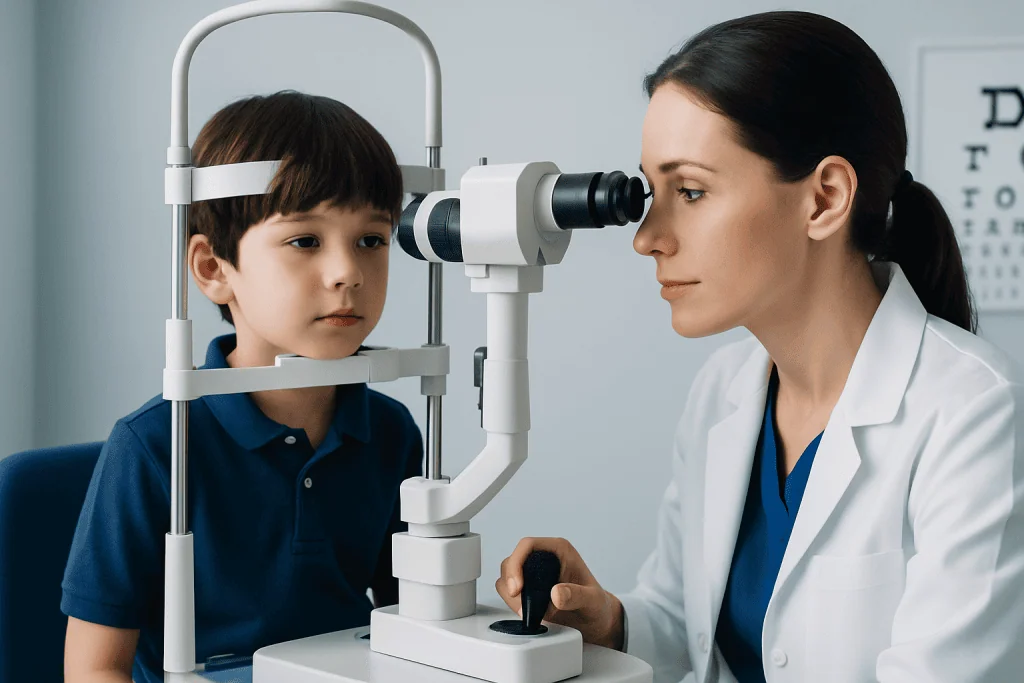
Diagnosis begins with a comprehensive eye examination. The eye care professional measures visual acuity, checks how clearly the child sees at distance and near, and performs refraction testing to determine the prescription. In children, cycloplegic drops may be used to temporarily relax focusing muscles so the true prescription can be measured more accurately.
The doctor may also assess eye alignment, focusing ability, and overall eye health. A dilated retinal exam helps evaluate the back of the eye, especially in children with higher myopia. In some clinics, axial length measurement is used to monitor the physical growth of the eye. Because myopia is closely linked to eye elongation, axial length can provide useful information beyond the glasses prescription alone.
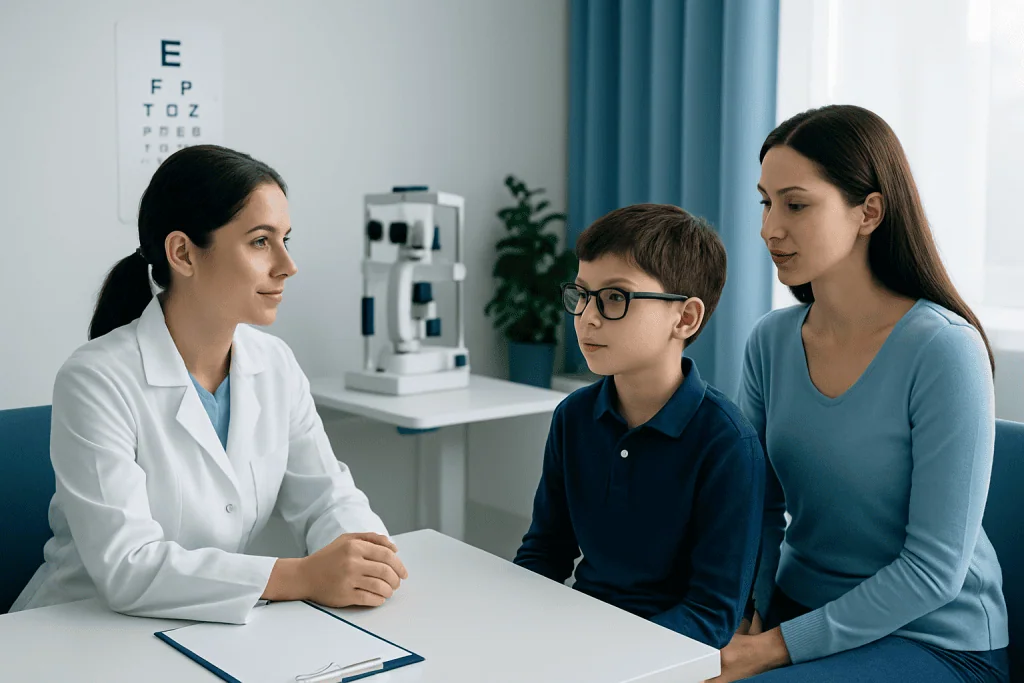
Monitoring frequency depends on the child’s age, prescription, and rate of change. Many children with active progression are reviewed every 6 to 12 months, and some may need more frequent follow-up when starting a myopia control treatment. Parents should keep a record of prescription changes, treatment plans, and any symptoms so that progress can be assessed over time.
Treatment Options to Slow Myopia Progression
Standard glasses or contact lenses correct blurry distance vision and are important for comfort, learning, and daily function. However, ordinary single-vision correction does not usually slow the underlying progression of myopia. Myopia control treatments are designed to reduce the rate of eye growth and prescription increase. They should be selected and supervised by a qualified eye care professional.
Low-dose atropine eye drops are one widely used option for slowing myopia progression in children. The exact concentration and schedule vary by patient and local clinical practice. Possible side effects may include light sensitivity or difficulty with near focusing, although lower concentrations are often better tolerated. Atropine should only be used under medical supervision, with follow-up to evaluate benefit and side effects.
Optical approaches include specially designed soft multifocal contact lenses, orthokeratology lenses, and certain myopia control spectacle lenses. Orthokeratology, often called ortho-k, uses rigid contact lenses worn overnight to temporarily reshape the cornea, allowing clearer daytime vision without glasses. It may help slow progression for some children, but it requires excellent hygiene and careful follow-up because overnight lens wear carries a risk of eye infection. Multifocal soft contact lenses and newer spectacle lens designs can also help manage peripheral focusing signals that influence eye growth.
No single treatment is best for every child. The doctor will consider prescription, corneal shape, tear film, maturity, sports participation, allergies, and the family’s ability to maintain lens care or eye drop routines. Sometimes lifestyle changes and one treatment are combined, and the plan may be adjusted if myopia continues to progress.
Prevention and Self-Care Habits
Not all pediatric myopia can be prevented, especially when genetics are strong. Still, everyday habits can support healthy vision and may help reduce the risk of onset or rapid progression. The most consistently recommended lifestyle step is increasing outdoor time. Children should be encouraged to spend regular time outdoors in safe conditions, with appropriate sun protection such as hats and sunglasses when needed.
Balanced near-work habits are also important. Children who read, study, or use screens for long periods should take regular breaks and avoid holding books or devices too close to the face. A practical approach is to pause often, look across the room or out a window, and relax the eyes before returning to near work. Good lighting, an appropriate desk setup, and limiting recreational screen time can also reduce visual fatigue.
- Encourage daily outdoor play or outdoor family activities when possible.
- Keep reading material and screens at a comfortable distance.
- Use good lighting for homework and reading.
- Break up long periods of close work with distance viewing.
- Make sure the child wears prescribed glasses or lenses as directed.
- Attend scheduled follow-up visits even when the child seems to see well.
Parents should avoid starting eye drops, supplements, online-purchased lenses, or eye exercises that claim to cure myopia without medical guidance. Myopia can be managed, but it cannot be reliably reversed by home remedies. Safe care begins with an accurate diagnosis and a treatment plan tailored to the child.
When to See a Doctor
A child should have an eye examination if there are signs of blurred distance vision, frequent squinting, headaches related to visual tasks, or difficulty seeing at school. An exam is also important if a parent or sibling has significant myopia, because family history increases the chance of childhood myopia. Even without symptoms, routine eye checks help detect vision problems early, when management may be more effective.
Parents should seek prompt medical attention if a child reports sudden vision loss, flashes of light, many new floaters, eye pain, significant redness, or a recent eye injury. These symptoms are not typical signs of simple myopia and may require urgent evaluation. Children who wear contact lenses should also be assessed quickly if they develop pain, light sensitivity, discharge, or a red eye.
For international families seeking evaluation or treatment planning, Acibadem International’s multidisciplinary specialists and JCI-accredited hospitals provide diagnosis and care for pediatric eye conditions, including childhood myopia. Families should bring previous prescriptions, eye examination reports, and details of any current glasses, contact lenses, or eye drops to help the doctor assess progression accurately.
Frequently asked questions
What is pediatric myopia?
Pediatric myopia is nearsightedness that develops in childhood. A child with myopia usually sees nearby objects clearly but has blurred distance vision. It occurs when light focuses in front of the retina rather than directly on it, often because the eye has grown too long.
Can my child's myopia be cured?
Myopia is not usually cured in the sense of permanently returning the eye to its original focusing shape. Glasses, contact lenses, and refractive correction can help a child see clearly, while myopia control treatments may slow progression. The aim is to manage the condition safely and reduce long-term risk.
At what age does childhood myopia usually start?
Myopia can begin at different ages, but it often appears during the school years. Children who develop myopia at a younger age may have a higher chance of progression because their eyes are still growing. Early detection allows the doctor to monitor changes and discuss myopia control options if needed.
Does screen time cause myopia?
Screen time alone is not the only cause of myopia, but long periods of close work and limited outdoor time may contribute to risk and progression. Children benefit from balanced routines that include breaks from near work and regular outdoor activity. Parents should focus on healthy visual habits rather than fear of screens alone.
Are contact lenses safe for children with myopia?
Many children can wear contact lenses safely when they are mature enough and receive proper instruction. Safety depends on hygiene, correct handling, appropriate lens selection, and regular follow-up. Overnight lenses such as orthokeratology require especially careful supervision because improper use can increase infection risk.
How often should a child with myopia have an eye exam?
The schedule depends on the child's age, prescription, and how quickly the myopia is changing. Many children with progressing myopia are checked every 6 to 12 months, while some need closer follow-up when starting treatment. The eye care professional will recommend a plan based on the child's individual risk.
What can parents do at home to help slow progression?
Parents can encourage regular outdoor time, limit long uninterrupted near work, ensure good lighting, and help the child follow the prescribed treatment plan. It is also important to attend follow-up visits and report any vision changes. Home habits are supportive, but they should not replace professional myopia management.
References
- American Academy of Ophthalmology
- American Association for Pediatric Ophthalmology and Strabismus
- International Myopia Institute
- World Health Organization
- Centers for Disease Control and Prevention
This article is for general information only and is not a substitute for professional medical advice. Please consult a qualified doctor about your individual situation.
Myopia in Turkey — costs, top hospitals & a free quote
JCI-accredited · board-certified surgeons · reply within 24h
Add us as a Preferred Source to see more of our trusted health content across Google Search, AI Overviews and Discover.