Rinne and Weber Test — Explained by Medical Evidence, Not Myths

The Rinne and Weber test compares how sound is heard through air and bone conduction. Together, the tests may help distinguish conductive hearing loss from sensorineural hearing loss.
Key Takeaways
- The Rinne and Weber test compares how sound is heard through air and bone conduction.
- Together, the tests may help distinguish conductive hearing loss from sensorineural hearing loss.
- Results depend on correct technique, the degree of hearing loss, and the hearing status of both ears.
- A normal bedside test does not rule out subtle hearing loss or all ear conditions.
- Sudden hearing loss, severe ear pain, dizziness, or neurological symptoms require prompt medical assessment.
The Rinne and Weber test are quick bedside hearing tests performed with a vibrating tuning fork. They can suggest whether hearing loss may be conductive or sensorineural, but they do not diagnose the cause or replace a formal audiology assessment.
Overview: What Are the Rinne and Weber Tests?
The Rinne and Weber test are simple hearing assessments that use a vibrating metal tuning fork, most commonly one tuned to 512 Hz. A clinician may perform them during an ear examination when a person reports reduced hearing, blocked ears, tinnitus, ear pain, or a difference in hearing between the two ears. The tests are painless, take only a few minutes, and do not involve radiation or needles.
The Rinne test compares sound heard through the air with sound transmitted through bone. The Weber test compares how sound is perceived between the left and right ears. Used together, they offer clues about the likely pattern of hearing loss, particularly whether it may involve the outer or middle ear, called conductive hearing loss, or the inner ear or hearing nerve, called sensorineural hearing loss.
These tests are screening tools rather than final answers. Their value is greatest when interpreted alongside a person’s symptoms, ear examination, medical history, and, when needed, formal hearing testing. Hearing loss can have many causes, including wax buildup, infection, fluid behind the eardrum, noise exposure, aging, medication effects, and less common neurological conditions.
How the Tests Are Performed
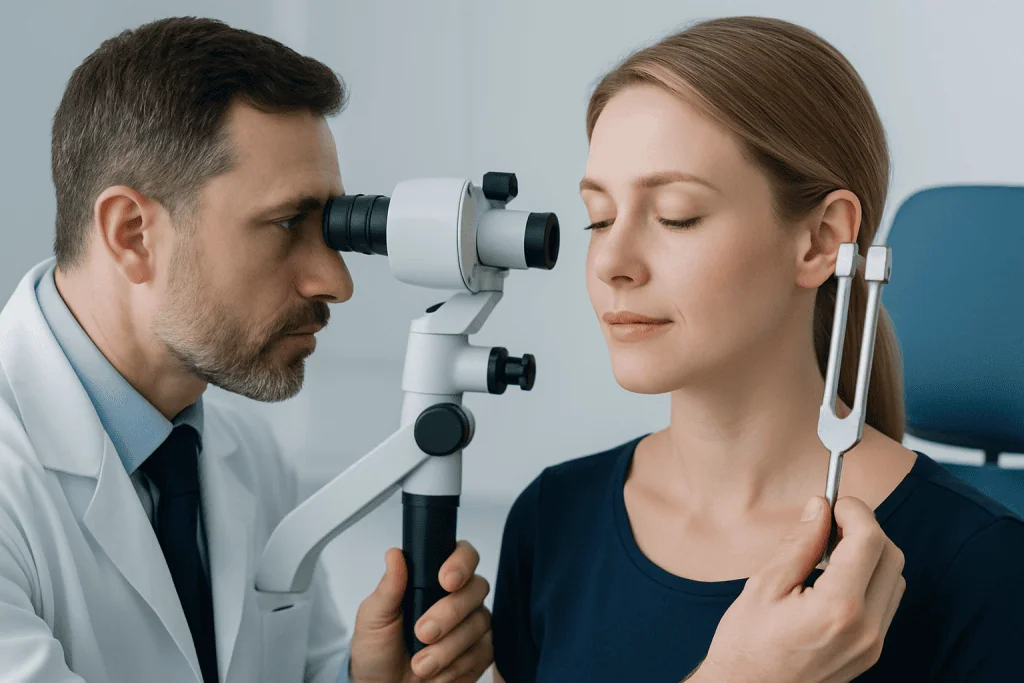
For the Rinne test, the clinician strikes the tuning fork gently so it vibrates and places its base on the bone behind the ear, known as the mastoid bone. This checks bone conduction. When the person can no longer hear the sound, the still-vibrating fork is moved close to the ear canal without touching it. This checks air conduction. In people with typical hearing, sound is heard longer through the air than through bone.
For the Weber test, the base of the vibrating tuning fork is placed at the center of the forehead, top of the head, or sometimes the upper front teeth. The person is asked whether the sound seems equally loud in both ears or louder on one side. Hearing the sound in the middle or equally on both sides can occur with normal hearing, but it may also occur when hearing loss is similar in both ears.
Clinicians should perform these tests in a reasonably quiet setting and explain what the person should report. A tuning fork should not be struck against a hard surface, as this may create extra sounds or damage the instrument. The tests assess sound perception only; they do not examine the eardrum directly or measure hearing thresholds with the precision of audiometry.
Understanding Results Without Common Myths

A commonly described normal Rinne result is called “Rinne positive”: air conduction is heard longer than bone conduction. This usually occurs in normal hearing and in most sensorineural hearing loss. Therefore, a positive Rinne result does not prove that hearing is fully normal, and it does not by itself exclude inner-ear hearing loss.
A “Rinne negative” result means bone conduction is heard as long as, or longer than, air conduction. This pattern may suggest conductive hearing loss in that ear, such as from earwax, middle-ear fluid, a perforated eardrum, or reduced movement of the middle-ear bones. However, test interpretation is not always straightforward. In profound hearing loss affecting one ear, sound transmitted through the skull may be heard by the opposite ear, producing a misleading result known as a false-negative Rinne test.
In the Weber test, sound that seems louder in an ear with reduced hearing can suggest conductive hearing loss on that side. By contrast, sound that seems louder in the better-hearing ear can suggest sensorineural hearing loss in the opposite ear. These are patterns, not certainties. For example, equal sound perception does not always mean normal hearing, particularly when loss is present to a similar degree in both ears.
- Myth: A tuning-fork test can identify the exact ear disease. Fact: It identifies a possible hearing-loss pattern, not a specific diagnosis.
- Myth: A normal Rinne result means no hearing problem. Fact: Mild, high-frequency, bilateral, and sensorineural losses may still be present.
- Myth: The louder side in the Weber test is always the affected ear. Fact: The meaning depends on whether hearing loss is conductive or sensorineural.
What Can Cause Conductive or Sensorineural Hearing Loss?
Conductive hearing loss occurs when sound has difficulty reaching the inner ear. Common examples include earwax blocking the canal, swelling of the ear canal, outer-ear infection, fluid in the middle ear after a cold, middle-ear infection, eardrum perforation, and otosclerosis, a condition that affects the small bones involved in hearing. Some causes are temporary and treatable, but assessment is important before attempting self-care.
Sensorineural hearing loss results from changes in the cochlea of the inner ear, the auditory nerve, or related hearing pathways. It may develop gradually with aging or long-term loud-noise exposure. Other possible causes include inherited factors, certain infections, head injury, medications that can affect hearing, Ménière’s disease, and, more rarely, conditions affecting the hearing nerve.
Mixed hearing loss means that conductive and sensorineural factors are both present. A person may also feel that an ear is blocked despite having no actual obstruction, particularly with some inner-ear conditions. This is why symptoms and bedside tests must be considered in context rather than used to make assumptions about the cause.
How Hearing Loss Is Diagnosed After Bedside Testing
If symptoms or tuning-fork findings suggest hearing loss, a clinician usually looks in the ear with an otoscope to check for wax, inflammation, discharge, eardrum changes, or signs of fluid. The medical history may include questions about the timing of symptoms, noise exposure, recent respiratory illness, ear surgery, medications, dizziness, balance problems, headaches, and family history of hearing loss.
Pure-tone audiometry is the standard formal test for measuring hearing thresholds across different sound frequencies. It can determine the degree, type, and symmetry of hearing loss more reliably than the Rinne and Weber tests. Speech testing may show how well a person understands spoken words, while tympanometry can assess eardrum movement and middle-ear pressure.
Further tests are selected only when clinically appropriate. Sudden or one-sided sensorineural hearing loss, persistent asymmetry, or symptoms suggesting a neurological cause may lead to referral to an ear, nose, and throat specialist or audiologist. Imaging is not needed for every person with hearing symptoms, but may be considered for selected cases after specialist assessment.
Treatment and Self-Care Depend on the Cause
There is no single treatment for an abnormal Rinne or Weber test because the tests do not identify the underlying cause. Earwax may be managed safely by a trained clinician when it is causing symptoms or blocking the view of the eardrum. Ear infections, middle-ear fluid, eardrum injury, and other conditions require treatment based on the examination and diagnosis.
For sensorineural hearing loss, support may include hearing aids, communication strategies, hearing rehabilitation, or, for selected people with severe hearing loss, assessment for implantable hearing technology. The best approach depends on the hearing test, daily communication needs, general health, and personal preferences. Prompt care is particularly important if hearing changes suddenly, because time-sensitive treatment may be considered.
At home, people should avoid putting cotton swabs, hairpins, candles, or other objects into the ear canal. These can push wax deeper, injure the ear canal or eardrum, and delay proper diagnosis. Reducing exposure to loud music, machinery, and recreational noise, including by using well-fitted hearing protection, can help protect hearing over time.
Acibadem International’s multidisciplinary specialists and JCI-accredited hospitals assess hearing concerns for international patients through clinical ear examination and appropriate audiological testing when needed.
When to Seek Medical Care
A non-urgent medical appointment is appropriate for gradual hearing reduction, recurring ear blockage, persistent tinnitus, repeated ear infections, or difficulty following conversation. Evaluation is also helpful when family members notice changes in hearing, even if the affected person has adapted to the problem. Early assessment can identify reversible causes and help prevent communication difficulties from becoming more disruptive.
Urgent medical assessment is recommended for sudden hearing loss in one or both ears, especially when it develops over hours or a few days. Sudden hearing loss may be accompanied by tinnitus, a blocked-ear sensation, or dizziness, and it should not be assumed to be simple wax. The same applies to hearing loss after head injury or a loud blast exposure.
Emergency care is appropriate when hearing symptoms occur with facial weakness, trouble speaking, severe headache, weakness or numbness on one side of the body, confusion, severe spinning dizziness, or loss of balance. These symptoms can have causes beyond the ear and need immediate evaluation. Ear pain with high fever, swelling behind the ear, bloody discharge, or severe illness also warrants prompt care.
Frequently asked questions
What is the difference between the Rinne and Weber test?
The Rinne test compares air conduction with bone conduction in each ear. The Weber test checks whether a tuning-fork sound is heard more strongly in one ear than the other. Together, they can suggest a pattern of hearing loss, but neither test confirms a diagnosis on its own.
Is a positive Rinne test normal?
Usually, a positive Rinne test means air conduction is heard longer than bone conduction, which is the expected pattern in normal hearing. It can also occur in sensorineural hearing loss. For that reason, a positive result does not guarantee that hearing is normal.
What does it mean if the Weber test is louder in one ear?
A louder Weber sound in one ear can suggest conductive hearing loss in that ear or sensorineural hearing loss in the opposite ear. The finding must be interpreted with the Rinne test, symptoms, and a full ear assessment. Formal audiometry is often needed to clarify the result.
Can the Rinne and Weber tests detect earwax?
The tests may suggest conductive hearing loss, which can occur with earwax blockage. However, they cannot confirm that wax is the cause. Looking into the ear with an otoscope is the appropriate way to check for wax and other visible ear problems.
Are tuning-fork hearing tests accurate?
When performed correctly, tuning-fork tests can provide useful bedside information, particularly for more noticeable one-sided or conductive hearing changes. Their accuracy is limited by technique, background noise, and the type and degree of hearing loss. Audiometry provides a more detailed and reliable measurement.
Can these tests diagnose sudden hearing loss?
They can help a clinician quickly assess whether sudden hearing symptoms may follow a conductive or sensorineural pattern. They cannot determine the exact cause or replace urgent specialist assessment. Sudden hearing loss should be evaluated promptly, even if the ear feels blocked.
References
- American Academy of Otolaryngology–Head and Neck Surgery
- National Institute on Deafness and Other Communication Disorders
- Merck Manual Professional Edition
- National Health Service
- World Health Organization
This article is for general information only and is not a substitute for professional medical advice. Please consult a qualified doctor about your individual situation.
Explore treatments in Turkey — costs, top hospitals & a free quote
JCI-accredited · board-certified surgeons · reply within 24h
Add us as a Preferred Source to see more of our trusted health content across Google Search, AI Overviews and Discover.

More from the Health Library

Razor Bumps: A Complete Medical Overview

Oculomotor Nerve: What Patients Need to Know

Social Queues: A Complete Medical Overview

Ercp Procedure: What Patients Need to Know

Head Tumors Signs: What Patients Need to Know