Sapphire Hair Transplant
Sapphire hair transplant is an FUE-based procedure using sapphire blades to open recipient channels before individual hair grafts are implanted, supporting precise placement and natural-looking growth.
Quick answer
A sapphire hair transplant is an FUE procedure in which the recipient channels, the tiny incisions that hold each graft, are opened with blades made from synthetic sapphire instead of steel. Your own follicles are extracted individually from a stable donor area and implanted into these channels. The blade refines one stage of surgery; diagnosis, planning, graft handling and aftercare remain equally important.
Sapphire FUE Hair Transplant in Turkey: What You Are Actually Choosing
A sapphire hair transplant is a follicular unit extraction (FUE) procedure in which the recipient channels, the small incisions that hold each graft, are opened with blades made from synthetic sapphire rather than steel. The operation moves your own healthy follicles from a stable donor area, usually the back and sides of the scalp, into regions of permanent thinning. It is intended for adults with a confirmed pattern of hair loss and enough donor hair to support the plan.
If you are researching a sapphire FUE hair transplant in Turkey, you will meet a great deal of marketing built around the word sapphire. It helps to be clear from the start about what the term does and does not mean. The blade material changes one stage of the operation: the creation of recipient channels. It does not extract the grafts, it does not alter the biology of the transplanted follicle, and it cannot compensate for a weak diagnosis, an overharvested donor area or a poorly designed hairline.
Hair loss affects more than appearance. A receding hairline, a widening parting or a thinning crown can change how you recognise yourself in photographs, how you style your hair and how you feel in professional and social settings. By the time most people consider surgery, they have already tried medication, cosmetic fibres, specialised shampoos or a change of hairstyle. They usually carry reasonable worries too: visible scarring, an unnatural result, discomfort during the procedure, and whether the transplanted hair will actually grow as promised.
Transplantation does not treat every type of hair loss, and it cannot create new follicles. Its value lies in careful patient selection, realistic planning, precise graft placement and the ability of suitable donor follicles to keep growing after they are moved. The decision is both medical and aesthetic. A technically successful procedure must protect the donor area, respect the natural direction and density of your existing hair, and anticipate how your hair loss may progress over the coming decades. A good consultation therefore spends less time on the number of grafts you want and more on what can be achieved safely and naturally over the long term.
What is a sapphire blade hair transplant?
A sapphire blade hair transplant is standard FUE hair transplant surgery in which the recipient incisions are made with fine, smooth blades manufactured from synthetic sapphire. During FUE, naturally occurring follicular units, small groups of one to several hairs as they grow on the scalp, are removed individually from the donor region and implanted into small channels created in the areas of hair loss. The sapphire element refers only to the instrument used to open those channels; the extraction itself is done with circular punches, not blades.
Sapphire blades are produced in different sizes and tip shapes, which lets the surgeon match channel dimensions to the size of each graft and the demands of each treatment area. Because the channels can be kept small and consistent, spacing, angle, direction and depth can be controlled with precision. That control is particularly useful when reconstructing a hairline or blending transplanted follicles with existing hair. The sapphire method is therefore best understood as a refinement of the channel-opening stage of FUE, not as a separate operation with its own biology.
Sapphire FUE should also be distinguished from strip surgery (FUT), in which a narrow section of donor scalp is removed and the wound is closed with sutures. Because FUE extracts follicles individually, it avoids a linear donor scar. It does leave tiny extraction points, which usually become difficult to see once healed, although no surgical technique is entirely scar-free.
What is sapphire micro FUE hair transplant?
Sapphire micro FUE is the same procedure described with one extra word. Micro FUE refers to the small-diameter punches used to loosen and extract individual follicular units from the donor area; sapphire refers to the blades used later to open the recipient channels. Clinics sometimes combine the two terms to signal that both stages of the operation use fine instruments. There is no separate micro-sapphire technology to compare or pay extra for. A more useful question to ask any clinic is how punch size and blade size will be selected for your skin characteristics, hair calibre, hair curl and the mix of graft types in your plan.
Is a sapphire hair transplant better?
Not automatically. Clinical evidence does not establish that sapphire blades alone produce superior results for every patient. What the blades offer is a practical tool: small, clean, consistently sized channels that support controlled placement. Whether that potential turns into a better result depends on everything around it: the accuracy of the diagnosis, the management of your donor supply, the design of the hairline, how gently the grafts are handled outside the body, and how carefully you follow aftercare. Treat the blade as one link in a chain rather than a stand-alone measure of quality. A clinic that leads with the instrument instead of the assessment is answering the wrong question first.
Is sapphire FUE better than DHI?
Neither technique is better for everyone; they differ in how the grafts are placed. In sapphire FUE, the surgeon opens all the recipient channels first, then the grafts are implanted into them. In DHI hair transplant, grafts are loaded into an implanter pen that creates the opening and places the follicle in a single movement. Channel-first work suits larger areas and gives the surgeon a clear view of the overall distribution before a single graft is placed. Implanter pens can suit work between existing hairs and cases where shaving is to be kept to a minimum. The honest answer is that the right technique follows from your pattern of loss, the size of the area, your hair characteristics and your surgeon’s experience, not from a league table of methods.
Who May Be a Candidate for Sapphire FUE?
Sapphire FUE may be considered by adults with stable or predictably progressive hair loss and an adequate supply of healthy donor follicles. Common starting points include a receding frontal hairline, deepening temporal recession, diffuse thinning across the top of the scalp, an enlarging crown, or reduced density after an earlier transplant.
Suitability cannot be judged from hair-loss photographs alone. The medical team assesses the cause and pattern of loss, the condition of the scalp, hair calibre and curl, donor density, follicular distribution, and the relationship between the available donor supply and the area that needs coverage. Age, family history, medication use, smoking, previous surgery and your expectations are all part of the picture.
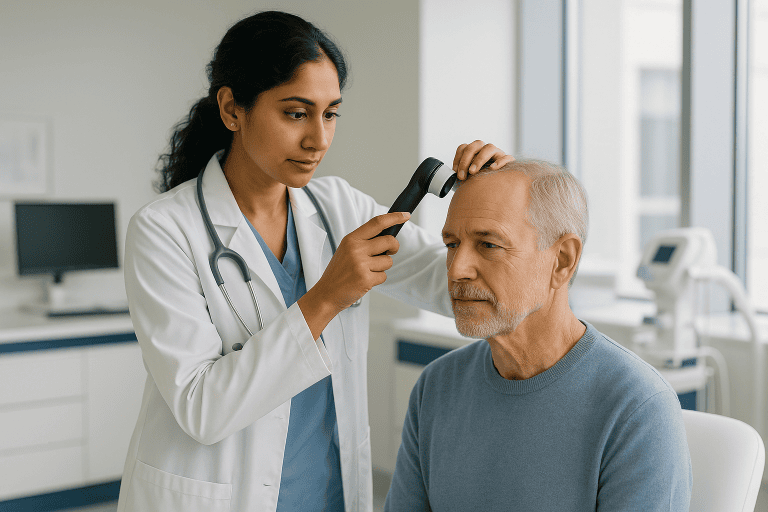
Diagnosis usually begins with a medical history and examination. The physician may inspect the scalp under magnification or with digital imaging to evaluate follicular miniaturisation, density, inflammation and signs of scarring. Standardised photographs document the starting point and support hairline planning. When hair loss is sudden, diffuse, patchy or associated with other symptoms, blood tests or a dermatology or endocrinology opinion may be recommended before surgery is even discussed.
A suitable candidate generally has:
- A confirmed form of hair loss that can reasonably be treated with transplantation
- A stable donor region with enough follicles for the proposed plan
- A healthy scalp without uncontrolled inflammation or infection
- Realistic expectations about density, coverage and the time required for growth
- Medical fitness for an elective procedure performed under local anaesthesia
- A willingness to follow instructions and consider ongoing treatment for non-transplanted hair when the treating doctor advises it
Not everyone should proceed immediately. Active alopecia areata, uncontrolled scarring alopecia, severe scalp disease, significant body dysmorphic concerns or an inadequate donor supply may make transplantation inappropriate. Poorly controlled diabetes, bleeding disorders, certain cardiovascular conditions and medicines that affect clotting all require careful evaluation. Temporary shedding caused by illness, nutritional deficiency, hormonal change, medication or major stress should be investigated and treated before surgery is considered, operating on a scalp that is shedding for a reversible reason wastes donor follicles that cannot be replaced.
Younger patients with rapidly advancing androgenetic hair loss need especially conservative planning. A low or overly dense juvenile hairline may become impossible to maintain naturally if the surrounding hair keeps thinning, leaving an isolated band of transplanted hair. Medical stabilisation and a period of observation are often the more sensible first step, however frustrating that feels at the time.
Hair-Loss Patterns Sapphire FUE May Address
The most common indication is androgenetic alopecia, also called male-pattern or female-pattern hair loss. In this condition, genetically susceptible follicles gradually become finer and shorter under hormonal influence. Follicles from the stable zone at the back and sides of the scalp are usually more resistant to this process, which is exactly why they are useful for transplantation: they tend to keep their resistant behaviour after being moved.
Sapphire FUE may also be considered for selected patients with:
- Frontal hairline recession or loss of the temporal points
- Thinning of the mid-scalp or crown
- Female-pattern hair loss when donor density is sufficient, see hair transplant for women for the specific considerations
- Localised loss following trauma, burns or previous surgery
- Stable, medically evaluated forms of scarring hair loss
- Patchy loss in the beard, moustache or eyebrows when appropriate
- An older transplant that needs refinement, better distribution or limited scar camouflage
Scarred areas need cautious assessment because reduced blood supply and altered tissue can affect graft survival. A small test session is sometimes advisable before committing grafts to a larger scarred region. In diffuse unpatterned hair loss, the donor area itself may be unstable, which can make FUE unsuitable despite obvious thinning elsewhere: this is one of the situations where an honest clinic will say no.
One limit applies to every pattern: transplantation treats the physical absence or miniaturisation of follicles. It does not stop ongoing loss in the hair that was not transplanted. Medical therapy prescribed by your treating doctor may therefore remain part of the overall plan before or after surgery, to protect the native hair around your grafts.
How a Sapphire FUE Hair Transplant Is Performed
A sapphire FUE hair transplant runs through six broad stages. Each one influences the final result, which is why the day itself is long and why preparation starts well before it.
- 1. Consultation, diagnosis and personalised planning
- 2. Medical preparation in the days before surgery
- 3. Donor hair extraction under local anaesthesia
- 4. Creation of recipient channels with sapphire blades
- 5. Implantation of the prepared grafts
- 6. Immediate aftercare and instructions for the first weeks
Consultation and Personalised Planning
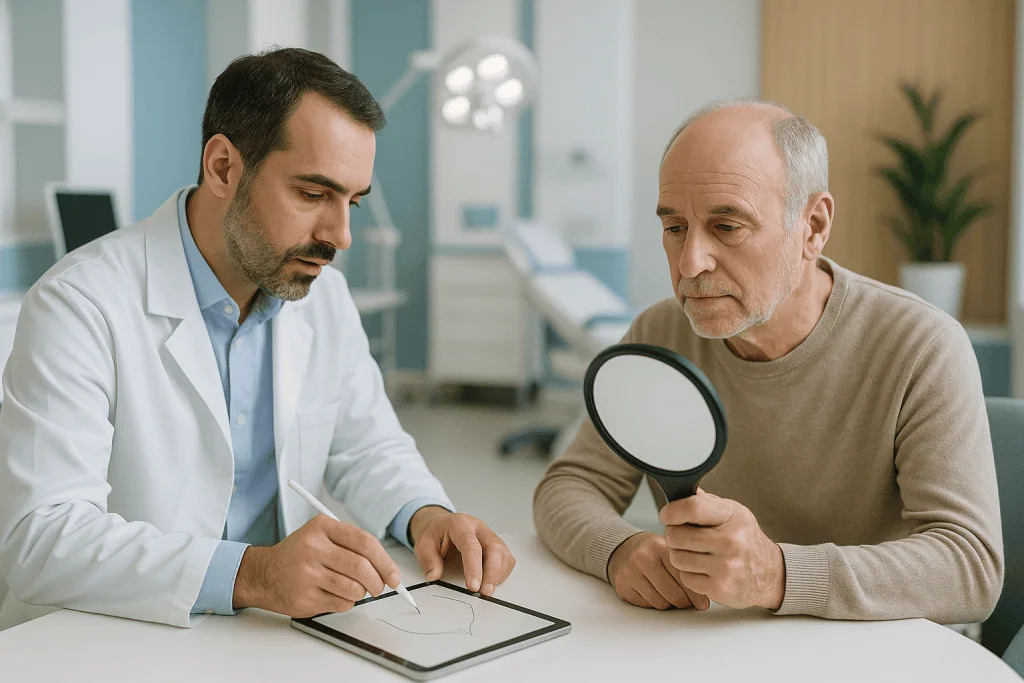
The process begins with confirmation of the diagnosis and an assessment of long-term donor capacity. The physician discusses which regions matter most to you and whether those priorities can be reconciled with the graft supply that actually exists. Hairline design considers facial proportions, age, ethnicity, hair characteristics, existing recession and, critically, the likelihood of future loss behind and around the planned zone.
Density is planned strategically rather than uniformly. The frontal hairline usually needs irregular, refined placement with single-hair grafts, while grafts containing more hairs are used behind it to build visual fullness where it counts. Crown restoration follows the natural whorl pattern but can consume a substantial number of grafts for a modest visual return. When donor supply is limited, staging the treatment or prioritising the frontal region often produces a more balanced, more durable result than trying to cover everything at once.
International patients often begin with a remote review using clear photographs, medical history and details of previous treatment. This supports preliminary planning, but the definitive graft estimate and final design are always confirmed through in-person examination: a number quoted from photographs is an estimate, not a commitment.
Medical Preparation
Before treatment, the clinical team reviews your medical conditions, allergies, current medicines, supplements and any previous reactions to anaesthesia. Blood testing and other assessments are arranged when indicated. You will receive individual instructions about anything that may increase bleeding; decisions about any prescribed medicine belong to the doctor who prescribed it, and the surgical team coordinates with that plan rather than overriding it.
Smoking and nicotine impair circulation and healing, so you may be advised to stop for a period before and after the procedure. Alcohol and non-essential supplements that affect bleeding may also need to be paused on medical advice. The scalp should be free of active infection, significant irritation or sunburn on the day.
The donor region is usually shaved short to allow accurate extraction, and the recipient area may be trimmed depending on the plan. If keeping the procedure discreet matters to you, partial-shave and no-shave approaches exist for selected cases: a hair transplant without shaving has its own trade-offs in session size and duration, which your surgeon can walk through. Arrive with a clean scalp and follow the clinic’s guidance on food, clothing and transport.
Donor Hair Extraction
On the day of surgery, the hairline and treatment zones are reviewed with you before final marking: this is your last practical chance to raise design questions, so use it. Photographs are taken, the scalp is cleansed and local anaesthetic is administered. Sedation may be considered in appropriate patients, but many people remain awake and talk with the team throughout.
Using magnification and small circular punches, follicular units are loosened individually from the donor area. The extraction pattern is deliberately distributed to preserve an even appearance and to avoid overharvesting any one zone. Punch size and technique are chosen according to skin characteristics, follicle depth, hair curl and the number of hairs within each unit, curly hair, for example, curves below the skin surface and needs a different approach from straight hair.
The extracted grafts are handled gently and inspected under magnification. They are sorted by hair count and quality, then kept in a controlled, hydrated environment until implantation. Limiting trauma, dehydration and unnecessary time outside the body is one of the quiet determinants of how well a transplant grows.
Creating Recipient Channels With Sapphire Blades
Once the recipient area is anaesthetised, the surgeon opens channels using appropriately sized sapphire blades. This is the stage the whole technique is named after, and it fixes the distribution, angle, direction and depth of the final growth pattern. Each channel should hold its graft without excessive compression or looseness.
Natural hair does not emerge vertically or at identical angles. Frontal hairs lie at an acute angle to the scalp, temple hairs follow their own distinct direction, and crown hairs rotate around a whorl. Reproducing these patterns takes deliberate planning; very regular rows or an overly straight hairline can look artificial even when every graft grows well.
Channel density must also respect the scalp’s blood supply, the graft sizes, any existing hair and the quality of the tissue. More incisions do not automatically mean a better result. Chasing extreme density increases tissue trauma and can put both transplanted and native follicles at risk: a limit that applies regardless of what the blades are made of.
Graft Implantation
The prepared follicular units are placed into the channels with fine instruments. Single-hair grafts are reserved for the leading edge of the hairline, where anything coarser would look abrupt; larger units provide density behind it. The team monitors depth and orientation throughout to reduce the risk of buried, elevated or damaged grafts.
Procedure length varies with the number of grafts, the complexity of the design and whether more than one region is treated. Many sessions occupy most of a day, with planned breaks for meals and comfort. Larger or corrective procedures may be divided into stages rather than stretching a single session beyond what is safe and efficient for the grafts.
Immediately After the Procedure
The donor area is cleaned and may be lightly dressed. Tiny crusts and pinpoint redness around the implanted follicles are expected. Mild swelling, tightness, tenderness, itching or temporary numbness can occur; most discomfort is manageable with the prescribed medication and eases over the first several days.
You will receive specific instructions on sleeping position, washing, medication, sun protection and activities to avoid. The grafts are most vulnerable to rubbing and impact in the early period, which is why the first nights and the first washes are so tightly choreographed. Washing begins according to the team’s protocol, using gentle application rather than pressure.
Visible crusts usually loosen during the first one to two weeks. The shafts of the transplanted hairs then commonly shed: an expected part of the hair growth cycle, not a sign that the follicles have been lost. New growth begins gradually after several months, and texture and coverage continue to mature over the following year, with the crown typically lagging behind the hairline.
Why Early Assessment Matters
Hair loss is not usually a medical emergency, but timely diagnosis preserves options. Progressive androgenetic alopecia keeps miniaturising native hair while the donor supply stays finite. Early medical management, prescribed by your treating doctor, may help stabilise susceptible follicles and allow any future transplant to be planned more conservatively.
Timing matters even more when loss is driven by inflammation or scarring. Untreated inflammatory disease can permanently damage follicles and can compromise transplanted grafts too. Sudden or diffuse shedding can reflect thyroid dysfunction, iron deficiency, autoimmune disease, medication effects or another medical issue that needs treatment rather than surgery.
Acting early does not always mean operating early. For some people the safest decision is to establish the cause, begin appropriate treatment and watch the pattern before committing irreplaceable donor follicles. A measured plan reduces the risk of an isolated transplanted hairline surrounded by continued thinning, of a depleted donor area, and of repeated corrective procedures later on.
Potential Benefits of Sapphire FUE
For an appropriately selected patient, sapphire FUE can offer the following practical benefits. None of them is automatic; each depends on the planning and execution described above.
| Benefit | What It Means for You |
|---|---|
| Individual follicular extraction | Grafts are removed without a long linear incision, so the donor area heals as many small extraction points rather than one sutured scar. |
| Controlled recipient-site design | Different blade dimensions let the surgeon tailor channel size, angle, direction and spacing to each treatment area. |
| Natural-looking distribution | Careful use of single- and multi-hair grafts can recreate a graduated hairline with visual density behind it. |
| Use of your own hair | Successfully established follicles grow biological hair that can be washed, cut and styled normally. |
| Relatively discreet healing | Most redness, crusting and swelling settle during the early recovery period, though visibility varies with skin and hair characteristics. |
| Long-term potential | Donor follicles resistant to pattern hair loss may keep producing hair for many years, while untreated native hair can continue to thin. |
Recovery and Hair-Growth Timeline
Healing and growth vary from person to person, but the timeline below reflects what many patients experience after an uncomplicated procedure. For a fuller day-by-day picture, the hair transplant recovery timeline guide breaks each phase down in detail, and the clinic’s complete post-op aftercare instructions cover washing, sleeping and activity in practical terms.
| Time Period | What You Can Expect |
|---|---|
| Day 1 | Small crusts, redness, tenderness and a tight sensation. The recipient area must not be touched or rubbed; sleeping with the head elevated may reduce swelling. |
| First week | Gentle washing begins according to instructions. Forehead swelling can appear and then subside. Many people resume light daily activities within several days, depending on appearance and comfort. |
| First month | Crusts usually clear and many transplanted hair shafts shed. Temporary shedding of nearby native hairs can also occur. Exercise and normal grooming return gradually, with clinical guidance. |
| Three to six months | Early new hairs emerge. They may look fine, uneven or lightly pigmented at first. Coverage is still immature; patience matters here more than at any other stage. |
| Six to twelve months | More follicles enter active growth, and hairs typically become thicker and easier to style. The hairline usually matures before the crown. |
| Longer term | Final maturation may continue for 12 to 18 months. Ongoing treatment may be recommended by your doctor to protect non-transplanted hair and maintain overall balance. |
The early shedding phase deserves emphasis because it unsettles almost everyone. The transplanted follicle survives beneath the skin; the visible shaft it arrived with is discarded as the follicle resets its growth cycle. Judging the operation at week six is judging it at its lowest visible point. The realistic checkpoints are the first fine growth at a few months, meaningful coverage towards the end of the first year, and continued refinement after that.
What Influences the Quality of the Result?
Hair transplant outcomes are not determined by a single instrument or a graft count. A good result reflects a chain of clinical decisions made before, during and after surgery, and the chain is only as strong as its weakest link.
Correct diagnosis is fundamental. Transplanting into an area affected by active autoimmune or inflammatory disease can lead to poor growth or reactivation of the disease. Distinguishing permanent pattern loss from temporary shedding prevents unnecessary surgery altogether.
Donor quality and long-term management set the biological limits of treatment. Density, hair calibre, curl, the contrast between hair and skin colour, follicular grouping and scalp laxity all affect visible coverage. A patient with coarse, wavy hair may achieve a fuller visual effect from the same number of follicles than someone with very fine, straight hair. The extraction plan must leave enough donor density for a natural appearance now and for possible needs later.
Hairline and recipient-site design determine whether growth looks age-appropriate. A natural hairline contains subtle irregularities and a gradual transition from finer single hairs to greater density behind them. Its height and contour should suit your face without spending an excessive share of the donor reserve on the first centimetre.
Graft handling matters because follicles are living tissue. Excessive force, drying, temperature swings or prolonged time outside the scalp reduce viability. Organised extraction, preparation, storage and implantation protect delicate follicular structures from the accumulated small injuries that never show on the day but show at twelve months.
The condition of the recipient scalp influences healing. Previous surgery, scars, sun damage, infection, reduced circulation or heavy smoking can all limit blood supply. In scarred tissue, realistic density goals and staged treatment are usually the safer route.
Postoperative care protects the grafts through early healing. Rubbing, scratching, sun exposure, strenuous activity too soon, or skipping the washing protocol can all raise the complication risk. Your written aftercare instructions will set out exactly what to do in the first days and weeks, and which early signs the team wants to review.
Risks and Limitations You Should Understand
Every surgical procedure carries risk, and an honest page says so. Potential complications of sapphire FUE include infection, bleeding, swelling, folliculitis, temporary numbness, itching, cysts, prolonged redness, uneven growth, visible thinning of the donor area, scarring, and temporary shock loss in nearby native hair. Less commonly, graft growth may be limited or the aesthetic design may need revision. Choosing an appropriately qualified medical team and setting realistic goals reduces these risks; nothing eliminates them.
Expectations are the other half of the equation. Transplantation improves coverage; it does not restore the density of an adolescent scalp. The visual result depends on how a finite number of follicles is distributed over the area you want covered, and more than one session may be appropriate for extensive loss. Results take time, and early shedding or patchy initial growth is not the final outcome.
It is also worth understanding what the procedure does not do. It does not halt the underlying hair-loss process in untreated hair, it cannot manufacture donor supply that is not there, and no blade material changes either fact. Patients who go in understanding these limits are consistently the ones most satisfied with their results.
Coming to Turkey for Sapphire FUE: How the Pathway Works
Turkey is one of the most established destinations for this procedure, and sapphire FUE in Turkey is now a routine reason for medical travel. That popularity cuts both ways: experienced, high-volume surgical teams operate alongside providers whose main product is a package rather than a plan. If you are considering a sapphire hair transplant in Turkey, the questions that matter are the same as anywhere else, who examines you, who designs the hairline, who does the surgery, and what happens if something needs attention after you fly home.
A typical care pathway for a sapphire FUE hair transplant in Turkey looks like this. Before travel, you share photographs, medical history and details of any previous treatment for a preliminary remote review. On arrival, the plan is confirmed, or revised, through in-person examination, because no responsible team finalises a design from photographs alone. The procedure itself usually takes place over a single long day. The first wash and a post-operative check are typically completed before you travel back, along with written aftercare instructions you can follow at home.
Plan the trip around the surgery, not the sightseeing. Allow enough days for the procedure, the first wash and the follow-up check before your return flight, and take the team’s advice on when flying is sensible for you. Small practicalities help more than they sound: button-front shirts so nothing drags over the grafts, a travel pillow that keeps pressure off the recipient area, and sun protection for the scalp during the early weeks. Follow-up after you return home commonly continues remotely, with photographs at agreed intervals and in-person review arranged when it is clinically useful.
Sapphire Hair Transplantation at Acibadem
International patients weighing up a sapphire FUE hair transplant in Turkey usually need to evaluate more than the operation itself. They need confidence that the diagnosis is sound, that the operating environment follows recognised safety practices, that the treatment plan is medically appropriate, and that support continues after they return home.
At Acibadem, hair restoration is treated as an individualised medical procedure rather than a standardised graft package. Physicians assess the scalp and donor area, review the likely progression of your hair loss, and build a plan around facial proportions, follicular characteristics, medical history and long-term donor preservation. Dermatology or other specialist input is brought in when the pattern of loss needs further investigation, and the broader hair transplant unit covers the full range of techniques, so the method is chosen to fit the case rather than the other way round.
Procedures take place within Acibadem’s hospital network, supported by established protocols for patient identification, infection prevention, medication management, sterilisation and clinical monitoring. Imaging and magnification assist with donor assessment, hairline documentation, graft preparation and placement. The purpose of the technology is practical: better planning, protected tissue, consistent work and clear information for the team throughout your care.
Multidisciplinary consultation is available when a patient’s health history extends beyond routine androgenetic hair loss, endocrine, dermatological, anaesthetic or surgical questions can each be reviewed by the relevant specialist. This matters most for patients with complex medical conditions, unexplained shedding, previous unsuccessful transplantation or scarring disorders, where decisions benefit from more than one clinical perspective.
International patient services coordinate the non-clinical details that make treatment abroad workable: scheduling, medical-record review, interpretation, airport and local logistics, and communication between you and the clinical team in multiple languages. Before travel, photographs and records support an initial assessment, with final planning confirmed by direct examination. The timing of your return journey is treated as part of the treatment plan, with instructions for protecting the grafts during travel and for managing the expected swelling and crusting. Follow-up can continue by photograph and remote communication after you are home.
A second opinion can be as valuable as a first one. The assessment can address whether surgery is advisable now, whether medical treatment should come first, whether a graft estimate you have been given elsewhere is realistic, and how your donor area should be conserved. It can also separate the clinical factors that genuinely drive results from the terminology used in advertising. Some patients are advised to postpone surgery, pursue medical treatment or scale back the proposed coverage, and that advice can matter more than any operation.
Making an Informed Decision
Sapphire hair transplantation can provide lasting, natural-looking coverage when the diagnosis is right, the donor area is sufficient and every stage is performed with care. Understand it for what it is: an FUE procedure in which sapphire blades open the recipient channels, not a technology that overcomes limited donor supply, active disease or unrealistic density goals.
A thorough consultation should leave you with clear answers about the cause of your hair loss, the stability of your donor region, the proposed hairline, the likely graft distribution, any probable need for future treatment, what recovery involves, and the risks that apply to you specifically. It should also leave you unhurried. A plan you understand, delivered by a team willing to tell you what it cannot do, is worth more than any promise built around the name of a blade.
Preparation
- A specialist assesses hair loss, donor density, scalp health and the proposed hairline. Patients may need blood tests and should disclose medications, supplements, allergies and medical conditions. Smoking, alcohol and blood-thinning medicines may need adjustment under medical guidance.
Aftercare
- Keep the scalp protected and follow the clinic’s washing, medication and sleeping instructions. Avoid scratching, strenuous exercise, direct sunlight, swimming and headwear that rubs the grafts during early healing. Temporary redness, swelling, crusting and shedding can occur before new growth develops gradually.
Frequently Asked Questions
What is a Sapphire hair transplant and how does it work?
A Sapphire hair transplant is an FUE-based technique in which individual hair follicles are removed from a donor area, usually the back or sides of the scalp. The surgeon then creates recipient channels using blades made from medical-grade sapphire before implanting the follicles. These fine blades may support precise channel placement and controlled density. At Acibadem Hospitals, specialists evaluate your hair loss, donor supply, scalp condition, and goals before recommending an appropriate technique.
How is Sapphire FUE different from a traditional FUE hair transplant?
Both procedures generally use the FUE method to extract individual follicular units. The main difference is how the recipient channels are opened: Sapphire FUE uses sapphire blades, while conventional FUE commonly uses steel blades. Sapphire blades can allow fine, precise incisions and may help surgeons plan natural hair direction and density. However, results depend more broadly on surgeon experience, donor hair quality, graft handling, and aftercare. Acibadem specialists can explain which approach suits you.
Am I a suitable candidate for a Sapphire hair transplant?
You may be suitable if you have stable pattern hair loss, sufficient healthy donor hair, realistic expectations, and no uncontrolled condition that could interfere with healing. Age alone does not determine eligibility, although the likely progression of hair loss should be considered. Certain scalp disorders, medications, smoking, or medical conditions may affect planning. An Acibadem specialist will review your health history, examine your scalp and donor area, and design a personalized treatment plan.
Is a Sapphire hair transplant painful?
A Sapphire hair transplant is usually performed under local anesthesia, so most patients feel pressure or movement rather than pain during extraction and implantation. Brief discomfort may occur when the anesthetic is administered. Afterward, mild tenderness, tightness, itching, or swelling can develop and is generally manageable with prescribed medication and aftercare. Comfort varies between patients. Tell your Acibadem medical team about anxiety, allergies, or previous reactions to anesthesia before treatment.
How long does a Sapphire hair transplant procedure take?
The procedure often takes several hours and may occupy most of the day. The exact duration depends on the number of grafts, the size of the treatment area, hair characteristics, and the complexity of the planned hairline. Larger sessions can take longer or occasionally require staged treatment. Patients should avoid making tight travel plans on the procedure day. Following examination, the Acibadem team can provide a more accurate schedule based on your personalized surgical plan.
What is the recovery time after a Sapphire hair transplant?
Most patients can resume light daily activities within a few days, although redness, small crusts, tenderness, and forehead swelling may remain temporarily. The implanted area should not be scratched or rubbed, and strenuous exercise is normally restricted for a period advised by your doctor. Crusts commonly clear gradually with careful washing. Healing speed differs between individuals. Acibadem provides detailed instructions covering sleep position, washing, medications, sun exposure, exercise, and follow-up care.
When will I see results after a Sapphire hair transplant?
Transplanted hairs often shed during the first few weeks, which is an expected part of the growth cycle and does not usually mean the follicles have been lost. New growth commonly begins gradually after several months, then becomes thicker and more noticeable over time. Final maturation may take around 12 months or longer, particularly in the crown. Timing varies with healing, hair biology, and aftercare. Your Acibadem specialist will monitor progress and explain realistic expectations.
How long should international patients stay in Turkey for a Sapphire hair transplant?
Many international patients plan several days in Turkey to allow time for consultation, pre-procedure checks, treatment, an initial wash, and an early follow-up. The recommended stay depends on the treatment plan and your medical needs. Flying is often possible after medical clearance, but swelling and aftercare requirements should be considered. Acibadem’s international patient services can help coordinate appointments and guidance. Confirm travel timing with your doctor before booking non-changeable flights.
What are the risks and side effects of a Sapphire hair transplant?
Temporary redness, swelling, itching, crusting, numbness, and mild discomfort are common after hair transplantation. Less common concerns include infection, bleeding, folliculitis, visible scarring, uneven growth, reduced graft survival, or an unnatural appearance. Temporary shedding of nearby existing hair can also occur. Choosing an experienced medical team and following aftercare instructions helps reduce avoidable risks. Acibadem specialists assess medical history, donor capacity, and scalp health to support safe, appropriate treatment planning.
How much does a Sapphire hair transplant cost in Turkey?
The cost varies according to the number of grafts required, the complexity of the hairline design, the medical team, hospital services, preoperative tests, medications, and follow-up arrangements. A low advertised package may not include every necessary service, so ask for a clear written explanation of what is covered. Acibadem provides a personalized assessment before preparing a treatment estimate. International patients should also consider travel, accommodation, and possible extended-stay expenses when planning their budget.
What factors have the greatest effect on the cost of a sapphire hair transplant?
The main factors are the extent of the area being treated, the graft plan, donor-hair characteristics, the clinical team involved, facility setting, pre-treatment assessment, aftercare and any travel-related services. A consultation is needed for a personalised quote.
Is sapphire FUE included in every FUE hair transplant package?
Not necessarily. FUE describes how grafts are extracted, while sapphire refers to the blades used to create recipient channels. Ask the provider to confirm the planned technique, instruments, graft handling process and who will perform each procedural stage.
What should I ask for when requesting a quote?
Ask for a written treatment plan explaining the proposed graft range, surgeon and team involvement, facility details, medications, tests, aftercare, follow-up and any travel, transfer or accommodation services. Also ask which items are not included.
How long will I need to stay for treatment and early aftercare?
The appropriate stay depends on the treatment plan, travel distance, medical assessment and the clinic's review schedule. Your care team can advise on travel timing, early washing instructions and whether an in-person check is recommended before departure.
Does a sapphire hair transplant guarantee hair growth?
No hair transplant can guarantee a particular outcome. Growth is influenced by donor quality, graft handling, healing, underlying hair-loss progression and adherence to aftercare. A specialist can explain realistic expectations for your individual situation.
Medically reviewed by the Acıbadem International Medical Board September 1, 2026
See our medical review board →
Update history
- PublishedAugust 3, 2026
- Medical review approvedSeptember 1, 2026
- Last content updateSeptember 1, 2026
Planning this treatment in Turkey
Our English guides for international patients: costs, timelines, safety and travel.
Planning tools for this treatment
Indicative figures for orientation only: your written plan and quote follow a free medical review.
Trusted care for international patients
Hair transplant cost in Turkeyledger-based guide ranges, or browse the full Turkey Medical Price Index.
From the Acibadem Blog
Sapphire Hair Transplant Myths: Does the Blade Alone Decide Density and Natural Direction?
No. In a sapphire hair transplant, the sapphire blade only makes the tiny recipient slits; it does not decide density or direction. Density depends…
Sapphire Hair Transplant Step by Step: Extraction, Channel Opening and Graft Placement
A sapphire hair transplant is a follicular unit extraction (FUE) procedure in which the recipient incisions are opened with a blade made of synthetic…
When Can You Wear a Hat After a Sapphire Hair Transplant? Channel Closure and Crust Shedding
Most surgical teams allow a loose, clean, breathable hat about 7 to 10 days after a sapphire FUE hair transplant, once the tiny recipient…