Scabies Treatment: Early Signs, Risk Factors, and How It Is Treated

Scabies is caused by tiny mites that burrow into the skin and spread mainly through prolonged skin-to-skin contact. Effective scabies treatment often requires treating the affected person and close household or sexual contacts at the same time.
Key Takeaways
- Scabies is caused by tiny mites that burrow into the skin and spread mainly through prolonged skin-to-skin contact.
- Effective scabies treatment often requires treating the affected person and close household or sexual contacts at the same time.
- Itching can continue for a few weeks after treatment, even when the mites have been cleared.
- Diagnosis is often based on symptoms and skin examination, but a doctor may also confirm it with skin testing.
- Washing clothing, bedding, and towels used recently helps lower the chance of reinfestation.
Scabies treatment usually includes a prescription medicine that kills mites, treatment of close contacts, and practical cleaning measures to reduce reinfestation. Early recognition matters because scabies can spread through close skin contact and may continue causing itching for several weeks even after successful treatment.
Overview: What scabies treatment involves
Scabies treatment is aimed at killing the mites, easing itching, and preventing the infestation from spreading to other people. In most cases, treatment involves a prescription medication applied to the skin or, in selected situations, an oral medication recommended by a doctor. Because scabies is contagious through close personal contact, clinicians often advise treating close household members and sexual partners at the same time, even if they do not yet have symptoms.
Scabies is not caused by poor hygiene. It develops when the human itch mite burrows into the outer layer of the skin, triggering an allergic reaction that leads to intense itching and a rash. The symptoms can resemble other skin conditions, so medical evaluation is helpful, especially if the rash is widespread, itching is severe at night, or more than one person in the household is affected.
A useful point for patients is that itching does not always stop immediately after successful treatment. The skin may remain irritated for two to four weeks as the immune reaction settles down. This does not always mean treatment has failed, but persistent or worsening symptoms should be reviewed by a qualified doctor, especially if new burrows or new rashes continue to appear.
Early signs and symptoms of scabies
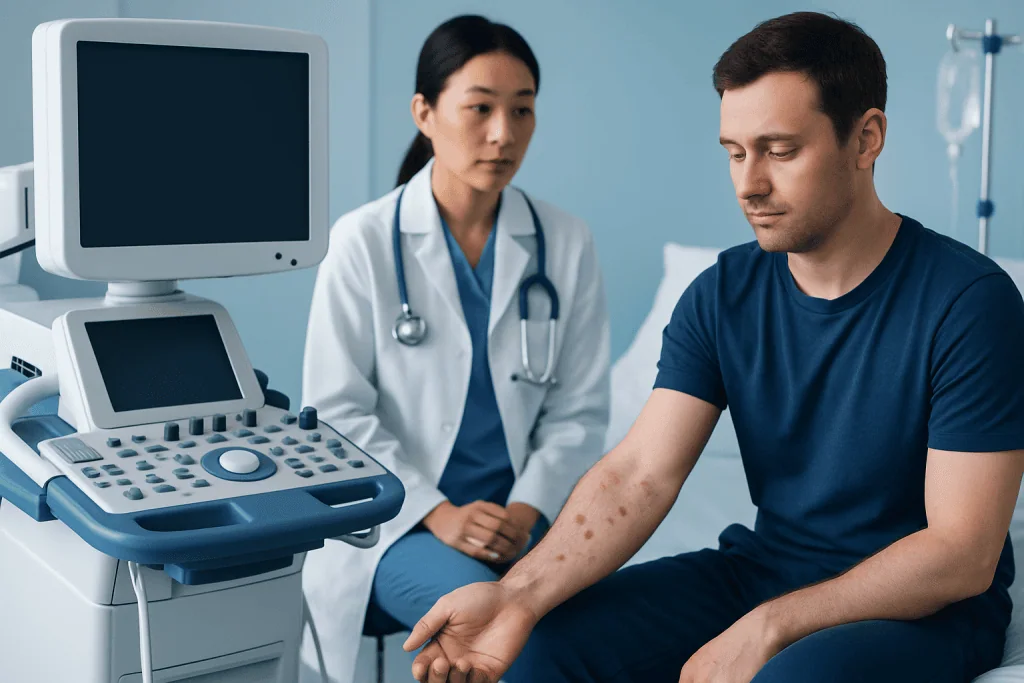
The most common early sign of scabies is itching that tends to become worse at night. Many people also develop a rash made up of small red bumps, tiny blisters, or scratch marks. Thin, wavy, thread-like lines on the skin, called burrows, may sometimes be seen. These often appear in the finger webs, wrists, elbows, armpits, waistline, buttocks, genitals, or around the breasts.
In infants, young children, older adults, and people with weakened immune systems, the pattern can be different. The scalp, face, neck, palms, and soles may be affected more often in babies and small children. In some people, scratching breaks the skin and leads to secondary bacterial infection, which can cause pain, crusting, or oozing.
Scabies can look similar to eczema, allergic rashes, insect bites, or other causes of itchy skin. That is why a rash alone cannot reliably confirm the diagnosis. A person with an unexplained itchy rash may also need evaluation for other skin conditions, including eczema, especially if the pattern is not typical.
- Intense itching, often worse at night
- Small bumps, blisters, or scaly irritated patches
- Burrows in skin folds
- Rash in finger webs, wrists, waistline, or genital area
- Similar itching in close contacts
Causes, spread, and risk factors

Scabies is caused by Sarcoptes scabiei var. hominis, a mite that lives only in human skin. It usually spreads through prolonged skin-to-skin contact, which is why it can pass between household members, sexual partners, and people living in close quarters. Brief casual contact is less likely to spread ordinary scabies, although the risk is higher with crusted scabies, a more severe and highly contagious form.
Risk increases in settings where people have close physical contact or share living space, such as households, dormitories, nursing homes, long-term care facilities, and childcare environments. Crowding can make spread easier. A person can have scabies even if they are otherwise healthy and clean, so it should not be seen as a sign of poor personal care.
Some groups may have more severe disease or need careful management. These include infants, pregnant people, older adults, and people with immune suppression. Crusted scabies can involve thick crusts with very large numbers of mites and needs urgent medical care because it spreads easily and can lead to skin breakdown or infection.
How doctors diagnose scabies
Doctors often diagnose scabies by asking about symptoms, examining the skin, and considering whether other people in the home have itching or rash. The pattern of nighttime itching, burrows, and rash in typical body areas can strongly suggest the diagnosis. A history of close contact with someone who has scabies or unexplained itching is also important.
In some cases, a clinician may confirm the diagnosis by taking a skin scraping, examining skin under magnification, or using dermoscopy to look for signs of the mite or eggs. These tests can be especially helpful when the diagnosis is uncertain, when symptoms continue after treatment, or when crusted scabies is suspected.
Because many itchy skin problems can look alike, doctors may also assess for other conditions such as dermatitis, fungal infection, or allergic reactions. If a person has persistent inflammation after treatment, a dermatologist may help distinguish ongoing irritation from active infestation. In selected cases, specialist dermatology care can help guide diagnosis and follow-up.
Scabies treatment options
The standard approach to scabies treatment is a prescription scabicide, meaning a medicine that kills the mites. The exact treatment depends on age, pregnancy status, overall health, severity of disease, and whether crusted scabies is present. Commonly used options include medicated creams or lotions applied to the whole body from the neck down, and sometimes the scalp in young children or older adults, exactly as directed by a doctor.
In some situations, doctors may prescribe an oral antiparasitic medicine. This may be considered when topical treatment has failed, when applying cream correctly is difficult, or when crusted scabies is present. Crusted scabies often requires a more intensive treatment plan and close medical supervision, as well as infection-control measures for contacts and the environment.
Symptom relief is also part of care. Anti-itch measures may include soothing moisturizers, gentle skin care, or medications recommended by a clinician to reduce itching and inflammation. If scratching has caused a bacterial skin infection, antibiotics may be needed. Patients who have extensive irritation or uncertain skin findings may also benefit from evaluation in dermatology and venereal diseases services.
One of the most important parts of successful treatment is timing. Everyone in the household and close physical or sexual contacts during the relevant exposure period may need treatment at the same time, even if they feel well. If only one person is treated, mites can continue circulating among contacts and lead to reinfestation.
Home cleaning and self-care after treatment
Cleaning measures help reduce the risk of reinfestation, but they support medical treatment rather than replace it. Clothing, bedding, and towels used during the few days before treatment are usually washed in hot water and dried on a hot cycle if the fabric allows. Items that cannot be washed can often be sealed in a plastic bag for several days, based on medical advice.
Vacuuming upholstered furniture, mattresses, rugs, and car seats may also be recommended, especially if crusted scabies is present. Ordinary scabies mites do not survive very long away from human skin, so extreme cleaning is usually unnecessary. Patients do not need to throw away mattresses, clothing, or furniture.
For comfort, people should avoid harsh soaps, heavy scrubbing, and fragranced products that may further irritate the skin. Gentle cleansers, bland moisturizers, and trimmed fingernails can help reduce damage from scratching. If itching is severe or sleep is affected, a doctor can suggest safe ways to manage symptoms while the skin heals.
When to seek medical care
Medical care should be sought if a person has an intensely itchy rash that is spreading, especially when itching is worse at night or several close contacts have similar symptoms. A prompt diagnosis can reduce discomfort and help prevent transmission to others. Medical review is also important for infants, pregnant people, older adults, and anyone with a weakened immune system.
A doctor should be contacted urgently if the skin becomes painful, warm, swollen, or starts to ooze, as these may be signs of bacterial infection. Thick crusts on the skin, widespread scaling, or symptoms in a person who is immunocompromised may suggest crusted scabies and need early specialist care. Persistent symptoms after treatment also deserve reassessment, since the cause may be incorrect application, reinfestation, resistance, or another skin condition.
Near the end of the care pathway, some patients may need broader support if complications or overlapping conditions are suspected. Multidisciplinary specialists at Acibadem International and its JCI-accredited hospitals diagnose and treat skin conditions for international patients, including assessment through check-up services when appropriate.
Frequently asked questions
How long does it take for scabies treatment to work?
The medicine starts killing mites soon after it is used correctly, but itching may continue for two to four weeks. This ongoing itch can happen because the skin is still reacting to the mites and their debris. If new burrows or new rash keep appearing, a doctor should review the treatment.
Can scabies go away on its own?
Scabies usually does not clear without proper treatment. The mites continue to live in the skin and can spread to others through close contact. Medical treatment is the safest way to remove the infestation.
Do all family members need scabies treatment?
Close household members and intimate contacts are often treated at the same time, even if they have no symptoms yet. This is because people may carry mites before itching begins. Treating everyone together lowers the chance of reinfestation.
Is scabies caused by poor hygiene?
No. Scabies is caused by a mite that spreads mainly through prolonged skin-to-skin contact. Anyone can get it, and having scabies does not mean a person is unclean.
What is the difference between ordinary scabies and crusted scabies?
Ordinary scabies usually causes itching and a limited rash with relatively few mites. Crusted scabies is a more severe form with thick crusts, many more mites, and a much higher risk of spreading to others. It needs prompt medical attention and often more intensive treatment.
Can a person still itch after successful scabies treatment?
Yes. Itching may continue for several weeks even after the mites are gone. This does not automatically mean treatment failed, but worsening symptoms or new skin lesions should be checked by a doctor.
References
- Centers for Disease Control and Prevention
- World Health Organization
- American Academy of Dermatology
- National Health Service
- BMJ Best Practice
This article is for general information only and is not a substitute for professional medical advice. Please consult a qualified doctor about your individual situation.
Explore treatments in Turkey — costs, top hospitals & a free quote
JCI-accredited · board-certified surgeons · reply within 24h
Add us as a Preferred Source to see more of our trusted health content across Google Search, AI Overviews and Discover.