Testicular Cancer Screening: How It Works, Results and What to Expect

Routine testicular cancer screening is not advised for people without symptoms or elevated risk because no screening method has been shown to improve outcomes in the general population. A painless lump, persistent swelling, heaviness or change in testicle size should be assessed promptly.
Key Takeaways
- Routine testicular cancer screening is not advised for people without symptoms or elevated risk because no screening method has been shown to improve outcomes in the general population.
- A painless lump, persistent swelling, heaviness or change in testicle size should be assessed promptly.
- Scrotal ultrasound is the main noninvasive test used to examine a suspected testicular lump.
- Blood tumor markers can support diagnosis and monitoring, but normal bloodwork does not rule out testicular cancer.
- Many testicular lumps are caused by noncancerous conditions, but only a medical assessment can determine the cause.
Testicular cancer screening usually means a targeted medical evaluation when a person notices a testicular change or has symptoms, rather than a routine screening test for everyone. A clinician may use an examination, scrotal ultrasound, blood tests and, when needed, further imaging to clarify the cause.
Testicular cancer screening: how it works
Testicular cancer screening is not a routine test recommended for all men without symptoms. Major health organizations do not advise population-wide screening with self-examination, clinician examination or ultrasound because testicular cancer is uncommon and is often highly treatable when found after symptoms begin. Instead, assessment is focused on people who notice a change or have a reason for closer clinical follow-up.
When a person has a lump, swelling, discomfort or another testicular change, the evaluation commonly begins with a medical history and physical examination. A clinician may then arrange a scrotal ultrasound, which uses sound waves to show whether a lump is inside the testicle or in surrounding tissues. This is the key first imaging test because it is quick, does not use radiation and can distinguish many different causes of scrotal symptoms.
Finding a change does not mean cancer is present. Cysts, fluid collections, enlarged veins, inflammation and benign growths can also cause lumps or swelling. However, it is important not to try to identify the cause by touch alone; prompt assessment helps ensure that appropriate care is not delayed.
Who may need assessment and what happens step by step
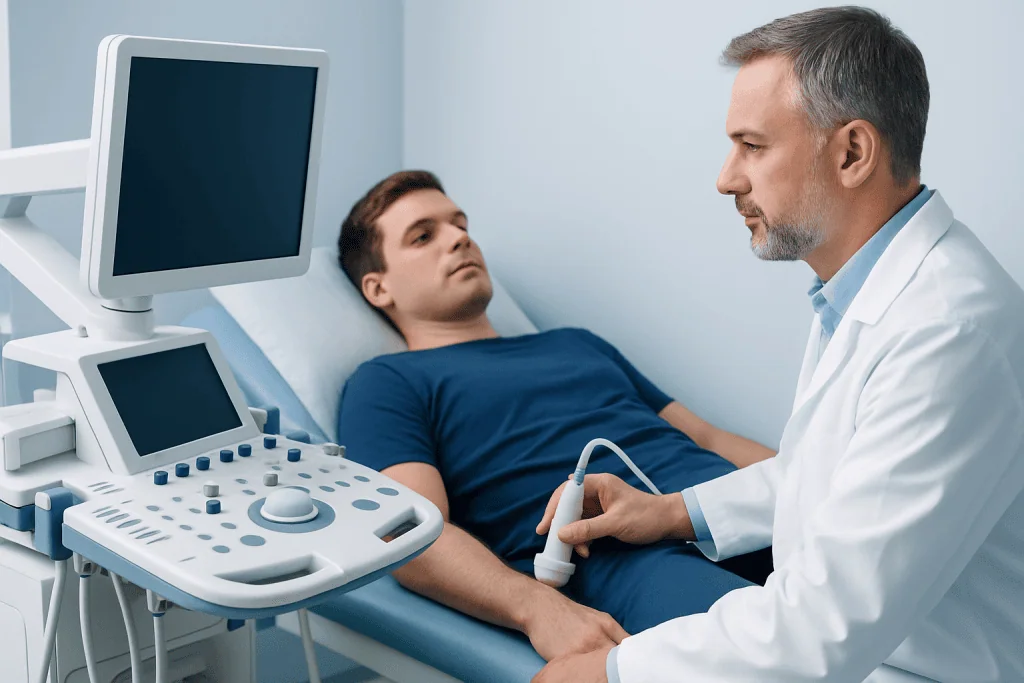
Anyone with a new or persistent testicular change should arrange a medical review. Assessment is especially important for people with a history of an undescended testicle, a previous testicular cancer, a close family history of the disease, infertility concerns or testicular atrophy. These factors raise risk, but most people diagnosed with testicular cancer do not have a known risk factor.
At the appointment, the clinician asks about when the change began, whether there is pain, infection symptoms, injury, fertility history and relevant family history. They examine the testicles, scrotum, groin and abdomen. This examination is brief and should be performed respectfully, with privacy and consent.
If ultrasound shows a suspicious mass within the testicle, blood tests for tumor markers may be ordered. These may include alpha-fetoprotein, beta-human chorionic gonadotropin and lactate dehydrogenase. If cancer is suspected, a urologist guides the next steps, which can include imaging to check whether disease has spread and surgery to remove the affected testicle for diagnosis and treatment. A needle biopsy through the scrotum is generally avoided when testicular cancer is suspected.
For people with confirmed disease, care may include testicular cancer care and discussions about fertility preservation before treatment where appropriate.
What are 5 warning signs of testicular cancer?

The most common warning sign is a new lump or firm area in one testicle, often without pain. A person may also notice a testicle becoming larger, harder or differently shaped. These changes should be checked even if they seem small or do not interfere with daily activities.
Five possible warning signs include:
- A painless lump, nodule or area of firmness in a testicle.
- Enlargement, shrinkage or a new difference in the size or shape of one testicle.
- A feeling of heaviness, fullness or dragging in the scrotum.
- A dull ache in the lower abdomen, groin or scrotum.
- Sudden fluid collection or swelling in the scrotum.
Less commonly, advanced disease can cause back pain, persistent cough, shortness of breath or breast tenderness. These symptoms have many possible causes and do not by themselves diagnose cancer. Still, they should be discussed with a clinician, particularly when they occur with a testicular lump or swelling.
Will testicular cancer show up in bloodwork?
Testicular cancer may cause raised levels of certain substances in the blood, known as tumor markers. The markers most often used are alpha-fetoprotein, beta-human chorionic gonadotropin and lactate dehydrogenase. They can help doctors support a diagnosis, plan treatment and monitor response after treatment.
However, bloodwork alone cannot screen reliably for or rule out testicular cancer. Some testicular cancers do not raise tumor marker levels, and these markers can also be altered by noncancerous conditions. A normal result should therefore not be used to dismiss a persistent lump or other concerning change.
Ultrasound and specialist assessment remain central when there is a suspected testicular mass. If treatment is needed, tumor markers are often measured before and after surgery and during follow-up, alongside examinations and imaging as clinically appropriate.
I've had a lump on my testicle for 20 years. What could it be?
A lump that has remained unchanged for many years may be due to a noncancerous condition, such as an epididymal cyst, spermatocele, varicocele, hydrocele, scar tissue or a benign lump in tissues beside the testicle. Some people also notice normal structures, including the epididymis, and mistake them for a new mass. It is not possible to tell the difference safely without an examination and often an ultrasound.
Long-term stability can be reassuring, but it does not replace medical assessment, particularly if the lump has never been evaluated. An appointment is worthwhile if there is any uncertainty, a change in size or firmness, pain, heaviness, swelling or a new difference between the testicles.
Ultrasound can usually clarify whether a lump is in the testicle itself or outside it. Lumps outside the testicle are more often benign, while a solid lump within the testicle requires urgent urological assessment. The goal is to establish the cause clearly and provide reassurance or treatment when needed.
How fast does testicular cancer spread?
How quickly testicular cancer grows or spreads varies by the type of tumor and the individual. Some tumors can spread beyond the testicle, often first to lymph nodes in the back of the abdomen, while others remain localized. It is not possible to predict the pace accurately from symptoms alone.
A new lump should therefore be assessed promptly, ideally within days rather than waiting weeks to see whether it disappears. Prompt evaluation does not mean assuming the lump is cancer; it means using ultrasound and specialist input to identify the cause and, if necessary, begin timely treatment.
Even when testicular cancer has spread, effective treatments are available for many people. The treatment plan depends on the tumor type, stage, tumor marker results, overall health and individual priorities, including fertility. Urology, oncology, radiology and fertility specialists may all contribute to care.
Benefits, risks and recovery after testing
The main benefit of evaluating a suspected testicular change is clarity. Ultrasound can identify many benign causes and can quickly detect findings that need specialist attention. It is painless for most people, requires no needles or radiation, and people can return to normal activities immediately afterward.
Blood tests involve a small needle prick and may cause brief discomfort, minor bruising or light-headedness. Imaging such as CT may be used after a cancer diagnosis to stage the condition; clinicians balance its benefit against radiation exposure and use it only when it is clinically appropriate.
There is no recovery period after an examination or ultrasound. If a suspicious mass leads to surgery, recovery and follow-up are individualized. A urologist discusses the procedure, possible effects on hormone production and fertility, options for sperm banking, and whether a testicular prosthesis is desired. Treatment may involve testicular cancer treatment tailored to the diagnosis and stage.
When to seek medical care
Medical care should be sought promptly for a new lump, persistent swelling, a change in size or firmness of a testicle, unexplained heaviness or ongoing discomfort in the scrotum or groin. A clinician should also assess a lump that has been present for a long time if it has never been checked, even when it is painless.
Sudden severe testicular pain, particularly with nausea, vomiting or a high-riding testicle, requires emergency care. This can be a sign of testicular torsion, in which blood supply to the testicle may be affected. Infection symptoms such as fever, redness, painful urination or rapidly increasing swelling also need urgent evaluation.
People can become familiar with their usual testicular appearance and feel after a warm shower, but scheduled self-exams are not a substitute for clinical care and are not formally recommended as a population screening method. Any new or uncertain finding should be discussed with a qualified doctor. Acibadem International’s multidisciplinary specialists and JCI-accredited hospitals can assess and treat testicular conditions for international patients.
Frequently asked questions
Is routine testicular cancer screening recommended?
Routine screening is not recommended for people without symptoms or known high-risk concerns. There is no evidence that regular ultrasound, clinician examination or self-examination screening improves outcomes in the general population. A new or persistent change should still be assessed promptly.
Can testicular cancer be painless?
Yes. A painless lump or hard area in a testicle is a common presentation. Pain can occur, but its absence does not make a lump harmless, so medical assessment is important.
What test is best for a testicular lump?
Scrotal ultrasound is usually the first and most useful test for a suspected testicular lump. It can show whether the finding is within the testicle or in nearby structures and helps guide the need for urology referral.
Can an infection cause a testicular lump or swelling?
Yes. Inflammation or infection of the epididymis or testicle can cause pain, swelling, warmth and sometimes a lump-like sensation. Because these symptoms can overlap with other conditions, a clinician should evaluate them rather than relying on symptoms alone.
Does a normal tumor marker blood test rule out testicular cancer?
No. Some testicular cancers do not produce raised tumor markers, especially at an early stage. Normal bloodwork does not replace ultrasound and specialist assessment when a lump is present.
Should someone wait to see if a testicular lump goes away?
It is safer to arrange a prompt medical assessment rather than wait. Many causes are benign, but an ultrasound can usually clarify the situation quickly. Sudden severe pain or swelling requires urgent emergency assessment.
References
- American Cancer Society
- U.S. Preventive Services Task Force
- National Cancer Institute
- European Association of Urology
- Mayo Clinic
This article is for general information only and is not a substitute for professional medical advice. Please consult a qualified doctor about your individual situation.
Testicular Cancer in Turkey — costs, top hospitals & a free quote
JCI-accredited · board-certified surgeons · reply within 24h
Add us as a Preferred Source to see more of our trusted health content across Google Search, AI Overviews and Discover.