Thompson Test: A Complete Medical Overview

The Thompson test helps assess whether the Achilles tendon may be torn. It is a physical examination test, not a treatment or a standalone diagnosis.
Key Takeaways
- The Thompson test helps assess whether the Achilles tendon may be torn.
- It is a physical examination test, not a treatment or a standalone diagnosis.
- A normal response is downward movement of the foot when the calf is squeezed.
- An abnormal result may point to a partial or complete Achilles tendon rupture.
- Imaging such as ultrasound or MRI may be used to confirm the diagnosis.
- Prompt medical assessment is important after a sudden calf or heel injury.
The Thompson test is a simple bedside exam doctors use to help identify an Achilles tendon rupture. During the test, the calf is gently squeezed while the patient lies face down; if the foot does not point downward as expected, this can suggest a tear in the Achilles tendon.
Overview: what the Thompson test shows
The Thompson test is a quick physical examination used to check whether the Achilles tendon is intact. The Achilles tendon connects the calf muscles to the heel bone and helps a person walk, run, jump, and rise onto the toes. If this tendon tears, the foot may not move normally when the calf muscle is squeezed.
In the test, the patient usually lies on the stomach with the feet hanging slightly off the edge of the examination table, or kneels on a chair. The clinician gently squeezes the calf. In a healthy tendon, this squeeze usually makes the foot point downward, a motion called plantar flexion. If that movement is absent or clearly reduced, the test may suggest an Achilles tendon rupture.
The Thompson test is helpful because it is simple, fast, and can be done at the bedside, in a clinic, or in an emergency setting. Even so, it is only one part of the overall assessment. Doctors also consider the patient’s symptoms, the physical examination, and sometimes imaging to confirm the diagnosis and guide treatment.
How the test is performed and how results are interpreted
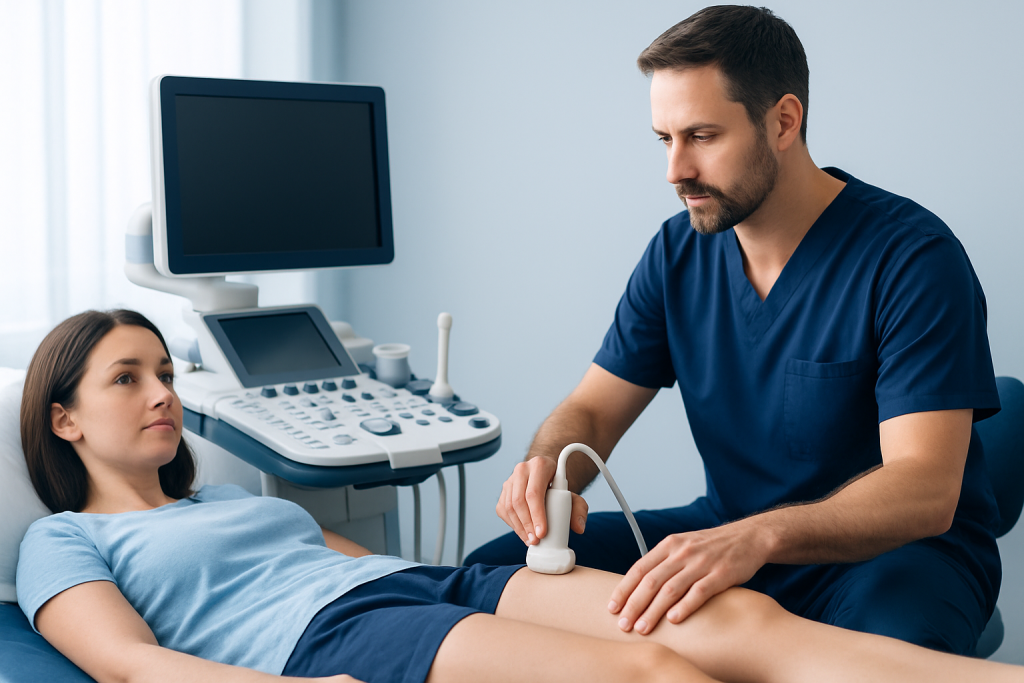
To perform the Thompson test, the clinician compares both sides whenever possible. The calf on the injured side is squeezed and the examiner watches for ankle and foot movement. Comparison with the uninjured leg can make subtle differences easier to recognize.
A normal result means the foot moves downward when the calf is squeezed, suggesting that the Achilles tendon is still transmitting force from the calf muscles to the heel. An abnormal result means there is little or no downward movement. This raises concern for a complete rupture, although the findings must still be interpreted in context.
Partial tears can be more difficult to assess. Some foot movement may still be present because nearby muscles can produce limited plantar flexion even if the Achilles tendon is injured. For that reason, a person should not rely on the test alone at home. A trained clinician is best placed to interpret the result safely and accurately.
The Thompson test may also be called the calf squeeze test. It is widely used because Achilles tendon rupture can sometimes be missed, especially if a person can still walk or move the ankle a little after injury.
Symptoms and signs that may lead to a Thompson test

Doctors often use the Thompson test when a person reports a sudden injury in the back of the ankle or lower calf. Many people describe a snapping, popping, or kicking sensation, as though someone hit the back of the leg. Pain, swelling, and difficulty pushing off the foot are also common.
Not everyone has severe pain. In some cases, the main clue is weakness rather than intense discomfort. A person may notice trouble climbing stairs, standing on tiptoe, or walking normally. Bruising can appear over time, and a gap in the tendon may sometimes be felt during an examination.
Symptoms that can prompt evaluation include:
- Sudden pain in the back of the ankle or calf
- A popping sensation during sports or a quick movement
- Swelling or bruising near the heel
- Difficulty pushing off when walking
- Weakness when trying to stand on the toes
- Reduced range of motion at the ankle
These symptoms do not always mean the tendon is ruptured. Strains, tendinitis, and other ankle injuries can cause similar complaints. The Thompson test helps narrow the possibilities, but diagnosis usually depends on the full clinical picture.
Causes, risk factors, and related conditions
The Thompson test is most commonly used when an Achilles tendon rupture is suspected. This injury often happens during sudden acceleration, jumping, pivoting, or an abrupt change in direction. Recreational sports are a frequent setting, especially after periods of deconditioning or inconsistent training.
Risk can increase with age-related tendon changes, tight calf muscles, poor flexibility, previous tendon problems, and returning too quickly to high-impact activity. Certain medications, including some corticosteroid exposures and some antibiotics in the fluoroquinolone class, have also been associated with tendon injury in some patients. A clinician can help review individual risk factors.
Not every painful Achilles problem is a rupture. Ongoing overuse may lead to Achilles tendinitis, which typically causes pain and stiffness rather than a sudden loss of strength. Calf muscle strain, ankle sprain, and other tendon or nerve problems can also mimic an Achilles injury.
Because treatment differs depending on the cause, a careful examination is important. A tendon that is inflamed but intact is managed differently from a partially torn or fully ruptured tendon. The Thompson test helps clinicians identify when a rupture should be strongly considered.
How doctors confirm the diagnosis
Diagnosis starts with the history and physical examination. The doctor asks how the injury happened, whether there was a pop, and how walking or standing has changed since then. The examination may include palpating the tendon, checking ankle motion, and assessing strength and ability to stand on tiptoe.
If the findings are clear, imaging may not always be necessary before initial treatment planning. However, imaging can be very useful when the diagnosis is uncertain, when a partial tear is suspected, or when treatment decisions need more detail. MRI can show the location and extent of tendon injury, while ultrasound may provide a quick, dynamic look at the tendon.
Doctors also consider other causes of pain or weakness in the lower leg. In some cases, additional evaluation is needed to rule out another tendon injury, severe muscle strain, or less commonly a nerve-related problem. The goal is not only to confirm whether the Thompson test is abnormal, but to understand the full nature of the injury.
Once the diagnosis is established, the care team discusses factors such as age, activity level, medical history, timing of injury, and treatment goals. These details help shape the best management plan for the individual patient.
Treatment options after an abnormal Thompson test
An abnormal Thompson test does not itself require treatment; rather, it signals the need to treat the underlying injury. If an Achilles rupture is suspected, early care usually includes resting the leg, avoiding strenuous weight-bearing, and protecting the ankle until a clinician gives further guidance. Prompt evaluation helps reduce the chance of delayed diagnosis.
Treatment may be non-surgical or surgical depending on the type of tear, the patient’s activity needs, overall health, and the specialist’s assessment. Non-surgical management often involves immobilization followed by a structured rehabilitation program. Surgical repair may be recommended for some complete ruptures or for patients with specific functional demands. In selected cases, orthopedic surgery may be part of care.
Rehabilitation is central to recovery in either approach. Guided stretching, strengthening, balance work, and gradual return to activity help the tendon heal while restoring mobility and function. A person should follow a clinician’s timeline rather than returning to sport too quickly.
For international patients seeking coordinated care, Acibadem International’s multidisciplinary specialists and JCI-accredited hospitals diagnose and treat Achilles tendon injuries, including evaluation with imaging and follow-up rehabilitation planning.
Self-care, prevention, and when to seek medical care
After a sudden suspected Achilles injury, self-care should focus on protection rather than testing the tendon repeatedly at home. Rest, limit activities that load the calf, and seek medical advice for safe next steps. Until a clinician has assessed the injury, it is wise to avoid forceful stretching, running, or jumping.
To help reduce the risk of Achilles injuries over time, people can build activity gradually, warm up before sports, maintain calf flexibility and lower-leg strength, and wear footwear suited to their activity. Training errors such as sudden spikes in intensity or volume are common contributors to tendon overload.
When to seek medical care: a person should be evaluated promptly if there is a sudden pop in the back of the ankle, marked weakness when pushing off, difficulty walking, rapid swelling, or an inability to stand on the toes. Medical review is also important if symptoms are getting worse, if the diagnosis is unclear, or if pain and stiffness persist despite rest.
Urgent assessment is especially important after a sports injury or fall when function changes suddenly. Early diagnosis supports appropriate treatment and may improve recovery planning.
Frequently asked questions
Is the Thompson test accurate for an Achilles tendon rupture?
The Thompson test is widely used and can be very helpful when performed by a trained clinician. However, it is not perfect on its own, especially in partial tears or complex injuries. Doctors usually interpret it together with symptoms, examination findings, and sometimes imaging.
Can a person walk if the Thompson test is abnormal?
Yes, some people can still walk after an Achilles tendon rupture, especially for short distances. Walking ability does not rule out a significant injury. That is one reason Achilles ruptures can sometimes be missed without a careful examination.
Does a positive Thompson test always mean a complete tear?
Not always. A clearly abnormal test strongly raises concern for a rupture, but other findings are needed to confirm the extent of injury. Partial tears and surrounding muscle activity can sometimes make interpretation less straightforward.
Can the Thompson test be done at home?
A home check is not a substitute for medical assessment. It can be difficult to position the body correctly and interpret subtle foot movement. Repeated self-testing may also delay proper care if a rupture is present.
What happens after a suspected Achilles tendon rupture?
A doctor will usually examine the ankle and calf, review how the injury happened, and decide whether imaging is needed. Early management may include protecting the tendon, limiting weight-bearing, and arranging orthopedic follow-up. Treatment may be non-surgical or surgical depending on the individual case.
Is the Thompson test painful?
The test is usually brief and involves squeezing the calf rather than directly pressing on the injured tendon. It may cause some discomfort if the area is already painful, but it is generally well tolerated. If pain is severe, the clinician can modify the examination.
References
- American Academy of Orthopaedic Surgeons
- American Orthopaedic Foot & Ankle Society
- National Institute for Health and Care Excellence
- MedlinePlus
- Mayo Clinic
This article is for general information only and is not a substitute for professional medical advice. Please consult a qualified doctor about your individual situation.
Joint and spine care in Turkey — expert assessment & treatment
JCI-accredited · board-certified surgeons · reply within 24h
Add us as a Preferred Source to see more of our trusted health content across Google Search, AI Overviews and Discover.