Tilt Table Test — Explained by Medical Evidence, Not Myths

A tilt table test helps doctors assess fainting, dizziness, and abnormal responses to standing. The test monitors heart rate, blood pressure, and symptoms while the table is tilted upright.
Key Takeaways
- A tilt table test helps doctors assess fainting, dizziness, and abnormal responses to standing.
- The test monitors heart rate, blood pressure, and symptoms while the table is tilted upright.
- It does not diagnose every cause of fainting on its own, but it can provide important clues.
- Preparation may include changing medicines, avoiding food for a period, and arranging a ride home if advised.
- Results are interpreted together with symptoms, medical history, and other heart or nervous system tests.
A tilt table test is a monitored test that shows how the body’s blood pressure and heart rate respond to being moved from lying flat to an upright position. It is mainly used to help evaluate unexplained fainting, near-fainting, dizziness, or suspected problems with autonomic nervous system regulation.
Overview: what a tilt table test actually shows
A tilt table test is a diagnostic procedure used to observe how the body reacts to a change in position, especially from lying down to standing-like upright posture. During the test, a person is secured on a special table while healthcare professionals continuously monitor blood pressure, heart rate, and symptoms. The goal is to see whether standing triggers an abnormal drop in blood pressure, an unusual heart rate response, or symptoms such as lightheadedness or fainting.
This test is most often used when someone has unexplained fainting episodes, near-fainting, or recurrent dizziness and routine evaluation has not fully explained the cause. It can help identify patterns linked to reflex syncope, orthostatic hypotension, or disorders of autonomic control. In some cases, it also helps assess suspected postural orthostatic tachycardia syndrome (POTS).
A common myth is that the tilt table test gives a simple yes-or-no answer for every fainting problem. In practice, it is one piece of a broader medical assessment. A normal test does not always rule out disease, and an abnormal test is interpreted in the context of the person’s symptoms, examination, heart tests, and medical history.
Why doctors recommend a tilt table test
Doctors usually recommend a tilt table test when symptoms suggest that standing or posture changes may be affecting circulation or nervous system regulation. Typical reasons include unexplained fainting, repeated near-fainting, dizziness when standing, palpitations with upright posture, or episodes of weakness, nausea, blurred vision, or sweating that appear before passing out.
The test is especially helpful when the cause is not obvious after an initial evaluation. That early evaluation often includes a review of symptoms, medication use, hydration habits, blood pressure measurements, and basic heart testing. If there is concern about a heart rhythm problem, other tests such as an electrocardiogram, ambulatory monitoring, or an electrophysiology study may be more appropriate or may be used alongside the tilt table test.
In some people, the test helps evaluate autonomic dysfunction, a group of conditions in which the nervous system does not regulate blood pressure, heart rate, digestion, sweating, or temperature normally. It may also support the assessment of dysautonomia when symptoms are triggered or worsened by standing.
- Recurrent fainting without a clear cause
- Near-fainting or prolonged lightheadedness after standing
- Suspected vasovagal syncope or orthostatic hypotension
- Possible POTS or other autonomic nervous system disorders
- Unexplained symptoms after basic heart tests are unrevealing
How the test is done and what to expect
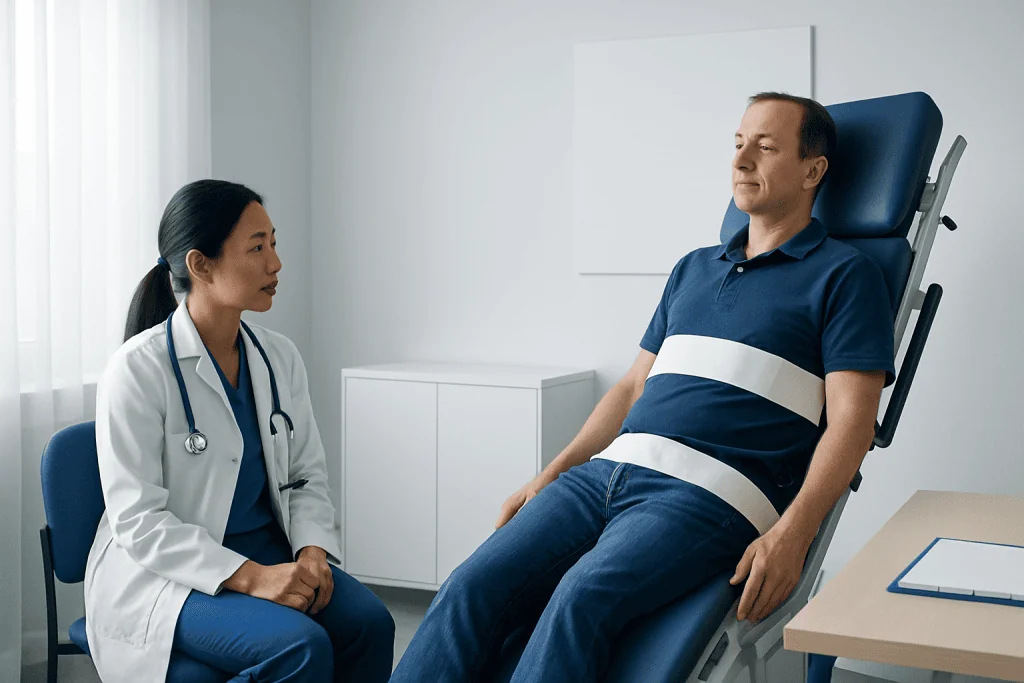
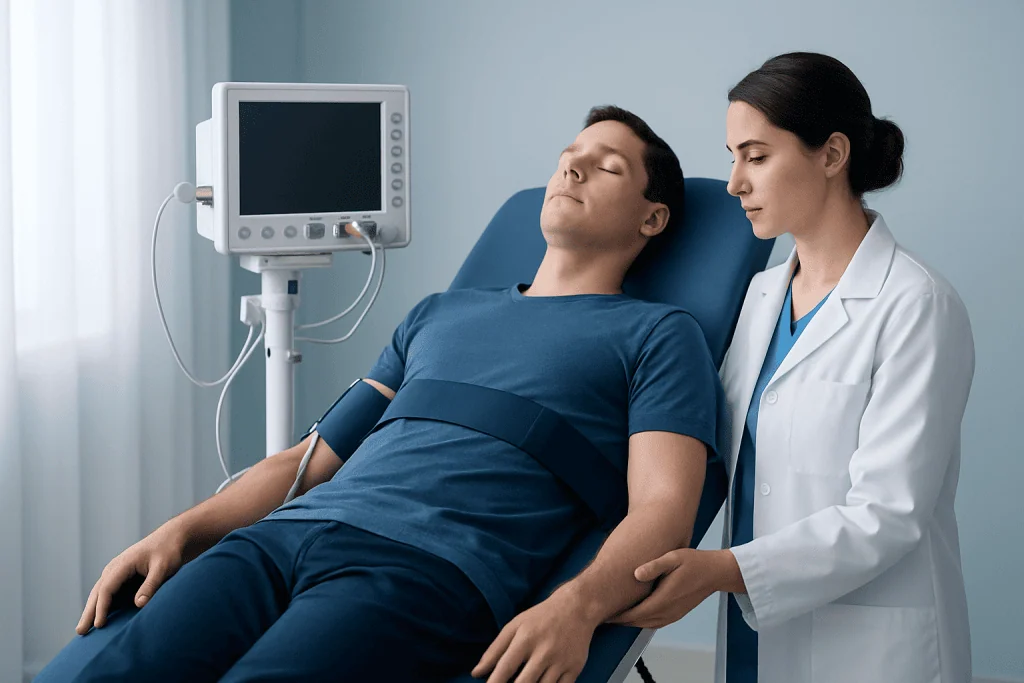
Before the test begins, the person lies flat on a narrow motorized table. Safety straps are placed around the body to prevent falling if fainting occurs. Monitoring equipment is attached, usually including blood pressure measurement and continuous heart rhythm recording. A healthcare professional stays present throughout the procedure.
The table is then tilted upward to a set angle, often close to the position of standing, while the person remains supported. This upright phase may last for a period of time while the team watches for changes in blood pressure, pulse, and symptoms. The person may be asked to describe any warning signs such as nausea, warmth, weakness, tunnel vision, or pounding heartbeat.
In some protocols, if the first stage does not reproduce symptoms, the team may use an additional trigger such as medication to make the test more sensitive. Not everyone needs this step. If symptoms become strong or blood pressure drops significantly, the table is returned to a flat position and supportive care is given. Most symptoms settle quickly once the body is horizontal again.
The test may feel uncomfortable if it reproduces the person’s usual symptoms, but it is performed in a controlled setting with close supervision. Patients often find it reassuring to know that the aim is not to make them feel unwell, but to safely capture the body’s response and clarify the cause of recurring episodes.
How to prepare and what the test may feel like
Preparation instructions can vary by center, so it is important to follow the advice given by the testing team. Many people are asked not to eat or drink for several hours before the test. Some may also be advised to avoid caffeine, nicotine, alcohol, or vigorous exercise beforehand because these can affect heart rate or blood pressure.
Medication instructions are especially important. A doctor may recommend temporarily adjusting certain medicines, particularly those that influence blood pressure, heart rhythm, or autonomic function. However, patients should never stop a prescribed medicine on their own; changes should only happen if specifically directed by the medical team.
On the day of the test, comfortable clothing is usually best. Some people feel completely fine throughout the procedure, while others experience their usual symptoms, such as dizziness, nausea, sweating, blurred vision, or fainting. If a sedative is not used, most patients can resume usual activities afterward, but the team may still recommend having someone accompany them home depending on symptoms and local protocol.
After the test, the care team explains whether symptoms occurred, whether blood pressure or heart rate changed abnormally, and whether further evaluation is needed. If there is ongoing concern about structural heart disease, the next steps may include imaging such as echocardiography or other targeted tests.
Understanding the results: what positive, negative, and inconclusive mean
A tilt table test is interpreted by looking at the pattern of blood pressure, heart rate, and symptoms over time. A result may be considered positive if the test reproduces the person’s symptoms along with findings that suggest reflex syncope, orthostatic hypotension, or an abnormal heart rate response to upright posture. This can help explain why fainting or severe dizziness happens in daily life.
A negative result means the expected abnormal response was not seen during the test. This does not always mean symptoms are unrelated to posture or that nothing is wrong. Some conditions are intermittent, and symptoms may not appear during a single testing session. Doctors therefore combine the result with the broader clinical picture.
Sometimes the findings are inconclusive. For example, a person may feel dizzy without a clear blood pressure drop, or heart rate may rise without matching the full pattern expected for a specific diagnosis. In these situations, the next step may involve home blood pressure logs, longer rhythm monitoring, blood tests, neurologic review, or targeted evaluation for syncope and autonomic disorders.
Importantly, the test is designed to support diagnosis, not to replace clinical judgment. A careful history remains one of the most valuable tools in understanding fainting and orthostatic symptoms, including what happens before, during, and after an episode.
What conditions can be found and how they are treated
The tilt table test may help identify several different patterns. One common finding is vasovagal syncope, also called reflex syncope, in which a trigger leads to a sudden drop in blood pressure, heart rate, or both. Another is orthostatic hypotension, where blood pressure falls after standing. A third pattern may suggest POTS, in which heart rate increases excessively on standing without the same degree of blood pressure drop.
Treatment depends on the cause rather than the test itself. Many people improve with practical measures such as drinking enough fluids, using more salt if a doctor recommends it, standing up slowly, avoiding prolonged standing, managing heat exposure, and learning physical counter-pressure maneuvers. Compression garments and structured exercise plans may also be helpful for some patients.
When symptoms are frequent or severe, doctors may prescribe medication or investigate related conditions that contribute to low blood pressure or autonomic dysfunction. If evaluation suggests a rhythm problem or another heart disorder, management may involve specialist cardiac care, including tests or procedures such as pacemaker treatment in selected cases where bradycardia or conduction disease is a confirmed contributor.
For international patients who need coordinated evaluation, Acibadem International’s multidisciplinary specialists and JCI-accredited hospitals diagnose and treat fainting and autonomic-related conditions using individualized assessment. Because fainting can have causes beyond blood pressure regulation alone, treatment planning is usually personalized rather than based on one test result.
When to seek medical care
Medical care is recommended if fainting happens for the first time, becomes recurrent, or is accompanied by injury. A person should also seek prompt assessment if fainting occurs during exercise, while lying down, or together with chest pain, shortness of breath, marked palpitations, severe headache, weakness, or confusion. These features can suggest causes that need urgent evaluation.
Even when symptoms seem mild, repeated dizziness on standing, repeated near-fainting, or symptoms that interfere with school, work, driving, or daily life deserve medical attention. Early assessment can help distinguish a benign reflex faint from dehydration, medication effects, heart rhythm problems, or neurologic conditions.
Patients should tell their clinician what they were doing before the episode, how long symptoms lasted, whether there was complete loss of consciousness, and how recovery felt afterward. Details from witnesses can also be valuable. If emergency warning signs are present, urgent medical services should be contacted rather than waiting for a routine visit.
Frequently asked questions
Is a tilt table test painful?
The test is not usually painful, but it can be uncomfortable if it brings on a person’s usual symptoms such as dizziness, nausea, or fainting. Patients are monitored closely, and the table can be returned to a flat position quickly if needed.
How long does a tilt table test take?
The exact length varies by protocol and whether an additional medication step is used. In many centers, the full visit takes around 30 to 90 minutes, including preparation and recovery time.
Can a tilt table test diagnose POTS?
It can provide important evidence that supports a diagnosis of POTS by showing how heart rate changes with upright posture. However, the diagnosis is based on specific clinical criteria and the person’s overall history, not on the test alone.
What should someone avoid before a tilt table test?
Patients are often told to avoid eating or drinking for a period before the test and may be advised to avoid caffeine, nicotine, or alcohol. Because instructions vary, the safest approach is to follow the testing center’s guidance exactly.
Is a normal tilt table test reassuring?
A normal result can be reassuring, but it does not always rule out the cause of symptoms. Some fainting or dizziness episodes are intermittent, so doctors may still recommend additional evaluation if symptoms continue.
Can children or older adults have a tilt table test?
Yes, the test can be used in different age groups when clinically appropriate. The decision depends on the symptoms, medical history, and whether the expected information is likely to help guide diagnosis or treatment.
This article is for general information only and is not a substitute for professional medical advice. Please consult a qualified doctor about your individual situation.
Heart care in Turkey — expert evaluation and treatment
JCI-accredited · board-certified surgeons · reply within 24h
Add us as a Preferred Source to see more of our trusted health content across Google Search, AI Overviews and Discover.
Check your numbers in seconds
BMI, calories, due date, blood pressure and 30+ more clinical calculators — free, instant, doctor-reviewed ranges.

More from the Health Library

Green Tea Matcha: A Complete Medical Overview

Shoulder Muscles: An Evidence-Based Guide for Patients

Toradol — Explained by Medical Evidence, Not Myths

Insulin Pen Needles: A Complete Medical Overview

Zoom Teeth Whitening — Explained by Medical Evidence, Not Myths