Triceps: What Patients Need to Know

The triceps help extend the elbow and support everyday pushing and lifting tasks. Common triceps symptoms include pain, tenderness, weakness, swelling, and reduced range of motion.
Key Takeaways
- The triceps help extend the elbow and support everyday pushing and lifting tasks.
- Common triceps symptoms include pain, tenderness, weakness, swelling, and reduced range of motion.
- Mild triceps strain often improves with rest, activity changes, ice, and guided rehabilitation.
- Sudden severe pain, bruising, marked weakness, or a visible deformity may suggest a tendon tear and needs medical evaluation.
- Persistent symptoms can also come from the shoulder, neck, or nerves rather than the triceps muscle itself.
Triceps are the large muscles at the back of the upper arm that help straighten the elbow and support pushing movements. Most triceps problems are caused by overuse, strain, tendon irritation, or less commonly a tear, and they can usually be assessed with a physical exam and treated based on the cause.
Overview: what the triceps are and why they matter
The triceps are a group of three muscle heads located on the back of the upper arm. Together, they form the main muscle responsible for straightening the elbow, a movement called extension. The triceps also help stabilize the shoulder and assist with many daily actions, such as pushing up from a chair, reaching, lifting, and supporting body weight through the arms.
Although many people think of the triceps mainly in terms of exercise or appearance, they are important for normal function. Pain in this area can interfere with work, sports, sleep, and routine self-care. Symptoms may come from the muscle itself, the triceps tendon near the elbow or shoulder, or nearby structures such as the shoulder joint, neck, or nerves.
In patient care, the term “triceps problem” may refer to several different issues rather than one diagnosis. These include muscle strain, delayed soreness after exercise, tendon inflammation or degeneration, bruising after a direct blow, and partial or complete tendon tears. Less commonly, pain that feels like a triceps problem may actually be referred from another condition, including some forms of herniated disc.
How the triceps work
The triceps brachii has three parts: the long head, lateral head, and medial head. These parts begin in the upper arm and shoulder region and join into a common tendon that attaches near the tip of the elbow at the olecranon. This anatomy allows the muscle to generate force across the elbow and, in the case of the long head, also contribute to shoulder movement.
The triceps are active during pushing motions such as opening a heavy door, rising from bed using the arms, performing a push-up, or using walking aids. They also help control movement when the elbow bends under load, which means the triceps can be stressed not only when pushing but also when lowering the body or lowering an object.
Because the triceps cross one or more joints and are used repeatedly in daily life and sport, they may become irritated by sudden overload or repetitive strain. Activities such as racket sports, throwing, weight training, manual labor, and falls onto an outstretched hand can all place stress on the triceps muscle-tendon unit.
Symptoms of triceps problems

Symptoms depend on the cause and severity. A mild strain may cause localized soreness at the back of the upper arm, especially after exercise or unusual effort. Tendon-related pain is often felt near the back of the elbow and may worsen with pressing, pushing, or straightening the arm against resistance.
People may notice pain, tenderness, tightness, weakness, swelling, or reduced movement. In some cases, there is bruising after an injury. A more significant tendon injury can cause a sudden sharp pain, a popping sensation, rapid swelling, and difficulty straightening the elbow. Some patients also describe reduced endurance, meaning the arm tires quickly even if basic movement is still possible.
Symptoms that suggest the source may not be only the triceps include neck pain, tingling, numbness, pain radiating below the elbow, or weakness affecting several muscle groups. These features can point toward nerve irritation or another musculoskeletal problem. Evaluation may overlap with care used for shoulder pain or spine-related arm symptoms.
- Muscle soreness after activity
- Pain at the back of the upper arm or elbow
- Tenderness when pressing the area
- Weakness during pushing or lifting
- Swelling or bruising after trauma
- Reduced elbow range of motion
- A pop, deformity, or sudden loss of strength in more severe injuries
Causes and risk factors
The most common cause of triceps pain is overuse. This may happen after a sudden increase in exercise intensity, repetitive pushing work, return to sport after time away, or poor movement mechanics during strength training. Muscle fibers can become overstretched, leading to a strain. Tendons can also become irritated over time when load exceeds the tissue’s ability to recover.
Direct trauma is another cause. A fall, collision, or impact to the back of the arm can cause bruising or muscle injury. Heavier injuries are less common but can include partial or complete triceps tendon rupture, usually after a forceful contraction or a fall. These are more likely when the tendon has been weakened by chronic overuse, previous injury, or underlying tissue changes.
Several factors can increase risk, including inadequate warm-up, poor conditioning, muscle imbalance, repetitive overhead or throwing activity, and sudden changes in training. Age-related tendon changes may also play a role. Sometimes pain at the back of the arm is not a primary triceps problem at all but a referred symptom from the neck, shoulder, or elbow, which is why careful diagnosis is important.
How doctors diagnose triceps pain or injury
Diagnosis starts with a detailed history. A doctor will ask when the symptoms began, whether there was a specific injury, what movements trigger pain, and whether there is bruising, weakness, numbness, or neck and shoulder symptoms. Knowing if the pain started after exercise, a fall, or a gradual increase in activity often helps narrow the cause.
A physical examination usually includes checking the shape of the arm, areas of tenderness, swelling, bruising, elbow motion, and strength during resisted extension. The shoulder, neck, and nerves may also be assessed to make sure symptoms are not coming from another area. This is especially important when pain radiates or is accompanied by tingling or broader weakness.
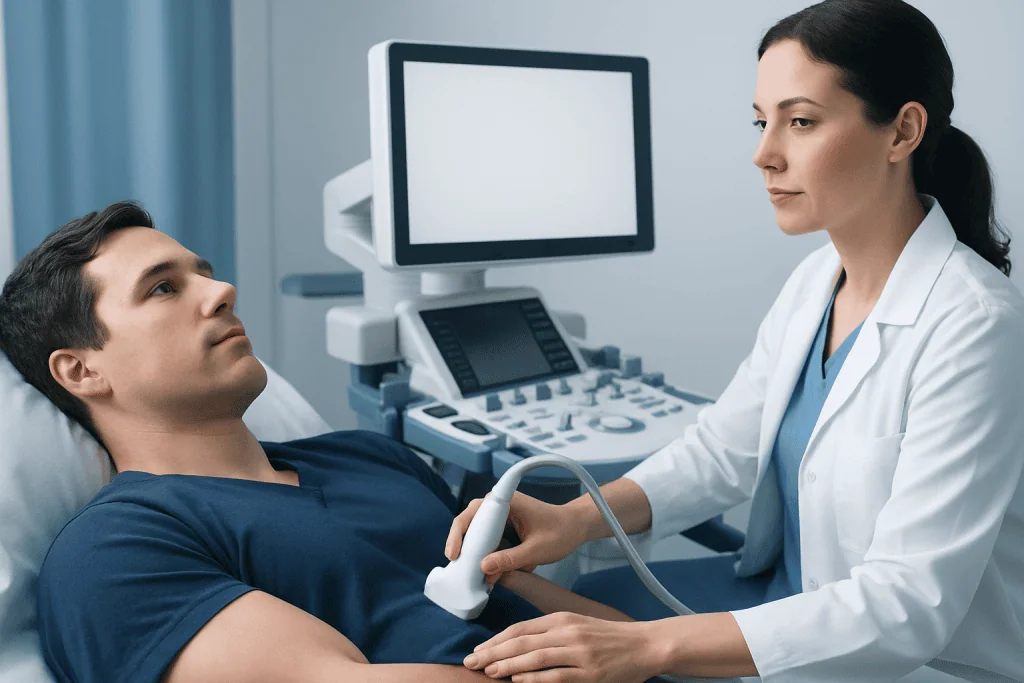
Imaging is not always needed for mild, improving symptoms, but it may be recommended if a tear is suspected or if symptoms persist. Ultrasound or MRI can help evaluate the triceps tendon and surrounding soft tissues. X-rays may be used if there has been trauma or if the doctor wants to rule out a fracture or other bone problem. In complex cases, diagnosis may be supported by orthopedic assessment and orthopedic evaluation and treatment.
Treatment options and recovery
Treatment depends on the diagnosis. Mild triceps strain or post-exercise soreness often improves with relative rest, temporary reduction of aggravating activity, ice, and a gradual return to movement. The goal is not complete inactivity for long periods, but a short phase of protection followed by safe loading as pain allows. Early gentle movement can help reduce stiffness.
When tendon irritation or weakness is present, rehabilitation becomes especially important. A tailored program may focus on flexibility, gradual strengthening, and correction of movement patterns involving the shoulder, elbow, and upper back. Guided physical therapy and rehabilitation can be helpful for persistent pain, recurring strain, or return to sport and work.
If pain is significant, a clinician may suggest short-term measures to control symptoms, but treatment should address the underlying cause rather than only reducing pain. More severe injuries, such as partial or complete tendon tears with major weakness, may require surgical evaluation. If there is concern for a rupture or a related elbow injury, assessment by teams experienced in upper limb and hand surgery or general orthopedic care may be appropriate.
Recovery time varies. Mild overuse soreness may settle within days, while muscle strains can take weeks depending on severity. Tendon injuries may take longer, particularly if symptoms have developed gradually over time. Returning too quickly to heavy exercise can delay healing, so progression is usually based on pain, strength, and function rather than the calendar alone.
Prevention and self-care
Most people can reduce the chance of triceps problems by progressing activity gradually. Sudden increases in weight, repetitions, throwing intensity, or training frequency are common triggers for strain. A sensible warm-up, attention to technique, and balanced strength across the shoulder, chest, back, and arms can help distribute load more evenly.
Self-care for mild symptoms includes resting from painful tasks, using ice for short periods after aggravating activity, and reintroducing movement gradually as comfort improves. Gentle range-of-motion exercises may help maintain flexibility, but stretching through sharp pain is not advised. If a home exercise plan causes worsening pain, it should be reviewed by a qualified professional.
General health habits also support tissue recovery. Adequate sleep, regular conditioning, and allowing time between heavy sessions are all useful. For athletes or people with physically demanding jobs, technique coaching and ergonomic adjustments can lower repeated stress on the arm. If symptoms keep returning, a fuller assessment is often more helpful than simply resting again.
When to seek medical care
Medical review is recommended if triceps pain is severe, lasts more than a short period, keeps returning, or interferes with normal activities. Prompt assessment is especially important after an injury that causes immediate weakness, marked swelling, extensive bruising, or a popping sensation. These features can suggest a more significant muscle or tendon injury.
Patients should also seek care if there is numbness, tingling, neck pain, fever, unexplained swelling, or inability to straighten the elbow properly. These symptoms may indicate a problem beyond a simple strain. Any pain after a fall or direct trauma should be evaluated if movement is limited or if a fracture is possible.
For international patients needing further assessment, Acibadem International’s multidisciplinary specialists in JCI-accredited hospitals evaluate arm, elbow, shoulder, and sports-related conditions and plan treatment according to the cause. Early evaluation can help clarify whether symptoms are coming from the triceps itself or from nearby joints, tendons, or nerves.
Frequently asked questions
What do the triceps do?
The triceps are the muscles on the back of the upper arm. Their main job is to straighten the elbow, and they also help with pushing movements and support shoulder stability.
Why does my triceps hurt after exercise?
Pain after exercise is often due to normal muscle soreness or a mild strain, especially after new or intense activity. If the pain is severe, one-sided, associated with bruising, or causes weakness, it should be checked by a doctor.
How can someone tell if a triceps injury is serious?
Warning signs include a sudden sharp pain, a popping feeling, visible swelling or bruising, and difficulty straightening the elbow. A visible deformity or major loss of strength can suggest a tendon tear and needs prompt medical assessment.
Can triceps pain come from the neck or shoulder?
Yes. Pain felt in the triceps area can sometimes be referred from the neck, shoulder, or nearby nerves rather than the muscle itself. Tingling, numbness, or pain traveling below the elbow makes this possibility more likely.
Do all triceps injuries need imaging?
No. Many mild strains can be diagnosed from the history and physical examination alone. Imaging such as ultrasound, MRI, or X-ray is usually reserved for suspected tears, trauma, or symptoms that do not improve as expected.
What helps a triceps strain recover?
Recovery usually includes short-term rest from painful activity, gradual return to movement, and progressive strengthening. Physical therapy may be useful if symptoms persist, recur, or affect sport, work, or daily activities.
References
- American Academy of Orthopaedic Surgeons
- National Institute of Arthritis and Musculoskeletal and Skin Diseases
- MedlinePlus
- Mayo Clinic
- American Society for Surgery of the Hand
This article is for general information only and is not a substitute for professional medical advice. Please consult a qualified doctor about your individual situation.
Joint and spine care in Turkey — expert assessment & treatment
JCI-accredited · board-certified surgeons · reply within 24h
Add us as a Preferred Source to see more of our trusted health content across Google Search, AI Overviews and Discover.