Vbt Surgery: Procedure, Recovery and Results

VBT surgery is intended mainly for selected patients who are still growing and have flexible scoliosis curves. A surgeon places anchors and a flexible tether along the outer side of the spinal curve to slow growth on that side.
Key Takeaways
- VBT surgery is intended mainly for selected patients who are still growing and have flexible scoliosis curves.
- A surgeon places anchors and a flexible tether along the outer side of the spinal curve to slow growth on that side.
- Recovery usually includes a short hospital stay, gradual return to daily activities, and regular imaging during growth.
- The procedure can preserve motion, but correction is less predictable than spinal fusion and revision surgery may be needed.
- A pediatric spine team evaluates curve pattern, growth remaining, lung health, imaging findings, and family goals before recommending treatment.
VBT surgery, or vertebral body tethering, is a minimally invasive scoliosis procedure designed for carefully selected growing children and adolescents. It uses a flexible cord to guide uneven spinal growth and may reduce curvature while maintaining more spinal movement than fusion surgery.
Overview: What Is VBT Surgery?
VBT surgery stands for vertebral body tethering surgery. It is a surgical option for some children and adolescents with idiopathic scoliosis, a sideways curve of the spine that develops without a known underlying cause. Rather than permanently joining spinal bones together, VBT uses a strong flexible cord, called a tether, to influence how the spine grows over time.
During growth, the tether is placed on the outer, or convex, side of the curve. By gently slowing growth on that side while the inner side continues to grow, the procedure aims to improve spinal alignment gradually. The goal is not only to reduce the curve but also to retain more natural movement than can be expected after spinal fusion.
VBT treatment is relatively newer than spinal fusion, and it is not suitable for every person with scoliosis. The available evidence supports careful patient selection and long-term follow-up, because results can change as a child grows. For an overview of the condition and its wider care options, see scoliosis.
How Vertebral Body Tethering Works
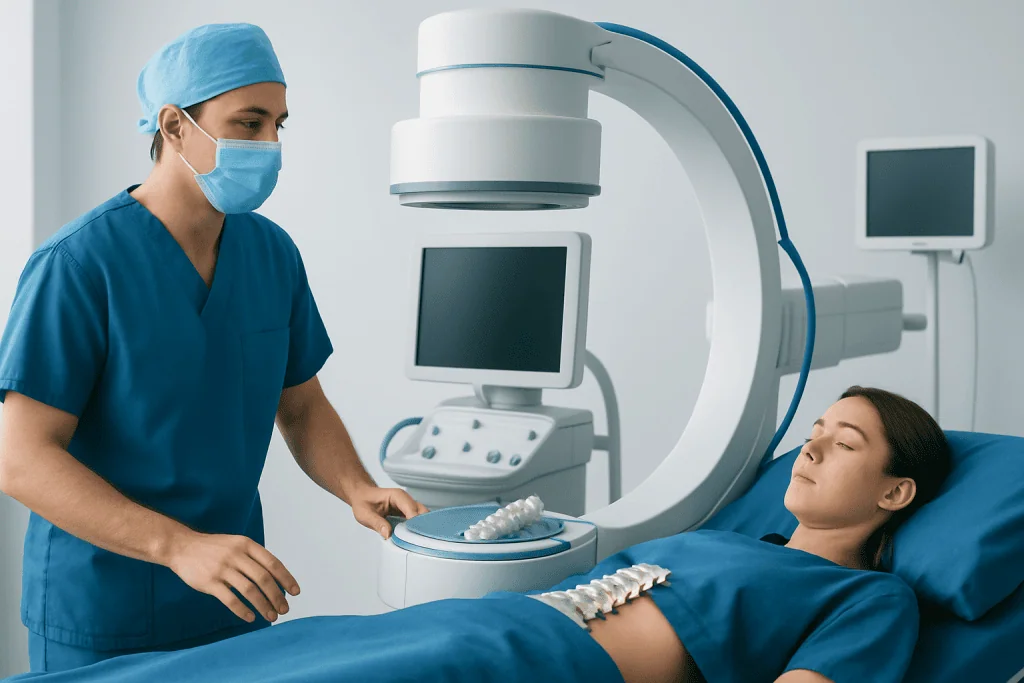
The spine grows from areas near the ends of each vertebra. In a growing child with scoliosis, one side of the curved section may grow more than the other, contributing to progression of the curve. VBT applies controlled tension across several vertebrae on the outer side of the curve to modify this uneven growth pattern.
The tether is attached to metal anchors placed in the vertebral bodies. It is tightened during surgery to provide an immediate partial correction, then continues to guide growth afterward. Because the cord is flexible rather than rigid, the treated part of the spine can continue to move. However, motion preservation does not mean the spine is unaffected; the procedure still changes spinal mechanics and requires ongoing monitoring.
VBT should be distinguished from traditional spinal fusion. Fusion uses screws, rods, and bone graft to permanently stabilize a section of the spine. It has a long record of predictable curve correction for many patients. VBT may be considered when preserving motion is an important goal and the child’s remaining growth offers a reasonable opportunity for guided correction.
Who May Be a Candidate for VBT Surgery?

Candidacy for VBT surgery is individualized. It is generally considered for children or adolescents who are still growing, have a scoliosis curve that is flexible on imaging, and have a curve size that may otherwise need surgery. The exact curve range, maturity assessment, and surgical approach vary according to the person’s anatomy and the treating team’s experience.
A pediatric orthopedic spine surgeon commonly reviews standing spine X-rays, bending X-rays, growth markers, medical history, and physical examination findings. MRI may be recommended in certain situations, such as unusual curve patterns, neurologic symptoms, or early-onset scoliosis. Lung function and the safety of accessing the chest may also be evaluated when a thoracic curve is being treated.
VBT is usually not the first choice for someone who has completed growth, has a very stiff or very large curve, has certain spinal conditions, or has medical factors that increase surgical risk. Bracing may still be appropriate for some growing children, while fusion can remain the more reliable surgical option for others. A complete scoliosis treatment assessment helps families compare these approaches in context.
- Remaining growth and skeletal maturity
- Curve location, size, rotation, and flexibility
- Whether the curve has progressed despite observation or bracing
- Overall health, lung anatomy, and previous chest or spine surgery
- The family’s understanding of expected benefits, uncertainties, and follow-up needs
VBT Surgery: Step by Step
Before surgery, the care team confirms the surgical plan through imaging and anesthesia assessment. The patient receives general anesthesia and is positioned to allow access to the side of the chest or abdomen, depending on the part of the spine being treated. Modern VBT surgery is often performed through several small incisions using camera-assisted techniques, although the approach depends on the curve and anatomy.
The surgeon carefully reaches the side of the spine while protecting nearby structures, including the lungs, blood vessels, nerves, and organs. Anchors are placed into selected vertebrae, then a polyethylene tether is passed through the anchors. The tether is tensioned in a planned sequence to achieve partial correction without over-tightening.
At the end of the operation, the team checks alignment with imaging and manages the chest space as needed. Some patients temporarily need a chest drain to remove air or fluid and help the lung fully re-expand. The incisions are closed, and the patient is monitored closely while waking from anesthesia.
Procedure duration, number of vertebrae treated, and hospital stay vary. Families should ask the surgical team how their child’s curve pattern affects the expected approach, whether a chest drain is likely, and what postoperative restrictions will apply.
Recovery Timeline and Follow-Up
After VBT surgery, patients typically spend the first days in hospital receiving pain relief, breathing support, and help with walking. The care team watches for comfortable breathing, stable vital signs, wound healing, and a safe return to eating, drinking, and moving independently. Early, gentle walking is usually encouraged to reduce complications associated with prolonged bed rest.
At home, recovery progresses gradually. School attendance, lifting, sports, swimming, and other activities are restarted according to the surgeon’s instructions. Many children return to light daily activities within weeks, but recovery is individual and vigorous or contact activities may need to wait longer. Pain and fatigue generally improve over time, and medication needs should be reviewed with the treating team rather than adjusted independently.
Follow-up is an essential part of VBT treatment because the tether works during growth. Scheduled clinical reviews and standing X-rays allow the surgeon to track correction, spinal balance, and tether condition. Follow-up often continues for years, including after growth is complete, as some changes may become apparent later.
Families should contact the surgical team promptly if there is worsening shortness of breath, fever, increasing wound redness or drainage, uncontrolled pain, new weakness or numbness, or a sudden change in posture. These symptoms do not always indicate a serious problem, but timely assessment is important.
Benefits, Limitations, and Possible Risks
A potential benefit of VBT surgery is preservation of movement across the treated spinal levels. For an appropriately selected growing patient, it may reduce the curve and avoid or delay spinal fusion. The minimally invasive access used in many procedures can also mean smaller incisions, although recovery and risks still need to be considered as for any major spine operation.
Its main limitation is that outcomes are less predictable because correction depends partly on future growth. A curve can continue to progress, improve more than intended, or lose correction over time. The tether can also stretch, wear, or break. A broken tether does not automatically cause symptoms or require another operation, but it needs evaluation in the context of curve progression and the patient’s overall spinal balance.
Potential surgical risks include bleeding, infection, anesthesia complications, injury to nearby nerves or blood vessels, lung-related complications such as air or fluid around the lung, persistent pain, and need for further surgery. Rarely, serious complications can occur. The treating team discusses how these risks apply to the individual patient and the steps used to reduce them.
VBT revision may be considered if there is substantial overcorrection, undercorrection, progression, tether failure with a worsening curve, or another clinically important concern. Revision may involve adjusting or replacing the tether, removing part of it, or converting to spinal fusion. The need for revision is one reason families should view VBT as a long-term treatment pathway rather than a single event.
When to Seek Medical Care
A child or teenager should be assessed by a qualified clinician if one shoulder, hip, or side of the rib cage appears higher than the other; the waist looks uneven; clothing hangs unevenly; or a forward-bend test suggests a rib prominence. These signs can occur with scoliosis and are often first noticed during growth spurts. Early assessment helps determine whether observation, bracing, or specialist referral is appropriate.
Medical review is especially important when a known curve seems to be progressing, when back pain is persistent or limiting daily life, or when there is a family history of scoliosis. Severe pain is not typical of uncomplicated adolescent idiopathic scoliosis, so it deserves assessment for other possible causes.
Urgent medical care is appropriate for new weakness, numbness, difficulty walking, loss of bladder or bowel control, significant breathing difficulty, or severe pain following injury. These symptoms require prompt evaluation and should not be attributed to scoliosis without medical assessment.
For international patients considering specialist review, Acibadem International’s multidisciplinary spine specialists and JCI-accredited hospitals provide evaluation and treatment for scoliosis, including surgical planning when appropriate.
Frequently asked questions
Is VBT surgery the same as spinal fusion?
No. VBT uses a flexible tether to guide spinal growth in selected growing patients, while spinal fusion permanently joins vertebrae using implants and bone graft. Fusion remains an established option with more predictable correction for many curve types.
How long does recovery from VBT surgery take?
The initial hospital recovery generally lasts several days, but the return to normal routines occurs gradually over weeks to months. The exact timeline for school, exercise, and sports depends on the surgical approach, healing, imaging findings, and the surgeon’s instructions.
Can the tether break after VBT surgery?
Yes. Tether stretching or breakage can occur, particularly as a child grows and remains active. It may not cause symptoms or require an operation, but the spine team will monitor curve alignment and discuss treatment if the curve worsens.
Who performs VBT surgery?
VBT surgery is performed by surgeons with specialized training and experience in pediatric spinal deformity surgery, often within a multidisciplinary team. When looking for vbt surgeons near me, families can ask about the surgeon’s experience with vertebral body tethering, patient selection, complication management, and long-term follow-up.
Will a child need a brace after VBT surgery?
Some surgeons may recommend a brace for a period after surgery, while others may not, depending on the curve, correction achieved, and surgical protocol. The treating surgeon provides individualized guidance based on postoperative imaging and healing.
What happens if VBT does not provide enough correction?
The team will review the curve, remaining growth, symptoms, tether condition, and overall spinal balance. Depending on the findings, observation, a VBT revision, or spinal fusion may be considered.
References
- Scoliosis Research Society
- American Academy of Orthopaedic Surgeons
- U.S. Food and Drug Administration
- National Institute of Arthritis and Musculoskeletal and Skin Diseases
- American Academy of Pediatrics
This article is for general information only and is not a substitute for professional medical advice. Please consult a qualified doctor about your individual situation.
Joint and spine care in Turkey — expert assessment & treatment
JCI-accredited · board-certified surgeons · reply within 24h
Add us as a Preferred Source to see more of our trusted health content across Google Search, AI Overviews and Discover.