

Vision Procedure Codes: An Evidence-Based Patient Guide

CPT and HCPCS codes describe services, tests, and supplies, while ICD-10-CM codes describe diagnoses or reasons for care. A comprehensive eye examination, refraction, and eyeglass frames may be represented by different code families.
Key Takeaways
- CPT and HCPCS codes describe services, tests, and supplies, while ICD-10-CM codes describe diagnoses or reasons for care.
- A comprehensive eye examination, refraction, and eyeglass frames may be represented by different code families.
- The same eye visit can include more than one code when medically appropriate and properly documented.
- Coverage for routine vision care differs from coverage for medically necessary eye care and depends on the individual plan.
- Patients should ask the eye care provider or insurer for a plain-language explanation of unfamiliar codes before payment decisions are made.
Vision procedure codes are standardized labels used to document eye care services, diagnoses, and certain supplies. Understanding their general purpose can help patients read an itemized bill or insurance explanation, but the final code selection is the responsibility of the qualified clinician and billing team.
Overview: What Vision Procedure Codes Mean
Vision procedure codes are standardized identifiers used in medical records, insurance claims, and itemized statements for eye-care services. They do not describe a person’s eyesight on their own. Instead, they help communicate what was done during a visit, such as an examination, a refraction to determine a glasses prescription, imaging, a treatment, or the provision of eyewear.
Several coding systems may appear on documents related to eye care. CPT codes generally describe professional services and procedures; HCPCS codes may describe supplies and products; and ICD-10-CM codes describe the diagnosis, symptom, or reason for the encounter. A claim may contain codes from more than one system because each answers a different question about the visit.
Codes are administrative tools, not a substitute for a clinical explanation. A patient who has questions about a charge, coverage decision, or medical record should request clarification from the provider’s billing office and their health or vision insurer. The provider should base coding on the services actually performed, the patient’s clinical needs, and applicable coding rules.
What Are the CPT Procedure Codes for Vision Services?
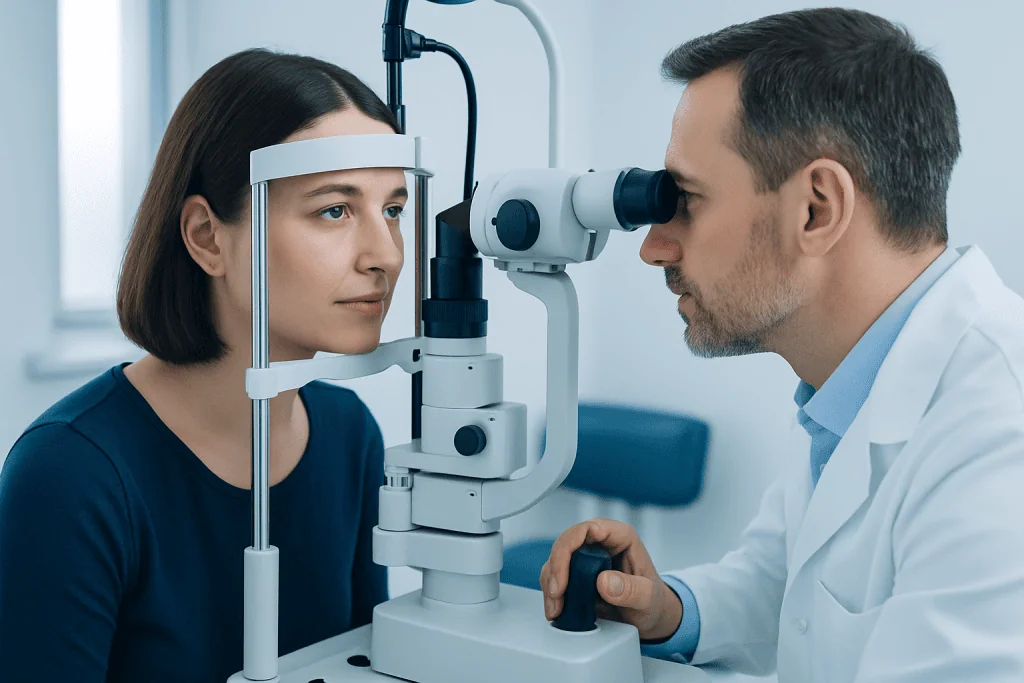
CPT, short for Current Procedural Terminology, is a code set maintained by the American Medical Association. In eye care, CPT codes can describe office visits, comprehensive ophthalmological services, diagnostic testing, procedures, and refraction. The appropriate code depends on the examination’s scope, medical complexity, documentation, and whether the visit concerns routine visual needs or an eye health problem.
For example, the vision procedure code 92014 is commonly associated with an established-patient comprehensive ophthalmological service. It is not simply a synonym for every annual eye exam. Its use depends on the service meeting the relevant coding requirements, and practices may use another appropriate code when the care provided is different.
The vision procedure code 92015 commonly refers to refraction, the assessment used to determine whether lenses may improve vision and what prescription may be needed. Refraction may be performed during an eye examination, but it can be billed separately. Many health insurance plans treat refraction as routine vision care rather than a covered medical service, although individual policies vary.
- Examination codes: describe the professional evaluation of eye health and vision.
- Testing codes: may describe services such as visual field testing, retinal imaging, or corneal measurements.
- Procedure codes: may describe treatments, surgery, or office-based interventions.
- Refraction codes: describe measurement of refractive error for a lens prescription.
Patients should not choose or request a particular CPT code in place of a clinical assessment. The clinician determines which service is medically appropriate, while the billing team assigns codes according to the documented care.
What Are the Eye Codes?

The phrase “eye codes” can mean different things. Some people use it to refer to ophthalmology CPT codes, while others mean diagnosis codes, optical-product codes, or the shorthand used by a particular insurer. Looking at the heading or label on a statement can help identify the system: CPT usually relates to a service, HCPCS often relates to a product or supply, and ICD-10-CM relates to a diagnosis or condition.
One frequently searched example is vision procedure code V2020. This is a HCPCS Level II code commonly used for eyeglass frames. It does not indicate an eye examination or establish that frames will be covered. Coverage may depend on a vision benefit, frame allowance, network status, medical necessity rules, and plan-specific limits.
Eye codes may also appear beside terms such as cataract, glaucoma, dry eye disease, diabetes-related eye disease, nearsightedness, or astigmatism. In this setting, the diagnosis code helps show why an evaluation or test was performed. It should accurately reflect the clinician’s assessment rather than be inferred by a patient from symptoms or a prior prescription.
For a clear explanation, patients can ask: “Is this code for an exam, a test, a refraction, a treatment, or eyewear?” They can also ask whether it was submitted to medical insurance, vision insurance, or both. This approach is often more useful than interpreting a code in isolation.
What Are the ICD-10 Codes Used in Optometry?
ICD-10-CM codes are diagnosis codes used in the United States to document health conditions, findings, injuries, symptoms, and factors affecting care. In optometry and ophthalmology, they may describe refractive errors, eye diseases, visual symptoms, follow-up care, or screening encounters. They are used alongside service codes to explain the clinical reason for the visit or test.
Common diagnostic categories in optometry include refractive errors such as myopia, hyperopia, astigmatism, and presbyopia; eye conditions such as conjunctivitis, dry eye disease, cataract, and glaucoma; and symptoms such as blurred vision, eye pain, or visual disturbance. Many ICD-10-CM codes have important details, including whether the right eye, left eye, both eyes, or an unspecified eye is affected.
A diagnosis code does not always mean that a serious condition has been confirmed. It may document a symptom being evaluated, a history of disease, or a reason for monitoring. Conversely, an insurance claim’s diagnosis code may not fully capture every clinical detail discussed during an appointment. The examination report and clinician’s explanation provide the most meaningful context.
Accurate diagnosis coding supports continuity of care and may influence whether certain tests are covered. Patients who notice an unfamiliar diagnosis on an explanation of benefits should contact the eye-care practice first; a coding or documentation issue can sometimes be clarified or corrected when appropriate.
How to Look Up Medical Procedure Codes
Patients can look up medical procedure codes using reliable sources, but code descriptions should be interpreted carefully. An insurer’s member portal, explanation of benefits, and customer service line can explain how a claim was processed under a specific plan. The eye-care provider’s billing office can explain what was performed and why a code was used.
For general definitions, patients may consult official or recognized coding resources. CPT code information is maintained by the American Medical Association, ICD-10-CM information is supported by the Centers for Disease Control and Prevention’s National Center for Health Statistics and the Centers for Medicare & Medicaid Services, and HCPCS information is maintained by CMS. Full coding guidance may be proprietary, updated periodically, or dependent on payer rules.
A practical way to review a bill is to compare the date of service, provider name, code, plain-language description, amount billed, insurer adjustment, amount paid, and patient responsibility. A difference between the billed amount and the amount owed does not necessarily indicate an error; it may reflect contracted rates, deductibles, copayments, coinsurance, exclusions, or out-of-network rules.
It is wise to contact the provider and insurer before paying an unexpected balance, particularly if a service was described as preventive, routine, diagnostic, or medically necessary in a way that seems inconsistent with the claim. Patients can request an itemized statement and, if needed, ask about the insurer’s appeal or reconsideration process.
How Eye Care Is Assessed and Delivered
Codes describe the care after it has been provided; they do not determine the medical plan. During an eye appointment, the clinician typically begins with a history of visual concerns, medications, overall health, prior eye conditions, and family history. Vision testing, eye-pressure assessment, and examination of the front and back of the eye may be included when appropriate.
Refraction is a step-by-step measurement that compares lenses to identify the combination that offers the clearest vision. The clinician or trained staff member may ask which of two lens choices appears clearer. If glasses or contact lenses are suitable, the resulting prescription is reviewed along with the patient’s visual needs, such as reading, driving, screen work, or sports.
Additional tests may be recommended when symptoms or examination findings suggest an eye health concern. These can include retinal imaging, visual field assessment, optical coherence tomography, corneal mapping, or other measurements. The type of test, benefits, limitations, and potential out-of-pocket costs should be discussed before non-urgent testing whenever possible.
Some people require medical or surgical eye care rather than, or in addition to, corrective lenses. For example, refractive surgery may be considered for suitable adults who want to reduce reliance on glasses or contact lenses. A detailed evaluation is needed to assess corneal health, prescription stability, eye surface health, and expectations before any procedure is considered.
Benefits, Limitations, Recovery, and Risks of Vision Procedures
The main benefit of a comprehensive eye assessment is that it evaluates both vision and eye health. Refraction can help identify the lenses most likely to improve clarity, while targeted testing can support earlier recognition and monitoring of certain conditions. Corrective lenses, medical treatment, and procedures are selected according to the person’s diagnosis and goals rather than a billing code.
Most routine eye examinations and diagnostic tests have little or no recovery time. Dilating drops can temporarily blur near vision and increase sensitivity to light for several hours, so patients may wish to arrange transport or avoid driving until their vision feels normal. Contact-lens evaluations and imaging may require additional time, but they are generally completed during an outpatient visit.
Procedural recovery depends greatly on the treatment. Laser or lens-based procedures may involve temporary dryness, glare, fluctuating vision, activity restrictions, eye drops, and scheduled follow-up visits. Potential risks vary by procedure and can include infection, inflammation, changes in vision quality, under- or over-correction, pressure changes, or the need for additional treatment. The treating ophthalmologist should explain the specific risks and expected recovery before consent.
Insurance coding cannot predict a treatment outcome or confirm candidacy. A safe decision is based on an individual eye examination, medical history, diagnostic findings, and a discussion of alternatives. Patients should make sure they understand what is included in the proposed care plan and which parts may be handled through medical versus vision coverage.
When to Seek Medical Care
Routine eye appointments are important for maintaining vision and checking eye health, especially for people with diabetes, high blood pressure, a family history of glaucoma, prior eye surgery, or regular use of contact lenses. The recommended frequency of examinations varies with age, symptoms, health conditions, and the clinician’s findings.
Prompt medical assessment is appropriate for new or sudden vision loss, a curtain or shadow across vision, sudden flashes or a large increase in floaters, severe eye pain, a painful red eye, chemical exposure, an eye injury, or vision changes with severe headache or neurological symptoms. These symptoms can have several causes, some requiring urgent treatment. Emergency services should be used when symptoms are severe or accompanied by signs such as weakness, facial drooping, difficulty speaking, or confusion.
Less urgent concerns, including gradually worsening vision, persistent dry or irritated eyes, headaches with visual tasks, trouble with night driving, or a change in a glasses prescription, should still be discussed with an optometrist or ophthalmologist. Patients can bring their insurance card, current eyewear, medication list, and any relevant claim documents to help address both clinical and billing questions.
Acibadem International’s multidisciplinary eye-care specialists and JCI-accredited hospitals support international patients who need assessment and treatment for eye conditions. A qualified clinician can explain recommended care, expected follow-up, and the administrative documentation connected with a visit.
Frequently asked questions
Does code 92014 mean a routine eye exam?
Code 92014 is commonly associated with a comprehensive ophthalmological service for an established patient, but it is not automatically used for every routine eye appointment. The correct code depends on the service performed and the documentation. A provider’s billing office can explain how a particular visit was coded.
Is vision procedure code 92015 covered by insurance?
Code 92015 commonly refers to refraction, which determines a lens prescription. Many medical plans exclude refraction or classify it as a routine vision benefit, while some vision plans may cover it under certain conditions. Coverage depends on the individual policy and network rules.
What does V2020 mean on an eye-care claim?
V2020 is a HCPCS Level II code commonly used for eyeglass frames. It identifies a product category rather than an eye examination or diagnosis. Whether frames are covered depends on the person’s vision plan benefits and allowance.
Why are there both diagnosis and procedure codes on my statement?
Procedure codes identify what service, test, treatment, or supply was provided. Diagnosis codes identify the reason for care, such as a symptom, refractive error, eye condition, or follow-up need. Insurers often need both types of information to process a claim.
Can a patient use codes to determine whether eye care is medically necessary?
No. A code alone cannot establish medical necessity because it does not include the full examination findings, history, or clinical judgment. The treating clinician and insurer apply separate standards when determining care recommendations and coverage.
What should a patient do if an eye-care code appears incorrect?
The patient should first contact the provider’s billing office and ask for an itemized explanation of the code and charge. If the claim was processed incorrectly, the practice may be able to review or correct it when appropriate. The insurer can also explain coverage rules and available appeal options.
References
- American Academy of Ophthalmology
- American Optometric Association
- American Medical Association
- Centers for Medicare & Medicaid Services
- Centers for Disease Control and Prevention
This article is for general information only and is not a substitute for professional medical advice. Please consult a qualified doctor about your individual situation.
Explore treatments in Turkey — costs, top hospitals & a free quote
JCI-accredited · board-certified surgeons · reply within 24h
Add us as a Preferred Source to see more of our trusted health content across Google Search, AI Overviews and Discover.

More from the Health Library



Related Specialists

Prof. Dr. Deniz Konya (m)
Neurosurgery
Dr. Aynur Göksel
Physical Medicine & Rehabilitation
Prof. Dr. Deniz Atasoy
General Surgery
Prof. Dr. Enis Rauf Coşkuner
Urology