When to Get a Second Opinion After Neurophysiology Testing

Neurophysiology tests such as EEG, EMG, and nerve conduction studies are useful, but results should always be interpreted alongside symptoms, history, and examination. A second opinion may be worthwhile if results are inconclusive, unexpected, technically limited, or different doctors give different explanations.
Key Takeaways
- Neurophysiology tests such as EEG, EMG, and nerve conduction studies are useful, but results should always be interpreted alongside symptoms, history, and examination.
- A second opinion may be worthwhile if results are inconclusive, unexpected, technically limited, or different doctors give different explanations.
- Bringing the original report, raw data if available, symptom history, and medication list can make a second review more useful.
- A second opinion does not mean the first doctor was wrong; it is often a normal step before long-term treatment or invasive procedures.
- Urgent symptoms such as seizures, sudden weakness, breathing problems, or rapidly worsening nerve symptoms need prompt medical attention rather than routine follow-up.
A second opinion after neurophysiology testing may be helpful when results are unclear, symptoms and findings do not match, or treatment decisions are significant. It can bring reassurance, confirm the diagnosis, or lead to a more accurate explanation of symptoms.
Overview
Neurophysiology testing measures how the brain, nerves, spinal pathways, and muscles are working. Common examples include electroencephalography (EEG), electromyography (EMG), nerve conduction studies (NCS), evoked potentials, and sleep-related neurophysiology tests. These studies can provide valuable information, but they are only one part of a full medical assessment.
A second opinion after neurophysiology testing can be helpful when a person feels uncertain about the results or the next step in care. This does not necessarily mean there is a mistake. In many cases, it simply means the findings are complex, symptoms are unusual, or treatment decisions are important enough to deserve a second review.
Test interpretation in neurophysiology can be nuanced. Small technical factors, timing of the study, the stage of disease, medicines, and even body temperature can influence findings in some tests. For this reason, doctors usually combine test results with the patient’s history, symptoms, neurological examination, and imaging or blood tests when needed.
What Neurophysiology Tests Can and Cannot Show
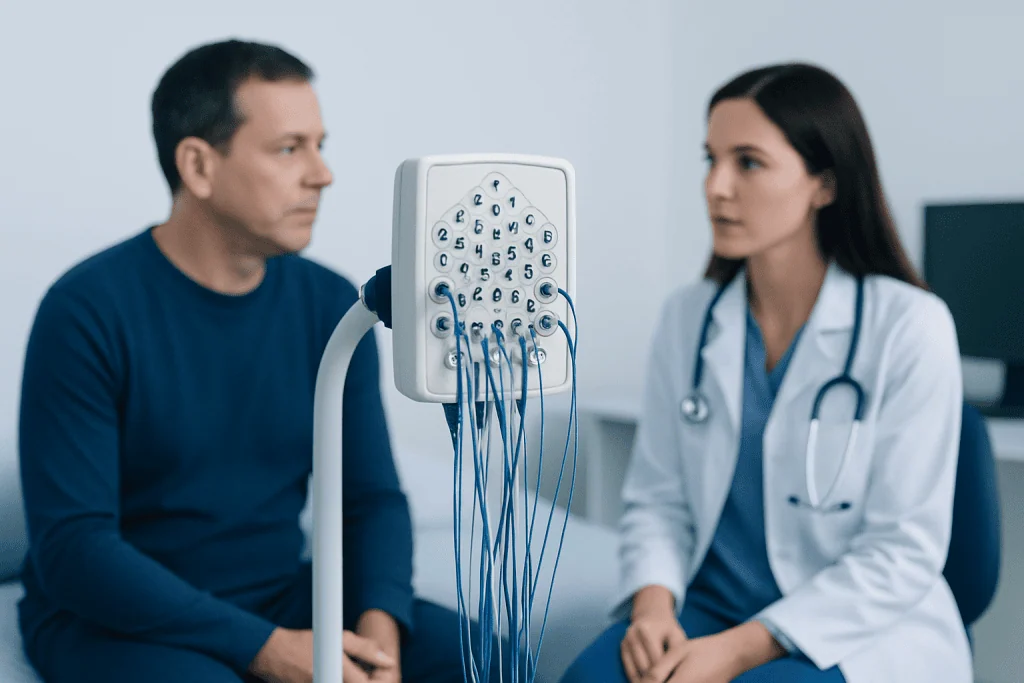
Neurophysiology tests can help detect abnormal electrical activity in the brain, problems in nerve signaling, disorders affecting muscles, and patterns that suggest damage in specific parts of the nervous system. For example, EEG may support the assessment of seizures or altered brain activity, while EMG and nerve conduction studies may help evaluate numbness, weakness, tingling, or suspected nerve compression.
At the same time, these tests do not always provide a complete answer on their own. A normal result does not always rule out disease, especially if symptoms are intermittent, very early, or affect areas not captured well during the test. An abnormal result may also be nonspecific, meaning it points to a problem but not to a single cause.
This is one reason a second opinion can be valuable. Another specialist may review whether the right test was performed, whether the findings fit the symptoms, or whether additional evaluation is needed. In some situations, repeating a study at the right time can be more useful than relying on an early or incomplete result.
- EEG looks at brain electrical activity.
- EMG evaluates muscle electrical activity.
- Nerve conduction studies assess how quickly and effectively nerves carry signals.
- Evoked potentials measure how the nervous system responds to sensory stimulation.
When a Second Opinion May Be a Good Idea

A second opinion after neurophysiology testing may be appropriate when the report is unclear, the wording is difficult to understand, or the conclusion seems uncertain. Terms such as “borderline,” “suggestive,” “nonspecific,” or “clinical correlation recommended” often mean that more context is needed before making a diagnosis or treatment plan.
It may also help if symptoms do not match the test results. For example, a person may have significant weakness, pain, numbness, fainting episodes, or seizure-like events, but the study appears normal or only mildly abnormal. In other cases, the test may show changes that seem more serious than the person’s day-to-day symptoms. A second review can help determine whether the findings are meaningful or incidental.
Another common reason is a major treatment decision. Before starting long-term antiseizure medicine, undergoing surgery for nerve compression, receiving immunotherapy for a neuromuscular disorder, or accepting a diagnosis that may affect driving, work, or lifestyle, many people reasonably want confirmation. This can be especially relevant when evaluating conditions such as epilepsy or when EMG findings may influence plans for brain and nerve surgery.
A second opinion is also worth considering if the test was technically difficult. Excess movement, poor sleep before the study, skin or temperature issues during nerve testing, severe pain, inability to relax during EMG, or a short recording time can all limit accuracy. If the original study quality was reduced, repeating or reinterpreting the test may provide a clearer answer.
Signs That Results Should Be Reviewed More Closely
Some situations suggest that test results deserve more detailed review by a neurologist or neurophysiologist with specific expertise. One is when two doctors give different explanations for the same report. Another is when the diagnosis changes quickly without a clear reason, or when symptoms are attributed to stress or anxiety before neurological causes have been properly considered.
People may also seek a second opinion if symptoms continue to worsen despite treatment based on the original test result. For instance, ongoing numbness, progressive weakness, muscle twitching, balance problems, blackouts, or persistent seizure-like episodes may justify reassessment. In certain cases, additional testing such as imaging, blood work, sleep studies, or repeat neurophysiology may be needed.
Family history can matter as well. If close relatives have neuromuscular disease, epilepsy, inherited neuropathy, or other neurological conditions, a broader evaluation may be appropriate even when the first test seems only mildly abnormal. Similarly, if a diagnosis would carry major emotional or practical consequences, another expert review can provide confidence in the next step.
- The report is hard to interpret or appears vague.
- Symptoms and findings do not seem to match.
- Different clinicians offer conflicting opinions.
- The proposed treatment is long term, invasive, or life-changing.
- Symptoms are progressing despite reassurance or treatment.
How a Second Opinion Is Usually Done
A second opinion often starts with a full review of the person’s medical history and symptoms rather than the test report alone. The specialist will usually ask when symptoms began, how they changed over time, what triggers them, what medicines are being taken, and whether there are relevant family, metabolic, autoimmune, or spine-related issues. A careful neurological examination is an important part of this process.
The doctor may then review the original neurophysiology report and, when available, the raw data itself. This can be especially important with EEG and EMG, where interpretation depends not only on the written conclusion but also on the actual tracing patterns and technical quality. In some cases, the second specialist agrees with the original result but explains it more clearly. In others, they may suggest that the findings are less definitive than they first appeared.
If needed, additional or repeat testing may be advised. This could include a longer EEG recording, sleep-deprived EEG, repeat EMG/NCS after an interval, imaging such as MRI, or broader neurological assessment through neurology care. The aim is not to repeat tests unnecessarily, but to make sure decisions are based on the best possible information.
Patients can help by bringing their reports, images or recordings if available, a timeline of symptoms, a medication list, and any previous blood test or scan results. This often makes the second opinion faster, more accurate, and more useful.
What Happens After the Review
After a second opinion, several outcomes are possible. The new specialist may confirm the original interpretation and treatment plan, which can be very reassuring. They may also refine the diagnosis, suggest monitoring over time, or recommend further testing before treatment begins. In some situations, they may identify an alternative explanation for symptoms.
If the second opinion changes the likely diagnosis, this does not automatically mean the first assessment was poor. Neurological conditions can evolve, and early testing may not always show the full picture. Interpretation can also differ between specialists, especially in borderline or technically limited studies. What matters most is reaching the most accurate explanation possible.
People should feel comfortable asking practical questions after the review. Helpful questions include: How certain is the diagnosis? What else could explain these findings? Do the results match the symptoms? Should the test be repeated? What happens if treatment is delayed briefly while more information is gathered? Clear communication often reduces anxiety and supports shared decision-making.
Self-Advocacy, Follow-Up, and When to Seek Urgent Care
It is reasonable for patients to advocate for themselves if they feel something does not add up. Keeping a symptom diary, noting triggers, recording episode frequency, and documenting changes in strength, sensation, or awareness can all help doctors connect symptoms with test findings. This can be particularly useful when events are intermittent and not captured during a single study.
Routine follow-up is important even after a reassuring result if symptoms continue. A normal neurophysiology test should not be ignored if there is persistent weakness, recurring blackout episodes, frequent falls, or progressive numbness. Sometimes the most accurate diagnosis becomes clearer only over time or after repeat examination and testing.
Urgent medical attention is needed for red-flag symptoms. These include a first seizure, repeated seizures, sudden weakness on one side, trouble speaking, loss of consciousness, severe breathing difficulty, rapidly worsening swallowing problems, or sudden inability to walk. In such cases, emergency evaluation should come before arranging a routine second opinion.
For international patients who want expert review of complex neurophysiology findings, Acibadem International’s multidisciplinary specialists and JCI-accredited hospitals evaluate neurological symptoms and coordinate further testing and treatment when needed, including assessment in neurosurgery or related specialties if a structural cause is suspected.
Frequently asked questions
Is it normal to ask for a second opinion after neurophysiology testing?
Yes. It is a common and reasonable step, especially when results are unclear, symptoms are still unexplained, or treatment decisions are significant. Many doctors welcome a second review because it can help confirm the best plan.
Should a normal EEG or EMG always be reassuring?
A normal result can be reassuring, but it does not always rule out every neurological condition. Some problems are intermittent, very early, mild, or difficult to capture during one test. Doctors usually interpret the result together with symptoms and examination findings.
What should a patient bring to a second-opinion appointment?
It is helpful to bring the original report, raw test data if available, scan results, blood tests, a medication list, and a summary of symptoms. A timeline of when symptoms started and how they changed can also be very useful. This gives the second specialist the best chance to provide a meaningful review.
Will the test need to be repeated?
Sometimes, yes. A repeat study may be useful if the first test was done too early, was technically limited, or did not capture the symptoms. In other cases, the existing study is enough and only the interpretation needs review.
Can two specialists read the same test differently?
Yes, this can happen, particularly with borderline or nonspecific findings. Neurophysiology interpretation involves clinical judgment as well as technical expertise. That is one reason second opinions can be helpful and reassuring.
When should someone seek urgent help instead of waiting for a second opinion?
Urgent help is needed for symptoms such as a first seizure, repeated seizures, sudden weakness, difficulty speaking, severe breathing problems, or loss of consciousness. Rapidly worsening swallowing difficulty or sudden inability to walk also needs immediate evaluation. These situations should be assessed promptly rather than through routine follow-up.
References
- World Health Organization
- National Institute of Neurological Disorders and Stroke
- American Clinical Neurophysiology Society
- International League Against Epilepsy
- National Institute for Health and Care Excellence
This article is for general information only and is not a substitute for professional medical advice. Please consult a qualified doctor about your individual situation.
Neurophysiology in Turkey — costs, top hospitals & a free quote
JCI-accredited · board-certified surgeons · reply within 24h
Add us as a Preferred Source to see more of our trusted health content across Google Search, AI Overviews and Discover.