

Quick answer
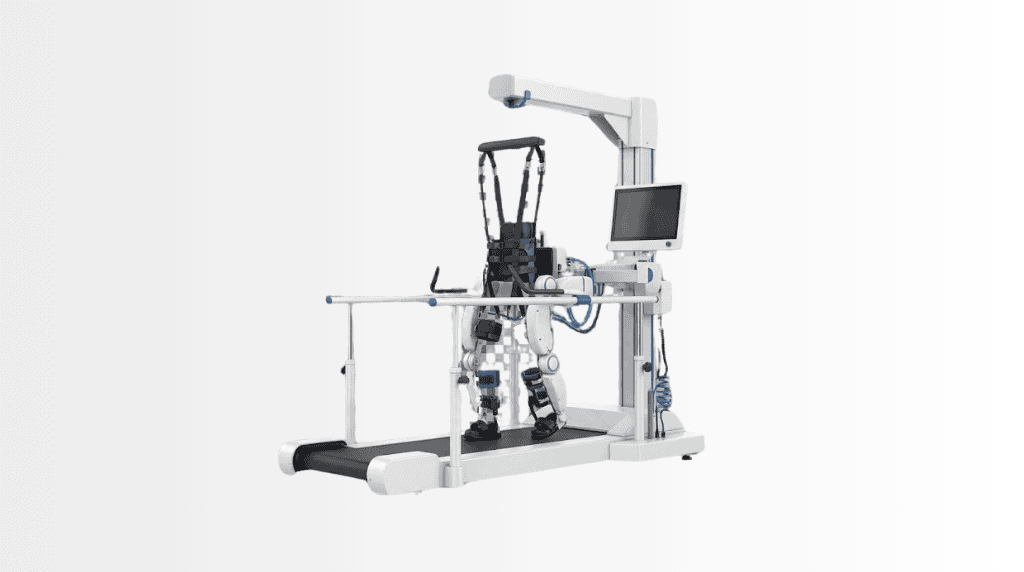
Lokomat Pro is a robotic gait-training system that supports treadmill-based walking practice by guiding the lower limbs through controlled movement patterns. At Acibadem in Turkey, it may be used within individualized neurological and physical rehabilitation programmes for patients with mobility impairments.
Walking is relearned by walking, thousands of correct, repeated steps that a weakened body cannot yet produce and a therapist’s hands cannot endlessly supply. The Lokomat solves that arithmetic: a robotic exoskeleton guides the legs through physiologically correct gait on a treadmill while dynamic body-weight support carries exactly as much load as the patient cannot, and a screen turns effort into feedback and games. Session after session, the machine delivers the dose of repetition that neuroplasticity: the nervous system’s relearning, actually requires.
What is Lokomat therapy?
The Lokomat Pro combines three elements: a treadmill; a harness system providing adjustable body-weight support; and robotic leg orthoses that attach alongside the patient’s legs, guiding hip and knee through a natural gait pattern with adjustable force. Guidance is not passive transport: the system measures how much the patient contributes and can reduce its assistance joint by joint as strength and control return, keeping the exercise at the edge of ability where relearning happens. Augmented-reality tasks on screen keep attention engaged, because active participation, not passive motion, drives neural change.
Who is robotic gait training for?
The established territory: stroke rehabilitation, where early, intensive, task-specific gait practice is a cornerstone of recovery; incomplete spinal cord injury, where guided stepping exploits preserved pathways; multiple sclerosis, cerebral palsy in paediatric programmes with appropriately sized orthoses, and selected traumatic brain injury and Parkinson’s cases. Candidacy is a rehabilitation physician’s decision, joint mobility, bone density, cardiovascular stability and skin condition are checked, and Lokomat enters as one element of a full rehabilitation programme, never as the programme itself.
Why the machine helps, honestly framed
Three honest mechanisms: dose, hundreds to over a thousand guided steps per session, several times the repetition manual training can sustain; quality, symmetric, physiologically timed gait rather than the compensating patterns weakness invents and then entrenches; and progression, measurable assistance levels, weight support and speed that the team tunes week by week, with the numbers documenting change. The equally honest boundary: robotic training complements hands-on physiotherapy, overground practice and strength work; evidence supports it as part of intensive programmes, not as a replacement for them, and outcomes depend on the underlying condition more than on any machine.
A session: what to expect
First visit: assessment and fitting, orthoses sized to your legs, harness adjusted, support and guidance calibrated. A typical session runs 30–60 minutes of walking time inside a therapy hour, at intensities the team sets; expect honest muscular tiredness rather than pain. Programmes usually schedule several sessions weekly across a rehabilitation block, with progress measured, distance, assistance levels, participation, rather than guessed. The therapist remains beside you throughout; the robot extends the therapist, it does not replace them.
Lokomat at Acibadem
Lokomat programmes run within the group’s physical medicine and rehabilitation practice, alongside the wider robotic-rehabilitation fleet, ArmeoSpring for the upper limb, C-Mill for overground gait challenges, and the neurology and neurosurgery teams whose patients they serve. International rehabilitation stays are planned records-first: current assessments define a realistic block length and goals before travel, and discharge notes carry the measured progression for the team continuing at home.
Why repetition heals: the neuroscience in plain words
After stroke or spinal injury, recovery is not the damaged tissue regrowing: it is the surviving nervous system rewiring, and rewiring obeys blunt rules. It is use-dependent: circuits strengthen only when driven. It is task-specific: walking is relearned by stepping, not by leg exercises alone. It is dose-hungry: meaningful cortical change in research settings tracks with repetition counts conventional therapy struggles to reach, which is precisely the gap robotic gait training fills, multiplying correct steps per hour severalfold. And it is engagement-gated: attention and effort modulate the plasticity chemistry, which is why the Lokomat’s feedback games are physiology, not decoration, and why guidance force is deliberately dialled down as ability returns, effort at the edge of capacity is the training stimulus itself. Timing matters too: the early months after injury are plasticity’s most generous window, but the door never fully closes, later blocks target function and confidence with honest, more modest expectations.
Inside a rehabilitation block: how Lokomat fits the week
A serious gait-rehabilitation week is an orchestra, not a solo. A representative rhythm: robotic gait sessions several times weekly delivering the stepping dose; hands-on physiotherapy translating pattern into real-world transfer, balance, weight shifts, floor-to-stand; overground walking practice, where treadmill gains meet gravity, doorways and turns; strength and spasticity management keeping the machinery workable; and, where the arms need their own recovery, ArmeoSpring sessions running in parallel. Progress reviews re-tune every dial, support percentage, guidance force, speed, session length, against measured milestones, and the block’s end produces something concrete: a documented functional change, a home programme, and written guidance for the team continuing wherever home is. The rehabilitation physicians conduct; the robot is one loud instrument.
Frequently Asked Questions
Why are so many repetitions necessary?
Because rewiring is dose-dependent, circuits strengthen with use, and the counts that drive cortical change are exactly what robotic guidance makes reachable within a session.
Does the timing of rehabilitation matter?
The early months are plasticity’s most generous window, so intensity early pays most, but later blocks still deliver honest, more modest functional gains.
What else happens in a rehabilitation block besides the robot?
Hands-on physiotherapy, overground practice, strength and spasticity work, and upper-limb robotics where needed; the Lokomat supplies dose inside that orchestra, not instead of it.
What conditions does Lokomat therapy treat?
Primarily stroke, incomplete spinal cord injury, multiple sclerosis and paediatric cerebral palsy, as part of an intensive rehabilitation programme prescribed by a rehabilitation physician.
Does Lokomat training hurt?
No, expect honest muscular tiredness, not pain; fitting is adjusted until guided walking is comfortable, and the therapist supervises throughout.
How long is a session?
Typically 30–60 minutes of walking within a therapy hour, several times weekly across a rehabilitation block.
Can Lokomat help years after a stroke or injury?
Later-stage gains are possible, honestly more modest than early ones: an assessment states what a block can realistically target in your case.
Will the robot walk for me?
Only as much as necessary: the system measures your contribution and withdraws assistance as control returns; your active participation is the treatment.
Is it suitable for children?
Yes, paediatric orthoses adapt the system for children, a mainstay of cerebral palsy gait programmes.
Who decides if I am a candidate?
A rehabilitation physician, after checking joint mobility, bone density, cardiovascular stability and skin condition; some situations genuinely rule it out.
How many sessions will I need?
Blocks are individual, commonly several weekly sessions over multiple weeks, with measured progression deciding continuation rather than a fixed number.
Does robotic training replace physiotherapy?
No: it multiplies the stepping dose inside a programme that still includes hands-on therapy, overground practice and strength work.
What does body-weight support do?
It carries exactly the fraction of your weight you cannot yet, letting correct stepping start earlier and safer than full-weight walking would allow.
How is progress measured?
In numbers, assistance levels, support percentage, speed, distance and participation, documented session by session and written into your discharge notes.
Can I plan an intensive rehabilitation stay from abroad?
Yes, records-first: current assessments define goals and block length before travel, and the measured outcomes travel home with you.
Related Medical Units
Available at these Hospitals











Related Treatments
Speak with our medical team
Find out how this technology could support your diagnosis or treatment.