

At Acibadem, What Happens If You Need ICU Care After Surgery

If you need ICU care after surgery at Acibadem, you are moved to a unit with closer monitoring and a higher level of nursing attention. Often this is planned in advance as a precaution after major surgery, not a sign of crisis. Your surgeon, anaesthesiology team and ICU clinicians share decisions, your family receives staged updates, and you move to a ward room once your condition is stable.
Perhaps your surgeon has mentioned that you might spend a night in intensive care, and the word has been sitting uneasily with you ever since. That reaction is normal. It is also, in many cases, out of proportion to what an ICU stay actually means: a higher level of monitoring and support while you recover, often planned before the operation even begins.
This guide explains what happens if you need ICU care after surgery at Acibadem, who decides, what the unit looks like, what the monitoring involves, how your family is kept informed, and how the move back to a standard room works. It is written for international patients, so the practical side of being far from home is covered alongside the clinical side.
At a glance
- What ICU means: Closer monitoring and extra support than a standard ward can provide
- Planned or unplanned: Many postoperative ICU stays are decided before surgery as a precaution
- Who coordinates care: Your surgeon, the anaesthesiology team, ICU clinicians and specialist nurses
- Family communication: Staged updates through the care team, supported by international patient services
- Length of stay: Decided by your stability, not by a fixed timetable, overnight is common after major surgery
- Support for international patients: Interpretation, a named coordinator, and practical help with accommodation and travel changes
What happens if you need ICU care after surgery
The first thing to understand about what happens if you need ICU care after surgery is that the decision is usually made in one of two ways. The first is a planned admission: before your operation, your surgeon and anaesthesiology team decide that the safest place to spend the first hours or the first night is the intensive care unit. The second is an unplanned admission: something during or immediately after the operation: a longer procedure than expected, blood pressure that needs medication to stay steady, breathing that recovers slowly from anaesthesia, makes closer observation the sensible choice.
Planned admissions are common after certain kinds of surgery. Major cardiac procedures handled by cardiovascular surgery teams, complex operations in neurosurgery, long abdominal procedures, and surgery in patients with existing heart, lung or kidney conditions all sit in this category. Age, obesity, sleep apnoea and some long-term medications can also tip the balance towards a precautionary ICU night, which is one reason bariatric and metabolic surgery teams sometimes build it into the plan. If you want more detail on which situations tend to lead to intensive care, there is a separate guide on when intensive care may be needed after surgery in Turkey.
So is it normal to go to the ICU after surgery? For minor and moderate procedures, no, most patients wake in a recovery area and go straight to a ward room. For major surgery, or for patients whose health history makes anaesthesia harder work, a short ICU stay is routine practice worldwide, not a sign that something has gone wrong. At Acibadem, this planning is done by a multidisciplinary team before the operation, so if ICU care is likely, you should hear about it in your pre-surgical consultation rather than discover it afterwards.
What usually happens right after your operation
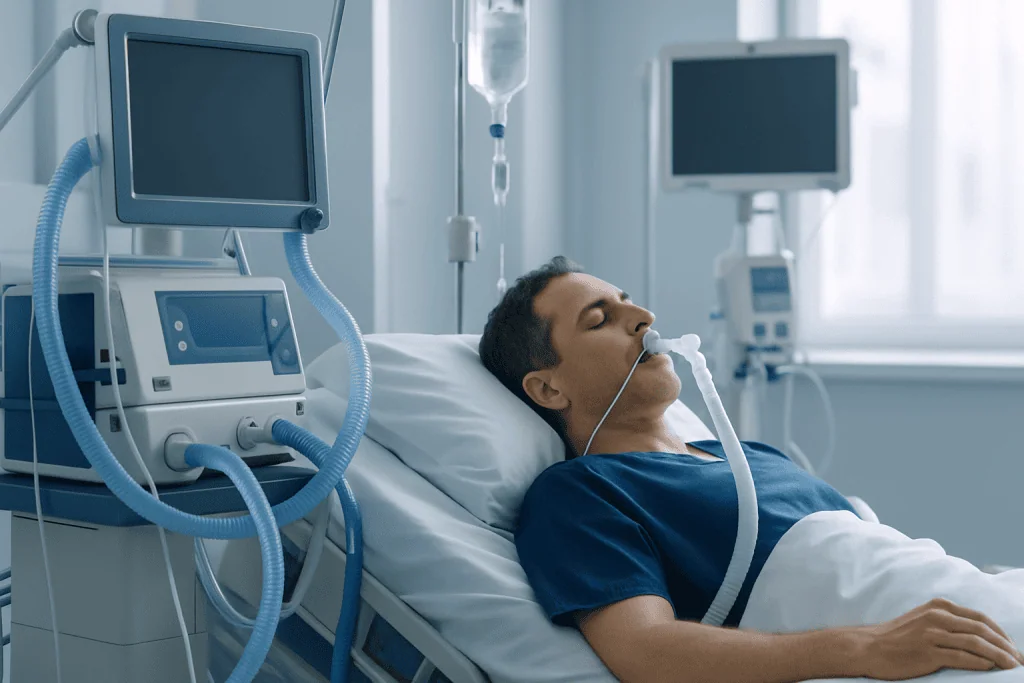
Every patient goes first to a recovery area, sometimes called the post-anaesthesia care unit, where staff monitor you as the anaesthetic wears off. If ICU care was part of the plan, or if your team decides in that moment that standard recovery is not enough, you are transferred to the intensive care unit. The move itself is organised by your clinical team, with continuous monitoring during the transfer. You may be fully awake for it, or you may have no memory of it at all; both are normal.
The ICU looks different from a ward room, and it helps to know that in advance. Expect more equipment around the bed: a heart monitor, a blood pressure cuff or a thin arterial line, a clip on your finger tracking oxygen, intravenous lines, possibly a urinary catheter or surgical drains, and sometimes an oxygen mask or breathing support. There is more light, more sound and more staff movement than on a ward, because the whole point of the unit is that clinicians can see and reach you immediately.
How you feel on arrival varies. Many patients are drowsy, thirsty, and a little disoriented, anaesthesia does that, and so does waking in an unfamiliar room. Some patients have a breathing tube for a period after major surgery and are kept sedated until it is removed; if that applies to your operation, your anaesthesiology team will normally explain it beforehand. The team’s first priorities are the same in every case: keep you stable, keep you as comfortable as possible, and watch closely for anything that needs an early response.
What care and monitoring you can expect in ICU

Postoperative ICU care is built around three things: frequent measurement, fast response, and the least intervention needed to keep you safe. Nurses check your vital signs continuously or at short intervals, assess your pain regularly, track fluid going in and out, and take blood tests when your doctors want to see how your kidneys, liver, blood count or oxygen exchange are coping after surgery. Your care plan is reviewed repeatedly through the day, not once on a morning round, and it can change from hour to hour depending on what the numbers show.
What that support actually involves depends on why you are there. Some patients need nothing more than observation until they are fully awake and their pain is controlled. Others receive oxygen, medications that steady blood pressure, help with blood sugar, nutrition support, or breathing assistance for a period. The direction of travel is always towards less: as your own body takes over each function, the corresponding support is reduced and eventually removed.
ICU care at Acibadem sits inside a wider hospital system rather than operating in isolation. If your recovery raises a question outside the ICU team’s own expertise: a heart rhythm that needs a cardiologist’s view, a chest X-ray that needs a pulmonologist, imaging or laboratory work: those specialists are brought into your case. In practice, this is what you are buying with an ICU bed: not just machines, but the ability to get the right pair of eyes on a problem quickly.
- Continuous or frequent monitoring of heart rhythm, blood pressure, oxygen and temperature
- Regular pain assessment and medication review by the treating team
- Breathing and oxygen support, stepped down as you improve
- Fluid balance, blood tests and organ function checks
- Specialist input from other departments when needed
- Early planning for transfer to the ward once you are stable
How serious is it if you are in the ICU?
This is the question underneath most patients’ anxiety, so it deserves a straight answer. Being in an ICU means you need, or might need, a level of monitoring and support that a ward cannot provide. It does not, by itself, tell you how serious your situation is. A patient spending a planned night in intensive care after a heart operation and a patient admitted urgently with a complication are in the same kind of unit but in very different circumstances.
The honest way to read an ICU admission is by its reason, not its label. If your team told you before surgery that you would go to intensive care, the admission is a safety measure built into the plan. If the admission was unplanned, it means something during or after the operation warranted closer watching, which can range from a slow wake-up from anaesthesia to a genuine complication. Your treating doctors are the only people who can tell you which applies to you, and at Acibadem they are expected to explain the reason in language you understand, with an interpreter present if you need one.
You may also wonder whether most patients leave the ICU and go home. No general figure would honestly apply to your individual situation, and this guide will not invent one. What can be said plainly is that planned, precautionary postoperative ICU stays are usually short, and that the length and outcome of any stay depend on the operation, the reason for admission and your overall health, all things your own team can discuss with you specifically.
How your family will be informed
For companions, the hardest part of an ICU stay is often the waiting. If you are transferred to intensive care, your family or travel companion is normally told that you have been moved for closer monitoring and why. Because the hours after surgery are exactly the period when your condition is being clarified, updates tend to come in stages: a short update soon after transfer, fuller information once the team has a clearer picture, rather than as one complete briefing.
Visiting in intensive care is more structured than on a ward. Units usually have set visiting windows, limits on how many people can be at the bedside, and hygiene rules such as hand disinfection before entry. Staff may ask visitors to wait outside during procedures or nursing care. This can feel restrictive, but it exists to protect rest, infection control and the team’s immediate access to every patient in the unit.
For international patients, Acibadem’s international patient services team supports this communication chain. They can arrange interpretation for medical updates, help your companion understand visiting procedures, and assist with the practical side, accommodation near the hospital, transport, and adjusting travel bookings if your stay runs longer than planned. If your companion is alone in Turkey while you are in intensive care, having one named coordinator to speak to matters more than almost anything else, so it is worth confirming who that person is before your operation.
How long you might stay, and when you move out of ICU
There is no fixed length for a postoperative ICU stay. Some patients stay a few hours or one night for observation; others need several days of support, particularly after major surgery, if breathing assistance is required, or if a complication needs treating. What decides the timing is a set of clinical questions, checked repeatedly: Are you breathing well on your own? Are your blood pressure and heart rate stable without heavy support? Are you awake and oriented? Is your pain controlled? Are your kidneys and other organs working normally?
When the answers are consistently yes, you are transferred to a standard inpatient room. This is a genuinely positive milestone, but it does not run on a timetable, doctors will sometimes keep a patient in intensive care a little longer than expected simply because they want more certainty before stepping down the monitoring. Slower-than-planned progress is one of the common reasons a hospital stay stretches, which is covered separately in the guide on when you may need extra nights in hospital after surgery in Turkey.
The handover from ICU to ward is a formal part of care, not an administrative shuffle. Your medications, wound care plan, mobility goals and monitoring schedule are passed to the ward team, and your surgeon remains involved. On the ward, recovery continues at a less intensive rhythm: getting out of bed, eating normally, reducing lines and drains, and preparing for discharge. Before you leave, the team should explain your follow-up plan: the guide on how many follow-up visits you might need in Turkey explains how those appointments are usually structured, and there is separate reading on post-surgery warning signs that need urgent medical advice for the period after discharge.
Practical questions worth asking before your surgery
If there is any possibility of an ICU stay, asking about it in advance strips away most of the fear. Useful clinical questions include: Is an ICU stay planned for my operation, or only a backup? What would make it necessary? Do any of my existing conditions raise the chance? Will I have a breathing tube afterwards, and for how long is that typical? What would the likely next steps be if intensive care were needed?
The practical questions matter just as much when you are travelling for treatment. Ask who your main point of contact is, whether interpretation is available at every stage including inside the ICU, how and when your companion will receive updates, and what happens to accommodation arrangements if your hospital stay lengthens. It is also reasonable to ask how a possible ICU stay is handled in your written quote, whether it is included for your procedure or would be itemised separately, so that an unplanned extra night is not also a financial surprise.
None of these questions is awkward or unusual. Surgical teams answer them constantly, and a patient who has asked them tends to cope better with the first disorienting hours after a big operation, because nothing in the room is a surprise.
Step by step
- Pre-surgery assessment and planning. Before your operation, the team reviews your health, the planned procedure and any factors that make closer monitoring advisable afterwards. If ICU care is likely or possible, it is discussed as part of your surgical and anaesthesia planning.
- Immediate recovery after surgery. You wake first in a recovery area where staff assess how you are responding. If you need a higher level of observation, transfer to the ICU is arranged promptly, with monitoring continuing throughout the move.
- ICU admission and stabilisation. The priority on arrival is to keep you stable and comfortable: pain control, breathing support if needed, and close tracking of your vital signs, fluids and medications.
- Ongoing monitoring and specialist input. Your condition is reviewed repeatedly and the care plan adjusted hour by hour. Specialists from other departments join your case when a specific question needs their expertise.
- Family updates and practical coordination. Your family or companion receives staged updates from the care team. Interpreters and international patient coordinators help make the information clear and manage practical arrangements such as accommodation.
- Transfer to the ward. Once your breathing, circulation, alertness and pain control are reliably stable, you move to a standard inpatient room, with a formal handover of your medications and care plan.
- Ward recovery and discharge planning. Recovery continues with mobilisation, nutrition, wound care and follow-up checks, plus planning for travel timing and what to watch for after leaving hospital.
Your checklist
- Ask before surgery whether ICU care is a planned part of your pathway or only a backup option
- Share your full medical history, including heart, lung, sleep and medication details
- Confirm who will update your family or companion after surgery, and how soon
- Save the contact details of your international patient coordinator
- Ask about interpretation support if English or Turkish is not your preferred language
- Ask how a possible ICU stay is reflected in your written quote
- Keep travel and accommodation plans changeable in case recovery takes longer than expected
- Make sure your companion knows the ICU visiting and waiting procedures in advance
Key takeaways
- ICU care after surgery frequently means precautionary close monitoring, decided before the operation, not a crisis.
- How serious an admission is depends on its reason, planned or unplanned, not on the word “intensive”.
- Length of stay is decided by stability checks, not a fixed schedule; overnight stays are common after major surgery.
- Family communication is more structured in ICU, with staged updates and set visiting windows.
- Your surgeon, anaesthesiology team, ICU clinicians and nurses share decisions throughout, with other specialists joining when needed.
- For international patients, Acibadem provides interpretation and a coordinator to handle the practical side of a longer stay.
Frequently asked questions
Is it normal to go to the ICU after surgery?
For minor and moderate procedures, most patients go from the recovery area straight to a ward room. After major surgery, cardiac, neurosurgical, long abdominal operations, or when a patient has significant heart, lung or other conditions, a planned short ICU stay is routine practice in hospitals worldwide. If it is likely for your operation, it is normally discussed before surgery, not discovered afterwards.
How serious is it if you are in ICU?
The unit itself does not tell you how serious your situation is; the reason for admission does. A planned precautionary stay after major surgery and an unplanned admission for a complication happen in the same kind of unit but mean very different things. Your treating doctors are the right source for what your own admission means, and they should explain it plainly, with interpretation if you need it.
How long do you stay in intensive care after surgery?
There is no standard timeframe. Some patients stay a few hours or one night for observation; others need several days if they require breathing support or more time to stabilise. The team decides based on repeated checks of your breathing, circulation, alertness, pain control and organ function, not on the clock.
Do most patients make it out of the ICU?
No single figure would honestly describe your individual situation, so this guide does not offer one. What can be said is that planned postoperative ICU stays are precautionary and usually short, and that the course of any stay depends on the operation, the reason for admission and your overall health. Your own treating team can discuss what applies specifically to you.
Will my family be told if I am moved to ICU?
Yes. Your family or companion is normally informed that you have been transferred for closer monitoring and why. Because the first hours after surgery are when your condition is being clarified, updates usually come in stages rather than as one complete briefing, and interpreters can be involved so nothing is lost in translation.
Can my companion visit me in ICU?
Usually yes, but within tighter rules than on a ward. ICUs typically have set visiting windows, limits on visitor numbers, and hygiene requirements such as hand disinfection. Staff may ask visitors to wait during procedures. Your companion should confirm the unit’s current policy with the nursing team.
What if I do not speak Turkish?
Acibadem’s international patient services provide interpretation and a coordinator for international patients. This covers medical updates, consent discussions and the practical side, visiting procedures, accommodation and travel changes, so that you and your companion can follow what is happening at every stage, including during an ICU stay.
What happens after I leave ICU?
You move to a standard inpatient room with a formal handover of your medications, wound care and monitoring plan. Recovery continues there at a less intensive rhythm, mobilisation, normal eating, removal of lines and drains, followed by discharge planning, follow-up appointments and guidance on what to watch for once you leave hospital.
Add us as a Preferred Source to see more of our trusted health content across Google Search, AI Overviews and Discover.

Update history
- PublishedJune 25, 2026
- Medical review approvedSeptember 13, 2026
- Last content updateSeptember 12, 2026
References2
- Intensive care: NHS nhs.uk
- Critical Care: MedlinePlus medlineplus.gov
More Patient Guides

Choosing Between Inpatient and Day-Case Treatment in Turkey
Inpatient and day-case treatment in Turkey differ mainly in overnight monitoring, recovery needs and travel planning. Learn how to choose safely.

How to Compare Hospitals in Turkey for Complex Treatment
Compare hospitals in Turkey for complex treatment by checking accreditation, specialist teams, ICU support, coordination, and follow-up.

At Acibadem, How We Explain Surgical Risks and Safety Checks Before You Travel
Surgical risks and safety checks before travel means understanding your personal risk, required tests, and travel timing before coming to Turkey.

At Acibadem, What to Check Before Comparing Treatment in Turkey With Care at Home
Comparing treatment in Turkey with care at home starts with safety, records, follow-up, travel timing and total support in Istanbul.