

PET-CT Scan in Turkey: Travel and Preparation Guide

Plan a PET-CT scan in Turkey as a half-day hospital visit, not a quick slot. Send your recent records ahead, confirm fasting and medication instructions with the imaging team, arrive with time to rest after your flight, and leave flexibility in your itinerary for the report and any follow-up consultation before you travel home.
How early should you fly in? Can you eat breakfast? How soon will the report be ready? These are the questions most people have before a PET-CT scan in Turkey, and the honest answer to each of them is: it depends on your scan, your tracer, and your care plan. This guide explains what depends on what, so you can plan around it.
It covers the practical journey from your home country to the imaging department and back: which documents to send ahead, how preparation works, what scan day actually involves, how results are prepared and shared, and what to check before you book flights. It does not replace the written instructions your imaging team will give you: those always take priority.
At a glance
- Best for: International patients scheduled for PET-CT imaging as part of diagnosis, staging, treatment planning, or follow-up
- Typical location: Hospital-based nuclear medicine and imaging departments, most often in Istanbul and other major Turkish cities
- Preparation: Fasting for a period the hospital defines, activity restrictions, blood glucose guidance for diabetic patients, and recent medical records sent in advance
- Time to allow: A half-day hospital visit, plus flexibility afterwards for the report and any consultation
- Support available: Interpreters, appointment coordination, transfer and hotel guidance, and help collecting reports and images
- Important note: Your own care team confirms timing, tracer type, and every personal instruction, preparation varies by diagnosis and health status
Planning a PET-CT scan in Turkey before you travel
A PET-CT scan in Turkey is rarely booked in isolation. It usually sits inside a wider plan: confirming a diagnosis, staging a known condition, planning treatment, or checking how treatment is progressing. Before you buy flights, confirm the exact appointment date, the hospital location, how long the whole visit is expected to take, and whether the scan will be combined with consultations, blood tests, or other imaging on the same trip.
The single most useful thing you can do before travelling is to share your recent medical records. That typically means pathology reports, previous CT, MRI or PET-CT images, oncology notes, discharge summaries, a current medication list, and recent blood tests. Doctors reading a new scan compare it against your history; a PET-CT viewed without earlier imaging tells them less than the same scan viewed alongside it. Our guide on how current your imaging needs to be explains what usually counts as recent enough and when older scans still help.
If your documents are not in English or Turkish, ask whether translation is needed before the appointment. Some records matter more than others: a pathology report usually needs to be understood precisely, while a routine blood panel often reads across languages without difficulty.
At Acibadem, patient service teams coordinate communication between you, the imaging department, and the relevant specialist team. This matters most when a PET-CT scan has to be timed around chemotherapy, radiotherapy, or surgery, because scanning too close to certain treatments can affect how the images are interpreted. The scheduling decision belongs to your treating doctor, not to the calendar.
What a PET-CT scan shows, and what it does not
PET-CT combines two technologies in one session. The PET component uses a small amount of radioactive tracer, most commonly a form of glucose called FDG, to show how active tissues are metabolically. The CT component maps anatomy in detail. Together they show where unusual activity is and what structure it sits in, which is why the combination is widely used in cancer assessment.
It is worth understanding the limits, because they shape realistic expectations. A PET scan is not a universal cancer detector. Some tumour types take up little of the standard glucose tracer and can appear faint or unremarkable, certain slow-growing cancers, some prostate and kidney tumours, and some mucin-producing tumours are common examples discussed in the medical literature. Very small deposits below the scanner’s resolution may not be visible at all, and normal high activity in organs such as the brain can make some areas harder to assess with the standard tracer. This is one reason different tracers exist for different questions, and why your doctor may combine PET-CT with other tests rather than relying on it alone.
None of this makes the scan less useful. It means the scan answers specific questions, and your medical team chooses it, and the tracer, when it is the right tool for your question. If your doctor has recommended a PET-CT, that recommendation reflects your particular situation, not a general rule.
A note on language, since you will see it on signage and paperwork: in Turkish, a CT scan is called bilgisayarlı tomografi, abbreviated BT. You may therefore see PET-CT written as PET-BT or PET/BT in Turkish documents, and the department itself signposted as nükleer tıpnuclear medicine. The examination is the same; only the abbreviation changes.
How to prepare in the days before your scan
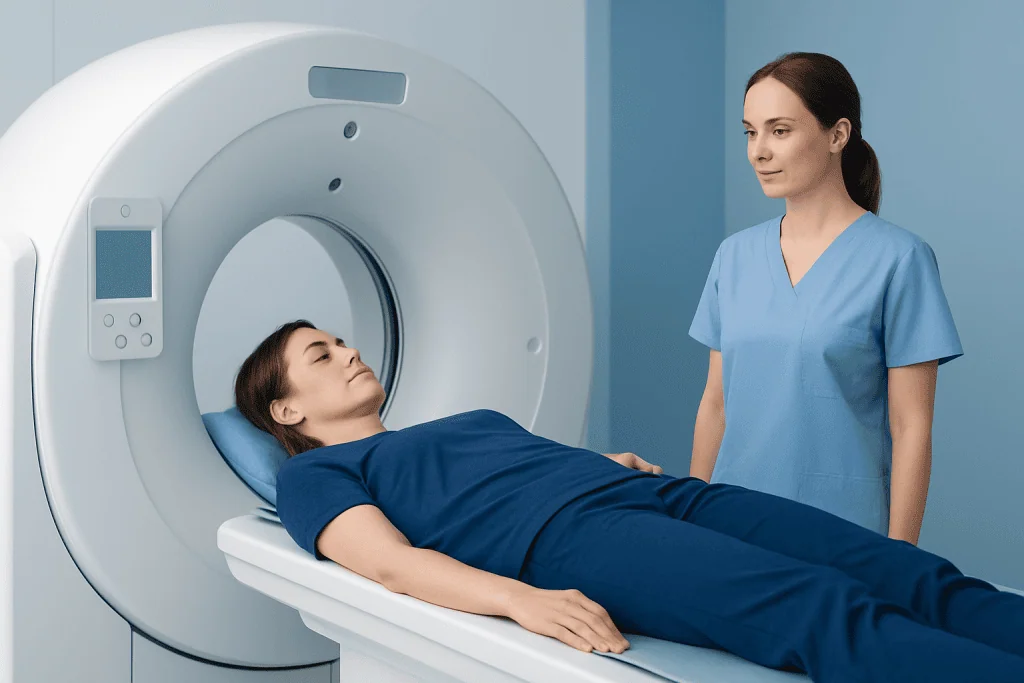
The hospital sends written preparation instructions before the scan. Read them early and raise questions well before you fly, particularly if you have diabetes or kidney disease, are pregnant or breastfeeding, have mobility needs, or take daily medication. Do not stop or adjust any prescription medicine on your own initiative; whether and how a medicine is taken around the scan is a decision for your treating doctor or the imaging team. If you take regular medicines, our guide on packing and documenting your prescriptions for travel covers the practical side.
Most FDG PET-CT appointments involve fasting for a period of several hours beforehand, and many hospitals ask you to avoid strenuous exercise the day before. There is a reason for both rules: the tracer behaves like glucose, so recent food intake and hard-working muscles pull it towards the wrong places and can blur the picture the doctors need. Water is often permitted and sometimes encouraged, but follow your specific instructions rather than a general rule.
Diabetic patients follow a modified pathway. Blood glucose levels affect how the tracer distributes, so the timing of insulin or tablets around the scan needs to be confirmed directly with the medical team, never rearranged on your own. Tell the hospital about your diabetes as early as possible so the appointment time can be set to suit your routine rather than fight it.
In the final 24 hours, keep plans simple: meals that follow your instructions, water if permitted, no heavy workouts, and enough rest. If you are flying into Istanbul, avoid scheduling the scan immediately after a long overnight journey unless your coordinator has confirmed the timing works. Fatigue makes fasting harder and the waiting periods longer than they need to feel. For a deeper walkthrough of the preparation rules themselves, see our companion guide on PET-CT preparation, timing and scan-day questions.
Arrival in Turkey and getting to the hospital

Keep your medical folder, passport, appointment confirmation, and contact numbers in your hand luggage, not in checked bags. Checked baggage occasionally arrives late; your records should not. If your scan is in Istanbul, allow generous transfer time, traffic varies sharply by time of day and by which airport you land at, and a journey that takes forty minutes at one hour can take much longer at another. Your coordinator can suggest realistic transfer times and hotel areas convenient for the hospital.
Acibadem can assist with practical arrangements such as airport reception guidance, hotel suggestions, local transfers, and interpreter scheduling, depending on your care plan. Interpreter support is arranged in advance, so state your preferred language before you arrive rather than on the day.
If you are travelling with a companion, share the full timetable with them, including the parts where they will be waiting rather than with you, nuclear medicine departments restrict access to some areas for radiation-safety reasons. Our guide on bringing a companion to Turkey for treatment covers what to plan on their side.
Tell the team before arrival if you use a wheelchair, oxygen, hearing support, or any other accessibility assistance; departments can prepare smoother access when they know in advance. The same applies if you feel anxious in enclosed spaces, find it difficult to lie flat, or have pain that makes staying still hard. These are common, manageable issues, but only if the team knows before you are on the table.
What to expect on scan day
Arrive at the time the hospital gives you, which is earlier than the scan time itself. A PET-CT visit is a sequence: registration, preparation, a blood glucose check where needed, tracer injection, a quiet resting period while the tracer distributes, and then the scan. The scan itself is relatively short; the visit around it is not. Plan the whole day loosely, with no tight commitments afterwards.
Wear comfortable clothing without metal details where possible, and bring a light layer, imaging areas often feel cool. Depending on the body region being scanned, you may be asked to remove jewellery, belts, glasses, hearing devices, or removable dental items. Leave valuables at your hotel or with your companion, following the hospital’s guidance.
The resting period after the injection is not dead time to negotiate away; it is part of the examination. You will usually be asked to sit or lie quietly, without much talking or moving, so the tracer settles where the physicians need to see it. During the scan, the technologists position you and ask you to remain as still as you can. If anything is uncomfortable, the position, the temperature, pain, anxiety, say so before the scan starts, while adjustments are still possible.
Documents, images, and results
Bring both digital and printed records where you can. Prior imaging is the most valuable item in your folder, because physicians compare the new scan against the old to judge whether findings are new, stable, or changing. CDs, USB drives, secure image links, and DICOM files are all workable, share them with your coordinator before the appointment or carry them with you. If you are unsure which formats travel well, our guide on travelling to Turkey with X-rays, MRI and CT scans goes through the options.
The PET-CT report is written by nuclear medicine or radiology physicians and may then be reviewed with your treating specialist. Report timing varies with the complexity of the scan, how much comparison work is needed, and whether your case is discussed in a multidisciplinary meeting. That variability is the honest reason not to book a departure that assumes a same-day report, sometimes it works out that way, and sometimes it should not be rushed.
Most international patients need the report, the images, and any recommendations to reach their doctors at home. Ask in advance how you will receive your files, whether the report will be in English, and whether a secure link, printed copy, CD, or electronic version can be provided. Sorting this out before scan day is far easier than chasing it from another country afterwards.
Costs, quotes, and insurance, how they work
You will find prices for a PET-CT scan in Turkey quoted across the internet, often as single headline figures. Treat those with caution, because the real cost of an imaging visit depends on components that differ from patient to patient: the tracer used, whether contrast is added to the CT component, whether the scan is bundled with consultations or other tests, interpreter and coordination services, and how the report is prepared and shared. A meaningful quote is written for your case after your records have been reviewed, and it should itemise what is included and what is not.
Turkey’s public health system covers its own residents and insured citizens; tourists and visiting patients are not covered by it and pay for care as private patients. That makes insurance worth checking before you travel, many travel policies exclude planned treatment abroad, and the exclusions matter more than the headline cover. Our guide on what international patients should check in their travel insurance sets out the questions to put to your insurer.
After the scan and returning home
After the scan you may be advised to drink fluids and follow simple radiation-safety precautions for a short period, typically practical measures such as limiting close, prolonged contact with pregnant women and young children for a window the hospital defines. Follow the advice given on the day; it depends on the tracer and your circumstances, not on a general rule you can look up in advance.
If the PET-CT is part of a broader treatment plan, a consultation usually follows once the report is ready. This is where your doctor explains what the scan suggests and how it fits with your earlier tests, symptoms, and treatment history. Write your questions down beforehand, consultations move quickly, and a written list works better than memory under pressure.
Before you leave Turkey, make sure you hold copies of the report, the images, any consultation notes, any medication changes documented by your doctor, and clear follow-up instructions, along with the contact details for questions after departure. A clean handover lets your local doctor pick up your care without gaps or repeated tests.
Step by step
- Send your records before booking final travel. Share recent imaging, pathology, oncology notes, medication lists, and blood tests with your coordinator. This lets the hospital confirm that a PET-CT is appropriate to schedule and whether other appointments should be planned into the same trip.
- Confirm your preparation instructions in writing. Ask about fasting hours, water, exercise restrictions, diabetes medication timing, and whether to take regular medicines on the day. Clarify anything unclear before you fly, not in the waiting room.
- Choose travel dates with flexibility built in. Arrive with time to rest before the appointment, especially after a long flight, and leave room afterwards for report preparation, a specialist consultation, or additional tests if your doctor recommends them.
- Pack a practical medical folder in hand luggage. Passport, appointment details, insurance and payment documents, previous reports, image files, medication list, allergy information, and emergency contacts, available even if checked baggage is delayed.
- Arrive early on scan day. The visit includes registration, preparation, and a resting period before the scan itself. Build in extra time for Istanbul traffic, hospital registration, meeting your interpreter, and pre-scan checks.
- Keep the rest of scan day quiet. You may feel entirely well afterwards, but the day is long. Avoid tight sightseeing plans, long transfers, or same-day flights unless your medical team has agreed the timing.
- Collect your report and follow-up plan before departure. Confirm how and when you will receive the written report and images, who will explain the findings, how your local doctor can access the files, and whom to contact with later questions.
Your checklist
- Passport, visa documents if required, and appointment confirmation
- Previous PET-CT, CT, MRI, ultrasound, and X-ray images in digital format
- Pathology reports, oncology notes, surgery reports, and recent discharge summaries
- Current medication list, allergies, and any diabetes treatment plan
- Written preparation instructions from the hospital
- Insurance policy details and confirmation of what it covers abroad
- Comfortable clothing without metal details and a light layer
- Water bottle if permitted by your instructions
- Local contact numbers for your coordinator, hotel, and companion
- Written questions for the post-scan consultation
Key takeaways
- A PET-CT scan in Turkey runs most smoothly when your records are reviewed and your preparation instructions confirmed before you travel.
- Fasting rules, diabetes timing, exercise restrictions, and every medication decision come from your own medical team, never from a general guide.
- PET-CT answers specific questions; some tumour types and very small findings are less visible with the standard tracer, which is why your doctor chooses the test and tracer for your case.
- International patient services can help with interpreters, transfers, hospital navigation, and report collection.
- Bring previous images and reports so physicians can compare accurately, and leave time after the scan for the report, consultation, and a clear follow-up plan before flying home.
Frequently asked questions
What is a CT scan called in Turkish?
A CT scan is called bilgisayarlı tomografi in Turkish, abbreviated BT. PET-CT therefore often appears as PET-BT or PET/BT on Turkish signage and paperwork, and the department is signposted as nükleer tıp, meaning nuclear medicine. The examination itself is identical; only the abbreviation differs from the English one.
What cancers cannot be detected by a PET scan?
PET with the standard glucose tracer relies on metabolic activity, so tumour types that take up little of the tracer can appear faint, certain slow-growing cancers, some prostate and kidney tumours, and some mucin-producing tumours are commonly cited examples. Very small deposits below the scanner’s resolution may also not be visible. Different tracers exist for different questions, and doctors often combine PET-CT with other tests rather than relying on it alone.
Do tourists get free healthcare in Turkey?
No. Turkey’s public health system covers its residents and insured citizens; tourists and international patients are treated as private patients and pay for their care. This is why it is worth checking your travel or health insurance policy carefully before travelling, including whether planned treatment abroad is excluded, and getting a written, itemised quote for any planned imaging or treatment.
Which hospital in Turkey is considered the best?
There is no single official ranking, and any page that names one hospital as “the best” is expressing an opinion. More useful questions are specific: does the hospital run a full nuclear medicine department, is the PET-CT read by nuclear medicine physicians, is the case reviewed with the relevant specialist team, and can the report be provided in your language? Compare hospitals on those points for your particular diagnosis.
Do I need to fast before my PET-CT scan?
Fasting for a period of hours is commonly required for FDG PET-CT, and you may also receive instructions about water, caffeine, exercise, and medication timing. The exact rules vary by tracer and by patient, so always follow the written guidance from your imaging team, particularly if you have diabetes, where preparation is adjusted around your treatment.
Can I fly after a PET-CT scan?
Many patients can travel after imaging, but follow the advice given by the hospital on the day, which depends on the tracer used and your circumstances. Avoid booking a tight same-day flight without checking first: the visit itself takes several hours, and the report is often not ready immediately. A relaxed departure is almost always the more comfortable plan.
What should I do if I am diabetic?
Tell the hospital as early as possible if you have diabetes or use insulin, tablets, or glucose monitoring devices. Blood glucose levels affect how the tracer distributes, so appointment timing and preparation are adjusted for diabetic patients. Do not change your diabetes medication routine yourself: the timing decisions belong to your doctor and the imaging team.
How will I receive my PET-CT results?
Ask before the appointment whether results will come as a printed report, digital file, secure link, CD, or a combination, and whether the report will be in English. The findings may be reviewed with a specialist, especially if they affect treatment decisions. Before returning home, confirm how your local doctor can access both the images and the written report.
Add us as a Preferred Source to see more of our trusted health content across Google Search, AI Overviews and Discover.

Update history
- PublishedJune 16, 2026
- Medical review approvedSeptember 13, 2026
- Last content updateSeptember 12, 2026
References2
- PET scan: NHS nhs.uk
- PET Scan: MedlinePlus medlineplus.gov
More Patient Guides
Sleep Apnea Testing in Turkey: What Happens During Your Evaluation
Sleep apnea testing in Turkey may include a consultation, overnight sleep study or home test, and a clear review of your results…

How to Organize Your Test Results Before Traveling to Turkey
Organize your test results before traveling to Turkey by sorting records, images, medicines and timelines so your Istanbul care team can review…

When Extra Tests Are Needed Before Treatment in Turkey
Extra tests before treatment in Turkey may be needed to confirm diagnosis, timing, and safety. Here is what you can expect in…

At Acibadem, How to Prepare for Blood Tests, Scans, and Pre-Op Checks
Blood tests, scans, and pre-op checks at Acibadem in Turkey help confirm you are ready for treatment and avoid delays on the…