

Preparing for Contrast Dye Imaging in Turkey

Preparing for contrast dye imaging in Turkey means sharing your medical history early, kidney function, allergies, diabetes medicines, pregnancy status and previous reactions, then following the exact fasting and hydration instructions for your specific scan. Bring previous images, a full medication list and implant cards on the day, arrive early for registration and consent, and confirm aftercare and result timing before you leave the department.
Worried that a scan booked in another country will go wrong because nobody there knows your history? That is the concern international patients raise most often before contrast imaging, and it is also the most fixable one. Preparation for a CT, MRI or angiography with contrast dye is mostly about information: what you share before you travel, and what you carry on the day. This guide walks through both, honestly, including the parts that depend on your individual case and cannot be answered in advance.
At a glance
- Best for: International patients scheduled for CT, MRI, angiography or other imaging that may use a contrast agent
- Key preparation: Share allergies, kidney history, diabetes medicines, pregnancy status, implant details and previous scan reports before travelling
- Before the scan: Fasting and fluid rules differ by scan type, follow the exact instructions issued for your appointment, not general advice
- On the day: Bring your passport, medical records, recent kidney function results if requested, a full medication list and any implant cards
- Afterwards: Expect a short observation period, hydration advice where appropriate, and clear guidance on when the report will be ready
What contrast dye imaging involves, and why preparation starts before you fly
Contrast dye imaging means a contrast agent is given before or during a scan so that certain organs, blood vessels or tissues show up more clearly on the images. It is common with CT, MRI and some vascular or interventional procedures. Your doctor may request contrast to clarify a diagnosis, plan a treatment, or compare a finding against earlier scans. Some questions can be answered without contrast; others cannot. That decision sits with the referring doctor and the radiologist, not with the booking calendar.
The contrast agent depends on the scan. CT contrast is usually iodine-based. MRI contrast is usually gadolinium-based. These are chemically different substances, so a previous reaction to one does not automatically rule out the other, but any previous reaction is exactly the kind of detail the radiology team needs to hear about early, not on scan day.
Preparing for contrast dye imaging in Turkey is best treated as a coordination process rather than a simple booking. Because you are travelling for the scan, the useful review work, previous reports, blood tests, medication details, should happen before your flight, so the radiologist and referring specialist can decide what is appropriate and whether anything needs repeating locally. Done properly, this front-loading is what prevents the frustrating scenario of arriving in Istanbul only to have a scan postponed for a missing blood test. The broader safety principles behind these checks are covered in our guide to radiology and imaging safety for international patients.
Medical information to share before your appointment
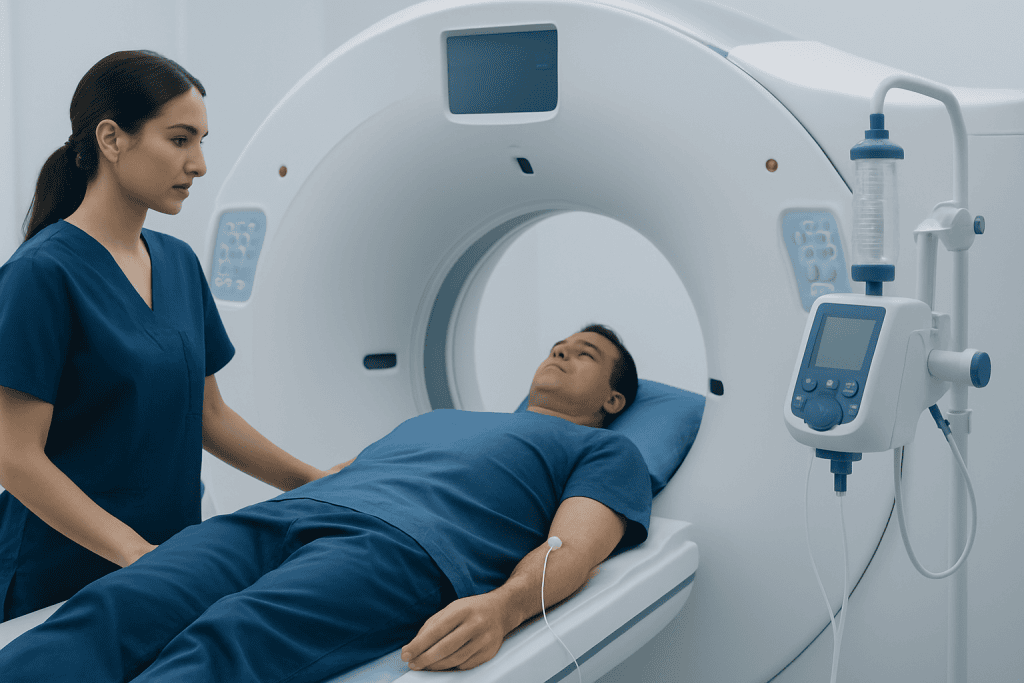
The single most useful thing you can do when preparing for contrast dye imaging in Turkey is to assemble a clear medical summary. Include why the scan has been requested, your main diagnosis or symptoms, previous surgeries, chronic conditions and any recent hospital admissions. If you have earlier imaging, bring both the written report and the actual images, on CD, USB or a secure digital link. Radiologists compare images, not just reports, and old scans often matter more than patients expect. If your files are large, our guide on sharing large imaging files with your doctor in Turkey explains the practical options.
Certain details carry particular weight for contrast planning: kidney disease or reduced kidney function, dialysis, diabetes, thyroid disease, asthma, severe allergies of any kind, previous contrast reactions, and pregnancy or breastfeeding. None of these automatically prevents imaging. What they do is change the plan: the type of contrast, the timing, the blood tests requested beforehand, or the aftercare advice. Withholding them does not make the scan simpler; it makes it riskier or delays it.
Prepare a medication list with exact names, doses and timing. This matters most for diabetes medicines, blood thinners, diuretics, heart medicines, kidney-related medicines and long-term steroids, because some of these interact with contrast planning. Never stop or adjust a prescribed medicine on your own initiative before a scan, any change is a decision for your treating doctor. A structured approach to building this list is set out in our guide to medication reconciliation in Turkey.
Blood tests, fasting and hydration: what to expect

Many patients need recent kidney function blood tests before contrast imaging, particularly before iodine-based CT contrast, and particularly if they have diabetes, known kidney disease, advanced age or a complex medical history. The usual tests are creatinine and estimated glomerular filtration rate (eGFR). Whether an existing result from your home country is recent enough depends on your situation; sometimes it is accepted, sometimes it is repeated in Turkey on the morning of the scan. Build that possibility into your schedule rather than treating the scan time as fixed to the minute.
Fasting rules are where general internet advice fails patients most often, because they genuinely vary. Some scans require several hours without food; others allow a light meal; abdominal studies sometimes involve oral contrast drunk over a set period before the scan. Clear fluids are often encouraged, but not for every examination. The honest answer to “how should I prepare?” is: follow the written instructions issued for your specific appointment, and if two sources conflict, ask the radiology department which one applies. This guide can tell you what to expect; only your appointment instructions can tell you what to do.
The coffee question deserves a direct answer, because it is asked constantly. Caffeine itself is not generally the concern with contrast, fasting is. If your instructions say clear fluids only, black coffee may or may not count as a clear fluid depending on the department’s protocol, and coffee with milk usually does not. If your instructions say nothing about fluids, that is worth a quick confirmation rather than a guess. It is a small question with a simple answer once asked, and an annoying reason to have a scan delayed if assumed.
Hydration is usually helpful before and after contrast, unless a doctor has restricted your fluids for heart, kidney or other reasons. Flying is dehydrating, and many international patients land in Istanbul the day before a scan. Drink water during travel when medically appropriate, go easy on alcohol, and mention any recent vomiting, diarrhoea or poor fluid intake to the team, dehydration is one of the few preparation factors you can genuinely influence yourself.
Allergies and previous contrast reactions
If you have ever had itching, a rash, swelling, breathing difficulty, dizziness, fainting or emergency treatment after a contrast scan, this belongs at the top of your pre-travel summary. Useful details include the name of the contrast agent if you know it, the type of scan, what happened, how quickly it happened and what treatment you received. A written note from the hospital where it occurred is the most valuable document you can provide.
Be precise rather than dramatic. A wave of warmth, a metallic taste and a sudden feeling of needing to urinate are expected, temporary sensations with some CT contrast injections: they are not allergic reactions, and labelling them as an allergy can complicate your care unnecessarily. Describe what actually happened and let the radiology team classify it. That is their job, and they are good at it.
Depending on your history and the medical question, the plan may involve pre-medication, a different contrast agent, a longer observation period, or imaging without contrast altogether. These are clinical decisions made after reviewing your file. Your role is simpler and earlier: give the team complete information with enough lead time to plan calmly, rather than forcing a last-minute change at the scanner door.
Pregnancy, breastfeeding and implanted devices
If there is any possibility of pregnancy, say so before the appointment. Some scans use ionising radiation, some contrast decisions change during pregnancy, and many hospitals test routinely regardless of what you report: our guide to pregnancy testing before surgery or imaging in Turkey explains how that usually works. Breastfeeding is also worth mentioning; advice varies by contrast agent, and the team will tell you whether any interruption applies in your case.
For MRI, implanted devices are a hard safety checkpoint, not a formality. Pacemakers, cochlear implants, aneurysm clips, neurostimulators, infusion pumps, retained metal fragments and many surgical implants each have their own compatibility rules; some devices are safe only under specific scanner conditions. Bring the implant card or manufacturer documentation for anything implanted in your body: the model number can be the difference between scanning today and rescheduling. The MRI-specific checks, including how claustrophobia is handled, are covered in detail in our guide to MRI in Turkey for international patients.
Arriving for your scan in Turkey
Arrive earlier than the scan time on your appointment letter. International patients typically need time for registration, identity checks, consent forms, translation support, insurance or payment confirmation, a nursing assessment and possibly same-day blood tests. If you are staying in a hotel, add a margin for Istanbul traffic, morning and evening peaks are genuinely unpredictable, especially near the bridges and business districts.
Wear comfortable clothing without metal details where possible, and leave jewellery at the hotel or be prepared to remove it. You may be asked to change into a gown for some examinations. A cannula is usually placed in a vein in your arm or hand for intravenous contrast; the injection itself takes moments, and the sensations described earlier, warmth, metallic taste, pass quickly for most people.
Bring a companion if you feel anxious, have mobility needs or would simply like support. Companions are generally not allowed inside the scan room, but they help with paperwork, transport and everything either side of the scanner. Interpreter support for consent forms and safety questions can be arranged in advance as part of the appointment coordination, medical terminology is stressful in a second language even for confident English speakers, and consent is not the moment to guess at meanings.
After contrast dye imaging: aftercare and what to avoid
Expect a short wait after the scan so the team can check how you feel, routinely brief, sometimes longer if you received contrast or have a history of reactions. Most people return to normal activities afterwards, but the specific advice depends on the contrast used, your kidney function and your overall health, so treat the department’s parting instructions as the authoritative version.
If fluids are allowed for you, drinking water after the scan helps your body clear some contrast agents. What to avoid is mostly a matter of your individual instructions: there may be guidance about diabetes medicines, breastfeeding timing, dialysis scheduling or strenuous plans in the hours afterwards. Before you leave the department, the team will also explain which delayed symptoms would warrant medical attention and how results will reach you, ask for this in writing if you are travelling on soon.
Results follow a two-step path: the radiologist writes a report, and your referring physician interprets it in the context of your condition. If you are flying home shortly after the scan, plan how you will receive the written report, the images and any translated documents your local doctor needs: the process is explained in our guide to getting lab test and imaging results during treatment in Turkey. And if the scan result may change your treatment plan, avoid booking a flight for the same afternoon; a day of flexibility spares you the cost of rebooking if your specialist wants a follow-up view.
Step by step
- Assemble your records before booking travel. Gather your referral, previous scan reports and images, recent blood results, a diagnosis summary and a complete medication list. Having these reviewed in advance tells the team whether contrast is likely, whether further tests are needed and how much time your visit should allow.
- Confirm the scan type and its exact preparation rules. Establish whether your appointment is CT, MRI or another test, and whether contrast is planned. Then follow the fasting, fluid and medication instructions issued for that appointment, preparation differs even between similar-sounding scans.
- Declare kidney history, allergies, pregnancy possibility and all medicines early. Kidney disease, diabetes, thyroid problems, asthma, severe allergies and any previous contrast reaction all shape the plan. Include over-the-counter products and supplements in your medication list.
- Check whether your kidney function results are recent enough. Creatinine and eGFR are commonly requested before iodine-based contrast. If yours need repeating in Turkey, build that into your scan-day schedule.
- Plan arrival time and transport realistically. Registration, translation, consent, nursing assessment and possible blood tests all happen before the scanner. In Istanbul, add a traffic margin on top.
- Bring documents and images on the day. Passport, appointment details, insurance or payment documents, recent lab results, implant cards, and previous imaging on CD, USB or secure link. Reports are useful; the actual images are often essential for comparison.
- Confirm aftercare and result logistics before leaving the department. Ask about fluids, any paused medicines, breastfeeding timing if relevant, when the report will be ready, and how to receive images for follow-up at home.
- Keep travel plans flexible around important scans. If the result may affect treatment decisions, leave room in your itinerary for the specialist to review findings and, if clinically necessary, request additional imaging.
Your checklist
- Passport and appointment confirmation
- Referral letter or a written reason for the scan
- Previous imaging reports and the images themselves, if available
- Recent creatinine or eGFR results, if requested
- Full medication list with names, doses and timing
- Written details of allergies or previous contrast reactions
- Implant cards for pacemakers, stents, clips or other devices
- Diabetes supplies, glasses, hearing aids or mobility aids you use
- Comfortable clothing without metal details
- Contact details for your home doctor or referring physician
Key takeaways
- Preparing for contrast dye imaging in Turkey is mostly an information exercise: records, medication list and previous images shared before you travel.
- Kidney function, diabetes medicines, allergies, pregnancy status and implanted devices are the safety details that shape the contrast plan.
- Fasting and fluid rules vary by scan: the instructions for your specific appointment override any general advice, including this guide’s.
- Arrive early for registration, interpretation, consent and any last checks; Istanbul traffic deserves its own margin.
- Before leaving the hospital, confirm aftercare instructions, result timing and how you will receive reports and images at home.
Frequently asked questions
Can I drink coffee before a CT scan with contrast dye?
It depends on your fasting instructions, not on the caffeine. If your instructions allow clear fluids, some departments count black coffee as one and others do not; coffee with milk usually breaks a fast. Confirm with the radiology department rather than guessing: it is a thirty-second question that can prevent a rescheduled scan.
What should I not do before a CT scan with contrast?
Do not eat or drink outside your written fasting instructions, do not change any prescribed medicine on your own, and do not withhold information about kidney problems, allergies, previous reactions or a possible pregnancy. Also avoid arriving dehydrated where fluids are permitted, and avoid wearing metal-heavy clothing or jewellery you would rather not remove.
What should I avoid after a CT scan with contrast?
Follow the specific instructions you are given, because they depend on the contrast used and your health. In general, avoid restricting fluids if drinking water is permitted, avoid ignoring any advice about diabetes medicines or breastfeeding timing, and avoid leaving the department without knowing when your report will be ready and which delayed symptoms the team wants you to watch for.
Will I always need contrast for my CT or MRI?
No. Some CT and MRI examinations are performed without contrast, while others need it to answer the clinical question clearly. The decision rests with your referring doctor and the radiology team, weighing your symptoms, previous imaging and safety factors such as kidney function and allergy history.
Can I fly after receiving contrast dye?
Many patients travel soon after contrast imaging without difficulty, but it is unwise to schedule a flight immediately after a scan whose results may change your treatment. Observation, results review or further discussion may be needed. If you have kidney disease, previous reactions or a complex treatment plan, raise the flight timing with your care team before confirming tickets.
What should I do if I take diabetes medicine?
List every diabetes medicine you take, tablets and insulin, with doses and timing, and share it before the appointment. Some diabetes medicines need special handling around contrast scans, fasting and kidney function testing, but any adjustment is a decision for your treating doctor or the radiology team, never something to do on your own.
What if I am claustrophobic or anxious about MRI?
Mention it when the appointment is arranged, not once you are on the scanner table. The team can explain what to expect, discuss comfort measures and advise whether additional planning is appropriate for you. Bringing a companion for the time before and after the scan helps many people, even though companions generally cannot enter the scan room itself.
How will I receive my scan results?
A radiologist reviews the images and writes a report for your referring physician, who explains the findings in the context of your condition. Ask when the report will be ready and whether you can receive the images digitally, on CD or through another secure method. If your doctor at home needs documents or translations, arrange them before leaving Turkey rather than requesting them remotely afterwards.
Add us as a Preferred Source to see more of our trusted health content across Google Search, AI Overviews and Discover.

Update history
- PublishedJune 22, 2026
- Medical review approvedAugust 30, 2026
- Last content updateAugust 30, 2026
References2
- CT scan: NHS nhs.uk
- MRI Scans: MedlinePlus medlineplus.gov
More Patient Guides
Sleep Apnea Testing in Turkey: What Happens During Your Evaluation
Sleep apnea testing in Turkey may include a consultation, overnight sleep study or home test, and a clear review of your results…

How to Organize Your Test Results Before Traveling to Turkey
Organize your test results before traveling to Turkey by sorting records, images, medicines and timelines so your Istanbul care team can review…

When Extra Tests Are Needed Before Treatment in Turkey
Extra tests before treatment in Turkey may be needed to confirm diagnosis, timing, and safety. Here is what you can expect in…

At Acibadem, How to Prepare for Blood Tests, Scans, and Pre-Op Checks
Blood tests, scans, and pre-op checks at Acibadem in Turkey help confirm you are ready for treatment and avoid delays on the…