

Sedation for Imaging Tests in Turkey: What to Ask

Ask five things before confirming a sedated scan in Turkey: whether sedation is genuinely needed or alternatives exist, who assesses you beforehand, what the fasting and medication instructions are in writing, how long recovery takes before discharge, and what the escort and travel restrictions are afterwards. Sedation changes the whole day: the appointment length, who must accompany you, and when you can safely fly.
Will you or your child need sedation for that MRI or CT in Turkey, and what does that change about your travel day? If staying still feels impossible, if the scanner space makes you panic, or if a child simply cannot cooperate for twenty minutes of stillness, sedation may come up. It is a reasonable option for some patients. It is also a bigger commitment than many people expect, and the right questions asked early make the day calmer and safer.
Sedation for imaging tests in Turkey is not something you simply add to a booking. It usually means an anaesthesiology review, fasting rules, extra monitoring during the scan, a recovery period afterwards, and restrictions on what you can do for the rest of the day. For an international patient, each of those details touches your flights, your hotel, your companion arrangements and the rest of your appointment schedule.
This guide explains when sedation is discussed, what types exist, what the assessment involves, and exactly what to confirm before you travel. It also covers the honest limits: the final decision on sedation is always made by the responsible medical team after reviewing your health history, age, the type of scan and safety considerations, not by the patient, and not in advance of a proper assessment.
At a glance
- Best for: Patients who feel anxious or claustrophobic, cannot stay still, or need paediatric imaging support
- Ask early: Whether sedation is genuinely needed, what alternatives exist, and whether an anaesthesiology review is required before the scan
- Plan for: Written fasting instructions, a medication review, recovery time in hospital and a responsible adult companion
- Bring: Passport, imaging request, previous reports, a full medication list, allergy history and any previous anaesthesia or sedation notes
- Do not assume: That you can fly, drive, work, sign documents or return to your hotel alone on the same day as sedation
Why sedation comes up for imaging tests in Turkey
Most imaging tests are completed fully awake. A CT scan often takes only minutes. Even a long MRI is manageable for most adults with clear instructions and a call button in hand. Sedation is discussed when remaining still is genuinely difficult: when the scan is long, when anxiety or claustrophobia is severe, when pain or a movement disorder makes stillness impossible, or when a child cannot safely cooperate for the full appointment.
The purpose is not only comfort. Movement blurs images. A scan that has to be repeated costs time, may need rescheduling, and, for a patient who has flown in for treatment, can disrupt an entire travel plan. Sedation exists to help the imaging team obtain clear pictures the first time.
That said, sedation for imaging tests in Turkey follows the same logic as anywhere else: it is a medical intervention with its own assessment, its own risks and its own recovery. Hospitals treat a sedated scan as a different category of appointment from a routine one, with a longer slot, more staff involved and stricter preparation rules. Expect the question “is sedation actually necessary here?” to be asked seriously, because for many anxious patients the answer, after preparation and coaching, turns out to be no.
What kinds of sedation are used for scans
“Sedation” covers a spectrum, and it helps to know the vocabulary before you ask questions.
- Minimal sedation (anxiolysis). A mild calming medicine, sometimes taken as a tablet before the scan. You stay awake and responsive; you simply feel less anxious. Even this level usually carries restrictions on driving and travelling alone afterwards.
- Moderate sedation (sometimes called conscious sedation). Medicine given through a vein makes you drowsy and relaxed. You can usually respond to voices but may remember little of the scan. Monitoring of breathing, heart rate and oxygen levels is standard.
- Deep sedation. You are asleep and unlikely to respond except to strong stimulation. This is typically managed by an anaesthesiology team and requires fuller monitoring and a longer recovery.
- General anaesthesia. A fully controlled state of unconsciousness, used for some paediatric scans and some longer or more complex procedures.
For a CT scan, sedation is uncommon in adults because the scan is so fast; when it is used, often for young children or patients who cannot stay still even briefly, it tends to be at the lighter end of the spectrum, though the team decides case by case. For an MRI, sedation is more often discussed because the scan is longer and the space is narrower. For interventional radiologybiopsies, drain placements and similar image-guided procedures, moderate sedation with local anaesthetic is common, and some procedures use deep sedation or general anaesthesia. If your appointment involves a procedure rather than a plain scan, ask specifically what level is planned and who administers it.
Nuclear medicine scans such as PET-CT imaging add another layer: they involve a tracer injection, a waiting period and specific preparation rules, so any sedation plan has to be coordinated with the tracer timing. This is exactly the kind of detail worth confirming before travel rather than on the morning of the scan.
The essential questions to ask before you confirm
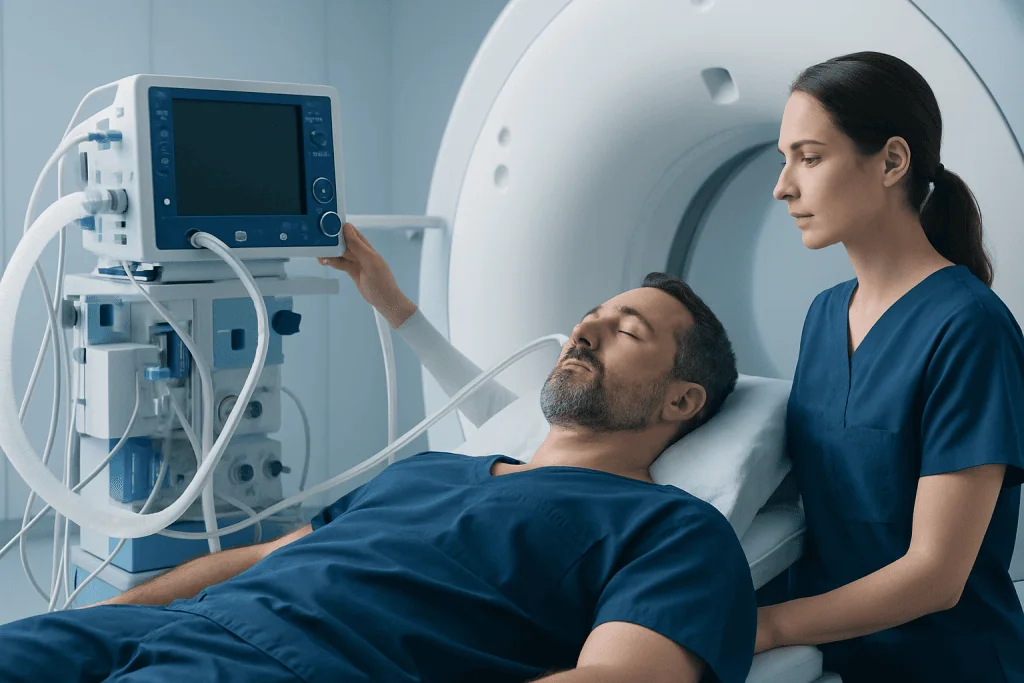
Before you reserve a sedated imaging appointment, establish whether sedation is recommended, optional or not appropriate for your situation. Some patients complete an MRI with coaching, music, a mirror or prism glasses, a wider-bore scanner where available, or a feet-first position for certain scans. Others genuinely need pharmacological support, young children, patients with movement disorders, severe pain, or claustrophobia that has already defeated a previous scan attempt.
Then ask about the process itself. Who assesses your fitness for sedation, and is that a separate consultation or part of the same visit? Who is present during the scan, and what monitoring is used? Where does recovery happen, how long does it typically last, and what does the team check before letting you leave? These are practical safety questions, not signs of mistrust, and a well-run imaging department will answer them without hesitation.
Useful questions to put in writing:
- Is sedation necessary for this scan, or are there non-sedation options worth trying first?
- Do I need a separate anaesthesia consultation, and can it happen the day before rather than the same morning?
- What are the exact fasting instructions for food, milk, formula, water, coffee and medicines?
- Can I take my usual heart, blood pressure, diabetes, seizure or anxiety medicines on the day?
- Will an interpreter be available during admission, consent and discharge instructions?
- How long should I plan to stay in the city after the scan before flying?
Turkey-specific planning also matters. Because sedation appointments involve more moving parts than a plain scan, guides on how to prepare for a sedation procedure in Turkey and why arriving early for tests matters cover the logistics side in more depth.
Fasting, medications and medical history

Fasting instructions are the single most important detail to get in writing. They differ by age, sedation level, medical condition and appointment time, and they are stricter for deeper sedation. General internet advice is not a substitute here: the team responsible for your sedation gives instructions that fit your case, and those are the only instructions that count. If you accidentally eat or drink outside the allowed window, the honest move is to say so: the scan may be delayed, but a delayed scan is safer than a hidden breakfast. If fasting affects other plans that day, it helps to plan your meals around the test in advance.
Share a complete medication and supplement list before the appointment: blood thinners, diabetes medicines and insulin, blood pressure tablets, seizure medicines, sleep aids, psychiatric medicines, pain medicines and herbal products. Some are continued as normal, some need timing adjustments, and some require specific planning around the sedation. None of that is a decision you make yourself, never stop or change a prescribed medicine unless your treating doctor or the hospital team specifically instructs it.
Your medical history shapes the sedation plan more than most patients realise. Mention allergies, asthma, sleep apnoea, heart or lung disease, reflux, previous problems with anaesthesia, the possibility of pregnancy, recent infections, loose teeth, and any history of difficult IV access. If the scan is an MRI, the team will additionally screen for pacemakers, implants, metal fragments, shunts, cochlear implants, clips, pumps and other devices, because MRI safety depends on knowing exactly what is in your body. Bring the device card or documentation if you have one: a make and model on paper answers questions a memory cannot.
What the day actually looks like
Arrive earlier than you would for a non-sedated scan. Registration, identity checks, interpreter support, consent, safety screening, IV placement and nursing assessment all take time, and rushing any of them helps no one. Expect to answer the same safety questions more than once, fasting status, allergies, implants. The repetition is deliberate and is one of the ways hospitals prevent mistakes.
You may be asked to change clothes, remove jewellery and metal items, and confirm recent test results. For children, comfort items can help, but check first: some toys and blankets contain metal or electronics and are not suitable in MRI areas.
After the scan, you move to a recovery area until the team is satisfied you are awake, stable and safe to leave with instructions. There is no fixed clock on this, recovery lasts as long as it needs to. Afterwards you may feel sleepy, unsteady, emotional, nauseated or simply flattened for the rest of the day. The part patients underestimate: even when you feel fine, coordination and judgement can remain affected for hours. That is why the restrictions on driving, alcohol, machinery and important decisions apply even to people who feel completely recovered.
Companion, interpreter and travel arrangements
Plan for a responsible adult to be with you at discharge and for the rest of the day. After sedation you should not expect to return to a hotel alone, navigate public transport without support, care for children unaccompanied, drive, or sign anything consequential until the restriction period given by the team has passed. Hospitals generally want to know in advance if a patient is travelling alone, because it changes how the discharge is planned. The guide on when you need someone with you after sedation or anaesthesia in Turkey explains these escort expectations in detail.
Language access matters most on sedation days, because the highest-stakes conversations, fasting rules, consent, allergies, medication timing, discharge guidance, all happen on this one day. Ask about interpreter support when you book: it works best when the preferred language is named in advance rather than requested on the morning of the scan, particularly for appointments involving a child.
Build slack into your schedule. A sedated scan can run long if the anaesthesiology review raises a question, if additional safety checks are needed, if recovery takes longer than average, or if the radiologist wants extra sequences. Avoid same-day flights, long road transfers and back-to-back medical appointments unless the hospital has confirmed the timing works. On flying specifically, the honest answer is that it depends on the sedation used, your condition and the reason for the scanthis guide on flying home after sedation or anaesthesia walks through how that decision is made.
Children, anxiety and special needs
Children are the most common reason sedation is discussed for imaging, simply because a scanner demands stillness in a strange, noisy environment. Ask whether child-friendly preparation is available, whether a parent can stay nearby during preparation and recovery, and what the fasting rules are for breast milk, formula, water and solid food: they differ by age and are often more permissive for clear fluids than parents expect, but only the team’s written instructions apply. Bring the child’s records, recent illness details if relevant, and notes from any previous sedation or anaesthesia.
Adults with autism, dementia, developmental differences, severe anxiety, trauma history, chronic pain or movement difficulties may also need a tailored plan. Tell the team what actually helps you cooperate: quiet step-by-step explanations, extra time, a familiar companion, avoiding specific triggers, or positioning support. These details sound small and change outcomes.
If claustrophobia is the main issue, ask about the non-sedation toolkit before committing to sedation: appointment timing, breathing coaching, music, continuous communication through the scanner, and, where safe and permitted, a companion in the room. Sedation is a legitimate answer for some patients. It is not the only comfort pathway, and it is not the first one to try for most adults.
How sedation affects cost and scheduling
Patients often search for a single price for a scan, a full-body MRI, for instance, and the honest answer is that no meaningful single figure exists, because a quote depends on variables that differ from patient to patient. For imaging with sedation, a written quote typically reflects: the type of scan and how many body regions are covered, whether contrast is used, the level of sedation planned and the anaesthesiology team’s involvement, whether a separate pre-sedation consultation is needed, and the length of recovery observation. Ask for the quote in writing and ask what it includes: the scan, the sedation, the anaesthesiology review, the radiology report and copies of the images are sometimes itemised separately.
Scheduling follows the same logic. A sedated scan occupies a longer appointment slot, may need to be placed on a day when the sedation team is available, and can shift if a pre-assessment raises a question. If your imaging is part of a wider treatment plan, it also has to fit around other appointments: the guide on organising your days between tests and treatment in Turkey covers that planning in more depth, including what happens when unexpected tests shift the schedule.
Results, follow-up and going home
Sedation for imaging tests in Turkey helps you complete the scan; it does not speed up the radiology report. Reporting time depends on the imaging type, its complexity and the hospital workflow. Before you leave, confirm when and how results will be shared, whether the images can be provided digitally, and which doctor will explain the findings, especially if you are seeing several specialists during one trip.
Make sure you understand the written recovery instructions before discharge, including what is expected after sedation and what the team considers unusual. Keep all imaging files, reports, discharge notes and medication instructions together for the journey home; a doctor abroad can work with a complete file and struggles with a partial one. And when the schedule feels tight, choose the slower, safer version of the day over the rushed one: a scan that had to be repeated because of a rushed plan costs far more time than an extra night in a hotel.
Step by step
- Share your scan request and health background. Provide the imaging request, the reason for the scan, previous reports and a full medication list before the appointment. Mention anxiety, claustrophobia, mobility issues, special needs, implanted devices, allergies and any prior anaesthesia concerns.
- Ask whether sedation is necessary or alternatives exist. Not every anxious patient or every child needs sedation. Ask whether the scan can be completed with preparation, positioning support, communication through the scanner, a shorter protocol or another comfort measure.
- Confirm the assessment process. Establish whether an anaesthesiologist or sedation-trained clinician reviews you before the test, and whether that happens on the same day or in advance: this matters most if you are travelling specifically for the imaging.
- Get fasting and medication instructions in writing. Know exactly when to stop food and drink and which medicines to take or hold. If you have diabetes, heart disease or epilepsy, or take blood thinners, ask for instructions specific to your case.
- Plan your companion and transport. Arrange a responsible adult for after the sedation and do not plan to return to the hotel alone. Request any transfer, wheelchair or interpreter support before the appointment day, not on it.
- Keep the day flexible. Registration, screening, preparation, the scan, recovery and discharge instructions all take time. Do not schedule tight flights, demanding sightseeing or major decisions for the same day.
- Leave with results arrangements and instructions. Confirm how you will receive the radiology report and images, and take the written discharge guidance with you before leaving the recovery area.
Your checklist
- Passport or official ID and appointment confirmation
- Imaging request, previous scans, reports and discharge summaries
- Full medication list with doses, including supplements and injections
- Allergy history and notes on any previous anaesthesia or sedation problems
- Implant, pacemaker, stent, shunt or pump documentation for MRI safety screening
- Written fasting and medication instructions from the hospital team
- Comfortable clothing without metal details, if suitable for the test
- A responsible adult companion for discharge after sedation
- Interpreter request and transfer plan arranged in advance, if needed
- Hotel address, local phone number and emergency contact details
Key takeaways
- Sedation for imaging is planned, assessed and monitored: it is never a simple add-on to a scan booking.
- Fasting, medication and escort instructions must come in writing from the team responsible for your sedation, and only theirs apply.
- Tell the team early about anxiety, special needs, implanted devices, allergies and previous sedation experiences: these details shape the plan.
- After sedation you need recovery time, a responsible adult companion, and a schedule with no same-day flights or major decisions.
- Costs and timing depend on the scan type, sedation level and team involvement; ask for a written, itemised quote rather than a single figure.
Frequently asked questions
What kind of sedation is used for a CT scan?
Often none: a CT scan usually takes only minutes, so most adults complete it awake. When sedation is used, typically for young children or patients who cannot stay still even briefly, it is commonly at the lighter end of the spectrum, though the level is decided case by case after a medical assessment. Deeper sedation or anaesthesia is reserved for specific situations.
Can I get sedation for an MRI scan?
Sedation is possible for MRI when severe claustrophobia, anxiety, pain or an inability to stay still would otherwise prevent a usable scan. It is not automatic: the medical team assesses whether sedation is appropriate for your age, health and scan type, and may first suggest non-sedation strategies such as coaching, music or a different position, which work for many patients.
Do they sedate you for interventional radiology?
Often, yes. Image-guided procedures such as biopsies and drain placements commonly use moderate sedation combined with local anaesthetic, and some procedures use deep sedation or general anaesthesia. The level depends on the procedure and your health, so ask specifically what is planned, who administers it and what recovery it involves.
How much does a full-body MRI cost in Turkey?
There is no single meaningful figure, because the price depends on how many body regions are scanned, whether contrast is used, whether sedation and an anaesthesiology team are involved, and what the quote includes: the report, digital images and any consultation may be itemised separately. Ask for a written quote that lists exactly what is covered before you commit.
Will I need to fast before a sedated imaging test?
Usually some fasting applies, but the exact rules depend on your age, health and the sedation level planned. Get written instructions covering food, water, coffee, milk, formula and medicines, and follow only those. If you accidentally eat or drink outside the allowed window, tell the team immediately: a delayed scan is safer than an undisclosed one.
Can my child be sedated for imaging?
Children sometimes need sedation to complete scans that require stillness, and the plan is always individualised. Ask about child-friendly preparation, the fasting rules for milk and formula, whether a parent can stay nearby during preparation and recovery, and bring details of recent illnesses, allergies and any previous sedation or anaesthesia experiences.
How long will I stay in the hospital after sedation?
Recovery time varies with the sedation used, your health and how quickly you become alert and stable. There is no fixed clock: the team observes you until agreed discharge criteria are met, and that can take longer than planned. Keep the rest of the day free and avoid tight travel arrangements.
Can I fly home the same day as a sedated scan?
Plan not to. Coordination and judgement can be affected for hours even when you feel well, and the safe interval before flying depends on the sedation used, your condition and the reason for the scan. The restriction period comes from the team that treated you, build your itinerary around it rather than against it.
Add us as a Preferred Source to see more of our trusted health content across Google Search, AI Overviews and Discover.

Update history
- PublishedJune 16, 2026
- Medical review approvedSeptember 13, 2026
- Last content updateSeptember 12, 2026
References2
- MRI scan: NHS nhs.uk
- Conscious sedation for surgery and procedures: MedlinePlus medlineplus.gov
More Patient Guides
Sleep Apnea Testing in Turkey: What Happens During Your Evaluation
Sleep apnea testing in Turkey may include a consultation, overnight sleep study or home test, and a clear review of your results…

How to Organize Your Test Results Before Traveling to Turkey
Organize your test results before traveling to Turkey by sorting records, images, medicines and timelines so your Istanbul care team can review…

When Extra Tests Are Needed Before Treatment in Turkey
Extra tests before treatment in Turkey may be needed to confirm diagnosis, timing, and safety. Here is what you can expect in…

At Acibadem, How to Prepare for Blood Tests, Scans, and Pre-Op Checks
Blood tests, scans, and pre-op checks at Acibadem in Turkey help confirm you are ready for treatment and avoid delays on the…