Thigh Lift
A thigh lift is a body-contouring surgery that removes excess skin and fat from the thighs, improving leg shape after weight loss, aging, or skin laxity.

Quick answer
A thigh lift (thighplasty) is a surgical procedure that removes excess skin, and sometimes localised fat, from the inner or outer thighs to create a smoother leg contour. It is most often chosen after major weight loss, when stretched skin no longer matches body size. Performed under general anaesthesia, it uses incisions in the groin crease or along the inner thigh, with light activity resuming within one to two weeks.
Thigh Lift: Understanding the Decision
A thigh lift is a surgical procedure that removes excess skin, and, where needed, localised fat, from the upper legs to give the thighs a smoother, firmer contour. It is designed for people whose main problem is loose, hanging or folded skin rather than fat alone, most often after significant weight loss, pregnancy, ageing or years of weight fluctuation. Because the operation leaves permanent scars and holds its result best at a stable weight, it suits people who have finished changing their body size and now want their skin to match it.
The thighs are one of the most stubborn areas of the body to reshape. Even with disciplined nutrition and regular exercise, skin that has been stretched over a long period may not contract on its own. That can leave loose folds along the inner thighs, soft tissue that rubs with every step, and an uneven leg contour that dictates what you can comfortably wear. Exercise strengthens the muscle underneath; it does nothing for skin that has lost its elastic support. When laxity, not fat, is the real issue, removing the redundant skin surgically is the only reliable way to correct it.
Choosing body-contouring surgery is a personal decision, and most people arrive at it with a mix of hope and hesitation. Will the scars be visible? How long does recovery genuinely take? Will the result look natural? For international patients there is an extra layer of practical questions, which is why a thigh lift in Turkey is one of the more heavily researched body-contouring options: people want to understand not only the operation itself but travel timing, communication and follow-up before they commit to anything.
This page explains what a thigh lift can and cannot do, the different surgical patterns, how the operation is performed, what recovery involves, the risks worth understanding, and what actually determines the price. At Acibadem, thigh lift surgery sits within a hospital-based surgical pathway that emphasises patient safety, individualised planning and plain communication before any treatment decision is made.
What Is a Thigh Lift (Thighplasty)?
A thigh lift, also called thighplasty, is a plastic surgery procedure that removes excess skin and soft tissue from the thighs to improve the contour of the upper legs. It is most commonly performed on the inner thighs, where skin laxity tends to be most visible and most uncomfortable, although some patients need correction of the outer thigh or a wider lower-body contouring plan. When loose skin and localised fat coexist, the procedure may be combined with liposuction to refine the shape further.
The distinction between fat and skin matters more than anything else in planning thigh lift surgery. Liposuction reduces fat volume, but it does not reliably tighten skin that has been significantly stretched. If elasticity is poor, removing fat without removing skin can leave the sagging unchanged, or make it look worse, because the deflated skin has even less underneath to support it. A thigh lift allows the surgeon to excise the redundant skin, reposition the remaining tissue and close the area under controlled tension, so the thigh sits smoothly against the leg instead of folding over it.
Although the word “lift” suggests simple elevation, the operation is really a combination of three things: skin removal, tissue reshaping and careful closure. Every plan balances contour improvement against scar placement, tension on the wound and protection of the lymphatic channels that drain the leg. That balance is why the preoperative assessment matters as much as the time in the operating theatre.
How can I get rid of thigh fat?
If your real concern is fat rather than loose skin, and you are asking how can I get rid of thigh fat, the honest first answer is not surgery: sustained changes to diet and activity reduce body fat overall, including in the thighs, although no exercise can target one area selectively. When stubborn deposits persist at a stable, healthy weight, liposuction can remove localised fat. A thigh lift only enters the picture when skin laxity is part of the problem, either on its own or alongside fat. During examination, a surgeon distinguishes between the two by assessing how much tissue can be gathered, how far the skin descends when standing, and how quickly it recoils when released. That assessment, not the mirror alone, determines which procedure is actually appropriate.
Types of Thigh Lift Surgery
A thigh lift is not one standard operation. The incision pattern is chosen to match where the laxity sits, how much skin must be removed, and how much scarring the patient is willing to accept in exchange for the correction. Broadly, the options run from a short scar hidden in the groin crease to longer incisions along the inner thigh, and, in patients after massive weight loss, patterns that also address the outer thigh and hip.
What is a mini thigh lift?
A mini thigh lift is a limited version of the procedure that uses a short incision placed high in the groin crease to tighten mild looseness in the upper inner thigh. Because the scar is short and sits largely within the natural fold, it appeals to patients with early or modest laxity who want the least visible scarring possible. Its limitation is equally clear: a groin-crease incision can only lift tissue near the top of the thigh. Skin that hangs further down the leg, or laxity that runs around the circumference of the thigh, cannot be corrected this way. A mini thigh lift performed on the wrong candidate produces a small scar and an unchanged thigh.
Medial (inner) thigh lift
A medial thigh lift addresses more significant inner-thigh laxity with an incision that typically begins in the groin and, when the excess runs vertically down the leg, extends along the inner thigh toward the knee. This vertical component allows the surgeon to remove skin along the whole length of the thigh rather than only at the top, which is why it is the workhorse technique after substantial weight loss. The trade-off is a longer scar on the inner leg, usually positioned so the legs conceal it when standing, but visible when the thighs are apart. Patients weighing this option should understand the exchange plainly: more correction requires more incision.
Outer, spiral and extended patterns
Some patients, particularly after major weight loss, have laxity that is not confined to the inner thigh. The outer thigh and hip may have descended together with the buttock, producing looseness that runs around the leg. In these cases the surgeon may recommend an extended or so-called spiral pattern that wraps further around the thigh, or may plan the thigh lift as one stage of a broader programme that also treats the abdomen, hips and buttocks. When several regions need correction, staging the surgery, rather than operating on everything at once, is often the safer route; a post-bariatric body lift is frequently sequenced with thigh surgery in exactly this way.
Who Is a Good Candidate for a Thigh Lift?
A thigh lift may be appropriate for adults with excess thigh skin that does not improve adequately with lifestyle measures. The most common background is substantial weight loss, including weight loss after bariatric surgery. Ageing, genetic skin laxity and repeated weight fluctuation produce the same problem by a slower route. Some candidates are already at a stable weight with good muscle tone: the muscle simply cannot be seen beneath skin that no longer fits.
Typical concerns include skin folds on the inner thighs, rubbing or chafing when walking, irritation in skin creases, difficulty wearing fitted clothing, or the persistent sense that the thighs look heavier than the rest of the body even after weight reduction. Not everyone is motivated by appearance. Many patients care most about hygiene, mobility or the daily discomfort of friction, reasons that are just as valid and often easier to assess objectively.
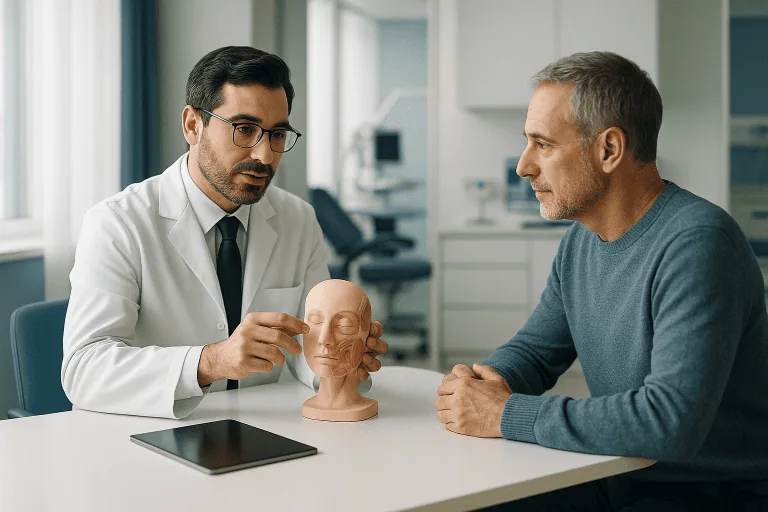
The assessment itself is clinical, not cosmetic guesswork. During consultation, the plastic surgeon examines skin elasticity, fat distribution, scar history, thigh circumference, tissue quality and how the thighs relate to the surrounding areas. Medical photographs are usually taken for planning. The review also covers general health, previous surgery, current medications, smoking status, any history of blood clots, weight stability and future weight goals.
Weight stability deserves emphasis. If further major weight loss is expected, surgery is usually better postponed until the weight has settled, because ongoing changes can undo the result, loss creates new laxity, gain stretches the repair. For post-bariatric patients, nutritional status matters too: protein levels, vitamin deficiencies and anaemia all affect wound healing and may need to be assessed and corrected before an operation is scheduled.
Finally, a thigh lift is not a weight-loss operation. It is a contouring procedure for people whose weight is reasonably stable but whose skin no longer matches their body. Good candidates are typically non-smokers, or genuinely willing to stop all nicotine use around surgery, able to follow recovery instructions for several weeks, and realistic about both the improvement and the permanent scars that come with it.
Concerns a Thigh Lift Can Address
The most common indication is loose skin after significant weight loss. Skin stretched over a long period loses the elastic fibres that would normally pull it back, leaving hanging tissue that affects comfort and proportion even once a healthier weight is achieved. This is a structural problem in the skin itself, no cream, machine or exercise regime restores elastic fibres that have failed.
Age-related relaxation is the second broad group. Collagen and elastin support declines over time, the skin becomes thinner and less resilient, and gravity gradually produces folds along the inner upper leg. When this change is mild, non-surgical management or simply monitoring may be reasonable. When the redundancy is significant, surgery is the only intervention that removes it.
Functional discomfort is a distinct and often underestimated indication. Loose inner-thigh skin can rub during walking, sport and ordinary daily movement, causing redness, rashes, folliculitis, odour, skin breakdown or repeated irritation, symptoms that tend to worsen in warm weather. A thigh lift reduces the overlapping skin and improves access for hygiene, although any active skin infection or inflammation should be treated and settled before elective surgery is planned.
For many post-bariatric patients, the thighs are one of several areas with redundant skin, and the thigh lift becomes part of a staged body-contouring programme. Staging keeps each operation to a safe length, allows recovery between procedures, and lets the plan adapt to the patient’s priorities, some people want the abdomen addressed first, others the thighs, depending on which affects their life most.
Liposuction may be combined with the lift when fat deposits remain and skin removal alone would not achieve the intended contour. In selected patients it also helps thin the tissue before the skin is excised. But in the inner thigh, restraint matters: blood supply and lymphatic drainage must be protected, because overly aggressive tissue handling in this region can lead to prolonged swelling.
How Thigh Lift Surgery Is Performed
Consultation and preparation
The process begins well before the operating room. A careful consultation establishes whether surgery is appropriate at all and which technique fits your anatomy. For international patients, a preliminary review of medical history, photographs and previous records is often carried out remotely, but a final in-person examination is always necessary before surgery, because skin quality, tissue mobility and incision planning must be assessed by hand and eye, not by photograph.
Preparation includes a medical evaluation and, where indicated, laboratory tests and an anaesthesia assessment. The surgical team reviews your full medication and supplement list; any adjustment around the operation is decided and directed by them, not managed on your own. Patients are asked to stop smoking and avoid all nicotine products, cigarettes, vaping, patches, gum, for a defined period before and after surgery, because nicotine narrows blood vessels and impairs the blood flow that healing incisions depend on. Post-bariatric patients may need nutritional optimisation first: adequate protein, corrected iron and vitamin levels, and good hydration all feed directly into wound healing.
What happens in the operating room
On the day of surgery, the sequence is deliberate and follows established safety protocols, patient identification, anaesthesia monitoring, infection-prevention measures and positioning that protects nerves and pressure points. A typical thigh lift proceeds through these steps:
- Step 1: Marking while standing. The surgeon draws the incision pattern with you upright, because gravity changes where the tissue sits. These markings determine how much skin can safely be removed and where the final scars are intended to lie, and they are discussed with you before anything else happens.
- Step 2: Anaesthesia. Thigh lift surgery is usually performed under general anaesthesia, with continuous monitoring of vital signs throughout.
- Step 3: Liposuction, if planned. When contouring fat removal is part of the plan, it is often done early in the procedure. A sterile fluid is first introduced into the area to reduce bleeding and make fat removal easier and gentler on the tissue.
- Step 4: Skin excision. The surgeon removes the planned excess skin and soft tissue along the marked pattern, checking tension as the tissue is brought together.
- Step 5: Deep support. Deeper supportive sutures anchor the tissue and take tension off the skin edges, which protects the closure and helps maintain the new contour over time.
- Step 6: Layered closure. Because the inner thigh moves constantly and is prone to moisture and tension, a careful, layered closure is one of the most important parts of the operation. Drains may be placed to remove fluid that can collect under the skin; in other cases the surgeon uses closure techniques that reduce the need for them.
- Step 7: Dressings and compression. Dressings and a compression garment are applied to support the tissues, limit swelling and protect the incision lines.
How long the operation takes depends on the technique, whether liposuction is included and whether another body-contouring procedure is performed in the same session. Many thigh lifts take several hours; the exact duration is individual and is discussed with you beforehand.
Where technology fits in
Technology supports every stage of the pathway, though its value lies in how the team uses it rather than in the equipment list. Preoperative photography and imaging support planning and documentation. Modern anaesthesia systems track vital signs continuously. In theatre, refined liposuction systems, specialised instruments and energy devices for bleeding control may be used according to the plan. After surgery, structured monitoring and follow-up systems help the team pick up concerns early, when they are easiest to manage.
Immediately after the operation
You wake in a recovery area where nurses and physicians monitor breathing, circulation, pain control, nausea and your first steps out of bed. Depending on the extent of surgery and your individual risk profile, you may be observed and discharged to your accommodation, or stay in hospital: this is decided on medical grounds, not by a fixed schedule. International patients should plan to remain locally for an early follow-up period so the surgical team can examine the incisions, manage or remove drains if they were used, and confirm that travel is safe before anyone boards a plane.
Recovery After a Thigh Lift
Recovery varies with the technique used, your individual healing and whether procedures were combined, but most patients move through recognisable stages. Swelling, bruising, tightness and soreness are expected in the first days. Walking is encouraged early, usually with a slightly cautious, shortened stride to reduce tension on the incisions, while strenuous exercise, heavy lifting, wide leg movements and prolonged unbroken sitting are avoided until the surgeon clears them.
| Time Period | What Patients Can Expect |
|---|---|
| Day 1 | Monitoring after anaesthesia, dressings and compression in place, soreness and tightness, early assisted walking, and instructions for incision care. |
| First Week | Swelling and bruising are common. Movement is cautious, drains are managed if used, and follow-up visits assess wound healing. |
| First Month | Many patients return to light routines. Compression may continue, incisions are still maturing, and strenuous activity remains restricted until approved. |
| Six to Twelve Weeks | Swelling decreases, walking becomes more natural, and a gradual return to exercise may be allowed depending on healing and surgeon guidance. |
| Longer Term | Contour continues to refine as tissues settle. Scars gradually soften and fade, although they remain permanent and need ongoing sun protection. |
How should you sit after a thigh lift?
Sit with your hips only gently bent and your knees comfortably apart within your surgeon’s guidance: the goal is to avoid sharp hip flexion and wide leg positions that pull on the groin and inner-thigh incisions. In practice, that means favouring slightly reclined positions over low, deep chairs, avoiding crossing your legs, and using a firm cushion so you are not sinking into a fold at the hip. Just as important as how you sit is how long: stand and walk for a few minutes at regular intervals rather than sitting for hours at a stretch, both to protect the incisions and to support circulation. Your surgeon will tailor positioning advice to your exact incision pattern, because a groin-crease scar and a vertical inner-thigh scar tolerate different movements.
Pain, swelling and compression
Discomfort is real in the first days but manageable with a structured plan; it is worth reading in advance about what patients can expect from pain control after surgery in Turkey so you know what is normal and what your options are. Swelling behaves differently here than in some other procedures: the inner thigh drains through lymphatic channels that the surgery inevitably disturbs, so swelling can linger longer than patients expect, particularly toward the knee. The compression garment is your main tool against it, worn as prescribed, usually for several weeks, along with walking, elevation when resting, and patience.
Returning to work and exercise
Most patients can return to light daily activities within the first one to two weeks, though the timeline is individual. Desk-based work is usually possible earlier than physically demanding work, and anything involving prolonged standing, lifting or leg strain needs longer. Vigorous exercise is typically delayed for several weeks and reintroduced gradually with the surgeon’s approval. The final contour is not what you see at two weeks: it continues to develop over months as swelling resolves and the tissues settle into their new position.
Scars and Long-Term Results
Scars are the permanent price of a thigh lift, and honest planning treats them as a central topic rather than a footnote. Where the scars lie depends on the technique: within the groin crease for a mini lift, along the inner thigh for a medial lift, extending further for spiral or combined patterns. Incisions are placed where anatomy allows them to be most discreet, but they never disappear.
Scar maturation follows a predictable arc. In the early months, scars are typically pink, firm and sometimes slightly raised. Over the following months they gradually soften, flatten and fade: a process that varies from person to person, since some people naturally form fine flat scars while others are prone to thickened or pigmented ones. Scar care usually includes silicone products, strict sun protection, massage once the surgeon approves it, and review at follow-up so any scar that is maturing poorly can be treated early.
The result itself is long-lasting when weight remains stable. The skin that was removed does not come back, but the operation does not stop time: natural ageing continues, and significant weight gain or loss after surgery will change the contour again. A stable weight, adequate protein intake, hydration and regular activity are the maintenance plan, unglamorous, but effective.
What do thigh lift before and after photos actually tell you?
Thigh lift before and after photographs are genuinely useful for understanding the realistic range of outcomes, provided you read them critically. Look for patients whose starting point resembles yours: someone with mild laxity corrected through a groin-crease incision tells you nothing about what a vertical medial lift will achieve after massive weight loss. Check that the “after” images were taken at least several months after surgery, once swelling has settled and scars have begun to mature, and that lighting, angle and posture match between the two images. Most importantly, ask to see the scars, not just the contour: a photograph framed to hide the inner thigh is answering a different question from the one you are asking.
Risks and What Shapes a Good Result
Is a thigh lift risky?
A thigh lift carries the risks of any significant operation, plus a few specific to the region, for suitable patients in a properly equipped hospital these risks are actively managed, but they are never zero. Possible complications include bleeding, infection, fluid collection under the skin (seroma), delayed wound healing, changes in skin sensation, asymmetry, visible or widened scars, contour irregularities, blood clots, and the possibility of revision surgery. Wound-healing problems deserve particular respect here because the inner thigh is mobile, warm, close to the groin and under constant tension when you walk, conditions that test any incision. Nicotine use, poorly controlled diabetes and excessive closure tension all raise the risk further. Informed consent is not a signature on a form; it is a detailed conversation about these risks, the alternatives and the limits, weighed against your personal health profile.
Beyond complications, several factors shape how good the final result can be. Skin quality comes first. Patients with moderate laxity and resilient tissue tend to heal with a smoother contour and less prolonged swelling. After major weight loss, the skin is often thinner and less elastic, and the laxity more extensive, surgery is still very much possible, but it may require a longer incision, staged treatment and franker expectation-setting.
Weight stability protects the result. Significant gain after surgery stretches the repaired skin; significant loss creates new looseness. Surgeons therefore recommend operating at a weight you can realistically maintain, not at a temporary low point reached through an unsustainable effort.
Nicotine is the modifiable risk that matters most. By narrowing blood vessels and reducing oxygen delivery to healing tissue, it directly increases the chance of wound breakdown, which in this operation means widened scars or open wounds on the inner thigh. Diabetes, anaemia, clotting disorders, immune conditions and certain medications also affect risk and are managed in coordination with the relevant specialists before surgery.
Surgical technique carries its own weight. The surgeon must remove enough tissue to change the contour meaningfully, but not so much that the closure becomes overly tight, excess tension invites wound separation, widened scars and irregularities. In the inner thigh, preserving lymphatic drainage is critical, because careless dissection leads to persistent swelling. This is precision work, and it rewards experience.
Finally, your own behaviour after surgery has a direct effect. Walk early, but avoid straining the incisions. Wear the compression garment as prescribed. Attend every follow-up appointment, especially as an international patient, because early issues such as fluid collection or delayed healing are far easier to manage when they are recognised promptly rather than discovered weeks later at home.
Thigh Lift Cost: What Actually Determines the Price
How much does a thigh lift cost?
There is no single honest number, because thigh lift cost is driven by the scope of your individual operation. A short groin-crease lift takes far less operating time than an extended vertical or spiral lift after massive weight loss. Adding liposuction adds time; combining the thigh lift with another body-contouring procedure changes the anaesthesia plan and the hospital stay; drains, garments, medications and follow-up visits all sit somewhere in the final figure. A meaningful quote is only possible after a surgeon has examined your skin and defined the plan: a fixed price offered before any assessment is a reason for caution, not reassurance. When comparing quotes for surgery in Turkey, ask exactly what a package includes and what falls outside it: hospital charges, anaesthesia, the number of follow-up visits, garment costs, extended accommodation if healing is slower than hoped, and the clinic’s policy if a revision is ever needed.
What about full body skin removal surgery cost?
Full body skin removal surgery cost is a different calculation from a thigh lift alone, because removing redundant skin from several regions, thighs, abdomen, arms, back, chest, is almost always staged across more than one operation. Each stage carries its own operating time, anaesthesia, hospital care and recovery period, so the total reflects how many regions need treatment and in how many sessions. Staging is a safety decision, not a billing strategy: limiting each operation’s length reduces risk and gives the body time to heal between procedures. If you are considering full-body contouring, ask for the whole staged plan in writing before comparing anything, so you are weighing complete pathways against each other rather than single procedures against multi-stage programmes.
How much is a mini thigh lift?
A mini thigh lift generally sits at the lower end of a clinic’s thigh lift pricing, because it involves a shorter incision, less operating time and usually a shorter recovery under supervision. But suitability should decide, not price: a mini lift performed on someone who actually needs vertical skin excision costs less and changes almost nothing. The cheaper operation is only the better operation when it is also the right one for your anatomy.
Why Acting Early Can Matter
A thigh lift is elective, which means it can be planned calmly rather than rushed. Even so, postponing the evaluation itself has costs. Repeated thigh chafing can lead to irritation, rashes, folliculitis, skin breakdown or recurrent inflammation in the skin folds, problems that affect walking, exercise tolerance, hygiene and quality of life long before anyone reaches an operating room.
For people who have lost a significant amount of weight, excess skin can become a daily reminder of a difficult health journey. Some delay consultation out of worry they will be told to lose more weight first, or because discussing the area feels uncomfortable. It helps to separate two things: a consultation is not a commitment. Its purpose is to clarify whether the issue is mainly skin, mainly fat, or both, and whether now is the right time or the wrong one.
Early planning matters even more for patients travelling from abroad. Body-contouring surgery needs time for medical review, travel coordination, preoperative tests, postoperative follow-up and a safe journey home. If nutritional optimisation, smoking cessation, weight stabilisation or management of another condition is needed first, identifying that early makes the eventual surgery safer and more predictable.
Delay also shifts what is achievable. Skin quality changes with age, weight fluctuation, sun exposure and hormonal factors, and while surgery can improve contour at many stages of life, a timely evaluation lets the surgeon recommend the most appropriate approach before additional laxity or functional symptoms accumulate. The decision itself should still be made without pressure, on medical suitability and personal goals.
Benefits of Thigh Lift Surgery
The potential benefits are both physical and personal, and they depend on your anatomy, the surgical plan and how healing progresses.
| Benefit | What It Means for You |
|---|---|
| Removal of excess thigh skin | Loose folds can be reduced, creating a smoother contour and improving the shape of the upper legs. |
| Improved comfort with movement | Less skin rubbing may make walking, exercise and daily activities more comfortable for appropriate patients. |
| Better clothing fit | Trousers, dresses, swimwear and fitted garments may sit more comfortably when redundant tissue is reduced. |
| Enhanced hygiene in skin folds | Reducing overlapping skin may help decrease moisture trapping and irritation in selected patients. |
| More balanced body contour | The thighs may appear more proportionate in relation to the abdomen, hips, buttocks and lower body. |
| Long-lasting improvement with stable weight | Results can be maintained over time when weight is stable and healthy habits continue, although natural ageing goes on. |
Coming to Turkey for a Thigh Lift: How the Pathway Works
For international patients, a thigh lift in Turkey is less about the flight and more about sequencing. The pathway usually begins remotely: medical history, photographs, previous weight-loss or bariatric records and current medication lists are reviewed before travel, so that by the time you arrive, the likely plan, the expected length of stay and any preparatory steps are already understood. The final surgical decision is still made in person, after direct examination.
A typical care pathway on the ground runs: in-person consultation and any outstanding tests shortly after arrival; the operation; a period of hospital observation as medically appropriate; then a series of local follow-up visits during which dressings are checked, drains are managed if used, and healing is assessed. It is worth understanding when to arrive before surgery in Turkey, because arriving too close to the operation date compresses the assessment and leaves no room for adjustments.
The return journey is a medical decision, not a calendar entry. Flying too soon after body-contouring surgery raises practical and medical concerns, so the clearance to travel comes from the surgical team once healing supports it: the guide on when it is safe to fly home after surgery in Turkey explains the reasoning in detail. Build flexibility into your booking rather than a fixed early return.
Follow-up does not end at the airport. Before departure, patients typically receive written postoperative instructions, documentation of the operation, and a plan for remote follow-up communication with the surgical team. For those continuing recovery at home, coordination with a local physician may be recommended so that garment weaning, scar care and any later questions have a nearby point of contact as well as a remote one.
Practicalities are simpler than most people fear, but they reward planning: accommodation within easy reach of the hospital for the follow-up period, loose comfortable clothing that does not press on the inner thigh, and a travel companion for the first days if possible. None of this is complicated: it simply works better decided in advance than improvised after surgery.
Thigh Lift Surgery at Acibadem
Thigh lift patients at Acibadem are treated within a full hospital environment rather than an isolated clinic. That distinction matters most for the patients who need it: after massive weight loss, with complex medical histories, or when procedures are combined, having anaesthesia teams, nursing care, laboratory services and medical consultation available within one system is a genuine safety consideration, not a marketing point.
Care is individualised rather than built around a single standard incision. Plastic surgeons assess the pattern of laxity, fat distribution, scar preferences, body proportion and functional symptoms before recommending a technique, and when the medical background is complex, they coordinate with the relevant specialists in anaesthesia, internal medicine and nutrition. Patients who have had bariatric surgery, at Acibadem or elsewhere, are evaluated with that history fully in view.
Perioperative care follows structured, evidence-based protocols: preoperative risk assessment, anaesthesia planning, infection prevention, measures to reduce blood-clot risk, pain management, early mobilisation and wound-care follow-up. In body contouring these details are not background administration: a refined result depends as much on safe recovery and attentive monitoring as on the incision itself.
Privacy and dignity carry particular weight in this kind of surgery. A thigh lift involves areas of the body that can feel difficult to discuss and examine, and a professional environment, clear explanations, unhurried consultations, respectful communication, makes it easier to reach a decision without pressure. The aim is that you understand what the procedure can improve, what it cannot change, where the scars will lie and what recovery will ask of you, before anything is scheduled.
International patient services support the practical side of the journey: appointment scheduling, medical record transfer, interpreter support, hospital registration and coordination between you and the clinical teams, so that language and logistics do not stand between a patient and clear medical information.
Making the Decision
If loose thigh skin affects your comfort, mobility, clothing choices or confidence, after weight loss, pregnancy or ageing, a thigh lift is worth discussing with a qualified plastic surgeon. The useful conversation is the complete one: not only the contour you want, but scar location, recovery time, risks, travel logistics and long-term maintenance, all weighed together.
Prepare for that conversation the way you would for any significant decision. Know your weight history, your previous procedures and your medications; think honestly about what bothers you most, appearance, friction, hygiene or all three, because that shapes which technique makes sense. A structured list such as the patient decision checklist of questions to ask before surgery in Turkey helps make sure nothing important goes unasked.
Body-contouring surgery is not only about appearance. For many patients it is the final chapter of a health journey: the point at which the body’s outside catches up with the work done on the inside. With careful planning, realistic expectations and disciplined aftercare, a thigh lift can deliver a meaningful, lasting improvement in thigh shape and daily comfort for the right candidate.
Preparation
- Before a thigh lift, the plastic surgeon evaluates skin quality, fat distribution, medical history, and expectations. Patients may need blood tests, medication adjustments, and to stop smoking before surgery. Maintaining a stable weight before the procedure helps support longer-lasting results.
Aftercare
- After surgery, patients usually wear compression garments and avoid strenuous activity while swelling and bruising improve. Incisions must be kept clean and follow-up visits are needed to monitor healing. Walking is encouraged early, but heavy exercise is typically delayed until cleared by the surgeon.
Frequently Asked Questions
What affects the cost of a thigh lift?
The main factors are the type of thigh lift, the amount of excess skin and fat, whether liposuction is added, hospital and anaesthesia needs, surgeon experience, and postoperative care. Travel, accommodation, interpreter support, and transfer services may also affect the total for international patients.
How can I get a personalised quote from Acibadem?
You can request a free consultation and share medical photos, health history, previous surgery details, and your goals. A plastic surgery specialist reviews suitability and the international patient team can explain what the proposed package includes.
Is a thigh lift package usually all inclusive?
Packages vary, so it is important to check what is included. Common inclusions may be consultation, hospital services, anaesthesia, preoperative tests, nursing care, interpreter support, transfers, and follow-up, while items such as extra hotel nights or additional treatments may be separate.
Does combining liposuction with a thigh lift change the cost?
Yes. Combining procedures can change operating time, anaesthesia requirements, garment needs, and aftercare planning. A surgeon must decide whether a combined approach is safe and appropriate for your anatomy and health status.
Will insurance cover thigh lift surgery?
A thigh lift is often considered cosmetic, but coverage rules differ by country, insurer, and medical circumstances. Patients should confirm directly with their insurer; Acibadem can provide medical documentation when appropriate, but coverage decisions remain with the insurer.
How should I compare quotes from different countries?
Compare more than the headline price. Check surgeon credentials, hospital accreditation such as JCI, anaesthesia and hospital inclusions, aftercare access, revision policy, language support, travel logistics, and who manages you if questions arise after returning home.
Medically reviewed by the Acıbadem International Medical Board September 13, 2026
See our medical review board →
Update history
- PublishedJune 8, 2026
- Medical review approvedSeptember 13, 2026
- Last content updateSeptember 12, 2026
Planning this treatment in Turkey
Our English guides for international patients: costs, timelines, safety and travel.
Trusted care for international patients
From the Acibadem Blog

When a Thigh Lift Needs Revision: Scar Migration, Residual Laxity and Timing of a Redo
A thigh lift revision is a second operation to correct problems left after an earlier thigh lift, most often a scar that has drifted…

Thigh and Arm Lift Scars: Where the Incisions Go and How They Mature
Thigh lift scars typically sit in the groin crease and, for larger lifts, extend down the inner thigh toward the knee; arm lift scars…
Doctors Performing This Treatment



Aesthetic Plastic & Reconstructive Surgery
Prof. Mehmet Veli Karaaltın, MD


Aesthetic Plastic & Reconstructive Surgery
Assoc. Prof. Erdem Güven, MD

Aesthetic Plastic & Reconstructive Surgery
Assoc. Prof. Ahmet Küçükçelebi, MD

Aesthetic Plastic & Reconstructive Surgery
Assoc. Prof. Mehmet Altıparmak, MD

Aesthetic Plastic & Reconstructive Surgery