

Acne Scars — Explained by Medical Evidence, Not Myths

Acne scars form when inflammation from acne damages the skin and healing leaves visible textural changes. Not all post-acne marks are true scars; some dark or red marks fade over time without becoming permanent.
Key Takeaways
- Acne scars form when inflammation from acne damages the skin and healing leaves visible textural changes.
- Not all post-acne marks are true scars; some dark or red marks fade over time without becoming permanent.
- Acne scar treatment depends on scar type, skin tone, acne activity, and overall skin health.
- Treating active acne early and avoiding picking can help lower the risk of new scars.
- Professional treatments often improve acne scars, but results usually take time and may require more than one method.
Acne scars are permanent or long-lasting changes in skin texture that can develop after inflamed acne heals, especially when deeper layers of skin are affected. Medical evaluation can identify the scar type and guide treatment, because different acne scars respond best to different approaches.
Overview: What acne scars are and what they are not
Acne scars are textural changes in the skin that remain after acne lesions heal. They usually develop when inflamed pimples, nodules, or cysts damage collagen and deeper skin structures. The skin then repairs itself, but the healing process may leave areas that are depressed, raised, or uneven.
It is also important to separate true acne scars from post-inflammatory marks. After acne clears, some people notice flat red, pink, brown, or darker spots. These are often not scars but color changes left by inflammation, and they may fade gradually over months. By contrast, true acne scars usually change the skin’s surface and are less likely to disappear on their own.
Acne scars can affect the face, chest, shoulders, and back. Their impact is not only cosmetic; they may also affect confidence, body image, and daily comfort. A medical assessment can help clarify whether the concern is active acne, pigment change, scarring, or a combination of these issues, including related skin conditions such as acne.
How acne scars form
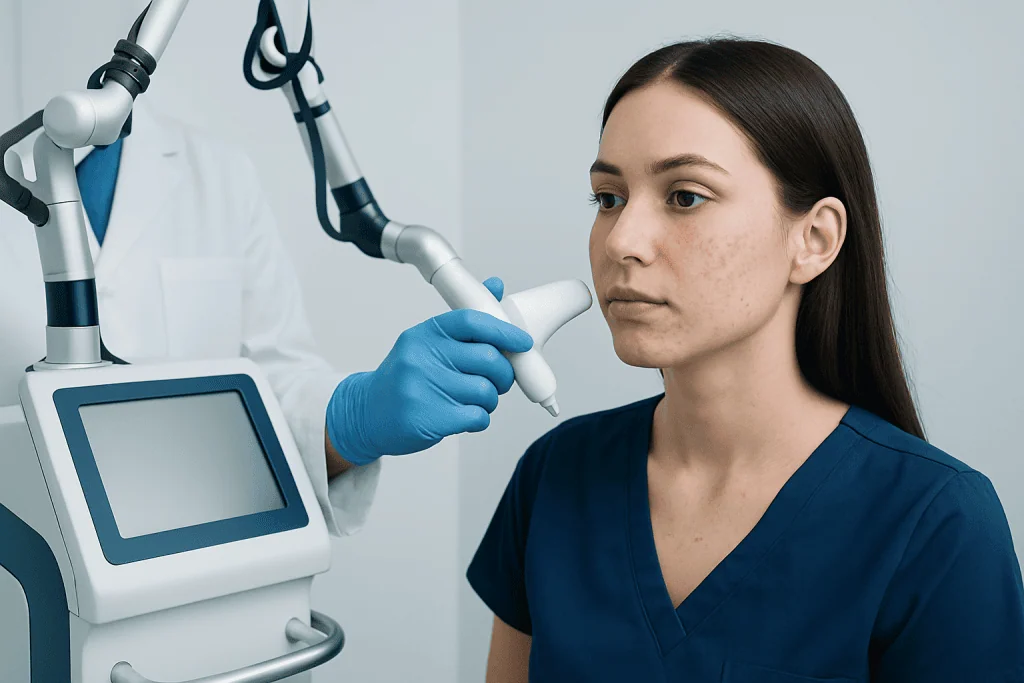
Acne begins when pores become clogged with oil, dead skin cells, and bacteria. When the blockage stays near the surface, a whitehead or blackhead may form. When inflammation becomes deeper, the wall of the pore can rupture and spill material into surrounding skin, causing a stronger inflammatory response.
This deeper inflammation is one of the main reasons acne scars develop. During healing, the body tries to rebuild damaged tissue with collagen. If too little collagen is produced, the result may be a depressed scar. If too much collagen forms, the result may be a raised scar. The balance between inflammation and repair helps determine the final appearance of the skin.
Not everyone with acne develops scars. Risk is generally higher when acne is severe, lasts a long time, or is repeatedly squeezed, picked, or manipulated. Delay in controlling inflammatory acne can also increase the likelihood that scars will form.
Types of acne scars and how they look

Doctors usually classify acne scars by their shape and depth. The most common group is atrophic scarring, in which there is loss of tissue and the skin looks indented. Atrophic scars are often divided into ice pick, boxcar, and rolling scars. Ice pick scars are narrow and deep, boxcar scars have more defined edges, and rolling scars create broader unevenness with a wave-like appearance.
Some people develop hypertrophic or <a href="https://acibademinternational.com/diseases/keloid-scars/”>keloid scars instead. These are raised areas caused by excess collagen production during healing. They are more common on the chest, shoulders, jawline, and back, and they may be more likely in people with a personal or family tendency toward abnormal scar formation.
Post-inflammatory hyperpigmentation or redness may appear alongside scars, making the skin look more affected than textural change alone would suggest. Because these findings can overlap, diagnosis is not always obvious from a mirror alone. A dermatologist may assess lighting, skin tension, scar depth, and skin tone before recommending a treatment plan.
- Ice pick scars: small, deep, narrow pits
- Boxcar scars: wider depressions with clearer borders
- Rolling scars: broad indentations with sloping edges
- Hypertrophic scars: raised scars limited to the original site
- Keloids: raised scars that may extend beyond the original acne lesion
Causes and risk factors
The strongest risk factor for acne scars is inflammatory acne, especially nodules and cysts. When inflammation is intense or prolonged, the chance of damage in deeper layers of skin increases. People with moderate or severe acne that is not well controlled may therefore have a higher risk of permanent textural changes.
Picking, squeezing, and scratching blemishes can worsen inflammation and disrupt healing. This can increase both the chance of infection and the chance of scarring. Even when squeezing seems to flatten a pimple temporarily, it may push inflammation deeper into the skin.
Skin type, genetics, and healing response also matter. Some people naturally scar more easily or form thicker raised scars. In addition, delayed treatment, repeated acne flares, and inadequate sun protection may make marks more visible and recovery slower. People with darker skin tones may be especially prone to noticeable post-inflammatory pigment changes, which can exist with or without true scarring.
How acne scars are diagnosed
Acne scars are usually diagnosed through a clinical skin examination. A doctor looks at the type of scar, the number of scars, the location, whether acne is still active, and whether there are also pigment changes. This matters because treating active breakouts and preventing new scars is often the first priority.
Assessment may include questions about when acne started, previous treatments, skin sensitivity, medications, pregnancy status when relevant, and any history of abnormal scarring. Doctors also consider skin tone, because some procedures carry a higher risk of post-inflammatory pigment change in certain patients.
There is no single best treatment for every scar pattern. In many cases, a combination approach works best. Careful diagnosis helps match the treatment to the scar type, whether that means resurfacing, collagen stimulation, release of tethered scars, or treatment of raised scar tissue. If procedures are being considered, the care plan may involve dermatology care and, in selected cases, laser treatment.
Treatment options for acne scars
Treatment for acne scars depends on scar type, severity, skin tone, and whether acne is still active. Topical products may help discoloration and support overall skin quality, but they usually have limited effect on established deep textural scars. For this reason, many patients need office-based procedures for meaningful improvement.
Common medical options include chemical peels, microneedling, subcision, laser resurfacing, dermal fillers, punch techniques for selected deep scars, and injections for raised scars. Some treatments stimulate collagen, some smooth the skin surface, and others release deeper scar bands that pull the skin downward. Raised scars may respond to steroid injections or other targeted therapies rather than resurfacing.
Combination treatment is often the most evidence-based strategy. For example, rolling scars may improve with subcision plus collagen-stimulating treatment, while boxcar scars may respond better to resurfacing or focused procedural techniques. When scars are severe or accompanied by skin laxity or contour irregularity, a specialist may discuss procedural options within medical aesthetics or selected reconstructive approaches.
Results are usually gradual, not immediate. Improvement often happens over a series of sessions and may be partial rather than complete. A realistic treatment plan focuses on smoother texture, more even skin appearance, and prevention of new scars through control of active acne.
Self-care, prevention, and daily habits that help
The best way to prevent acne scars is to treat acne early and consistently. People with painful, deep, or frequent breakouts should not wait for scars to develop before seeking advice. Managing acne reduces ongoing inflammation and lowers the chance that new lesions will heal with permanent textural change.
Daily skin care should be gentle. Non-comedogenic cleansers, moisturizers, and sunscreen can support the skin barrier while reducing irritation. Sunscreen is especially important because ultraviolet exposure can darken post-inflammatory marks and make uneven skin tone more noticeable.
Avoid picking or popping acne lesions whenever possible. Hands, fingernails, and pressure can increase trauma and worsen healing. If over-the-counter skin care is not helping after a reasonable trial, or if the skin is becoming irritated, a doctor can advise on safer next steps.
- Use sunscreen regularly to reduce visible post-acne marks
- Choose non-comedogenic skin products
- Avoid harsh scrubbing and frequent picking
- Seek treatment for active acne before scarring progresses
- Follow a treatment plan consistently and patiently
When to seek medical care
Medical care is advisable when acne is painful, deep, widespread, or leaving marks that do not fade. A person should also seek care if acne scars are affecting confidence, emotional well-being, or daily life. Early assessment can help prevent additional scarring and identify treatments that are appropriate for the skin type and scar pattern.
A doctor should also evaluate any raised scar that continues to enlarge, any sudden change in the skin that does not fit a usual acne pattern, or skin irritation from self-treatment. People with darker skin tones, sensitive skin, or a history of keloids may benefit from specialist guidance before trying stronger procedures at home or in non-medical settings.
For international patients who need assessment and treatment planning, Acibadem International’s multidisciplinary specialists in JCI-accredited hospitals diagnose and treat acne scars using individualized, evidence-based approaches. The aim is to match treatment safely to the skin’s needs while also addressing active acne and pigmentation when present.
Frequently asked questions
Can acne scars go away on their own?
True acne scars usually do not disappear completely on their own because they involve structural change in the skin. However, post-acne color changes such as red or brown marks may fade gradually over time. A medical evaluation can help distinguish between scars and temporary marks.
What is the difference between acne marks and acne scars?
Acne marks are usually flat changes in skin color left after inflammation, while acne scars involve changes in skin texture or contour. Marks may improve naturally over months, but scars are more persistent. Both can occur together, which is why treatment may need more than one approach.
Which treatment is best for acne scars?
There is no single best treatment for all acne scars. The most effective option depends on whether the scars are deep, shallow, rolling, boxcar, ice pick, or raised, as well as on skin tone and active acne. Many people benefit from a combination of treatments rather than one method alone.
Does treating active acne help prevent scarring?
Yes, controlling active acne is one of the most important ways to reduce the risk of new scars. Ongoing inflammation can continue to damage deeper skin layers, especially with nodules and cysts. Early treatment also reduces the temptation to pick or squeeze lesions.
Are home remedies effective for acne scars?
Home skin care may help overall skin health and may improve mild discoloration, but it is usually limited for established textural acne scars. Strong DIY treatments can also irritate the skin and make marks more noticeable. It is safer to discuss persistent scarring with a qualified doctor.
Can people with darker skin tones be treated for acne scars safely?
Yes, acne scars can be treated safely in darker skin tones, but treatment should be chosen carefully. Some procedures can increase the risk of post-inflammatory pigment change if not properly selected. A dermatologist can tailor the plan to skin tone, scar type, and sensitivity.
References
- American Academy of Dermatology
- National Institute of Arthritis and Musculoskeletal and Skin Diseases
- Mayo Clinic
- National Health Service
- British Association of Dermatologists
This article is for general information only and is not a substitute for professional medical advice. Please consult a qualified doctor about your individual situation.
Acne in Turkey — costs, top hospitals & a free quote
JCI-accredited · board-certified surgeons · reply within 24h
Add us as a Preferred Source to see more of our trusted health content across Google Search, AI Overviews and Discover.

More from the Health Library



Related Specialists
Prof. Dr. Halit Çavuşoğlu
Neurosurgery
Assoc. Prof. Dr. Nuri Peker
Gynecology & Obstetrics
Prof. Dr. Bülent Özçelik
Gynecology & Obstetrics
Damla Tuncay
Physical Medicine & Rehabilitation