Spondylolisthesis: What Patients Need to Know

Spondylolisthesis means one vertebra has slipped forward relative to the vertebra below it. Some people have no symptoms, while others develop low back pain, stiffness, or leg symptoms from nerve irritation.
Key Takeaways
- Spondylolisthesis means one vertebra has slipped forward relative to the vertebra below it.
- Some people have no symptoms, while others develop low back pain, stiffness, or leg symptoms from nerve irritation.
- Causes vary and include age-related wear, stress injuries, congenital differences, and less commonly trauma.
- Diagnosis usually involves a physical exam and imaging such as X-rays, with MRI used when nerves may be affected.
- Treatment often begins with activity changes, physical therapy, pain relief measures, and sometimes bracing or injections.
- Medical review is important if there is worsening pain, weakness, numbness, walking difficulty, or bladder or bowel symptoms.
Spondylolisthesis is a condition in which one spinal bone moves forward over the bone below it. It can be mild and cause few symptoms, or it can lead to back pain, leg pain, and nerve-related problems that need medical evaluation.
Overview
Spondylolisthesis is a condition in which one vertebra, or spinal bone, slips forward over the vertebra beneath it. It most often affects the lower back and may be found in children, athletes, adults, or older people depending on the cause. In many cases, the slip is small and stable, and some people do not realize they have it until imaging is done for another reason.
For patients, the most important point is that spondylolisthesis is not the same in every person. Some have only mild back discomfort, while others develop leg pain, tingling, or weakness if nearby nerves are irritated. The degree of symptoms does not always match the size of the slip, so treatment decisions are based on the whole clinical picture rather than imaging alone.
The condition is often described by type and by grade. Types refer to the reason the vertebra slipped, such as age-related wear or a stress-related defect in part of the spine. Grades describe how far the vertebra has moved forward. These details help doctors estimate stability, choose treatment, and decide whether specialist assessment is needed.
Symptoms and How It May Feel
Spondylolisthesis can cause no symptoms at all, especially when it is mild. When symptoms do appear, the most common complaint is lower back pain that may worsen with standing, walking, bending backward, or physical activity. Some people notice tight hamstrings, stiffness, or a feeling that the back tires easily.
If the slipped vertebra narrows the space for spinal nerves, symptoms can extend into the buttocks or legs. These may include pain, burning, tingling, numbness, or weakness. In some people, discomfort improves when sitting or leaning forward, because that posture can reduce pressure on the nerves.
Symptoms vary by age group. Children and teenagers with a stress-related form may report pain during sports, especially activities involving repetitive back extension. Adults and older patients more often develop symptoms gradually as part of wear-and-tear changes in the spine, sometimes alongside spinal stenosis.
- Low back pain or soreness
- Muscle tightness or stiffness
- Leg pain similar to sciatica
- Tingling or numbness in one or both legs
- Weakness or reduced walking tolerance
- Changes in posture or gait in more advanced cases
Causes and Risk Factors

Spondylolisthesis has several recognized causes. One common type is degenerative spondylolisthesis, which develops as joints, discs, and supporting ligaments change with age. These changes can reduce stability in the spine and allow one vertebra to move forward slightly. This form is more common in middle-aged and older adults, particularly in the lower lumbar spine.
Another well-known type is isthmic spondylolisthesis. In this form, there is a small stress fracture or defect in a part of the vertebra called the pars interarticularis. It may result from repeated strain during growth, especially in sports that involve frequent back arching, twisting, or impact. Gymnastics, football, diving, and weight training are examples where this pattern may be seen.
Less common causes include congenital differences in spinal structure, sudden trauma, and diseases that weaken bone. Risk factors can include family history, repetitive spinal loading, age-related spinal degeneration, obesity, and coexisting spinal conditions. In some patients, spondylolisthesis is associated with disc degeneration or scoliosis, which can influence posture and symptoms.
How Doctors Diagnose Spondylolisthesis
Diagnosis begins with a careful medical history and physical examination. A doctor will ask where the pain is located, what activities worsen it, whether symptoms travel into the legs, and whether there are any signs of weakness, numbness, or balance problems. Examination often includes checking posture, spinal movement, muscle strength, reflexes, and sensation.
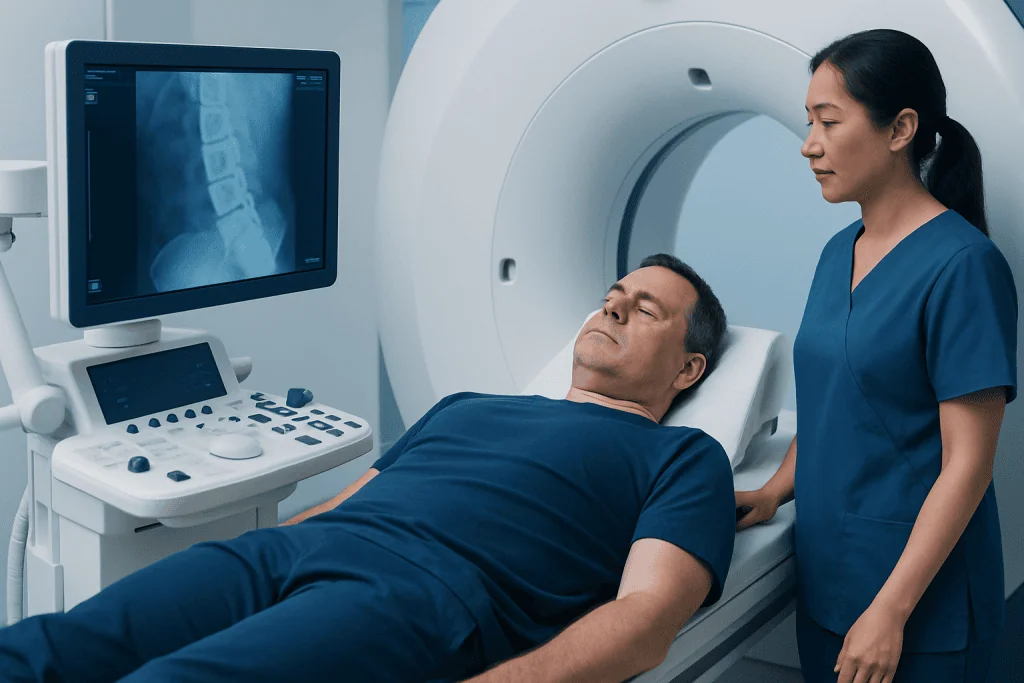
Plain X-rays are commonly the first imaging test because they can show alignment of the vertebrae and whether one has slipped forward. In some cases, side-view images clearly show the amount of slippage. Flexion and extension X-rays may also be used to assess whether the spine is stable or whether the slip changes with movement.
MRI is especially useful when leg pain, numbness, or weakness suggests nerve compression. It can show discs, nerves, and soft tissues in greater detail. CT may be used in selected cases to better define bone anatomy or a pars defect. These imaging tools help distinguish spondylolisthesis from other causes of back pain and guide planning for spine surgery when surgery is being considered.
Treatment Options
Treatment depends on symptoms, the type and grade of the slip, age, activity level, and whether there is nerve compression. Many people improve without surgery. Initial treatment often includes temporary activity modification, short-term pain relief measures, and a structured physical therapy program focused on core strength, flexibility, and movement patterns that reduce strain on the lower back.
Doctors may also recommend anti-inflammatory medicines when appropriate, along with heat, ice, and guided return to activity. In some younger patients or in selected cases of painful stress injury, bracing may be considered for a limited period. If symptoms involve irritated nerves or if pain persists despite conservative care, image-guided injections may sometimes help reduce inflammation and support rehabilitation.
Surgery is usually reserved for ongoing disabling pain, progressive neurologic symptoms, marked instability, or failure of non-surgical treatment. The operation may involve decompression to relieve pressure on nerves, stabilization with fusion, or both. For some patients, this may overlap with techniques used in herniated disc surgery or other spinal fusion procedures, depending on the anatomy and the structures involved.
Care is individualized, and the goal is not only to reduce pain but also to protect nerve function and restore daily activity. Near the end of the treatment journey, some international patients may seek assessment at centers such as Acibadem International, where multidisciplinary specialists in JCI-accredited hospitals evaluate and treat complex spine conditions.
Prevention and Self-care
Not all cases can be prevented, but certain habits may lower strain on the lower back and support recovery. Regular exercise that improves core strength, hip mobility, and general conditioning can help stabilize the spine. Learning proper body mechanics for lifting, bending, and sports technique is also important, especially for people who perform repetitive extension movements.
For people with symptoms, self-care usually means staying active within comfortable limits rather than prolonged bed rest. Walking, guided stretching, and exercises prescribed by a clinician or physiotherapist are often more helpful than complete inactivity. Weight management, stopping smoking, and maintaining bone health may also support long-term spinal wellbeing.
Young athletes should take persistent back pain seriously rather than trying to push through it. Early assessment can sometimes prevent symptoms from worsening and may allow a safer, more gradual return to sport. Self-care works best when it complements professional advice, particularly if pain keeps returning or daily function is affected.
- Warm up before sports and training
- Strengthen abdominal and back-supporting muscles
- Use safe lifting techniques
- Avoid sudden increases in training load
- Seek assessment for ongoing or recurrent back pain
When to Seek Medical Care
Medical review is appropriate if back pain lasts more than a few weeks, keeps returning, or interferes with sleep, work, walking, or exercise. A doctor should also assess pain that spreads into the leg, especially if it is accompanied by tingling, numbness, or weakness. These features can suggest that a spinal nerve is being affected.
Urgent medical care is needed if there is sudden or worsening leg weakness, loss of balance, difficulty controlling the bladder or bowels, or numbness in the groin or saddle area. Although these symptoms are not common, they can signal significant nerve compression and should not be ignored.
Children, teenagers, and athletes should be evaluated sooner if lower back pain appears with sports participation or worsens with arching the back. Early diagnosis can clarify whether symptoms come from muscle strain, a stress-related spinal injury, or spondylolisthesis and can guide a safer treatment plan.
Frequently asked questions
Is spondylolisthesis the same as a slipped disc?
No. Spondylolisthesis means one vertebra has shifted forward over another, while a slipped or herniated disc involves the disc material between vertebrae. Both can cause back pain or nerve symptoms, but they affect different structures.
Can spondylolisthesis go away on its own?
The vertebral slip itself usually does not reverse on its own. However, many people have mild, stable spondylolisthesis and their symptoms improve significantly with non-surgical treatment. The main aim is to control pain, protect nerve function, and improve mobility.
Does everyone with spondylolisthesis need surgery?
No. Most patients are treated first with conservative measures such as physical therapy, activity changes, and pain management. Surgery is usually considered only when symptoms remain significant, nerve problems progress, or the spine is unstable.
Can exercise make spondylolisthesis worse?
Appropriate exercise is often helpful, but certain movements may aggravate symptoms, especially repeated back extension or heavy loading without proper technique. A clinician or physiotherapist can guide safer exercises based on the type of spondylolisthesis and current symptoms.
Is spondylolisthesis serious?
It can range from mild and incidental to more symptomatic cases that affect daily life. Serious complications are uncommon, but nerve compression can occur in some people. That is why persistent pain, leg symptoms, or weakness should be assessed by a doctor.
Can children or teenagers develop spondylolisthesis?
Yes. Young people can develop it, especially if there is a stress injury in part of the vertebra or a congenital structural difference. Sports with frequent bending backward may increase risk, so persistent back pain in active children and teens deserves medical attention.
References
- National Institute of Arthritis and Musculoskeletal and Skin Diseases
- American Academy of Orthopaedic Surgeons
- National Institute of Neurological Disorders and Stroke
- North American Spine Society
- MedlinePlus
This article is for general information only and is not a substitute for professional medical advice. Please consult a qualified doctor about your individual situation.
Joint and spine care in Turkey — expert assessment & treatment
JCI-accredited · board-certified surgeons · reply within 24h
Add us as a Preferred Source to see more of our trusted health content across Google Search, AI Overviews and Discover.