Scar Tissue — Explained by Medical Evidence, Not Myths

Scar tissue is made of collagen that forms as part of normal healing. Not all scars cause symptoms, but some may lead to pain, itching, stiffness, or cosmetic concern.
Key Takeaways
- Scar tissue is made of collagen that forms as part of normal healing.
- Not all scars cause symptoms, but some may lead to pain, itching, stiffness, or cosmetic concern.
- The type, location, and depth of an injury affect how noticeable or bothersome a scar becomes.
- Treatment depends on the scar’s appearance, symptoms, and impact on movement or daily life.
- Medical review is important if a scar changes, becomes very painful, limits function, or shows signs of infection.
Scar tissue is the body’s natural way of healing after injury, surgery, burns, acne, or inflammation. Most scars are harmless, but some can become raised, tight, painful, or restrictive depending on where they form and how the body heals.
Overview: what scar tissue really is
Scar tissue is the fibrous tissue the body creates to repair skin or deeper tissues after damage. It forms after events such as cuts, surgery, burns, acne, inflammation, or trauma. In simple terms, scar tissue is not “extra skin” or “toxins trapped in the body.” It is a normal healing response built mainly from collagen.
Medical evidence shows that scars develop because repaired tissue is organized differently from the original tissue. Healthy skin and other tissues have a more complex structure, while scar tissue is usually denser and arranged in a more uniform pattern. This helps close and strengthen the injured area, but it can also make the area feel firmer, tighter, or less flexible.
Scar tissue can form on the skin, under the skin, or inside the body. For example, it may develop after an operation, after a tendon or muscle injury, or around areas of chronic inflammation. Some internal scarring can contribute to pain or reduced movement, while many internal scars cause no symptoms at all and are only discovered during imaging or surgery.
Most scars gradually settle over time. They often become flatter, softer, and paler over months. However, some scars remain raised, thick, itchy, painful, or functionally limiting. This is why assessment focuses not only on how a scar looks, but also on how it feels and whether it affects daily activities.
How scar tissue forms and why it varies
Healing usually happens in several stages. First, the body stops bleeding and starts inflammation, which helps clear damaged cells and reduce infection risk. Next, repair tissue begins to form, with collagen laid down to close and support the injured area. Finally, the scar remodels over time as the body strengthens and reorganizes the tissue.
Several factors influence how much scar tissue forms and what it looks like. These include the size and depth of the wound, whether stitches were needed, infection, the amount of tension on the skin, the body area involved, and a person’s age, skin type, and genetics. Some people are naturally more prone to thick or raised scars.
Not all scar tissue behaves the same way. A fine flat scar after a clean surgical incision is very different from a wide scar after a deep wound, a burn scar that contracts, or a keloid that grows beyond the original injury. This variation is one reason myths about “breaking up all scar tissue” can be misleading. Some scars improve with time and conservative care, while others need targeted medical treatment.
It is also important to remember that internal and external scars are different. Skin scars can often be seen and touched, but internal scar tissue may affect organs, muscles, fascia, tendons, or joints in less obvious ways. Management depends on the tissue involved and the symptoms present.
Symptoms and types of scar tissue
Many scars cause no symptoms beyond a visible mark. When symptoms do occur, they may include itching, tenderness, burning, sensitivity, tightness, pulling, reduced flexibility, or pain with movement. In some people, scars also cause emotional distress if they are prominent or located in a visible area such as the face, neck, or hands.
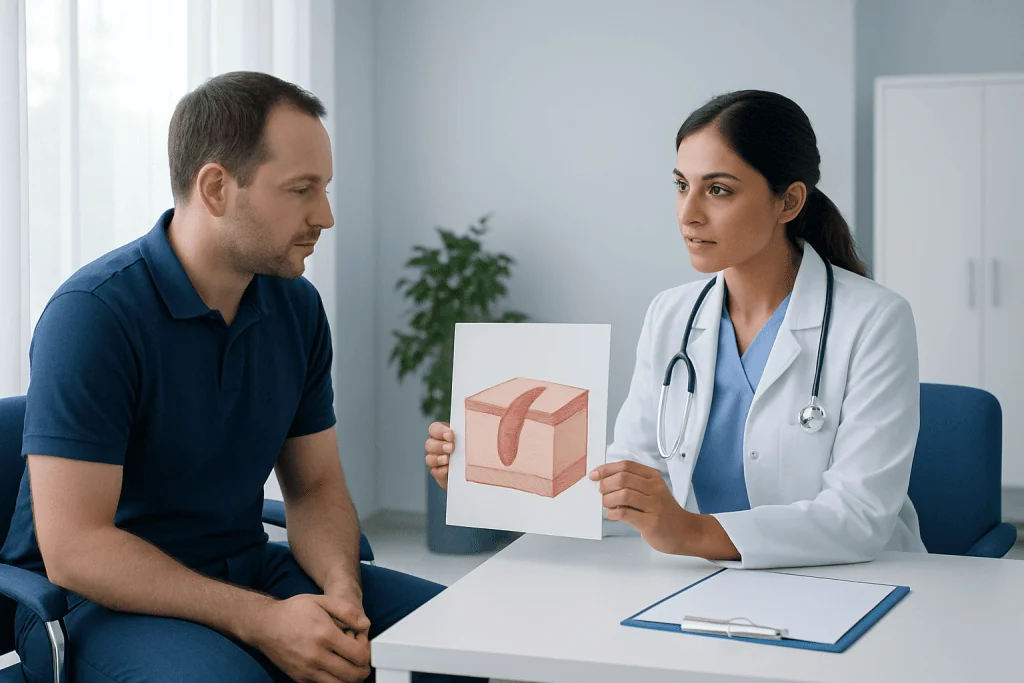
Doctors often describe scars by type. Flat scars are usually the most common and often fade with time. Hypertrophic scars are raised and thick but stay within the borders of the original wound. Keloid scars extend beyond the original injury and can continue growing. Contracture scars, often seen after burns, can tighten the skin and affect mobility.
Internal scar tissue may present differently. A person may notice stiffness after surgery, reduced range of motion after a musculoskeletal injury, or ongoing discomfort around a healed area. Scar-related pain can sometimes be difficult to distinguish from inflammation, nerve irritation, joint problems, or another condition, which is why proper evaluation matters.
- Visible thickening, redness, or raised texture
- Itching or tenderness during healing
- Tightness or pulling across a joint or surgical area
- Pain with touch or movement
- Restricted motion or reduced function
- Cosmetic concern, especially in exposed areas
Causes, risk factors, and common myths
Scar tissue can follow almost any process that injures tissue. Common causes include surgery, cuts, burns, piercings, severe acne, infections, sports injuries, and inflammatory skin conditions. It may also form after repetitive strain or tissue damage involving muscles, ligaments, or tendons. In some cases, a scar becomes more noticeable because healing took longer or the wound was under tension.
Risk factors for more prominent scars include a family history of keloids, darker skin tones, younger age, delayed wound healing, infection, repeated trauma to the same area, and wounds on the chest, shoulders, upper back, jawline, or earlobes. Smoking, poor nutrition, and certain medical conditions may also affect healing quality.
One common myth is that all scar tissue is harmful and should be aggressively “broken down.” In reality, scar tissue is part of normal repair. Another myth is that pain in a healed area must always come from scar tissue. Pain can also be related to nerve sensitivity, ongoing inflammation, joint disease, or conditions such as a herniated disc when symptoms involve the spine or limbs.
Another misunderstanding is that every visible scar can be erased completely. Evidence-based treatments can often improve symptoms and appearance, but results vary with scar type, age, location, and skin characteristics. Setting realistic expectations is an important part of care.
How doctors diagnose scar tissue problems
Diagnosis usually begins with a clinical history and physical examination. A doctor will ask when the scar formed, whether it followed surgery or injury, how symptoms have changed, and whether there is pain, itching, numbness, tightness, or limitation of movement. They will also examine the color, thickness, texture, and borders of the scar.
When deeper tissues may be involved, the examination focuses on function as well as appearance. For example, a clinician may assess joint movement, muscle strength, posture, and whether certain motions trigger pain. This helps distinguish a symptomatic scar from other causes of discomfort, such as tendon injury or a condition like scoliosis when posture and spinal mechanics are involved.
Imaging is not needed for most routine skin scars, but it may be useful when symptoms suggest internal scarring or another underlying problem. Ultrasound, MRI, or other tests may be considered in selected cases. If a scar looks unusual, changes unexpectedly, or raises concern for another diagnosis, a dermatologist, surgeon, or other specialist may recommend further evaluation.
Diagnosis also includes identifying whether a scar is primarily a cosmetic concern, a source of symptoms, or a functional problem. This distinction helps guide treatment. A scar that is painless but very visible may be managed differently from one that causes contracture, nerve irritation, or reduced mobility.
Treatment options: from observation to procedures
Treatment depends on the type of scar, where it is located, how old it is, and whether it causes symptoms. Many scars improve over time without invasive treatment. For newer scars, doctors may suggest gentle scar massage when appropriate, sun protection, silicone gel or sheets, and measures that reduce tension on healing skin. These approaches aim to support remodeling and reduce thickening.
If a scar is raised, itchy, or cosmetically bothersome, medical treatments may help. Options can include steroid injections, pressure therapy, laser-based treatments, or selected minor procedures. When a scar causes significant surface changes, some people may benefit from scar revision to improve contour, texture, or tension. For acne-related facial scarring, care may overlap with acne treatment if active breakouts are also contributing.
Scars that restrict movement may need rehabilitation. Physical therapy can help improve flexibility, function, and comfort, especially after injury or surgery involving muscles, joints, or tendons. If symptoms involve a hand, wrist, or fingers, assessment may overlap with hand surgery when contracture, tethering, or structural issues are suspected.
Some scars require surgical treatment, but surgery is not always the first step because any procedure can create a new scar. Doctors weigh the likely benefits against the possibility of recurrence, especially in people prone to hypertrophic or keloid scars. The best results often come from a personalized plan rather than a single treatment.
Self-care, prevention, and what may help at home
Good wound care is one of the best ways to reduce unnecessary scarring. Following medical instructions, keeping the wound clean, avoiding picking or scratching, and protecting healing skin from sun exposure can all support better scar maturation. If stitches, dressings, or follow-up visits are recommended, these should not be skipped.
Once a wound has closed and a clinician says it is safe, simple self-care may help. This may include moisturizing the area, using silicone-based scar products, and doing gentle mobility exercises if advised after surgery or injury. Strong home treatments, harsh scrubs, or unproven remedies can irritate the skin and sometimes worsen the scar.
Prevention is not always fully possible, because genetics and wound depth matter. Even with excellent care, some people develop raised or persistent scars. Still, early attention to problematic scars can improve outcomes. Anyone who has had a previous keloid or thick scar should tell their doctor before elective surgery or body piercing.
Acibadem International’s multidisciplinary specialists and JCI-accredited hospitals diagnose and treat scar-related concerns for international patients, particularly when scars affect appearance, comfort, or movement after injury or surgery.
When to seek medical care
Medical review is advisable if a scar becomes increasingly painful, very itchy, rapidly thickened, or starts limiting movement. A scar should also be checked if it repeatedly breaks down, bleeds easily, drains fluid, or develops signs of infection such as worsening redness, warmth, swelling, or pus.
It is also sensible to seek care if a scar causes numbness, tingling, or significant pulling across a joint, or if the appearance of a scar is causing distress and home measures are not helping. After surgery, any concern about healing should be discussed with the surgeon or treating doctor rather than managed alone.
Prompt evaluation matters because not every post-injury lump, discoloration, or painful area is simply scar tissue. Sometimes symptoms come from inflammation, nerve involvement, a recurrent skin condition, or a different medical problem that needs its own treatment plan.
Frequently asked questions
Is scar tissue permanent?
Scar tissue is a permanent part of healing, but its appearance and feel often change over time. Many scars become flatter, softer, and less noticeable over months to years.
Can scar tissue cause pain?
Yes, scar tissue can sometimes cause pain, tenderness, burning, or a pulling sensation. However, pain in a healed area is not always caused by scar tissue, so a doctor may need to look for other explanations.
What is the difference between a hypertrophic scar and a keloid?
A hypertrophic scar is raised but stays within the boundaries of the original wound. A keloid grows beyond the original injury and may continue enlarging over time.
Can massage remove scar tissue?
Massage does not erase scar tissue, but in some cases it may help improve flexibility, comfort, and how a scar feels as it matures. It should only be started when the wound is fully healed and a clinician has said it is safe.
Do all surgical scars need treatment?
No. Many surgical scars heal well and need only routine aftercare and time. Treatment is usually considered if a scar becomes raised, painful, tight, or cosmetically distressing.
Can scar tissue form inside the body?
Yes, scar tissue can form in deeper tissues or internally after surgery, injury, or inflammation. Internal scarring may cause no symptoms, or it may contribute to stiffness, pain, or changes in function depending on the location.
This article is for general information only and is not a substitute for professional medical advice. Please consult a qualified doctor about your individual situation.
Explore treatments in Turkey — costs, top hospitals & a free quote
JCI-accredited · board-certified surgeons · reply within 24h
Add us as a Preferred Source to see more of our trusted health content across Google Search, AI Overviews and Discover.

More from the Health Library

Castor Oil for Hair — Explained by Medical Evidence, Not Myths

Healthy Snacks for Teens: A Complete Medical Overview

Phobia From Birds: Symptoms and Treatment Options

Advantages of Steam Rooms — Explained by Medical Evidence, Not Myths

Knee Bruises — Explained by Medical Evidence, Not Myths