How to Read Glasses Prescription? Here Is What the Evidence Says

A glasses prescription is a lens formula, not a diagnosis by itself. SPH shows the main lens power, while CYL and AXIS describe astigmatism.
Key Takeaways
- A glasses prescription is a lens formula, not a diagnosis by itself.
- SPH shows the main lens power, while CYL and AXIS describe astigmatism.
- ADD is extra power for near work in bifocal or progressive lenses.
- PD helps center lenses correctly but may not always appear on the prescription.
- Sudden vision change, eye pain, flashes, or double vision should be assessed by a doctor promptly.
Most glasses prescriptions simply describe how lenses correct common focusing problems, and they do not usually signal a serious eye disease on their own. Reading the numbers becomes easier once a person knows what each abbreviation means, what is normal variation between eyes, and when symptoms such as sudden blur, pain, or flashes need medical review.
Overview: what a glasses prescription actually means
For most people, a glasses prescription is simply a practical set of measurements used to focus light more clearly on the retina. It usually reflects common vision issues such as nearsightedness, farsightedness, astigmatism, or age-related difficulty with near vision. In other words, it is often harmless in itself and mainly helps an optician or eye care professional make the right lenses.
When someone asks how to read glasses prescription, the shortest answer is this: look for the main lens power for each eye, then check whether there is a separate astigmatism value, whether an axis is listed, and whether there is an added near-vision power. Most prescriptions are written separately for the right eye and left eye, often using the abbreviations OD for the right eye and OS for the left eye. Some forms also use RE and LE.
A prescription does not automatically explain why vision changed, and it does not replace a full eye health assessment. If the numbers are stable and symptoms are mild, the issue is often routine. However, sudden changes in vision, eye pain, light sensitivity, or distortion deserve medical review because they may point to an eye condition rather than a simple refractive error.
How to read the common terms and numbers
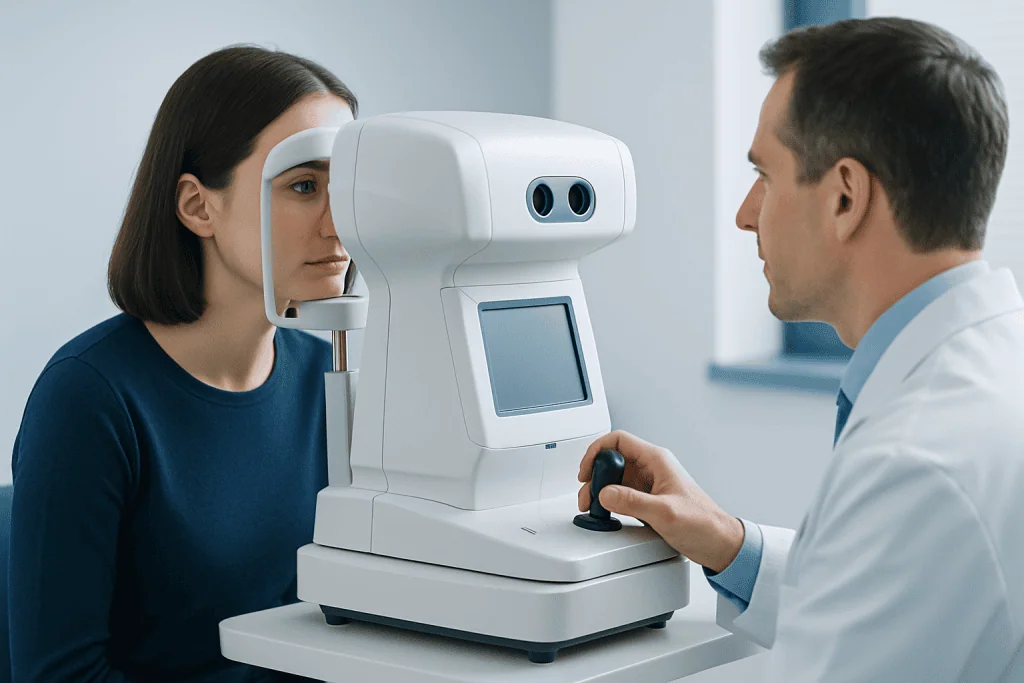
Most eyeglass prescriptions include several standard abbreviations. Understanding these makes the document much easier to interpret. The most important parts are the sphere value, any astigmatism values, and near-vision additions if needed.
The common terms include:
- OD: right eye
- OS: left eye
- OU: both eyes
- SPH or Sphere: the main lens power
- CYL or Cylinder: the amount of astigmatism correction
- AXIS: the direction of astigmatism correction, measured from 1 to 180
- ADD: extra magnifying power for reading or near work
- PD: pupillary distance, the distance between the centers of the pupils
- Prism: a special correction used in some eye alignment problems
These values are usually written in diopters, the unit used for lens power. Negative numbers typically indicate nearsightedness, while positive numbers usually indicate farsightedness or reading support. The higher the absolute number, the stronger the correction. Even so, the same number can feel different from person to person depending on age, eye coordination, and how the lenses are used.
Some prescriptions also note whether lenses are intended for distance, near, or constant wear. If anything seems unclear, an optometrist or ophthalmologist can explain what each entry means and whether it matches the symptoms a person is experiencing.
Understanding SPH, CYL, AXIS, ADD, and PD in plain language

SPH tells the basic focusing power of the lens. A minus sign, such as -2.00, usually means the person is nearsighted and sees better up close than far away. A plus sign, such as +1.50, usually means farsightedness or extra support for focusing. If the sphere is marked plano or 0.00, there may be no main spherical correction in that eye.
CYL and AXIS appear when astigmatism is being corrected. Astigmatism means the eye does not focus light evenly, often because the cornea or lens has an irregular curve. The CYL number shows how much astigmatism correction is needed, and the AXIS shows its orientation. The axis is not a strength value by itself; it only makes sense together with the cylinder number.
ADD is used for reading segments, bifocals, or progressive lenses. It represents additional plus power placed into the lower or near-vision part of the lens. This is commonly prescribed when age-related near focusing changes develop, a condition known as presbyopia.
PD, or pupillary distance, helps position the optical center of the lenses in front of the pupils. This can improve comfort and clarity, especially in stronger prescriptions or progressive lenses. While PD is important for making glasses, it may be measured separately and is not always included on every clinical prescription form.
What the numbers can suggest about vision problems
A prescription can suggest the type of refractive error, but it does not confirm the health of the eye itself. A negative sphere often points to myopia, or nearsightedness. A positive sphere may suggest hyperopia, often called farsightedness. Cylinder and axis values indicate astigmatism, which is very common and may occur with either nearsightedness or farsightedness.
If the prescription includes an ADD value, the person may be developing more difficulty with near tasks such as reading menus, using a phone, or sewing. This commonly happens with age and does not necessarily mean eye disease. It reflects a reduced ability of the natural lens inside the eye to change focus at close range.
Differences between the two eyes are also common. One eye may need more correction than the other, and this alone is not always a problem. However, large changes compared with an older prescription, especially if they happen quickly, may lead a clinician to look for dry eye, cataract, blood sugar changes, or other causes.
People sometimes expect a stronger prescription to mean “worse eyes,” but that is too simplistic. Lens strength describes how much optical help is needed, not how healthy the eye is. Someone with a high prescription may have healthy eyes, while a person with only a small prescription can still have an underlying condition that needs medical attention.
How doctors assess vision changes and check the prescription
If a person has blurred vision, headaches with reading, frequent squinting, or trouble seeing road signs, an eye doctor usually starts with a history and vision testing. The clinician may ask when symptoms began, whether they are constant or intermittent, whether they affect one eye or both, and whether there are related symptoms such as eye strain, redness, flashes, or double vision.
The exam commonly includes visual acuity testing, refraction, and an eye health assessment. During refraction, the clinician compares different lens powers to determine which provides the clearest vision. In children or in some adults, drops may be used to relax focusing to obtain more accurate measurements. This is often followed by slit-lamp examination and, when appropriate, measurement of eye pressure and examination of the retina.
Doctors also look for causes of blur that glasses alone cannot fix. These may include dry eye, cataract, corneal disease, retinal disease, or glaucoma. If symptoms suggest a structural problem in the cornea, more specialized testing may be needed, especially when irregular astigmatism raises concern for conditions such as keratoconus.
When glasses are appropriate, treatment may be as simple as a new prescription or properly fitted lenses. In some cases, contact lenses or laser eye surgery may be discussed for suitable candidates after a full evaluation.
Treatment options and practical next steps
The most common treatment for refractive error is properly prescribed eyewear. Single-vision lenses can correct one main distance, while bifocal or progressive lenses can help with both distance and near tasks. Good lens alignment and an accurate PD are especially important for comfort, particularly in stronger or multifocal prescriptions.
Contact lenses may be an option for some people, including those with astigmatism or high prescriptions. In selected cases, specialty lenses can offer sharper vision than glasses. Some people with irregular corneal shape may be assessed for contact lens fitting or other corneal treatments if standard glasses do not provide clear vision.
For age-related lens clouding, updating the prescription may help only temporarily. If cataracts begin to affect daily activities, the doctor may discuss cataract surgery as a treatment option. If there is concern about increased pressure or optic nerve damage rather than a simple focusing issue, further evaluation for conditions such as glaucoma may be needed.
When surgery is being considered, suitability depends on the person’s eye health, corneal measurements, tear film, age, and visual goals. In tertiary centers, a multidisciplinary team may review whether lens-based or corneal-based procedures are most appropriate. Acibadem International’s multidisciplinary specialists and JCI-accredited hospitals also diagnose and treat eye conditions for international patients when further evaluation is needed.
Self-care, common mistakes, and how to use the prescription wisely
A glasses prescription works best when it is recent and used for the purpose it was written for. Distance glasses may not be ideal for close work, and reading glasses may not be suitable for driving. Wearing an outdated pair is a common reason for eyestrain, especially when screen use or detailed near tasks increase.
It also helps to understand what a prescription cannot do. It does not predict whether a person will need treatment beyond glasses, and it does not measure eye health by itself. Someone can have a perfectly readable prescription and still need regular eye examinations, particularly if there is diabetes, hypertension, family history of eye disease, or age-related risk.
For comfort and eye health, people can take practical steps at home:
- Use adequate lighting for reading and close work.
- Take regular breaks from screens.
- Follow advice on contact lens hygiene carefully.
- Attend routine eye examinations at the interval recommended by a clinician.
- Seek review if new headaches, persistent blur, or difficulty adapting to lenses develops.
If visual needs change often, the clinician may also look for systemic factors such as blood sugar fluctuations, medication effects, or dry eye. These are common and treatable causes of unstable vision that may mimic a prescription problem.
When to seek medical care
Most questions about how to read glasses prescription can be handled during a routine eye exam, and many prescription changes are not urgent. Still, some symptoms should not be ignored. Prompt medical review is important if vision becomes suddenly blurred, one eye sees much worse than the other without explanation, or there is new eye pain, redness, halos around lights, or significant light sensitivity.
Urgent assessment is also advisable for flashes of light, a sudden increase in floaters, a curtain-like shadow in the vision, double vision, or vision loss after an injury. These symptoms may point to conditions that glasses cannot correct. Likewise, if a person has repeated trouble adjusting to a new prescription, the issue may be lens fit, but it can also reflect an eye surface problem, cataract, or another underlying disorder.
Children should be assessed if they squint, sit very close to screens, complain of headaches, avoid reading, or show an eye turn. Adults should seek review when vision changes interfere with driving, work, reading, or balance. A qualified ophthalmologist or optometrist can decide whether the issue is a routine refractive change or something that needs further investigation, including advanced testing or corneal treatment in selected cases.
Frequently asked questions
What do OD and OS mean on a glasses prescription?
OD refers to the right eye, and OS refers to the left eye. Some prescriptions may also use RE and LE instead. These labels help keep the measurements for each eye separate.
What does a minus or plus number mean on eyeglass prescriptions?
A minus number usually means nearsightedness, where distant objects are harder to see clearly. A plus number usually means farsightedness or additional near focusing support. The size of the number shows the lens power needed, not the overall health of the eye.
Is CYL the same as astigmatism?
CYL is the part of the prescription that corrects astigmatism. If no cylinder value appears, either there is no astigmatism correction or it is too small to require treatment in that prescription. The axis value works together with CYL to place the correction in the correct direction.
Why is PD important if it is not always written on the prescription?
PD helps center the lenses correctly in front of the pupils, which improves comfort and clarity. It is especially important for stronger prescriptions and progressive lenses. Some clinicians record it separately because it is part of fitting the glasses rather than measuring the eye’s focusing power.
Can a person use an old prescription if vision seems similar?
Sometimes an older pair still feels acceptable, but an outdated prescription can contribute to eyestrain, headaches, or reduced clarity. This is more likely if visual demands have changed or if near work has increased. A current eye exam is the best way to confirm that the prescription is still appropriate.
Does a stronger prescription mean the eyes are unhealthy?
No. A stronger prescription only means more lens power is needed to focus light clearly. Eye health depends on many other factors, which is why routine examinations are still important even if the prescription seems straightforward.
References
- American Academy of Ophthalmology
- National Eye Institute
- American Optometric Association
- Royal College of Ophthalmologists
- World Health Organization
This article is for general information only and is not a substitute for professional medical advice. Please consult a qualified doctor about your individual situation.
Explore treatments in Turkey — costs, top hospitals & a free quote
JCI-accredited · board-certified surgeons · reply within 24h
Add us as a Preferred Source to see more of our trusted health content across Google Search, AI Overviews and Discover.

More from the Health Library



Related Specialists

Prof. Dr. Meral Bayramoğlu
Physical Medicine & Rehabilitation
Dr. Mücahit Güner
Oral & Dental Health
Prof. Dr. Ersin Özaslan
Medical Oncology
Assoc. Prof. Dr. Mehmet Salih Söylemez
Orthopedic Surgery & Traumatology