Cycloplegia — Explained by Medical Evidence, Not Myths

Cycloplegia affects accommodation, the eye’s automatic adjustment for clear near vision. Eye specialists often induce cycloplegia temporarily with drops to measure refractive errors accurately, especially in children.
Key Takeaways
- Cycloplegia affects accommodation, the eye’s automatic adjustment for clear near vision.
- Eye specialists often induce cycloplegia temporarily with drops to measure refractive errors accurately, especially in children.
- Blurred near vision and light sensitivity after dilating drops are expected and usually wear off as the medicine leaves the body.
- Cycloplegia that develops without eye drops needs prompt assessment because it can occasionally be linked to eye, nerve, medication, or systemic health problems.
- New vision loss, eye pain, marked redness, severe headache, nausea, or neurological symptoms require urgent medical care.
Cycloplegia is a reduced or absent ability to focus on near objects because the eye’s focusing muscle is temporarily or, rarely, persistently unable to work. It is commonly induced with prescribed eye drops during an eye examination, where it helps provide an accurate assessment of vision and eye health.
What Cycloplegia Means
Cycloplegia means paralysis or temporary relaxation of the ciliary muscle, a small muscle inside the eye that helps focus vision at different distances. When a person looks at something nearby, this muscle normally changes the shape of the natural lens. This process is called accommodation. With cycloplegia, the lens cannot adjust in the usual way, so close objects commonly appear blurred.
In clinical practice, cycloplegia most often refers to an expected, medication-induced effect during an eye examination. An ophthalmologist or optometrist may use cycloplegic drops to relax focusing and usually enlarge the pupils at the same time. This prevents the eye from unconsciously “over-focusing” during refraction testing and can make a glasses prescription more reliable.
The term can also describe a less common medical problem in which focusing is impaired because of an injury, inflammation, nerve-related condition, or medicine effect. The meaning therefore depends on context: cycloplegia after prescribed examination drops is generally temporary, while unexplained new focusing difficulty should be assessed by an eye-care professional.
How Normal Focusing Works—and Why Drops Are Used
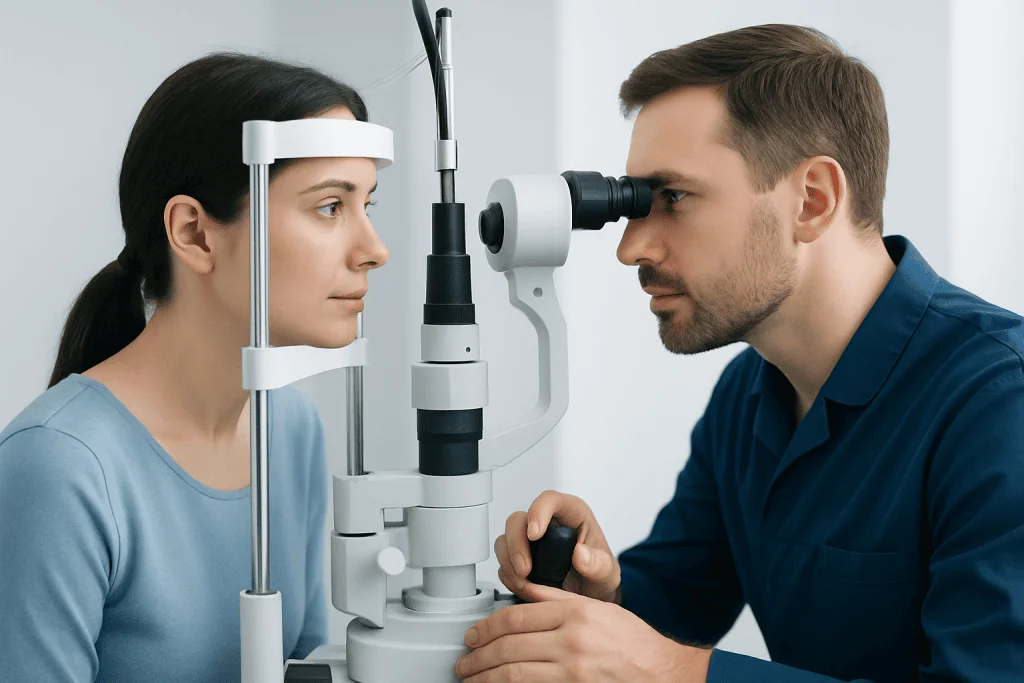
Accommodation is particularly active in children, teenagers, and young adults because their lenses are flexible and their focusing response is strong. During a standard vision test, some people—especially children—may involuntarily accommodate and mask farsightedness. This can make it difficult to determine whether glasses are needed or what prescription is most appropriate.
Cycloplegic drops temporarily block signals that make the ciliary muscle contract. Once the muscle is relaxed, the clinician can measure the eye’s refractive error without the influence of active focusing. This assessment is called cycloplegic refraction. It is widely used in pediatric eye care and may also be useful for adults with inconsistent measurements, suspected accommodative spasm, eye strain, or certain binocular vision concerns.
These drops often also cause mydriasis, or pupil dilation. Although cycloplegia and pupil dilation frequently occur together, they are not identical. A dilated pupil may make the eyes more sensitive to light, whereas cycloplegia specifically describes the loss of focusing ability. Not all pupil-dilating drops cause the same degree of cycloplegia.
Symptoms and Expected Effects

The most typical symptom of cycloplegia is blurred near vision. Reading, using a phone, computer work, sewing, or other close tasks may feel difficult until the effect resolves. Distance vision may be relatively clear, although some people notice overall blur or difficulty switching focus between distances.
When cycloplegia is caused by examination drops, additional temporary effects can include light sensitivity, glare, mild stinging when drops are applied, and awareness that the pupils look larger than usual. Children may become briefly bothered by bright environments. Wearing sunglasses outdoors and reducing close visual tasks can improve comfort while the drops remain active.
Duration varies according to the specific medicine, concentration, number of drops, age, iris color, and individual response. Some drops wear off within hours, while others may affect near vision or pupil size for a day or longer. The prescribing clinician should explain what to expect and provide practical advice about school, work, driving, and follow-up.
- Temporary blur after clinician-administered drops is usually an anticipated effect.
- Light sensitivity is common when pupils are enlarged.
- Sudden focusing difficulty without drops, especially in one eye, is not something to self-diagnose.
Causes Beyond an Eye Examination
Most cases of cycloplegia encountered in eye clinics are intentionally produced by medication. Drops such as atropine, cyclopentolate, or tropicamide may be selected based on the person’s age, the purpose of testing, and the desired duration of action. They belong to a group of medicines that reduce the activity of certain nerve signals within the eye.
Unintentional cycloplegia is much less common. It may occur after accidental exposure to medicines or substances with anticholinergic effects, including certain medications used for nausea, allergy symptoms, bladder conditions, mood disorders, or neurological conditions. Medicines should never be stopped without medical guidance, but a clinician should review all prescription drugs, over-the-counter products, eye drops, patches, and supplements when unexplained visual symptoms occur.
Other potential causes include eye trauma, inflammation involving structures inside the eye, and rare disorders affecting the nerves that control the pupil and focusing system. In some cases, a person may have difficulty with accommodation rather than complete cycloplegia. Age-related loss of near focusing, known as presbyopia, is common from midlife onward but is a gradual lens-related change, not the same as sudden cycloplegia.
Assessment and Diagnosis
An eye-care professional starts by asking when symptoms began, whether they affect one or both eyes, and whether eye drops, new medicines, injury, headache, or other symptoms are present. They may ask about double vision, drooping of an eyelid, pupil asymmetry, pain, redness, flashes, floaters, nausea, weakness, numbness, or changes in speech. These details help distinguish a routine medication effect from a problem requiring further evaluation.
The examination may include visual-acuity testing at distance and near, assessment of pupils, eye movement testing, refraction, slit-lamp examination, and measurement of eye pressure when appropriate. A clinician may also evaluate how the eyes work together and whether the focusing response is reduced or uneven. In children, cycloplegic refraction can be particularly important for identifying significant farsightedness or other refractive errors that could affect visual development.
Additional tests are not needed for every person. However, when symptoms are sudden, unusual, prolonged, or associated with neurological signs, the ophthalmologist may coordinate care with a primary care doctor, neurologist, or emergency team. Blood tests or imaging are considered only when the history and examination suggest an underlying cause that warrants investigation.
Treatment, Recovery, and Practical Self-Care
Treatment depends on the cause. When cycloplegia is deliberately produced for an eye examination, treatment is usually not required. The effect fades as the medication wears off. The safest approach is to follow the clinician’s instructions, avoid driving or operating machinery if vision is blurred or glare is troublesome, and arrange help with transport when needed.
Simple comfort measures may include wearing sunglasses outside, using brighter but non-glare lighting for movement around the home, and postponing close reading or detailed screen work. Adults should be cautious with activities that require sharp near vision, and caregivers should supervise children appropriately until their vision feels normal again. Using extra eye drops, herbal remedies, or another person’s medication to reverse dilation is not recommended unless specifically prescribed.
If a medication is contributing to unexpected symptoms, the clinician may adjust the treatment plan after weighing its benefits and risks. Cycloplegia related to inflammation, injury, or a nerve problem is managed by treating the underlying condition. Recovery can vary, which is why follow-up is important. Acibadem International’s multidisciplinary specialists and JCI-accredited hospitals evaluate eye and related neurological concerns for international patients when coordinated care is needed.
When to Seek Medical Care
After planned cycloplegic drops, patients should contact the prescribing eye clinic if blur, dilation, or discomfort lasts substantially longer than expected, or if they are unsure whether it is safe to resume normal activities. A clinician should also be consulted for new difficulty focusing that occurs without an examination, particularly if it begins suddenly, affects one eye, or follows an eye injury.
Urgent medical assessment is important for severe eye pain, significant eye redness, marked headache, nausea or vomiting, sudden loss of vision, halos around lights, or rapidly worsening symptoms. These symptoms are uncommon after routine dilation but can signal a condition that needs immediate treatment. People with known narrow angles or a history of angle-closure glaucoma should tell the eye-care team before dilating drops are used.
Emergency care is also appropriate if visual changes occur alongside facial weakness, weakness or numbness in an arm or leg, confusion, difficulty speaking, severe imbalance, or a sudden severe headache. These symptoms may not be caused by cycloplegia itself, but prompt evaluation is the safest course. Early assessment is reassuring when symptoms are benign and supports timely treatment when another condition is present.
Frequently asked questions
Is cycloplegia permanent?
Cycloplegia caused by prescribed examination eye drops is usually temporary. Its duration depends on the medication used and the individual’s response, ranging from hours to sometimes longer. Persistent or unexplained focusing difficulty should be evaluated by an eye-care professional.
Why do children often need cycloplegic eye drops?
Children have strong natural focusing ability, which can hide farsightedness during an ordinary vision test. Cycloplegic drops relax this focusing response so the clinician can measure refractive error more accurately. This helps guide decisions about glasses and visual development.
Can a person drive after cycloplegic drops?
Some people can drive safely after short-acting drops, while others have blurred vision or troublesome glare. It is best to follow the advice of the treating clinician and avoid driving if vision is not clear and comfortable. Arranging transportation in advance is often practical after a dilated eye examination.
Are dilated pupils and cycloplegia the same thing?
No. Pupil dilation means the opening in the center of the eye becomes larger, while cycloplegia means the focusing muscle is temporarily unable to adjust the lens for near vision. The same eye drops may cause both effects, but they describe different processes.
What should a person do if near vision suddenly becomes blurry without eye drops?
Sudden new focusing problems should be discussed promptly with an ophthalmologist or another qualified clinician. The assessment is especially important if symptoms occur in one eye or are accompanied by pain, redness, headache, double vision, pupil changes, or neurological symptoms. Urgent symptoms should be assessed without delay.
Can cycloplegic drops cause side effects outside the eye?
Systemic side effects are uncommon when drops are used correctly, but some people, particularly young children or sensitive individuals, may experience flushing, dry mouth, fever, unusual behavior, or a rapid heartbeat. Caregivers should follow dosing instructions carefully and contact a clinician promptly if concerning symptoms develop. Pressing gently at the inner corner of the eye after instillation may reduce drainage into the nose and throat when advised by the clinician.
References
- American Academy of Ophthalmology
- American Association for Pediatric Ophthalmology and Strabismus
- National Eye Institute
- Merck Manual Professional Edition
- Mayo Clinic
This article is for general information only and is not a substitute for professional medical advice. Please consult a qualified doctor about your individual situation.
Explore treatments in Turkey — costs, top hospitals & a free quote
JCI-accredited · board-certified surgeons · reply within 24h
Add us as a Preferred Source to see more of our trusted health content across Google Search, AI Overviews and Discover.

More from the Health Library



Related Specialists

Psk. Mehmet Güney Ziyalan
Psychology
Dr. Nihan Ölmez
Radiology
Dr. Halit Altunköse
Emergency Service
Dr. Semra Kavas
Infectious Diseases & Clinical Microbiology