LASIK Consultation: An Evidence-Based Patient Guide

A LASIK consultation evaluates more than glasses prescription; corneal thickness, shape, tear production, pupil size, and retinal health also matter. Most consultations take about one to two hours because certain measurements may require pupil dilation and contact lens removal in advance.
Key Takeaways
- A LASIK consultation evaluates more than glasses prescription; corneal thickness, shape, tear production, pupil size, and retinal health also matter.
- Most consultations take about one to two hours because certain measurements may require pupil dilation and contact lens removal in advance.
- Not everyone is a suitable LASIK candidate, but alternatives such as PRK, SMILE, implantable lenses, or continued use of glasses and contact lenses may be considered.
- LASIK is usually planned for a separate date after testing and informed consent, although same-day treatment may be possible in selected settings.
- Questions about visual goals, night vision, dry eye, work demands, costs, recovery, and alternatives can support an informed decision.
A LASIK consultation is a detailed eye assessment that helps an ophthalmologist decide whether laser vision correction is appropriate and which option may best fit a person’s eyes and visual needs. It includes vision testing, corneal measurements, medical-history review, and a balanced discussion of expected benefits, limitations, recovery, and risks.
LASIK consultation: meaning and purpose
A LASIK consultation is an appointment with an eye specialist to determine whether laser-assisted in situ keratomileusis (LASIK) is a safe and appropriate way to reduce dependence on glasses or contact lenses. It is not simply a prescription check. The consultation examines the overall health and structure of the eyes, confirms whether the prescription is stable, and matches possible treatment choices to the person’s daily visual needs.
LASIK reshapes the cornea, the clear front surface of the eye, so that light focuses more accurately on the retina. It can correct many cases of short-sightedness, long-sightedness, and astigmatism. The consultation is therefore an essential safety step: it identifies factors that could affect outcomes or make another approach more suitable.
The visit should also support informed decision-making. An ophthalmologist or qualified refractive-surgery team explains what LASIK can realistically achieve, including the possibility of needing reading glasses later in life or, less commonly, additional correction. A person should feel comfortable taking time to consider the information before deciding on surgery.
What happens during a LASIK consultation?
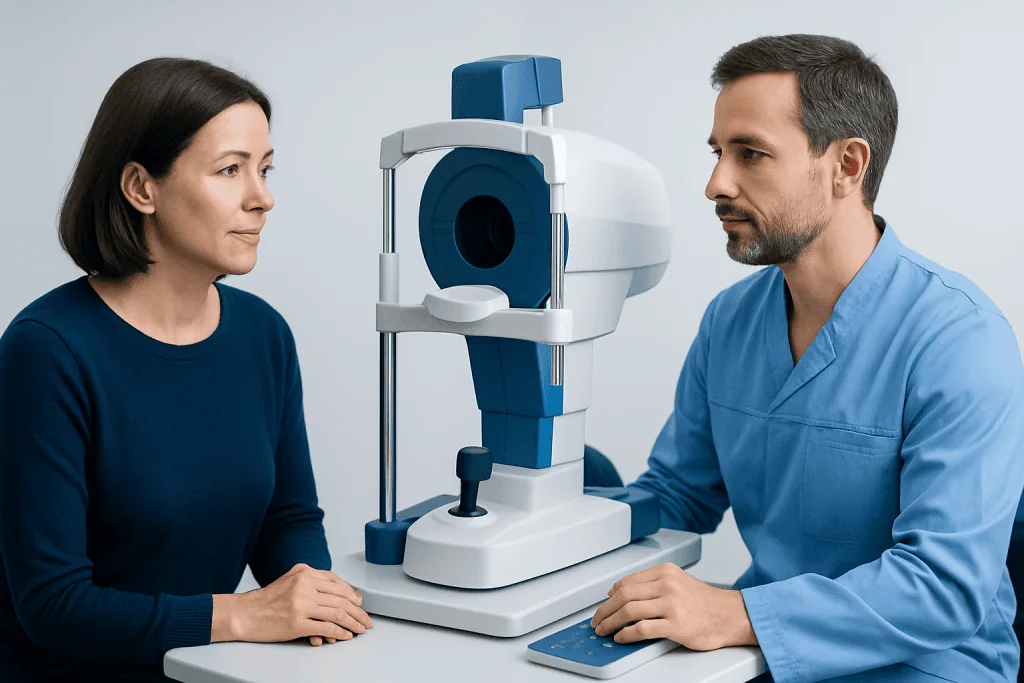
The appointment begins with a discussion of current vision concerns, glasses and contact lens use, occupation, hobbies, and goals. For example, someone who drives frequently at night, works extensively on screens, plays contact sports, or has early reading-vision changes may have different priorities. The clinician will also review general health conditions, eye history, allergies, medications, previous eye surgery, and family history of certain corneal diseases.
Testing usually includes a refraction to measure the glasses prescription, visual-acuity testing, and assessment of eye pressure. The cornea is mapped with computerized imaging, often called topography or tomography, to evaluate its curvature and detect irregularities. Corneal thickness is measured because sufficient tissue is needed for safe laser reshaping. Tear-film testing may also be performed, as untreated dry eye can affect comfort and visual quality after surgery.
A comprehensive eye examination may include dilating drops to allow a clear view of the retina and optic nerve. Pupil size in dim light, lens clarity, and eye alignment can also be assessed. These findings help identify concerns such as cataract, glaucoma risk, retinal disease, or corneal irregularity, which may change the recommended plan.
LASIK consultation length commonly ranges from about one to two hours, especially when dilation or extensive imaging is needed. Vision may remain blurred and light-sensitive for several hours after dilating drops, so arranging transport or avoiding driving may be sensible.
Who may be a candidate for LASIK?

Suitable candidates are generally adults whose prescription has been stable for at least a year and whose eyes are healthy. They should have corneas with an appropriate shape and thickness, realistic expectations, and a prescription within the range that the surgeon and technology can safely treat. Eligibility is based on individual findings rather than age or prescription alone.
LASIK may be postponed or avoided during pregnancy or breastfeeding because hormonal changes can temporarily alter vision and corneal measurements. Active eye infection, significant dry eye, uncontrolled diabetes, certain autoimmune conditions, unstable prescription, keratoconus or suspected corneal weakness, and some retinal or lens conditions require careful evaluation. Some people may be better served by another refractive procedure or by glasses and contact lenses.
People over about 40 may begin to develop presbyopia, an age-related reduction in near focusing ability. LASIK can improve distance vision but does not stop presbyopia. Options such as monovision testing with contact lenses, in which one eye is corrected more for near tasks, may be discussed. The best approach depends on lifestyle, eye dominance, and tolerance for differences between the eyes.
Alternatives may include surface laser treatment such as PRK, small-incision lenticule extraction, implantable contact lenses, or lens-based surgery in selected patients. Choosing an alternative is not a failure of LASIK screening; it is often a sign that the assessment has identified the safer or more suitable option.
How LASIK surgery works, step by step
LASIK is typically an outpatient procedure performed with numbing eye drops. The person remains awake, and the surgical team provides instructions throughout. A device gently holds the eyelids open, and a laser is used to create a thin flap in the cornea. The flap is lifted so that a second laser can reshape the underlying corneal tissue according to the planned correction.
After reshaping, the flap is carefully returned to its original position, where it naturally adheres without stitches. The laser treatment itself is usually brief, although preparation and positioning take longer. Both eyes are often treated during the same appointment when it is clinically appropriate.
Modern laser systems use detailed corneal measurements and eye-tracking technology to help align treatment accurately. Nevertheless, no procedure can promise perfect vision or eliminate every visual symptom. The preoperative plan should include a discussion of the individual’s likely visual result and the possibility of enhancement or ongoing use of glasses for certain tasks.
For readers exploring laser vision correction options, LASIK eye surgery information can provide further context on evaluation, procedure planning, and follow-up care.
Recovery timeline, expected benefits, and possible risks
Many people notice clearer vision within a day after LASIK, but vision can fluctuate during the early healing period. Mild burning, tearing, light sensitivity, a gritty sensation, and temporary blur are common shortly after surgery. Eye drops are usually prescribed to support healing and reduce infection and inflammation risk, and rubbing the eyes should be avoided.
Follow-up visits allow the ophthalmologist to check healing, vision, and flap position. Most people return to many routine activities quickly, but the surgical team may advise temporarily avoiding swimming, hot tubs, dusty environments, eye makeup, and contact sports. The exact recovery timeline varies, so individual postoperative instructions should take priority.
Potential benefits include reduced reliance on corrective lenses and greater convenience for selected daily activities. However, LASIK has possible side effects and complications. These can include dry eye symptoms, glare, halos, starbursts around lights, reduced contrast sensitivity, undercorrection or overcorrection, visual fluctuations, flap-related problems, infection, inflammation, and rarely more serious loss of vision. Careful screening and follow-up reduce risk but cannot remove it completely.
Night-vision symptoms and dry eye deserve particular discussion for people who already have these concerns or who drive at night often. A clinician can explain whether the examination findings suggest an increased likelihood of symptoms and whether treatment of dry eye or an alternative procedure should be considered first.
Preparing for the visit and useful LASIK consultation questions
Contact lenses can temporarily alter corneal shape, so the clinic may ask a person to stop wearing them before testing. The required interval varies by lens type and individual circumstances; the clinic should provide specific instructions. Bringing current glasses, a medication list, prior eye records if available, and details of previous eye procedures can make the evaluation more complete.
Helpful LASIK consultation questions include:
- Am I a candidate for LASIK, and what findings support or limit candidacy?
- Which procedure do you recommend for my eyes, and why?
- What level of vision is realistic for distance, computer work, driving, and reading?
- How could LASIK affect dry eye or night vision in my case?
- What follow-up schedule, recovery restrictions, and warning symptoms should I expect?
- What alternatives are appropriate if LASIK is not the best option?
Some people ask about LASIK consultation and surgery on the same day. In some clinics, same-day treatment may be available if all testing is complete, the eyes are suitable, and the person has had adequate time to understand the options and consent without pressure. Others prefer a separate surgery date, particularly if pupils were dilated or if they would like time to reflect on the recommendation.
The phrase “LASIK consultation ICD-10” may appear in insurance or administrative searches. ICD-10 codes are diagnostic classification codes used for medical documentation and billing; they do not determine whether someone is medically suitable for LASIK. Refractive surgery is often considered elective, so individuals should ask their insurer and clinic about coverage and documentation requirements.
When to seek medical care
Before pursuing LASIK, a person should arrange an eye examination promptly if there is sudden vision loss, new flashes of light, a curtain-like shadow, severe eye pain, marked redness, injury, or a sudden increase in floaters. These symptoms are not typical reasons to wait for a refractive consultation and may need urgent assessment.
After LASIK or another eye procedure, increasing pain, worsening redness, discharge, a significant reduction in vision, or new light sensitivity should be reported to the surgical team without delay. Attending all planned follow-up visits is important even when vision seems to be improving.
People with persistent dry eye, changing vision, diabetes, autoimmune disease, previous eye surgery, or a family history of keratoconus should mention this at the initial appointment. These factors do not always rule out vision correction, but they make specialist assessment especially important.
Acibadem International’s multidisciplinary specialists and JCI-accredited hospitals assess and treat eye conditions for international patients, with treatment planning guided by individual eye findings and overall health.
Frequently asked questions
What is the meaning of a LASIK consultation?
A LASIK consultation is a comprehensive eye assessment to determine whether laser vision correction is appropriate. It includes measurements of vision and corneal structure, an eye-health examination, and discussion of likely results, limitations, risks, and alternatives.
How long does a LASIK consultation take?
A LASIK consultation often takes about one to two hours. The exact time depends on the testing performed and whether dilating eye drops are needed for a detailed examination of the retina.
Can LASIK consultation and surgery happen on the same day?
Same-day LASIK may be possible in selected circumstances after complete testing and informed consent. However, many people choose a separate surgery date so they can review the recommendation, arrange transport, and make a considered decision.
Should contact lenses be stopped before a LASIK consultation?
Usually, yes. Contact lenses can temporarily change corneal shape and may affect the accuracy of measurements. The clinic will advise how long to stop lenses based on the type worn and the person’s eye findings.
What if a person is not suitable for LASIK?
Not being a LASIK candidate does not mean vision correction options are unavailable. Depending on the reason, an ophthalmologist may discuss PRK, another laser procedure, implantable lenses, lens-based surgery, treatment for dry eye, or continued use of glasses or contact lenses.
Does LASIK prevent the need for reading glasses later in life?
No. LASIK corrects the existing focusing error in the cornea, but it does not prevent presbyopia, the normal age-related loss of near focusing ability. Reading glasses or another near-vision strategy may still be needed later.
References
- American Academy of Ophthalmology
- U.S. Food and Drug Administration
- National Eye Institute
- Royal College of Ophthalmologists
This article is for general information only and is not a substitute for professional medical advice. Please consult a qualified doctor about your individual situation.
LASIK in Turkey — costs, top hospitals & a free quote
JCI-accredited · board-certified surgeons · reply within 24h
Add us as a Preferred Source to see more of our trusted health content across Google Search, AI Overviews and Discover.