Does Xray Detect Cancer: Preparation, Procedure and Results

X-rays may identify suspicious abnormalities, but they do not confirm whether a change is cancer. Chest X-rays can help assess symptoms such as persistent cough, chest pain, or unexplained shortness of breath.
Key Takeaways
- X-rays may identify suspicious abnormalities, but they do not confirm whether a change is cancer.
- Chest X-rays can help assess symptoms such as persistent cough, chest pain, or unexplained shortness of breath.
- CT, MRI, ultrasound, PET/CT, laboratory tests, and biopsy may be used after an abnormal X-ray.
- The best test depends on the possible cancer type, symptoms, body area, and individual risk factors.
- A radiologist interprets imaging findings, while tissue biopsy is commonly needed for a definite diagnosis.
X-rays can sometimes reveal changes that may be caused by cancer, such as an unusual mass, bone damage, or fluid around the lungs. However, an X-ray alone cannot diagnose cancer, and an abnormal result usually needs assessment with other imaging tests and sometimes a biopsy.
Does Xray Detect Cancer?
Does xray detect cancer? An X-ray can show changes that may be associated with cancer, but it cannot reliably prove that cancer is present. It may reveal a mass, an area of abnormal density, a collapsed portion of lung, bone destruction, or other findings that need further investigation.
X-rays use a small amount of ionizing radiation to create images of structures inside the body. They are especially useful for viewing bones and the chest, where air-filled lungs provide contrast. A normal X-ray does not rule out every cancer, particularly small, early, or hidden tumors.
When an X-ray finding is concerning, the next step may be a CT scan, MRI scan, ultrasound, PET/CT, blood testing, or a biopsy. These tests help clinicians understand the location and nature of an abnormality and, when needed, confirm a diagnosis through examination of tissue cells.
How X-rays Work and What They Can Show
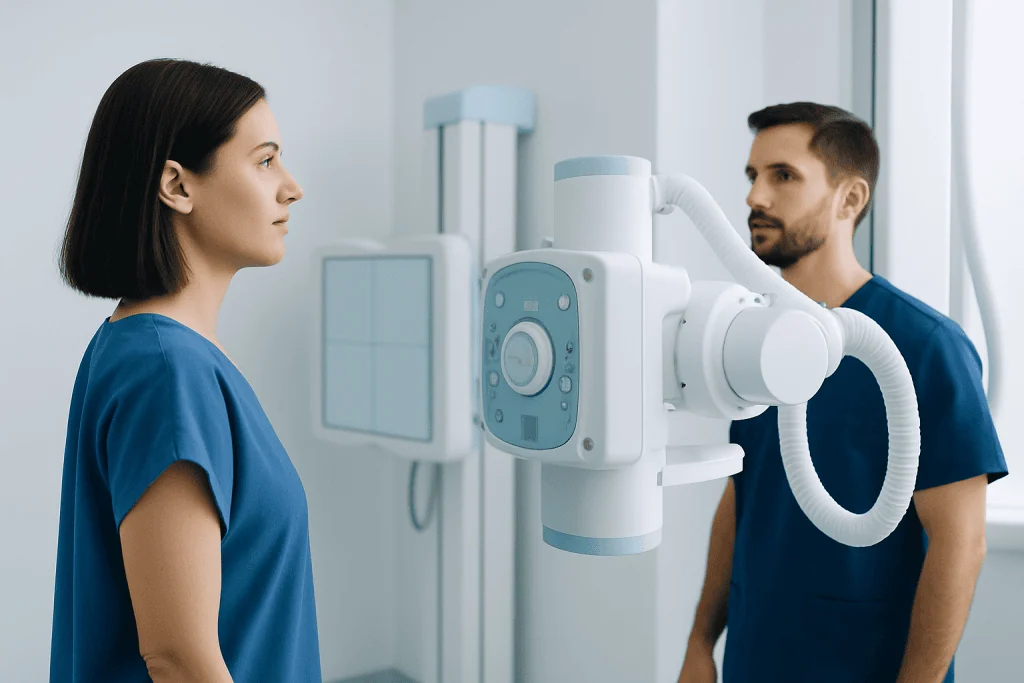
An X-ray machine sends a controlled beam of radiation through the body to a detector. Dense structures, such as bone, absorb more radiation and appear lighter on the image. Air appears darker, while soft tissues appear in different shades of gray. A radiologist reviews the image alongside the person’s symptoms and clinical history.
A chest X-ray may show a lung mass, enlarged structures in the center of the chest, fluid around the lung, or changes caused by airway blockage. Bone X-rays may show a fracture, unusual bone loss, or an abnormal area of bone formation. These appearances can have many causes, including infection, inflammation, injury, and non-cancerous growths.
In other words, if people ask whether X-rays catch cancer, the answer is that they can sometimes detect signs that prompt cancer evaluation. They are usually a starting point rather than a final cancer test. The image may also miss tumors that are small, obscured by other structures, or located in soft tissue where X-ray detail is limited.
Who May Need an X-ray and How the Procedure Is Done
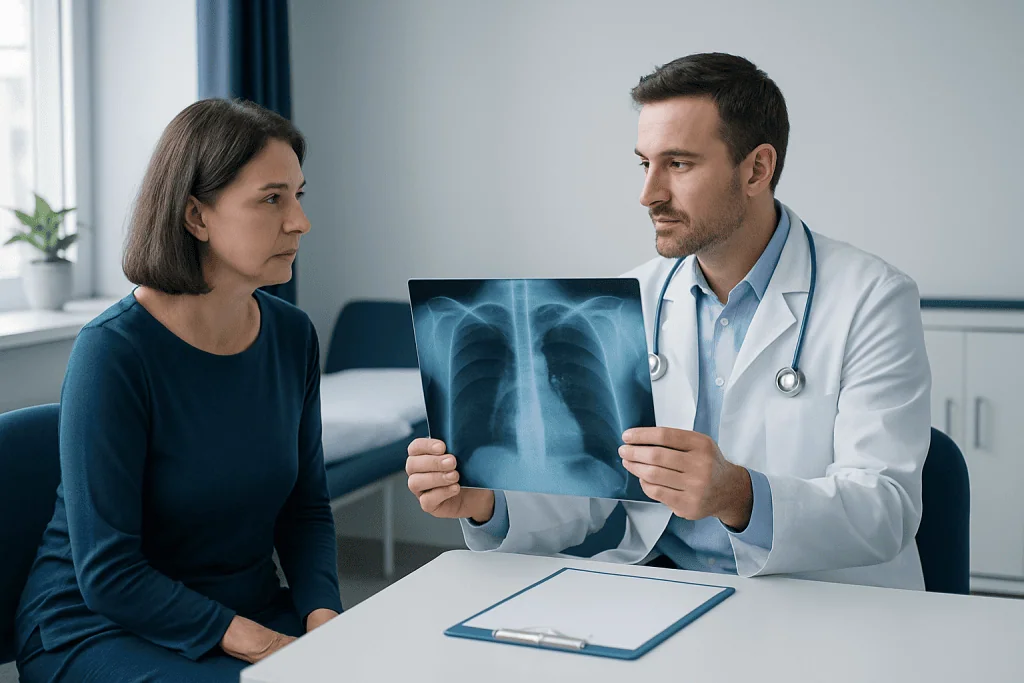
A clinician may recommend an X-ray when symptoms, examination findings, or medical history suggest that imaging could be helpful. For example, a chest X-ray may be considered for persistent respiratory symptoms, while a bone X-ray may be used to investigate persistent localized pain, an injury, or an abnormality found on another test. X-rays are not used as a general screening test for most cancers.
Preparation is usually simple. Most routine X-rays do not require fasting, injections, or special medicines. The person may be asked to remove jewelry, metal objects, or clothing with metal fasteners and wear a gown. It is important to tell the imaging team about pregnancy, a possible pregnancy, prior imaging, or any relevant health condition.
During the procedure, a radiographer positions the body carefully and may ask the person to stay still or hold their breath briefly. A chest X-ray commonly includes images from the front and side. The exposure itself takes less than a second, and the appointment is generally brief. The images are then interpreted by a radiologist and shared with the referring clinician.
There is no recovery period after a standard X-ray. People can usually return to normal activities immediately. Results may be available promptly in urgent settings, while routine reports can take longer depending on the care setting and whether comparison with earlier images is needed.
Benefits, Limits and Safety of X-ray Imaging
The main benefits of X-rays are speed, broad availability, and the ability to identify certain important abnormalities quickly. They can help guide the next clinical decision, such as whether more detailed imaging is needed or whether symptoms may be due to a non-cancer cause such as pneumonia, a fracture, or chronic lung disease.
The key limitation is that an X-ray provides less detail than many other imaging methods. An X-ray cannot always distinguish cancer from scar tissue, infection, benign nodules, or other conditions. Therefore, can X-ray determine cancer? Usually, no. A suspicious image should be evaluated in context rather than interpreted as a diagnosis by itself.
X-rays involve low levels of ionizing radiation. For most medically appropriate examinations, the potential benefit of useful diagnostic information outweighs the small risk. Imaging teams use the lowest reasonable dose and avoid unnecessary repeat studies. Pregnancy should always be discussed in advance so the examination can be adapted, delayed, or replaced if appropriate.
- Benefit: quick assessment of the chest, bones, and some urgent symptoms.
- Limitation: small or early cancers may not be visible.
- Next step: abnormal findings may require targeted imaging or biopsy.
What Test Can Detect Most Cancers?
No single test can detect most cancers accurately in every person. Cancers arise in many organs and behave differently, so testing is chosen according to age, sex, symptoms, family history, personal risk factors, and the organ being assessed. A test that is useful for one cancer may have little value for another.
Established screening approaches include mammography for breast cancer, cervical screening for cervical cancer, stool-based tests or colonoscopy for colorectal cancer, and low-dose CT for selected people at high risk of lung cancer. These tests are designed for specific groups and should be discussed with a qualified clinician. They are not interchangeable, and they do not eliminate the need to assess new symptoms.
For someone with concerning symptoms, the most useful pathway may combine a medical examination, blood or stool tests, focused imaging, endoscopy, and tissue sampling. A biopsy is often the test that establishes whether suspicious cells are cancerous and identifies the tumor type, which is essential for planning treatment.
Can a Radiologist Tell If It Is Cancer From a CT Scan?
A CT scan provides far more detailed cross-sectional images than a standard X-ray. A radiologist can often identify features that make a finding more or less suspicious for cancer, such as its size, shape, edges, growth over time, relationship to nearby structures, and whether there are enlarged lymph nodes or spread to other areas.
Even so, CT findings alone do not always confirm cancer. Infections, inflammatory conditions, scars, and benign growths can sometimes look similar to a tumor on a scan. The report may recommend comparison with previous imaging, a repeat scan after an interval, PET/CT, MRI, blood tests, or a biopsy.
CT is frequently used to investigate an abnormal chest X-ray and to assess a suspected tumor in the chest, abdomen, or pelvis. Depending on the clinical situation, it may be part of a broader cancer evaluation that includes cancer treatment planning after a diagnosis is confirmed.
What Is the Best Scan to Detect Cancer?
There is no universally best scan to detect cancer. The most appropriate imaging test depends on where cancer is suspected and the clinical question. CT is often useful for the lungs, abdomen, pelvis, and many urgent assessments. MRI offers detailed views of soft tissues, including the brain, spine, liver, pelvis, and some breast findings. Ultrasound can assess many abdominal, pelvic, thyroid, and superficial lumps.
PET/CT may help assess the metabolic activity of some known or suspected cancers and evaluate whether disease may have spread. Mammography remains central to breast cancer screening, while low-dose CT is used for lung cancer screening only in people who meet specific eligibility criteria. A clinician selects tests carefully to avoid unnecessary imaging and to obtain information that will influence care.
Does X-ray reveal cancer in every location? No. It may be helpful for the chest and bones, but it has limited ability to show many soft-tissue organs. When cancer is a concern, the best scan is the one matched to the individual’s symptoms, risk profile, and initial findings.
How Do Most Cancers Get Detected?
Most cancers are detected through a combination of screening, investigation of symptoms, follow-up of an incidental finding, and monitoring in people with known risk factors. Screening can find some cancers before symptoms appear, while symptom-based assessment is important when someone notices a persistent or changing health problem.
Common symptoms that warrant medical assessment include a new lump, unexplained bleeding, a persistent cough or change in voice, ongoing changes in bowel or bladder habits, unexplained weight loss, swallowing difficulty, or pain that persists without a clear cause. These symptoms are common and often have non-cancer explanations, but a clinician can determine whether testing is appropriate.
When imaging shows a concerning change, specialists may coordinate further testing and treatment discussions. Acibadem International’s multidisciplinary specialists and JCI-accredited hospitals support diagnosis and treatment planning for international patients. The focus is on clarifying the cause of an abnormal finding and selecting care based on the individual diagnosis.
When to Seek Medical Care
Medical care should be sought for symptoms that are persistent, worsening, unexplained, or causing concern. This includes coughing up blood, increasing shortness of breath, chest pain, a new or growing lump, unexplained bleeding, or significant unintentional weight loss. Urgent assessment is appropriate for severe breathing difficulty, severe chest pain, or heavy bleeding.
An abnormal X-ray should be discussed with the clinician who ordered it, even if the person feels well. The report may describe a finding as uncertain or recommend another examination; this does not necessarily mean cancer is present. Timely follow-up helps ensure that the next steps are appropriate and avoids unnecessary delay.
People should not rely on a normal X-ray to dismiss persistent symptoms. If symptoms continue or change, a doctor may recommend a different test or referral, because the choice of investigation should be guided by the whole clinical picture.
Frequently asked questions
Does xray detect cancer early?
An X-ray may detect some visible changes at an early stage, particularly in the chest or bones, but it is not sensitive enough to find all early cancers. Small tumors and abnormalities hidden behind normal structures may not appear on an X-ray. Appropriate screening tests are more reliable for detecting certain cancers before symptoms develop.
Do X-rays show cancer as a white spot?
Some abnormalities may appear as lighter or denser areas on an X-ray, but a white spot is not automatically cancer. Infection, scarring, fluid, calcification, and benign conditions can also alter the image. A radiologist considers the pattern, location, and clinical history before recommending next steps.
Can a normal chest X-ray rule out lung cancer?
No. A normal chest X-ray lowers the chance of some visible lung abnormalities but cannot rule out lung cancer completely. If symptoms persist or a person has significant risk factors, a clinician may consider CT or another evaluation.
Is a CT scan better than an X-ray for cancer?
CT generally provides more detailed images than a standard X-ray and can reveal many abnormalities that an X-ray cannot show clearly. However, CT is not always the best first test and uses more radiation. The right test depends on the body area, symptoms, and reason for imaging.
Is a biopsy always needed after an abnormal X-ray?
No. Some X-ray findings are clearly related to a non-cancer condition or can be clarified with another imaging test. When cancer remains a possibility, a biopsy is often needed to confirm the diagnosis because it allows cells or tissue to be examined directly.
How long does it take to get X-ray results?
The imaging procedure itself is usually completed within minutes. In urgent care settings, preliminary interpretation may be available quickly, while routine reports may take longer. The referring clinician can explain when and how results will be discussed.
References
- World Health Organization
- National Cancer Institute
- American Cancer Society
- RadiologyInfo.org
- American College of Radiology
This article is for general information only and is not a substitute for professional medical advice. Please consult a qualified doctor about your individual situation.
Oncology care in Turkey — second opinion and treatment plan
JCI-accredited · board-certified surgeons · reply within 24h
Add us as a Preferred Source to see more of our trusted health content across Google Search, AI Overviews and Discover.