Hip Impingement Treatment: How It Works, Results and What to Expect

Hip impingement, also called femoroacetabular impingement (FAI), can cause groin pain, stiffness and pain with bending or twisting. First-line treatment commonly includes activity modification, physiotherapy and pain-management measures recommended by a clinician.
Key Takeaways
- Hip impingement, also called femoroacetabular impingement (FAI), can cause groin pain, stiffness and pain with bending or twisting.
- First-line treatment commonly includes activity modification, physiotherapy and pain-management measures recommended by a clinician.
- Hip arthroscopy can reshape bone and repair damaged tissue in selected patients with persistent symptoms.
- Recovery time varies with the procedure, the condition of the cartilage and labrum, and the person’s rehabilitation progress.
- Early assessment is important for severe pain, inability to bear weight, fever, or hip pain after a significant injury.
Hip impingement treatment aims to reduce pain, restore hip movement and protect the joint by addressing abnormal contact between the ball and socket of the hip. Many people improve without surgery, while arthroscopy may be considered when structured nonsurgical care does not provide enough relief.
Hip impingement treatment: how it works
Hip impingement treatment reduces painful contact between the top of the thigh bone (femur) and the hip socket (acetabulum). This condition is often called femoroacetabular impingement, or FAI. It may occur when the femoral head is not perfectly round (cam impingement), when the socket covers too much of the femoral head (pincer impingement), or when both features are present.
Treatment is individualized. The main goals are to ease symptoms, improve hip strength and movement, help a person return to valued activities safely, and address associated problems such as irritation or tearing of the labrum, the cartilage rim around the hip socket. Imaging findings alone do not determine treatment, because some people have FAI-shaped bones without pain.
Most people begin with nonsurgical care. If pain and functional limits continue despite an appropriate rehabilitation program, an orthopedic hip specialist may discuss hip arthroscopy as one possible treatment. Surgery is intended to correct the mechanical source of impingement when it is likely to be contributing to symptoms.
Symptoms, causes and who may benefit from treatment
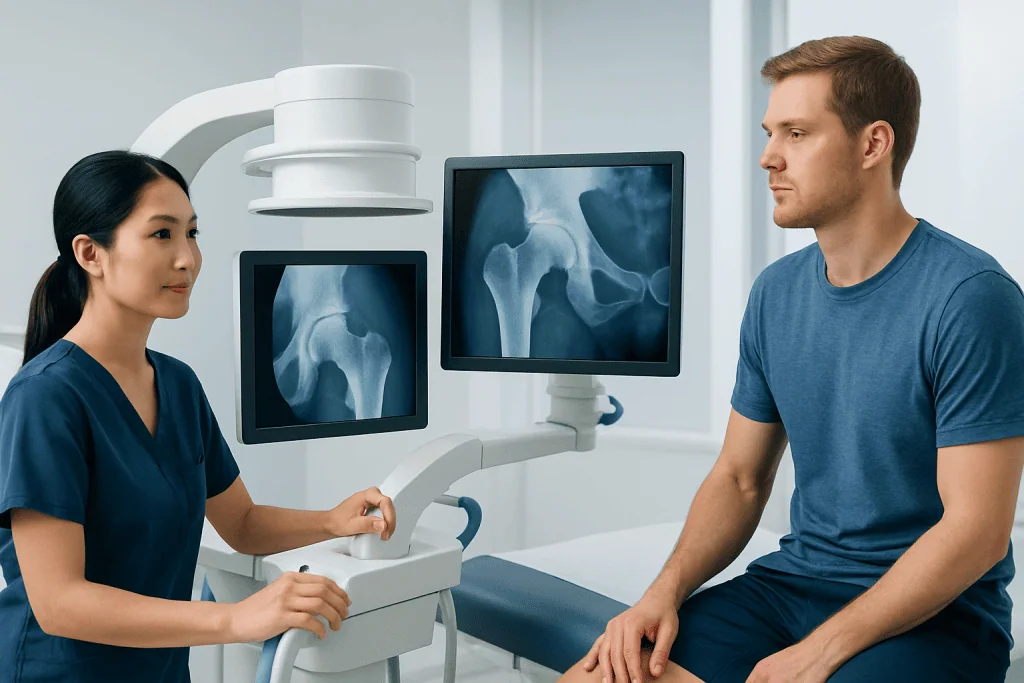
Hip impingement commonly causes pain deep in the groin or at the front of the hip. Pain may also be felt at the side of the hip, buttock or thigh. It can be triggered by sitting for a long time, squatting, climbing stairs, turning, running, cycling, or sports involving repeated hip flexion and rotation. Clicking, catching, stiffness and reduced range of motion can occur, although these symptoms have several possible causes.
FAI usually reflects the shape of the hip bones that developed during growth. Repetitive high-impact sport during adolescence may contribute in some people, but hip impingement is not simply caused by exercise or by poor posture. Hip pain can also result from tendon problems, bursitis, arthritis, stress injuries, referred back pain, or other conditions, so a careful assessment is important.
People most likely to benefit from targeted treatment are those whose symptoms, examination findings and imaging results point to FAI as the source of pain. Treatment decisions also consider age, activity goals, hip stability, the labrum and cartilage condition, and whether osteoarthritis is already present. Advanced arthritis may make joint-preserving arthroscopy less helpful than it is for a hip with relatively preserved cartilage.
Nonsurgical hip impingement treatment

Conservative treatment is often the first approach and may be effective, particularly when symptoms are mild or recent. A clinician may recommend temporarily reducing activities that reliably provoke deep hip pain, such as very deep squats, repeated pivoting, or prolonged low sitting. This does not necessarily mean stopping all activity; maintaining comfortable low-impact movement is often useful.
Physiotherapy is a central part of treatment. A therapist can help improve hip and trunk strength, movement control, flexibility where appropriate, and technique for work, exercise and sport. Rehabilitation usually focuses on gradual progression rather than forcing the hip into painful end-range positions. The program should be tailored to the individual’s symptoms and goals.
Anti-inflammatory medicines or other pain-relieving options may be considered by a doctor when safe for the individual. Image-guided injection into the hip joint may sometimes be used to help clarify the pain source or provide temporary symptom relief. Injections do not change bone shape, and their role should be discussed carefully with a qualified clinician.
- Modify painful movements while remaining as active as comfort allows.
- Follow a structured physiotherapy and strengthening plan.
- Address training load, movement patterns and gradual return to sport.
- Review ongoing pain or loss of function rather than self-managing indefinitely.
Hip impingement surgery: candidacy and step-by-step procedure
Hip impingement surgery is generally considered when a person has persistent, activity-limiting symptoms, a clinical assessment consistent with FAI, and insufficient improvement after well-directed nonsurgical treatment. It is not recommended solely because an X-ray or MRI shows FAI morphology. A hip-preservation specialist weighs potential benefits against factors such as joint degeneration, cartilage loss, hip dysplasia and other causes of pain.
Most procedures are performed using hip arthroscopy, also called keyhole surgery. The patient receives anesthesia, and the surgeon makes small incisions around the hip. A camera and fine instruments are introduced into the joint. Fluid is used to create space and allow the surgeon to view the cartilage, labrum and other joint structures.
During the procedure, the surgeon may trim excess bone from the femur, the socket, or both, to reduce impingement. A torn or detached labrum may be repaired when possible; occasionally, damaged tissue is treated in another way depending on its condition. The incisions are closed after the instruments are removed. Procedure details vary, and the surgeon explains the planned approach based on the person’s anatomy and scans.
Preoperative planning may include X-rays and MRI, sometimes with specialized imaging to evaluate bone shape, cartilage and the labrum. The care team also reviews medicines, medical conditions, anesthesia considerations and rehabilitation arrangements before surgery.
Benefits, risks and recovery timeline
For appropriately selected patients, surgery may reduce pain, improve hip function and support return to daily activities and sport. Results depend on many factors, including the degree of cartilage damage, the accuracy of diagnosis, the procedure performed, rehabilitation participation and individual healing. Surgery cannot guarantee that pain will completely disappear or prevent all future hip arthritis.
After hip arthroscopy, many people go home the same day or after a short hospital stay, depending on their procedure and general health. Crutches are often used initially, especially after labral repair or cartilage-related procedures. Early rehabilitation typically includes gentle mobility and exercises designed to protect the repair while reducing stiffness.
Recovery is gradual. Desk-based work may be possible within a few weeks for some people, while physically demanding work needs more time. Walking and basic daily activity commonly progress over the first several weeks. Strength, control and sport-specific conditioning are developed over subsequent months. A return to running, pivoting sports or heavy training should be guided by the surgical and rehabilitation team rather than by a fixed date.
Potential risks include infection, bleeding, blood clots, nerve irritation, stiffness, ongoing pain, incomplete symptom improvement, and the need for further treatment. There are also risks related to anesthesia and traction used during arthroscopy. A surgeon can explain how these risks apply to the individual and what measures are used to reduce them.
Can you fully recover from hip impingement?
Many people with hip impingement achieve substantial pain relief and return to their usual activities with appropriate treatment, but “full recovery” means different things for different individuals. Some improve with activity changes and physiotherapy alone. Others need surgery because symptoms remain limiting or there is treatable labral or mechanical injury.
Recovery is more likely to be favorable when the hip joint has limited cartilage damage and the diagnosis clearly matches the person’s symptoms. If osteoarthritis is established, treatment can still improve comfort and function, but surgery to reshape bone may not restore a normal joint or reverse arthritis.
Long-term self-management remains valuable even after successful care. Keeping hip and trunk muscles strong, increasing training loads gradually, using movement modifications when needed, and responding early to recurrent symptoms can help support ongoing hip health.
How long does it take to fix hip impingement?
The time needed to improve hip impingement depends on the cause of symptoms and the treatment chosen. With nonsurgical care, a structured physiotherapy program may require several weeks to a few months before progress can be judged. Some people improve sooner, while others need adjustments to the plan or further assessment.
After arthroscopic surgery, recovery is usually measured in months rather than days or weeks. Early healing and protected movement occur first, followed by progressive strengthening, balance and activity-specific rehabilitation. Higher-impact sport often requires a longer period of conditioning and clearance from the care team.
It is important not to compare recovery too closely with another person’s timeline. Labral repair, cartilage procedures, preexisting weakness, work demands and sport goals can all affect the pace. Regular follow-up helps the team adapt rehabilitation safely when progress is slower or symptoms change.
How painful is a hip impingement?
Hip impingement can range from a mild ache after activity to pain that interferes with walking, sitting, sleep, work or sport. A common pattern is sharp or pinching pain in the groin when the hip is deeply bent or rotated. Some people experience only stiffness or reduced performance rather than severe pain.
The intensity of pain does not always match the appearance of the hip on imaging. Labral irritation, cartilage injury, muscle tension, activity level and individual pain sensitivity can all influence symptoms. This is why clinicians combine a medical history, examination and imaging instead of relying on one test.
New severe pain, inability to bear weight, pain with fever or feeling unwell, marked redness or swelling, or pain following a fall or accident needs prompt medical assessment. These signs may indicate a problem other than uncomplicated hip impingement.
Is hip impingement surgery worth it?
Hip impingement surgery may be worthwhile for someone with persistent, clearly diagnosed FAI whose pain continues to limit daily life or important activities despite a suitable course of nonsurgical treatment. The decision is personal and should balance likely symptom improvement with recovery time, surgical risks, current activity limits and the condition of the joint cartilage.
Surgery tends to be considered more favorably when the hip has little to no advanced arthritis and when the symptoms are reproduced on examination and supported by imaging. It may be less likely to help if pain comes mainly from another source, if significant arthritis is present, or if the expected benefits do not outweigh the demands of rehabilitation.
A detailed consultation allows the patient to ask what findings surgery would address, what improvement is realistic, what alternatives remain, and what the rehabilitation plan involves. Acibadem International’s multidisciplinary orthopedic specialists and JCI-accredited hospitals evaluate and treat hip conditions for international patients through individualized diagnostic and rehabilitation planning.
When to seek medical care
Anyone with hip or groin pain that lasts more than a few weeks, repeatedly returns with activity, limits walking or exercise, or affects work and sleep should arrange an assessment with a qualified doctor. Earlier evaluation can help identify whether FAI, a labral problem, arthritis, tendon injury or another condition is responsible.
Urgent medical care is appropriate for severe pain after trauma, inability to stand or bear weight, a visibly deformed hip, fever with hip pain, rapidly increasing swelling, or a hot and red joint. These symptoms are not typical of uncomplicated FAI and require timely evaluation.
People with persistent symptoms may benefit from assessment by an orthopedic specialist with experience in hip preservation. The evaluation should include discussion of daily function, exercise goals, medical history and all reasonable treatment options, including rehabilitation and surgery when appropriate.
Frequently asked questions
What is the first treatment for hip impingement?
The first treatment is usually a tailored nonsurgical plan. It often includes reducing activities that trigger pain, physiotherapy to improve hip and trunk control, and clinician-guided pain relief when appropriate. The plan is adjusted according to symptoms, examination findings and activity goals.
Can physical therapy fix hip impingement?
Physical therapy does not change the shape of the hip bones, but it can meaningfully reduce symptoms and improve function for many people. It can improve strength, movement control and tolerance for daily activity or sport. Persistent symptoms should be reviewed by a clinician rather than managed through increasingly painful exercise.
Does hip impingement always require surgery?
No. Many people manage hip impingement successfully without surgery. Surgery is generally reserved for persistent, function-limiting symptoms when assessment indicates that FAI is the likely pain source and structured nonsurgical care has not been sufficient.
Can hip impingement lead to arthritis?
FAI is associated with damage to the labrum and cartilage in some people, which may contribute to later osteoarthritis. However, not everyone with FAI develops arthritis, and the exact risk varies. Maintaining regular follow-up for persistent symptoms can help guide appropriate care.
What should be avoided with hip impingement?
Movements that consistently cause sharp deep hip or groin pain should be reduced temporarily, especially repeated deep bending, twisting and high-impact activities. Complete inactivity is usually not necessary and may worsen weakness. A physiotherapist can advise on safer modifications while rehabilitation progresses.
How is hip impingement diagnosed?
Diagnosis combines the person’s symptoms, physical examination and imaging such as X-rays and MRI when needed. A clinician may also consider diagnostic injections in selected cases. Imaging changes alone are not enough, because similar bone shapes can occur in people without hip pain.
References
- American Academy of Orthopaedic Surgeons
- American Orthopaedic Society for Sports Medicine
- National Institute of Arthritis and Musculoskeletal and Skin Diseases
- International Society for Hip Preservation Surgery
This article is for general information only and is not a substitute for professional medical advice. Please consult a qualified doctor about your individual situation.
Joint and spine care in Turkey — expert assessment & treatment
JCI-accredited · board-certified surgeons · reply within 24h
Add us as a Preferred Source to see more of our trusted health content across Google Search, AI Overviews and Discover.