Peyronie’s Disease: Penile Curvature, Pain, and Treatment Options

Peyronie’s disease is usually related to fibrous plaque in the tunica albuginea, the firm tissue that helps the penis become rigid during erection. Symptoms may include penile curvature, pain during erections, indentations, shortening, or erectile dysfunction.
Key Takeaways
- Peyronie’s disease is usually related to fibrous plaque in the tunica albuginea, the firm tissue that helps the penis become rigid during erection.
- Symptoms may include penile curvature, pain during erections, indentations, shortening, or erectile dysfunction.
- Diagnosis is usually made by medical history and physical examination; ultrasound may be used to assess plaque and blood flow.
- Treatment depends on whether the disease is active or stable and may include observation, medication, traction therapy, injections, or surgery.
- Men should seek medical advice if curvature, pain, or erection changes affect sexual activity, confidence, or quality of life.
Peyronie’s disease is a condition in which scar-like plaque forms in the penis, sometimes causing curvature, pain, shortening, or difficulty with erections. Many men improve with time or treatment, and a urologist can help choose the safest approach based on symptoms and goals.
Overview
Peyronie’s disease is a benign condition that affects the penis, most often by causing a noticeable curve during erection. It happens when a firm, fibrous area called a plaque develops in the tunica albuginea, the elastic tissue surrounding the erectile chambers of the penis. This plaque is not cancer, and it is not an infection. However, it can change the way the penis expands during an erection.
The condition may develop gradually or seem to appear after a specific event, such as bending during sexual activity. Some men have pain, while others mainly notice curvature, narrowing, or shortening. The degree of curvature varies widely; for some men it is mild, while for others it can make intercourse difficult or uncomfortable.
Peyronie’s disease is more common in middle-aged and older men, but it can occur at different adult ages. It is also frequently underreported because many men feel embarrassed or assume nothing can be done. In reality, urologists evaluate and treat this condition regularly, and many treatment options are available depending on the stage and severity.
Symptoms and Stages

The main symptom of Peyronie’s disease is a change in penile shape during erection. The penis may curve upward, downward, or to either side. Some men notice an hourglass shape, a hinge-like bend, or a narrower area along the shaft. A firm lump or band may be felt under the skin, although the plaque is often easier for a doctor to detect during examination.
Pain is more common in the early phase, especially during erections. This discomfort often improves over time, even if curvature remains. Erectile dysfunction can also occur, either because of changes in penile structure, reduced confidence, performance anxiety, or associated blood flow problems.
Doctors often describe Peyronie’s disease in two stages. The active phase is when pain, inflammation, or changing curvature may be present. This phase can last several months or longer. The stable phase is when pain has usually settled and the curve has not changed for a period of time, often making certain treatments, especially surgery, more predictable.
- Common symptoms include penile curvature, painful erections, shortening, indentation, and difficulty with penetration.
- Symptoms can affect sexual activity, self-esteem, and relationships, even when the physical curve is moderate.
- Not every curve is Peyronie’s disease; some men naturally have a mild lifelong curvature.
Causes and Risk Factors
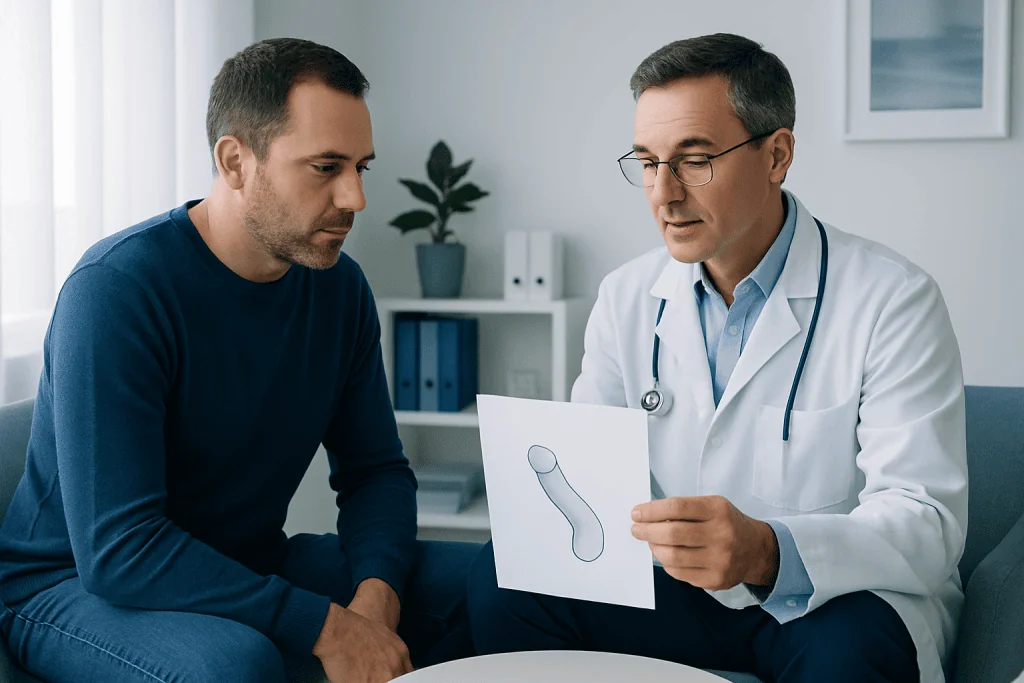
The exact cause of Peyronie’s disease is not fully understood, but it is often linked to wound healing inside the penis. Small injuries, sometimes too minor to remember, may occur during sexual activity, sports, or other bending forces. In some men, the healing process leads to excess collagen and fibrous plaque rather than flexible tissue.
Not everyone who has penile trauma develops Peyronie’s disease. Individual healing response, genetics, and connective tissue tendencies appear to play a role. Peyronie’s disease is more common in men who have Dupuytren’s contracture, a condition that causes tightening of tissue in the palm. It may also be associated with conditions that affect blood vessels and tissue health.
Risk factors may include age, a family history of Peyronie’s disease or connective tissue disorders, diabetes, smoking, and erectile dysfunction. Prior prostate surgery or pelvic procedures may also be associated in some men, although the relationship can vary. Having a risk factor does not mean a man will develop the condition; it only helps doctors understand the broader context.
Peyronie’s disease is not caused by a sexually transmitted infection, poor hygiene, or sexual activity itself. It is not contagious. Understanding this can help reduce unnecessary worry and encourage men to seek appropriate medical guidance.
Diagnosis
A urologist usually diagnoses Peyronie’s disease through a careful medical history and physical examination. The doctor may ask when symptoms began, whether pain is present, whether the curve is changing, and how erections and sexual activity are affected. It can be helpful for the patient to bring a clear photograph of the erect penis taken at home from different angles, if he feels comfortable doing so.
During the examination, the doctor may feel for plaques, assess penile length, and check for areas of tenderness or deformity. The goal is not only to confirm Peyronie’s disease but also to understand whether symptoms are active or stable. This distinction helps guide treatment decisions.
Penile ultrasound may be recommended in some cases. Ultrasound can show plaque location, calcification, and blood flow within the penis. Sometimes an erection is medically induced in the clinic so the curvature and blood flow can be assessed more accurately. This is done in a controlled medical setting with clear explanation beforehand.
Other causes of penile pain or erection changes may also be considered. These can include injury, infection, dermatologic conditions, or vascular erectile dysfunction. A respectful, confidential evaluation helps patients receive the most appropriate care without judgment.
Treatment Options
Treatment for Peyronie’s disease is personalized. If the curve is mild, pain is improving, and sexual function is not significantly affected, observation may be appropriate. Many men in the active phase are monitored while symptoms stabilize. During this time, doctors may focus on pain control, sexual counseling, and managing erectile dysfunction if present.
Non-surgical options may include oral medications in selected cases, although evidence for many tablets is limited. Penile traction therapy may help some men reduce curvature or preserve length when used correctly and consistently under medical guidance. Vacuum erection devices may be considered for erectile support, but they should be used as advised to avoid injury.
For men with a stable curve that interferes with intercourse, injections into the plaque may be discussed. Injectable treatments aim to soften or remodel the plaque and are usually combined with specific stretching or modeling instructions. They are not suitable for every type of plaque or curvature, so careful assessment is important.
Surgery may be considered when the disease has been stable and the deformity prevents satisfactory sexual activity. Surgical options include plication, plaque incision or grafting, and penile prosthesis placement when significant erectile dysfunction is also present. Each approach has benefits and trade-offs, including possible changes in length, sensation, or erectile function, so shared decision-making with an experienced urologist is essential.
Living With Peyronie’s Disease
Peyronie’s disease can affect more than physical function. Men may feel anxious, frustrated, or less confident about sexual intimacy. These feelings are common and understandable. Open communication with a partner, when possible, can reduce pressure and help couples adapt while treatment decisions are being made.
Sexual activity is usually safe if it is comfortable and does not cause further injury. Using adequate lubrication, avoiding positions that increase bending, and stopping if pain occurs can help reduce discomfort. Men with erection difficulties should discuss this with a doctor rather than trying unregulated products, as some supplements may be ineffective or unsafe.
General health measures can support erectile and tissue health. These include not smoking, limiting alcohol, staying physically active, managing diabetes or blood pressure, and maintaining a healthy weight. While lifestyle changes do not remove plaque by themselves, they may improve overall sexual health and treatment outcomes.
Emotional support is also important. Some men benefit from counseling, sex therapy, or a consultation where both partners can ask questions. Peyronie’s disease is a medical condition, not a personal failing, and support can make treatment feel more manageable.
Prevention and Self-Care
There is no guaranteed way to prevent Peyronie’s disease, because individual healing responses cannot always be predicted. However, reducing avoidable penile injury may help. Men should avoid forceful bending during sexual activity and address erectile dysfunction early, because partial erections may be more vulnerable to bending trauma.
Self-care should be gentle and medically guided. Patients should not attempt aggressive stretching, forceful straightening, or unapproved injections, as these may worsen injury. If traction or device-based therapy is recommended, correct technique and follow-up are important.
Keeping track of symptoms can help the doctor assess progression. Men may note the degree of curvature, pain level, erection quality, and any changes in sexual function. Photographs of the erect penis, taken safely and privately, may provide useful comparison over time.
Because Peyronie’s disease can overlap with erectile dysfunction and cardiovascular risk factors, routine health care matters. Managing blood sugar, cholesterol, blood pressure, and smoking status can benefit both sexual and general health.
When to See a Doctor
A man should see a qualified doctor or urologist if he notices a new penile curve, pain with erections, a lump or firm band under the skin, penile shortening, or difficulty with intercourse. Early evaluation is useful even when symptoms are mild, because it helps confirm the diagnosis and identify whether the disease is active or stable.
Medical care is also recommended if erectile dysfunction develops, if the curve is worsening, or if the condition is causing distress in a relationship. Prompt advice can help men avoid unsafe self-treatment and understand realistic options. Peyronie’s disease is common enough that urologists are familiar with discussing it discreetly and professionally.
International patients who need evaluation may seek care in centers with urology, imaging, sexual medicine, and reconstructive expertise. Acibadem International’s multidisciplinary specialists and JCI-accredited hospitals diagnose and treat Peyronie’s disease for international patients, with care plans tailored to individual findings and preferences.
Frequently asked questions
Is Peyronie’s disease dangerous?
Peyronie’s disease is not cancer and is not contagious. It can, however, affect erections, sexual activity, and confidence. A urologist can evaluate the condition and explain whether monitoring or treatment is appropriate.
Can Peyronie’s disease go away on its own?
Pain often improves over time, especially after the active phase. Curvature may improve in some men, remain stable, or worsen. Because the course varies, medical evaluation helps guide safe observation or treatment.
Does every penile curve mean Peyronie’s disease?
No. Some men have a mild natural curve that has been present for many years and does not cause pain or sexual difficulty. Peyronie’s disease is more likely when curvature is new, changing, associated with pain, or linked to a palpable plaque.
What is the best treatment for Peyronie’s disease?
There is no single best treatment for every patient. The right option depends on the stage of disease, degree of curvature, erection quality, plaque features, and personal goals. Treatments may range from monitoring and traction therapy to injections or surgery.
Can sexual activity make Peyronie’s disease worse?
Sexual activity is usually acceptable if it is comfortable and does not cause bending injury. Men should avoid positions or movements that place strong pressure on the penis, especially with partial erections. If pain or instability occurs, a doctor should be consulted.
When is surgery considered?
Surgery is usually considered when Peyronie’s disease is stable and curvature or deformity prevents satisfactory sexual activity. It is not typically the first option during the active, changing phase. A urologist can explain the most suitable procedure and possible trade-offs.
References
- American Urological Association
- European Association of Urology
- Mayo Clinic
- Cleveland Clinic
- National Institute of Diabetes and Digestive and Kidney Diseases
This article is for general information only and is not a substitute for professional medical advice. Please consult a qualified doctor about your individual situation.
Oncology care in Turkey — second opinion and treatment plan
JCI-accredited · board-certified surgeons · reply within 24h
Add us as a Preferred Source to see more of our trusted health content across Google Search, AI Overviews and Discover.