

Fiber Post Application After Root Canal: When It Is Used and Why

A fiber post may be used after root canal treatment when a tooth is badly broken down and needs extra support for restoration. The post is placed inside a prepared root canal space and bonded to the tooth; it mainly helps retain the core buildup.
Key Takeaways
- A fiber post may be used after root canal treatment when a tooth is badly broken down and needs extra support for restoration.
- The post is placed inside a prepared root canal space and bonded to the tooth; it mainly helps retain the core buildup.
- Not every root canal-treated tooth needs a post, and placing one unnecessarily may remove healthy tooth material.
- Fiber posts are often preferred because they are tooth-colored and have flexibility similar to natural dentin.
- Long-term success depends on remaining tooth structure, careful bonding, and a well-fitted final restoration such as a crown.
Fiber post application after root canal is a restorative step used to help support a tooth that has lost significant structure. It does not replace the root canal itself, but it can improve retention for the final restoration, often a filling or crown, when chosen for the right case.
Overview
Fiber post application after root canal is a dental procedure used to help rebuild a tooth that has been weakened by decay, fracture, repeated dental work, or the access opening made during root canal treatment. After the infected or inflamed pulp is removed and the canals are cleaned and sealed, the dentist evaluates how much healthy tooth structure remains above the gumline. If there is not enough structure to securely hold a filling or core buildup, a post may be considered.
A fiber post is a slender, tooth-colored rod placed into part of the cleaned root canal space. It is bonded with dental cement and serves as an anchor for the core material that rebuilds the missing part of the tooth. This rebuilt foundation then supports the final restoration, which is often a crown. In many cases, the overall care involves both root canal treatment and later dental crown restoration.
It is important to understand that a post does not strengthen every tooth automatically, and it is not needed in all cases. In fact, if enough healthy tooth remains, a dentist may restore the tooth without a post. The decision is based on careful assessment of the tooth’s structure, location in the mouth, bite forces, and long-term restorative goals.
When a Fiber Post Is Used
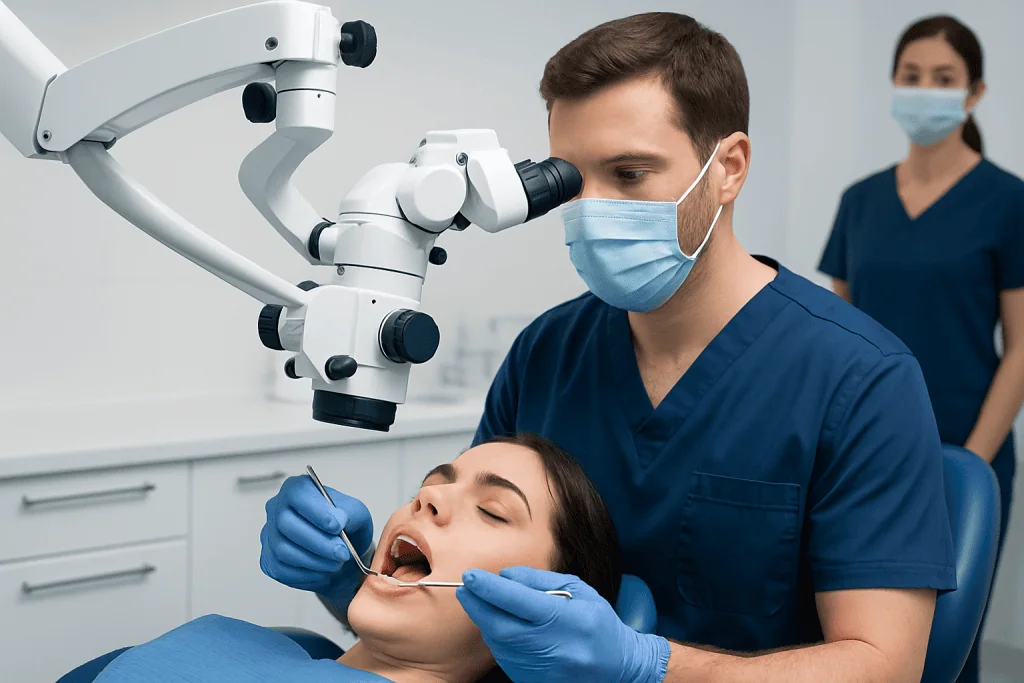
A fiber post is most often used when a root canal-treated tooth has lost a large amount of crown structure and needs additional retention for a core buildup. This situation commonly occurs in teeth with extensive decay, a large old filling, or a fracture that leaves only thin walls of tooth tissue. Front teeth and premolars may especially benefit when little internal support remains, though molars can also need posts in selected cases.
The key reason for using a post is not to reinforce the root itself, but to help hold the rebuilding material in place. If the tooth can already retain a filling or bonded core securely, a post may not add value. Dentists try to preserve as much natural tooth tissue as possible, because remaining structure is one of the strongest predictors of a successful restoration.
A dentist may consider a fiber post in situations such as:
- Severe loss of tooth structure after decay or trauma
- Need for a core buildup before placing a crown
- Limited walls of healthy enamel or dentin left above the gumline
- Esthetic areas where a metal-free restoration is preferred
- Teeth expected to receive moderate functional load with a good ferrule effect
If a tooth is split deeply, has severe root damage, or lacks enough sound tissue to be restored predictably, a post may not be appropriate. In those cases, the dentist may discuss other options and assess the tooth through a broader general dentistry evaluation.
Why Fiber Posts Are Often Preferred

Fiber posts are widely used because their mechanical behavior is closer to natural dentin than that of traditional metal posts. This means they can distribute biting forces in a more favorable way, which may reduce the risk of certain types of root fracture. They are also tooth-colored, which can be especially helpful for front teeth or other visible areas where metal could show through the restoration or the gumline.
Another advantage is that fiber posts can often be bonded adhesively to the root canal dentin and the core buildup material. This creates a more integrated restoration, especially when modern adhesive techniques are used carefully. Their placement is generally conservative compared with some cast post systems, because less internal tooth structure may need to be removed.
Fiber posts are not perfect for every situation. They can fail if bonding is compromised, if there is too little remaining tooth tissue, or if heavy bite forces place too much stress on the restoration. The final result depends not only on the post itself, but also on the quality of root canal treatment, the amount of remaining tooth, the design of the core, and whether the tooth receives an appropriate protective restoration afterward.
How the Procedure Is Performed
Before placing a fiber post, the dentist confirms that the root canal treatment has been completed properly and that the tooth is suitable for restoration. X-rays may be used to check the root, canal filling, and surrounding bone. A portion of the root canal filling material is then removed from the upper part of the canal, while an apical seal is left at the end of the root to maintain the success of the root canal treatment.
The post space is prepared carefully so that the dentist removes only the amount of material needed to fit the post. The chosen fiber post is tried in, adjusted if necessary, and bonded into the canal with resin cement. After the post is secured, core buildup material is placed around it to rebuild the missing portion of the tooth.
Once the tooth has enough form and support, the dentist prepares it for the final restoration. In many cases, that means a crown to protect the tooth from fracture and to restore function and appearance. Planning and precision are important throughout the process, and modern digital dentistry tools may help with imaging, design, and restoration fit in selected cases.
Local anesthetic may be used if needed, especially if gum tissue must be shaped or if the tooth is sensitive to manipulation. After the procedure, mild tenderness is possible for a short time, but many people return to normal activities the same day unless additional restorative steps are planned.
Benefits, Limitations, and Possible Risks
The main benefit of fiber post application after root canal is improved retention for the core and final restoration in a tooth that would otherwise be difficult to rebuild. It can help preserve a natural tooth that still has a restorable root and sufficient surrounding support. Because fiber posts are esthetic and metal-free, they can also be a good option when appearance matters.
Still, a fiber post is not a guarantee against fracture or future dental problems. A post cannot compensate for a tooth with poor structural prognosis, active decay, an inadequate ferrule, or uncontrolled biting forces. If too much internal tooth structure must be removed to place a post, the disadvantages may outweigh the benefits.
Possible complications can include debonding of the post, loosening of the core, crown failure, recurrent decay, or fracture of the remaining tooth structure. Less commonly, problems may relate to the root itself, particularly if the tooth was already weak before treatment. Good case selection and careful technique help reduce these risks.
If symptoms such as persistent pain, swelling, a loose restoration, or a crack in the tooth develop later, the tooth should be reassessed promptly. Sometimes the issue is with the crown or core rather than the root canal, but only a dental exam can determine the cause reliably.
Recovery and Caring for the Restored Tooth
Recovery after fiber post placement is usually straightforward. Some patients notice mild sensitivity or tenderness when chewing for a short period, particularly if the tooth has just undergone several restorative steps. This commonly settles as the tissues adapt, but any pain that increases or lasts should be checked by a dentist.
The restored tooth should be cared for like the rest of the mouth, with consistent brushing, flossing, and regular professional dental visits. Good dental hygiene is especially important because the long-term survival of the tooth depends not only on the post and crown, but also on healthy gums and prevention of new decay around the margins of the restoration.
If a temporary restoration is in place before the final crown, it is wise to avoid very hard, sticky, or chewy foods on that side. Once the final restoration is completed, the tooth can usually function normally, although people who clench or grind their teeth may need extra protection. In such cases, the dentist may assess habits such as teeth grinding and recommend a night guard or other supportive care.
When to See a Dentist
A person should see a dentist if a root canal-treated tooth feels weak, has lost a filling, has broken further, or causes discomfort when biting. A tooth that has had root canal treatment is often more brittle than before, especially if much of the original structure was already missing. Prompt evaluation can help determine whether a fiber post, a core buildup, a crown, or another approach is most appropriate.
Urgent dental review is advisable if there is swelling, severe pain, a bad taste in the mouth, pus drainage, or a crack that seems to extend below the gumline. These symptoms can point to reinfection, structural failure, or another problem that needs timely care. Delaying treatment may reduce the chances of saving the tooth.
People who have had repeated restorations on the same tooth, have heavy bite forces, or have experienced dental trauma may benefit from a more detailed restorative assessment. Near the end of the care pathway, Acibadem International’s multidisciplinary specialists in JCI-accredited hospitals diagnose and treat dental conditions for international patients, including advanced restorative planning where procedures such as fiber application are considered.
Frequently asked questions
Is a fiber post always needed after a root canal?
No. Many root canal-treated teeth can be restored successfully without a post if enough healthy tooth structure remains to hold the restoration securely. A dentist decides based on how much of the tooth is left, where the tooth is located, and how much biting force it will need to handle.
What does a fiber post actually do?
A fiber post mainly helps retain the core buildup that rebuilds the missing part of the tooth. It does not replace the root canal treatment and it does not simply make every tooth stronger. Its benefit depends on careful case selection and proper bonding.
Is a fiber post better than a metal post?
In many situations, fiber posts are preferred because they are tooth-colored and have flexibility closer to natural dentin. This may allow forces to be distributed more favorably. However, the best choice depends on the tooth's anatomy, the amount of structure left, and the restorative plan.
Will a tooth with a fiber post still need a crown?
Often, yes. If a tooth has lost a lot of structure, a crown is commonly recommended to protect it and restore function after the post and core are placed. Some teeth may be restored differently, but the final plan depends on the tooth's condition and location.
Is fiber post placement painful?
The procedure is usually well tolerated. Because the nerve has already been removed during root canal treatment, the tooth itself often has limited internal sensation, though the surrounding tissues can still be sensitive. The dentist can use local anesthesia if needed to keep the procedure comfortable.
How long can a fiber post restoration last?
A well-planned restoration can last for many years, but no dental treatment lasts forever. Long-term success depends on the quality of the root canal treatment, the amount of natural tooth structure left, oral hygiene, bite forces, and regular dental follow-up.
References
- American Association of Endodontists
- American Dental Association
- European Society of Endodontology
- National Institute of Dental and Craniofacial Research
This article is for general information only and is not a substitute for professional medical advice. Please consult a qualified doctor about your individual situation.
Root Canal in Turkey — costs, top hospitals & a free quote
JCI-accredited · board-certified surgeons · reply within 24h
Add us as a Preferred Source to see more of our trusted health content across Google Search, AI Overviews and Discover.

Dental & Oral Health
Full-scope dental care from implants and aesthetics to oral and maxillofacial surgery.
158 specialists in this unitRelated Treatments
More from the Health Library



Related Specialists

Assoc. Prof. Dr. Ferit Bayram
Oral & Dental Health
Dt. Alara Naz Kenir
Oral & Dental Health
Dt. Gonca Katmer
Oral & Dental HealthDt. Doğa Baysal
Oral & Dental Health