Interventional Neurology in Turkey: Hospital Quality, Travel Planning, and Follow-Up

Interventional neurology uses catheter-based techniques to diagnose and treat certain brain and blood vessel conditions. Hospital accreditation, specialist experience, 24/7 emergency capability, and multidisciplinary care are key quality markers.
Key Takeaways
- Interventional neurology uses catheter-based techniques to diagnose and treat certain brain and blood vessel conditions.
- Hospital accreditation, specialist experience, 24/7 emergency capability, and multidisciplinary care are key quality markers.
- Travel planning should include medical record transfer, timing, visas, insurance questions, and recovery arrangements.
- Follow-up care is essential and should be organized before treatment, especially for patients returning home soon after discharge.
- Not every patient or condition is suitable for travel; urgent neurological symptoms require immediate local emergency care.
Interventional neurology in Turkey may be considered by patients seeking minimally invasive treatment for stroke and other blood vessel conditions affecting the brain and nervous system. Careful review of hospital quality, specialist expertise, travel logistics, and follow-up plans can help patients make informed, safe decisions.
Overview: What Interventional Neurology Involves
Interventional neurology in Turkey refers to minimally invasive procedures used to diagnose and treat certain conditions affecting the brain, spinal cord, head, neck, and blood vessels of the nervous system. These procedures are usually performed through a small catheter inserted into a blood vessel, often in the wrist or groin, and guided with advanced imaging to the area that needs treatment.
This field is closely related to interventional neuroradiology and endovascular neurosurgery. Depending on the hospital, the team may include neurologists, neuroradiologists, neurosurgeons, anesthesiologists, intensive care specialists, and rehabilitation professionals. The goal is often to treat serious neurological conditions with less disruption to the body than open surgery.
Common reasons patients seek this care include acute ischemic stroke, brain aneurysms, arteriovenous malformations, carotid or intracranial artery narrowing, and some vascular malformations. In selected cases, interventional procedures may reduce bleeding risk, restore blood flow, or prevent future neurological damage. For related conditions, patients may also read about stroke or brain aneurysm.
Turkey is considered by some international patients because many large hospitals offer advanced imaging, catheter-based treatment, and coordinated inpatient care. Even so, the decision should be based on medical need, hospital quality, and the ability to arrange safe follow-up rather than travel convenience alone.
Which Conditions and Procedures Are Common
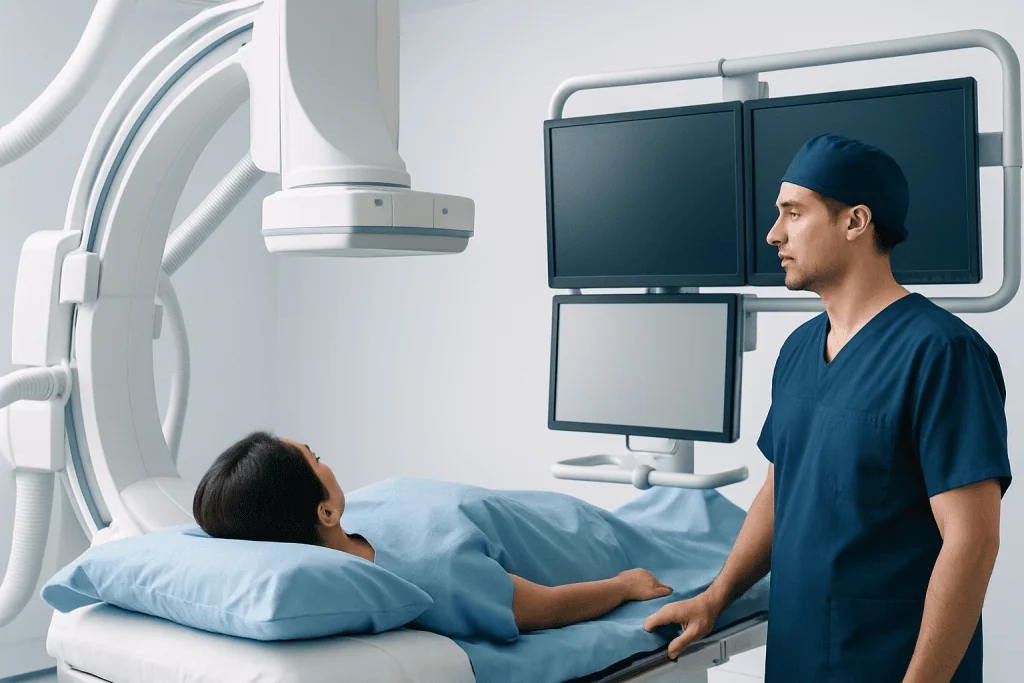
Interventional neurology is most often associated with emergency and vascular brain care. A well-known example is mechanical thrombectomy, a procedure used to remove a blood clot from a blocked artery in the brain in carefully selected patients with acute ischemic stroke. Time is critical in this setting, so patients with sudden weakness, speech difficulty, facial drooping, severe dizziness, or vision loss should seek the nearest emergency department immediately rather than planning travel.
Other common procedures include coiling or flow-diverting treatment for some aneurysms, embolization for certain vascular malformations, and angioplasty or stenting in selected narrowed arteries. Diagnostic cerebral angiography may also be used to map blood vessels in detail when MRI, CT, or ultrasound does not provide enough information.
Not all blood vessel problems require an interventional procedure. Some aneurysms, stenoses, or vascular abnormalities are monitored with imaging and managed with medicines or risk-factor control. In other cases, open neurosurgery or standard neurology treatment may be more appropriate than an endovascular approach.
Because treatment choice depends on anatomy, timing, symptoms, and overall health, patients benefit from a center that can offer more than one option. Hospitals that provide interventional neurology procedures alongside neurology, neurosurgery, and intensive care can often tailor treatment more effectively to the individual case.
How to Judge Hospital Quality and Safety

Hospital quality is one of the most important factors when considering interventional neurology in Turkey. Patients and families should look for internationally recognized accreditation, experienced specialists, modern angiography suites, advanced CT and MRI imaging, stroke-ready emergency services, intensive care support, and clear infection-control and patient-safety protocols. Hospitals that treat neurological emergencies around the clock are especially important for time-sensitive conditions.
Team structure also matters. Interventional procedures for the brain are safest when supported by a multidisciplinary service that can rapidly involve stroke neurologists, neurosurgeons, neuroanesthesiologists, critical care specialists, and rehabilitation teams. If a complication occurs or if the original diagnosis changes, access to these specialists can be essential.
Patients may wish to ask practical questions before choosing a center. Examples include whether the hospital performs the recommended procedure regularly, whether an ICU bed is available if needed, whether interpreters are provided, how imaging is reviewed before travel, and whether the team can coordinate with the patient’s doctor at home. It is also reasonable to ask who will be responsible for care after discharge and how urgent concerns are handled.
Acibadem International notes that its multidisciplinary specialists and JCI-accredited hospitals diagnose and treat neurological and cerebrovascular conditions for international patients. Even so, each patient should still review the specific hospital, physician team, and treatment plan in detail before making travel decisions.
Who May Be a Good Candidate for Travel
Travel for interventional neurology is usually most suitable for stable patients who need planned evaluation or treatment, rather than for people experiencing a new neurological emergency. For example, a patient with an unruptured aneurysm identified during routine imaging may have time to gather records and seek opinions. By contrast, a patient with sudden stroke symptoms, a ruptured aneurysm, new seizures, or rapidly worsening neurological deficits needs emergency local care without delay.
Good candidates for medical travel are often those who can safely fly, tolerate hospital admission away from home, and participate in follow-up planning. The treating team will consider age, mobility, blood pressure control, anticoagulant use, recent bleeding, kidney function, and other chronic conditions. A patient’s support system is also important, especially if language assistance, rehabilitation, or help with daily activities will be needed after discharge.
Before travel is confirmed, the receiving hospital usually reviews imaging and medical records to decide whether the case is appropriate. This may include MRI or CT scans, angiography images, lab results, current medications, allergies, prior procedures, and specialist notes. Clear pre-travel review helps avoid unnecessary trips and reduces the risk of arriving without the information needed for safe care.
In some cases, related services such as stroke treatment or neurosurgery may be discussed if imaging suggests that an endovascular procedure is not the best option. A comprehensive center can explain why one route may be safer or more effective than another.
Travel Planning Before the Procedure
Once a patient is accepted for evaluation or treatment, travel planning should focus on safety and continuity rather than convenience alone. Medical travelers should confirm the expected length of stay, whether a companion is recommended, and how long they may need to remain in Turkey after the procedure. The answer depends on the condition treated, the complexity of the procedure, and how quickly recovery is expected.
Patients should prepare a complete medical file in advance. This usually includes passport details, emergency contacts, imaging on disc or secure transfer, medication lists, allergies, prior operations, vaccination records if relevant, and a summary from the home doctor. Bringing a written list of questions can also help patients and families understand the benefits, risks, alternatives, and discharge plan.
It is also wise to ask about non-medical details that affect recovery. These include airport transfer arrangements, nearby accommodation for relatives, dietary needs, mobility assistance, and interpreter availability. Patients should understand whether they may be able to return by standard commercial flight or whether they will need additional observation before traveling home.
Financial planning matters as well. Patients should clarify what the package does and does not include, how unforeseen tests or ICU stays are billed, and whether travel insurance or health insurance will contribute. Written estimates and clear administrative communication can reduce stress during a period when the patient should be focused on treatment and recovery.
What Diagnosis, Treatment, and Recovery May Look Like
After arrival, the hospital may repeat some tests even if scans were done elsewhere. This is normal and often necessary because treatment decisions in interventional neurology depend on up-to-date imaging, laboratory results, and the patient’s current neurological examination. Depending on the condition, tests may include CT, MRI, ultrasound, cerebral angiography, and heart rhythm or blood pressure assessment.
The procedure itself is usually performed in a specialized angiography suite. Sedation or general anesthesia may be used, depending on the type of intervention and the patient’s condition. Through a small vessel entry point, the physician guides tiny instruments to the target area to remove a clot, place coils, deliver embolic material, widen a narrowed vessel, or perform another planned treatment.
Recovery varies widely. Some patients spend a short time in a monitored unit and are discharged within days, while others need ICU care, longer observation, or rehabilitation. The immediate recovery period focuses on neurological checks, blood pressure control, prevention of bleeding or vessel complications, medication adjustments, and repeat imaging when needed.
For some patients, recovery continues with physical therapy and rehabilitation or speech and occupational support after stroke or other neurological injury. Early rehabilitation planning can make the transition home smoother and helps set realistic expectations for regaining function.
Follow-Up After Returning Home
Follow-up is a crucial part of successful care and should be arranged before the procedure takes place. Patients should know who will review them after discharge in Turkey, what warning signs require urgent help, which medicines they must continue, and when they need repeat scans or blood tests. A written discharge summary in English can make communication with the home medical team much easier.
Many neurological and vascular conditions need ongoing monitoring even after technically successful treatment. For example, a treated aneurysm may require repeat imaging over time, and a stroke patient may need long-term control of blood pressure, cholesterol, diabetes, or heart rhythm problems. Follow-up often involves both the procedural team and local physicians in neurology, primary care, cardiology, or rehabilitation.
Patients should ask whether remote follow-up is available and which issues can be handled virtually versus those that require in-person review. It is also helpful to confirm how imaging performed at home should be shared with the treating hospital. Clear channels for questions after discharge can reduce confusion, especially if symptoms change after travel.
Families should remember that recovery is not only about the procedure itself. Emotional adjustment, fatigue, mobility limits, and changes in communication or memory may continue for some time after a neurological event. A coordinated plan that includes rehabilitation and local support can be just as important as the intervention.
When to Seek Urgent Medical Attention
Anyone who develops sudden neurological symptoms should seek immediate emergency care. These symptoms include facial drooping, weakness or numbness on one side of the body, trouble speaking or understanding speech, sudden severe headache, loss of balance, sudden confusion, loss of consciousness, or new vision loss. These can be signs of stroke, brain bleeding, or another emergency that should not wait for international travel.
After an interventional procedure, urgent assessment is also needed for severe headache, worsening weakness, increasing confusion, chest pain, shortness of breath, significant bleeding at the catheter entry site, or new swelling and pain in a limb. Patients should follow the discharge instructions they receive and contact local emergency services if symptoms are severe or rapidly changing.
Patients who are unsure whether travel is medically safe should ask a qualified specialist before booking flights. This is especially important for those who recently had a stroke, surgery, brain bleeding, uncontrolled blood pressure, active infection, or unstable heart or lung disease. A careful medical review can help determine the safest timing and route for treatment.
Interventional neurology can be highly effective in selected patients, but it works best when treatment is matched to the right condition, delivered in a high-quality hospital, and followed by a reliable aftercare plan. Thoughtful preparation helps patients make confident, informed choices.
Frequently asked questions
What is interventional neurology?
Interventional neurology is a field that uses minimally invasive catheter-based techniques to diagnose and treat certain conditions affecting the brain, spinal cord, and blood vessels. It may be used for selected cases of stroke, aneurysm, vascular malformation, or arterial narrowing.
Is it safe to travel to another country for interventional neurology treatment?
It can be safe for carefully selected, medically stable patients when treatment is planned in advance at a qualified hospital. Safety depends on the patient’s condition, the timing of travel, the experience of the treating team, and a clear follow-up plan after discharge.
Can someone travel during an acute stroke or neurological emergency?
No. Acute stroke and other sudden neurological emergencies need immediate treatment at the nearest emergency department. Delaying care for travel can reduce treatment options and increase the risk of permanent disability.
How can patients assess hospital quality in Turkey?
Patients can look for international accreditation, 24/7 emergency capability, advanced imaging, intensive care support, and experienced multidisciplinary specialists. It is also helpful to ask about communication, interpreter services, discharge planning, and how complications are managed.
What records should patients send before traveling?
Patients usually need to share recent imaging, reports, blood tests, medication lists, allergy information, prior procedure notes, and a summary from their current doctor. Sending complete records early helps the hospital decide whether the patient is a suitable candidate and what treatment may be appropriate.
Will follow-up still be needed after the procedure?
Yes. Most patients need some form of follow-up, such as medication review, repeat imaging, neurological assessment, or rehabilitation. A good plan includes both the treating hospital and the patient’s doctors at home.
References
- World Stroke Organization
- American Heart Association
- National Institute of Neurological Disorders and Stroke
- European Stroke Organisation
- World Federation of Interventional and Therapeutic Neuroradiology
This article is for general information only and is not a substitute for professional medical advice. Please consult a qualified doctor about your individual situation.
Interventional Neurology in Turkey — costs, top hospitals & a free quote
JCI-accredited · board-certified surgeons · reply within 24h
Add us as a Preferred Source to see more of our trusted health content across Google Search, AI Overviews and Discover.