

Flying After LASIK: When It Is Usually Fine and How to Handle Cabin Dryness

Key Takeaways
- Commercial aircraft cabins are pressurized to roughly 6,000 to 8,000 feet and hold only around 10 to 20 percent humidity, so dry air rather than altitude is what a healing LASIK eye notices.
- A LASIK flap contains no gas bubble, so cabin pressure does not create a force across it; the strict no-fly rule after eye surgery applies to retinal procedures that inject gas.
- Mayo Clinic describes the first post-operative check at one to two days after LASIK, and most surgeons want that visit completed before clearing air travel.
- LASIK temporarily reduces tear production, with dryness commonly lasting up to about six months while corneal nerves regrow, which is why lubricating drops belong in hand luggage.
- Screens do not harm the cornea but lower blink rate, so in-flight entertainment is best taken in twenty to thirty minute stretches with deliberate blinking and breaks.
- The CDC flags clot risk on journeys over about four hours, and walking the aisle every couple of hours helps your legs and gives your tear film a rest from the screen.
Flying after LASIK is usually fine once your surgeon has completed the first post-operative check, which typically happens one to two days after surgery, and has confirmed the corneal flap is settling. Cabin pressure does not harm a healing cornea; the real issue is very dry cabin air, which worsens the temporary dry eye most people have after LASIK. Use preservative-free lubricating drops as directed and confirm timing with your treating team.
The boarding pass is already on her phone. Three weeks ago she booked a window seat for a long-awaited trip; nine days ago she walked out of a laser suite able to read the exit sign without her glasses for the first time since the sixth grade. Now, with the suitcase half packed, a small doubt arrives: is flying after LASIK actually a good idea, or is she about to undo the whole thing at 35,000 feet?
It is one of the most common questions people ask in the first fortnight after laser vision correction, and the answer is more reassuring, and more specific, than most travel forums suggest. The altitude is not the villain. The air is.
This explainer walks through what actually happens to the cornea, why airplane cabins are among the driest rooms you will ever sit in, how surgeons typically think about timing, and what to pack so a six-hour flight does not feel like six hours of sandpaper.
Is flying after LASIK safe for the eye itself? What the procedure actually changes
To understand why flying after LASIK rarely worries eye surgeons, it helps to picture what the laser did. LASIK, short for laser-assisted in situ keratomileusis, reshapes the cornea, the clear dome at the front of the eye that does most of the eye’s focusing. A thin hinged flap is lifted from the corneal surface, an excimer laser removes a precise layer of tissue underneath to change the curve, and the flap is laid back down without stitches. The Mayo Clinic describes the flap as reattaching on its own within the healing period, held first by the natural suction of the corneal tissue and then by the surface cells that grow across the edge.
Nothing about this involves sealed air or gas inside the eye. That distinction matters, because the eye surgeries that carry a strict no-fly order are a different category altogether: retinal procedures in which a gas bubble is injected into the back of the eye. A gas bubble expands as cabin pressure falls, and the eye pressure can rise sharply. A LASIK flap contains no bubble; it is tissue resting on tissue, bathed in tears.
What the procedure does do, at least for a while, is disturb the tiny corneal nerves that tell the brain to blink and to make tears. Mayo Clinic notes that LASIK causes a temporary decrease in tear production, with dryness commonly lasting for the first several months while those nerves recover. Dry eye is therefore the single most relevant issue when you step into an airplane, and it is a comfort and healing-quality issue rather than a flap-safety issue.
So the honest framing is this: the cabin cannot “pop” your flap or reverse your correction. What it can do is make a dry, slightly fragile surface drier, which is uncomfortable and, in the earliest days, worth avoiding.
How soon after LASIK can you fly? Typical waiting ranges
No national guideline from the NHS, NICE or any US body sets a mandatory number of days before you may board a plane after LASIK. What exists instead is a widely shared clinical logic: your surgeon wants to see the eye at the first post-operative visit before you leave town. Mayo Clinic describes that first check as happening one to two days after surgery, with further visits spaced through the first six months.

At that early visit the surgeon lifts the lid, looks at the flap under a slit lamp (a microscope with a bright beam used to examine the front of the eye), checks that the edges are smooth and the surface cells have sealed, and measures your vision. If all is as expected, many surgeons are comfortable with air travel shortly afterward. Others prefer you wait until the one-week check, particularly for long-haul flights, because the surface is still healing and drops are still frequent.
Three practical points shape the timing conversation:
- Distance from the surgeon. A flight that takes you far from the team who operated means any early problem is handled by a stranger. That is a reason some surgeons ask for a week rather than a day or two.
- Flight length. A ninety-minute hop and a fourteen-hour overnight flight are not the same exposure to dry air, screen time and interrupted drop schedules.
- Your own healing. People who report heavy dryness or light sensitivity at the first visit are often asked to wait a little longer.
The useful takeaway is that the question is not “how many days is legal” but “has my surgeon seen the flap and said yes.” Ask the question directly at your first follow-up, with your travel dates in hand, and let that answer set your plans.
Does flying increase eye pressure, and does it matter after LASIK?
People worry about this because cabins are pressurized to an altitude, not to sea level. The CDC Travelers’ Health Yellow Book explains that commercial aircraft cabins are typically maintained at a pressure equivalent to roughly 6,000 to 8,000 feet above sea level. That is why ears pop and why a sealed bag of chips puffs up on the tray table.
The eye is not a sealed bag. Intraocular pressure, the fluid pressure inside the eyeball, is regulated by the eye continuously producing and draining a watery fluid called aqueous humor. This drainage system adjusts to ambient pressure changes without difficulty in healthy eyes, which is why millions of people with glaucoma, who monitor eye pressure closely, fly without incident. Measured changes in eye pressure at cabin altitude are small and short-lived in people with no gas in the eye.
After LASIK the relevant question is narrower still: could a modest pressure shift disturb a flap? The flap is on the outside surface of the eye, in contact with cabin air on one side and the cornea on the other. Both sides experience the same cabin pressure, so there is no pressure gradient across the flap trying to lift it. Pressure inside the eye pushes on the whole cornea from behind, exactly as it did before surgery, and the laser treatment is designed to leave a structurally sound cornea beneath the flap.
One caveat belongs here for completeness. Some people with very high short-sightedness have thin corneas, and the surgeon will have screened for this before offering LASIK at all. If you were told your corneas were borderline, the pre-operative decision already addressed it; flying does not add a new structural load.
Short answer: cabin altitude produces no clinically meaningful eye-pressure change for a healed or healing LASIK eye. Save your attention for the humidity gauge, not the altimeter.
Why airplane cabins dry your eyes: the humidity math
Open a weather app in a comfortable living room and relative humidity will often read somewhere around 30 to 50 percent. The CDC Yellow Book notes that aircraft cabin humidity typically runs low, often around 10 to 20 percent, because the air drawn in from outside at cruising altitude is extremely cold and holds almost no moisture. Deserts are frequently more humid than the seat you are sitting in.
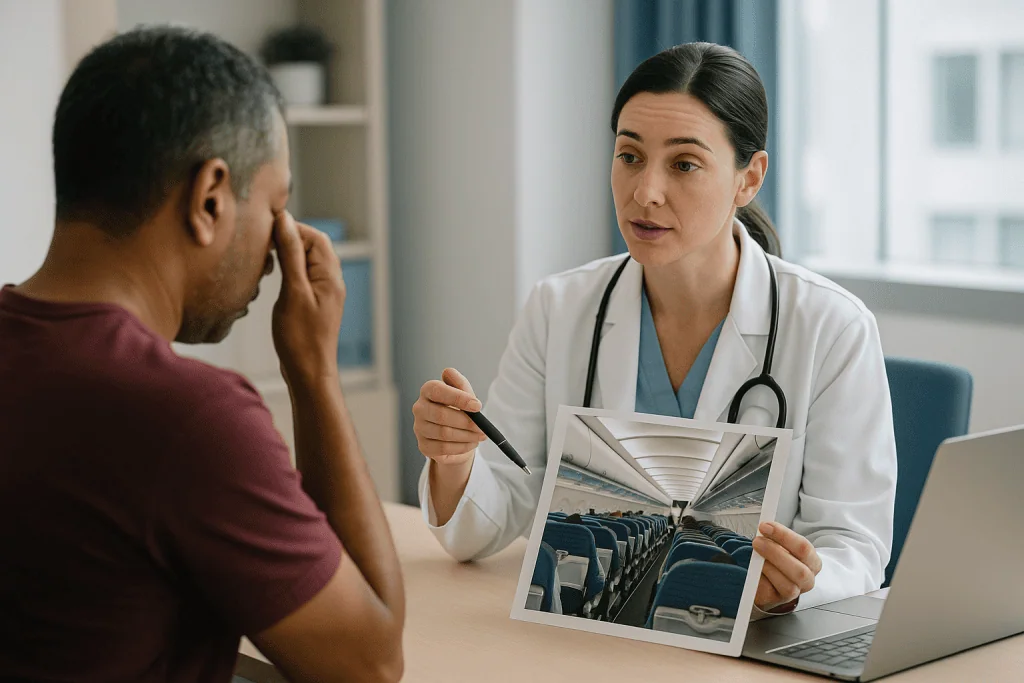
Your tear film is a three-layer coating on the cornea: a thin oily layer on top that slows evaporation, a watery middle layer, and a mucus layer that helps the tears cling to the surface. In dry air the watery layer evaporates faster than usual. After LASIK, two things make that worse. First, the nerves that trigger reflex tearing have been partly cut by the flap and are regrowing, so the eye does not “notice” the dryness and respond with extra tears as briskly as it normally would. Second, people blink less when they concentrate, and in-flight screens, books and tablets all invite long, unblinking stares.
The result is familiar to anyone who has flown with contact lenses: grittiness, a burning sensation, fluctuating blur that clears for a moment after a blink, and redness by the time the seatbelt sign comes off for landing. For a freshly operated eye, this is not merely unpleasant. A dry surface heals less smoothly, and dry patches can make vision seem worse than it really is, which can be alarming when you have just paid close attention to every change in your sight.
None of this is dangerous in a routine sense. It is predictable, and predictable problems can be planned for. The next section is that plan.
Dry eyes on a plane after LASIK: a seat-by-seat plan
Think of the flight as a dry-eye event with a start, a middle and an end, and manage each phase.
Before boarding. Put your lubricating drops in a clear bag in hand luggage, not checked baggage. Most airport security rules allow medically necessary liquids above standard limits, but single-use preservative-free vials sidestep the issue entirely and are what most surgeons recommend in the early weeks, because preservatives can irritate a healing surface. Use a drop before you walk down the jet bridge so you start with a full tear film.
During the flight. Set a quiet phone timer to prompt a drop roughly as often as your surgeon advised, and more often if you feel grit. Angle the overhead air vent away from your face; a jet of dry air aimed at your eyes is the single fastest way to strip the tear film. Blink deliberately when you realize you have been staring, and close your eyes for a few minutes each hour. Drink water rather than alcohol or multiple coffees, both of which can contribute to dehydration. A sleep mask helps on overnight flights, and the mild warmth of your own closed lids slows evaporation.
Rubbing. The strongest single instruction after LASIK is not to rub the eyes, and Mayo Clinic and MedlinePlus both flag it, because in the first weeks a firm rub can shift the flap. Dry, itchy eyes make you want to rub. Have drops within reach so the urge is met with moisture instead of knuckles. If you sleep, wear the protective shields your surgeon gave you if you are still within the window they specified.
After landing. Expect redness and blur to settle within hours of returning to normal humidity. If they do not, see the red-flag section near the end of this article.
Who is usually fine to fly after LASIK, and who is usually asked to wait
Surgeons tend to sort travelers into three loose groups. The boundaries are clinical judgment, not rules, so treat this as a map of how the conversation usually goes.
Usually fine with ordinary precautions. Someone whose first post-operative check showed a well-positioned flap and clear cornea, whose vision is in the expected range for the day, who has mild dryness controlled with drops, and who is taking a flight short enough that no doses of prescribed drops will be missed. Returning to a city with an ophthalmologist available, or returning to the operating team itself, strengthens the case.
Often asked to delay a few days or a week. People with marked dryness or light sensitivity at the first visit; people whose flap edge showed any irregularity the surgeon wants to watch; those flying very long-haul immediately after surgery; and anyone whose trip takes them somewhere eye care is hard to reach. The NHS notes that recovery after laser eye surgery can take a few weeks and that early follow-up is part of the process, which is the reasoning behind the pause.
Usually asked to wait until a specific recheck. Anyone who had an unexpected finding on the day of surgery, such as a flap complication the surgeon managed and now wants to see again, or anyone who has developed inflammation under the flap, a condition called diffuse lamellar keratitis that is treated with prescribed anti-inflammatory drops and monitored closely. These are uncommon, and when they occur, the treating team sets the timeline.
A practical tip: if your trip is already booked, tell the surgeon before the procedure. Some teams will schedule surgery with the departure date in mind, or arrange a named colleague at your destination for the one-week check. The decision stays with the team; your job is to give them the dates.
Flying after LASIK vs PRK vs SMILE: how the procedures compare for travel
Laser vision correction comes in several forms, and the one you had changes what matters on a plane. The table summarizes the travel-relevant differences; the clinical details are drawn from Mayo Clinic and NHS descriptions of each technique.
| Procedure | What is done to the surface | Early comfort | Main travel concern |
|---|---|---|---|
| LASIK | Hinged flap lifted, laser applied beneath, flap replaced | Mild discomfort, vision often functional within a day or two | Dry eye; avoiding eye rubbing while the flap seals |
| PRK (photorefractive keratectomy) | Surface layer of cells removed, laser applied directly, cells regrow | More discomfort for several days; vision blurrier for longer | Pain and light sensitivity in the first week; bandage contact lens often in place |
| SMILE (small incision lenticule extraction) | Laser cuts a thin disc inside the cornea, removed through a small incision | Similar to LASIK, typically mild | Dry eye, usually reported as somewhat less than LASIK |
Why the differences matter in a cabin: PRK leaves the corneal surface temporarily open while new cells grow back, so dry air stings more and the first several days are often spent with a soft bandage lens and prescribed drops. People who had PRK are generally asked to stay closer to home for longer than LASIK patients, and most would not enjoy a flight in the first week regardless of permission. SMILE involves no large flap, so the rubbing warning is slightly less emphatic, but the dryness advice is identical.
Regardless of technique, the same three things decide your readiness: what the surgeon sees at follow-up, how dry you are, and how far from care you are going.
A LASIK travel recovery timeline: what the first days and weeks usually look like
Healing follows a recognizable arc, and knowing the arc helps you place a flight sensibly within it. The ranges below reflect typical descriptions from Mayo Clinic and MedlinePlus; your own course may be faster or slower, and your surgeon’s instructions take precedence.
The first 24 hours. Expect hazy vision, watering, a foreign-body sensation and light sensitivity. Most people are asked to go home and sleep with protective shields in place. Flying is not realistic and not advised during this window.
Days one to two. The first post-operative check, which Mayo Clinic places at one to two days, confirms the flap position and measures vision. Vision is often already useful for ordinary tasks. Many surgeons clear short flights from this point if the examination is reassuring.
The first week. Drops are frequent, often both an antibiotic and an anti-inflammatory as prescribed, plus lubricants as needed. MedlinePlus notes that many people return to work within a few days. Vision may still fluctuate, especially late in the day or in dry rooms. Avoid swimming, hot tubs and eye makeup, which the NHS and MedlinePlus advise for the early weeks because of infection risk.
Weeks two to four. Most prescribed drops have stopped; lubricants continue. The flap edge is well sealed. Longer flights become much more comfortable, and the rubbing warning begins to relax, though many surgeons prefer you keep the habit of not rubbing indefinitely.
Months one to six. Mayo Clinic describes dryness as commonly persisting for up to about six months while corneal nerves regrow, and vision as continuing to stabilize across this period, with follow-up visits spaced through it. Travel is routine by now; dry air remains the one thing to plan for.
Long-haul flights, time zones and the follow-up visit you should not skip
Short flights are mostly a comfort question. Long-haul flights add logistics that are easy to overlook in the excitement of new vision.
Drop schedules across time zones. Prescribed drops in the first week are usually timed by interval, not by clock. If your surgeon said every so many hours, keep that interval running on the clock you left with until you land, then shift gradually. Write the times on a card rather than trusting memory in a dim cabin.
Sleeping on the plane. Reclined, half-asleep passengers rub their eyes without knowing it. If you are within the window in which your surgeon asked you to wear shields at night, wear them on an overnight flight too. They look odd. They work.
The one-week check. Mayo Clinic describes regular follow-up through the first six months after LASIK, and the early visits are where small problems are caught while they are still small. If your trip means missing the one-week appointment, ask whether it can be brought forward, pushed back a few days, or carried out by an ophthalmologist at your destination with a report sent to your surgeon. A video call is better than nothing but cannot replace a slit-lamp examination of the flap.
Carrying your paperwork. Pack a short summary from your surgeon: the date and type of procedure, the drops you are using, and a contact number. If anything goes wrong far from home, the clinician who sees you will want exactly this information, and a phone photograph of the document is a reasonable backup.
Sun at your destination. Light sensitivity is common early on. Good-quality sunglasses with UV protection make bright environments, snow, sand and water far more tolerable and protect the eye while it heals.
Clot prevention and general travel safety basics after any recent procedure
LASIK is a brief surface procedure, not an operation that leaves you immobile, so it does not meaningfully raise your blood clot risk the way major surgery can. Even so, any article about flying after a medical procedure should include the general safety basics, because they apply to every passenger and especially to anyone who has recently been less active than usual.
The CDC Yellow Book describes travel-related deep vein thrombosis, a blood clot in a deep leg vein, as an uncommon but recognized risk of prolonged immobility, with risk rising on journeys of more than about four hours and in people with additional factors such as recent major surgery, pregnancy, hormone therapy, cancer, a previous clot, or significant obesity. The guidance is simple and sensible:
- Walk the aisle periodically, roughly every couple of hours on long flights, when the seatbelt sign allows.
- Flex and circle your ankles and tighten your calf muscles while seated.
- Choose an aisle seat if you tend to stay put rather than disturb neighbors.
- Stay hydrated with water; limit alcohol, which also worsens dry eye.
- Avoid tight clothing at the knees and waist that restricts leg circulation.
- If you have personal clot risk factors, ask your usual doctor before a long trip whether compression stockings or other measures are appropriate for you.
Signs of a clot that warrant prompt medical attention include swelling, pain or warmth in one calf, and, more urgently, sudden breathlessness or chest pain, which can indicate a clot has traveled to the lung.
For the eyes, the overlap is pleasing: the same habits that keep blood moving, standing up, hydrating and taking breaks from the screen, also give the tear film a chance to recover. A short walk to the back of the cabin every so often is good for your legs, your eyes and your mood.
Screens, sleep and sunlight: can I watch TV 3 days after LASIK and use in-flight entertainment?
The question “can I watch TV three days after LASIK” is really a question about screens in general, and the answer from mainstream sources is reassuring. Screens do not damage the healing cornea. Mayo Clinic and MedlinePlus list activities to avoid early on, such as swimming, eye makeup, contact sports and rubbing, and screens do not appear on those lists.
What screens do is lower your blink rate. People staring at a display blink noticeably less often than during conversation, and every unblinked second lets the tear film thin. On a plane, where the air is already at 10 to 20 percent humidity by CDC description, a two-hour film becomes two hours of accelerated evaporation on an eye that is not yet producing normal tears.
Practical rules for in-flight viewing in the early weeks:
- Pause every twenty to thirty minutes, close your eyes for a minute, and use a lubricating drop if the surgeon’s schedule allows.
- Turn screen brightness down and increase text size so you are not squinting; squinting narrows the lids and slows blinking further.
- Prefer audio, podcasts or an audiobook for part of the flight. Your eyes rest, your brain stays occupied.
- If vision blurs while watching, blink several times first. Blur that clears with a blink is dryness, not a problem with the correction.
Sleep is the opposite case: it is actively good for a healing cornea, because closed lids stop evaporation and the surface cells repair fastest in the dark. If you can sleep on the plane, do, with shields if you are still in the shielding window.
Sunlight on arrival deserves a word. Light sensitivity is common for days to weeks, and reflected glare off water or snow can be startling. Sunglasses are a comfort measure rather than a medical necessity, but a necessary comfort on a bright beach.
What happens 10 years after LASIK? The long view for frequent flyers
Travelers planning a lifetime of flights often ask what the eye looks like a decade on. The honest answer has three strands, and none of them involves airplanes.
The correction itself. LASIK reshapes corneal tissue permanently; the tissue removed does not grow back. Mayo Clinic notes that vision usually stabilizes within the first few months and that a small proportion of people experience regression, a gradual drift back toward the original prescription, which may be addressed with glasses or, in some cases, a repeat procedure if the cornea has enough thickness. Neither outcome can be promised or predicted for any individual.
The rest of the eye keeps aging. LASIK treats the cornea, not the lens inside the eye. The lens stiffens with age, producing presbyopia, the difficulty focusing on near objects that leads most people to reading glasses in their forties regardless of any earlier surgery. Later still, the lens can cloud into a cataract. Neither is caused by LASIK, and both can be treated in the usual way, although your eye care team will want your pre-LASIK measurements when calculating a cataract lens implant, so keep a copy of your surgical record.
Dry eye. For most people, dryness improves substantially within the first six months as nerves regrow, in Mayo Clinic’s description. A minority report longer-lasting dryness, and people who were dry before surgery are more likely to be in that group. For a frequent flyer, this means the cabin-air habits in this article may be worth keeping for years, not weeks.
A decade after LASIK, flying is simply flying. The flap has long since integrated, pressure questions are moot, and the only item that may remain on the packing list is a vial of lubricating drops.
What people often get wrong about flying after LASIK
Travel forums are full of confident advice about flying after LASIK, and much of it is wrong in instructive ways.
“Cabin pressure can lift the flap.” The flap sits on the surface of the eye with cabin air on both sides of it; there is no pressure difference to lift anything. The no-fly rule people are half-remembering belongs to retinal surgery with a gas bubble, a completely different operation.
“You can never fly for a month.” No major guideline sets this. Surgeons individualize timing around the first post-operative check, which Mayo Clinic places at one to two days, and around flight length and distance from care. Some ask for a week; a month is unusual for uncomplicated LASIK.
“There are things you can never do after LASIK.” The early restrictions, such as no swimming, no eye makeup, no contact sports and no rubbing, are time-limited measures while the surface heals, not lifelong bans. The one habit many surgeons encourage you to keep forever is gentle treatment of your eyes, which is good advice for anyone.
“Dry eye on a plane means the surgery failed.” Dryness is the expected, temporary consequence of cut corneal nerves and is amplified by 10 to 20 percent cabin humidity. Blur that clears with a blink or a drop is dryness, not regression.
“Higher altitude destinations are risky.” A mountain town is at the same altitude as a cabin or lower, and the eye adjusts. Dry mountain air is the issue again, not the thinness of it.
“Screens must be avoided for a week.” Screens reduce blinking but do not harm the cornea. Manage them with breaks and drops rather than avoidance.
The pattern in every myth is the same: people blame the altitude when they should be watching the humidity, and they treat temporary healing instructions as permanent laws.
Questions to ask your care team before you book or board
The most useful conversation about flying after LASIK happens before surgery, with your travel dates on the table. The second most useful happens at the first follow-up. Here are the questions worth asking, in roughly the order they tend to matter.
- Given what you see today, when are you comfortable with me flying, and does that change for a flight longer than a few hours?
- Which of my follow-up visits is essential to attend in person, and can any be arranged with an ophthalmologist at my destination?
- How should I time my prescribed drops if I cross several time zones?
- Which lubricating drops do you recommend for the flight, and how often may I use them?
- For how many nights should I keep wearing protective shields, and should I wear them when sleeping on a plane?
- Is there anything about my corneal thickness, my prescription or my dryness before surgery that makes you want me to be more cautious with travel?
- What symptoms would make you want me to find an eye doctor abroad rather than wait until I return?
- Can I have a written summary of my procedure and medications to carry with me?
- Will I need to restrict swimming or water sports at my destination, and for how long?
- If I notice blur, how do I tell dryness from something that needs attention?
Write the answers down, or ask whether the clinic can add them to your discharge sheet. Memory is unreliable in the slightly dazed hour after an eye examination, and the answers to these questions are the ones you will want at the gate.
One more point is worth stating plainly. If the surgeon’s answer to the timing question is not the one your itinerary wanted, the itinerary should move. Rebooking a flight is tedious. Managing an eye problem in an unfamiliar city is worse.
When to call your doctor: red-flag signs after LASIK, at home or away
Most of what you feel in the first weeks after LASIK, mild grittiness, fluctuating blur that clears with a blink, light sensitivity and occasional watering, is part of ordinary healing. A small number of symptoms are different, and both Mayo Clinic and MedlinePlus advise contacting the surgeon promptly if they appear. Treat the following as reasons to call the same day, or to seek an eye specialist locally if you are traveling:
- Sudden or worsening pain, particularly pain that is increasing rather than easing over the first days.
- A sudden drop in vision, or vision that was clear and becomes markedly worse and does not improve with blinking or lubricating drops.
- Increasing redness, thick discharge or crusting, which can signal infection.
- Any direct knock, poke or firm rub to the eye, especially in the first weeks, even if it feels fine afterward, because flap displacement needs to be checked.
- A new sense that something is physically on the eye that does not shift with drops.
- Marked new light sensitivity or haloes that were not present the day before.
- New floaters, flashes of light, or a shadow or curtain across part of your vision. These are not typical of LASIK healing and need urgent assessment for the retina.
If you are abroad and cannot reach your surgeon quickly, an emergency department or any ophthalmologist can examine the eye and contact your team. Carry the written summary of your procedure so the examining clinician knows what was done and which drops you are using.
Everything in this article describes typical patterns reported in mainstream medical sources. It does not replace the instructions from the team who examined your eyes, and every decision about when you fly, which drops you use and when you return for review rests with them.
Frequently asked questions
How soon after LASIK can you fly?
Most surgeons clear flying once the first post-operative examination, typically one to two days after surgery according to Mayo Clinic, has confirmed the flap is in place and healing normally. Some prefer you wait until the one-week check for long-haul flights or trips far from eye care. No national guideline sets a fixed number of days; the decision rests with your surgeon after examining the eye.
Does flying increase eye pressure after LASIK?
Not in any clinically meaningful way. The eye regulates its internal fluid pressure continuously, and the modest cabin altitude equivalent of 6,000 to 8,000 feet produces only small, brief changes in healthy eyes. The LASIK flap has cabin air on both sides, so there is no pressure difference acting on it. The eye surgeries that forbid flying involve an injected gas bubble, which LASIK does not use.
What helps dry eyes on a plane after LASIK?
Preservative-free lubricating drops used as your surgeon directed, with extra drops whenever you feel grit, are the mainstay. Point the overhead vent away from your face, blink deliberately during screen time, close your eyes for a few minutes each hour, drink water rather than alcohol or excess coffee, and consider a sleep mask on overnight flights. Avoid rubbing your eyes, which can shift the flap in the early weeks.
What does a LASIK travel recovery timeline look like?
The first day brings haze, watering and light sensitivity; the first check at one to two days confirms the flap; the first week involves prescribed drops and avoiding swimming, makeup and rubbing; by weeks two to four most prescribed drops have stopped and longer flights are comfortable; dryness commonly improves over up to about six months. These are typical ranges from Mayo Clinic and MedlinePlus, not promises for any individual.
Can I watch TV 3 days after LASIK?
Yes, screens do not damage the healing cornea and are not on the lists of early restrictions from Mayo Clinic or MedlinePlus. Watching does lower your blink rate, which thins the tear film, so take a break every twenty to thirty minutes, blink deliberately, lower the brightness and keep lubricating drops to hand. Blur that clears with a blink is dryness rather than a problem with the correction.
What can you never do after LASIK?
Very little, permanently. The early restrictions, including swimming, hot tubs, eye makeup, contact sports and rubbing the eyes, are time-limited measures while the surface heals over the first weeks, not lifelong bans. Many surgeons do encourage you to avoid rubbing your eyes indefinitely as a general habit. Your own surgeon will tell you when each restriction lifts based on how your eyes are healing.
What happens 10 years after LASIK?
The corneal reshaping is permanent, and Mayo Clinic notes that vision usually stabilizes within the first months, though a small proportion of people experience some regression toward their old prescription. The rest of the eye keeps aging as it would have anyway: presbyopia typically brings reading glasses in the forties, and cataracts can develop later. Both can be treated in the usual way; keep your pre-LASIK measurements for any future lens surgery.
Is it safe to fly the day after LASIK?
It depends on what the surgeon finds at the first-day examination. If the flap is well positioned and vision is in the expected range, some surgeons permit a short flight that day, with frequent lubricating drops and strict avoidance of eye rubbing. Many prefer a few more days, especially for long flights. Flying before any post-operative check is generally not advised because early problems are easiest to fix when caught promptly.
Can I fly after PRK as soon as after LASIK?
Usually not as soon. PRK removes the surface cell layer of the cornea rather than lifting a flap, so the surface is open for several days while cells regrow, and discomfort and light sensitivity are typically greater and longer-lasting than after LASIK. Most people with PRK are asked to stay close to their surgeon for longer, and few would find a flight comfortable in the first week.
Should I worry about blood clots on a long flight after LASIK?
LASIK itself does not meaningfully raise clot risk, since it is a brief surface procedure that does not immobilize you. General travel advice from the CDC still applies to everyone on flights over about four hours: walk the aisle periodically, flex your calves while seated, stay hydrated and limit alcohol. Anyone with personal clot risk factors should discuss precautions with their usual doctor before a long journey.
References
This article is for general information only and is not a substitute for professional medical advice. Please consult a qualified doctor about your individual situation.

More from the Blog

Monovision vs Multifocal Lenses for Presbyopia: How the Two Approaches Feel Day to Day
Monovision corrects one eye for distance and the other for near, so the brain switches between them; multifocal lenses split incoming light so each…

Who Is a Candidate for ReLEx SMILE? Prescription Range, Corneal Maps and Tear Film
A typical candidate for SMILE eye surgery is an adult with stable nearsightedness, with or without astigmatism, whose corneal maps show a regular shape…

Light Sensitivity and Tearing in the First Days After LASEK: Expected or a Warning Sign?
Light sensitivity and tearing are expected in the first days after LASEK, because the cornea's thin surface layer is healing and its nerve endings…

Astigmatism Laser Recovery: Why Vision Fluctuates Before It Settles
Vision commonly fluctuates for weeks after laser treatment for astigmatism because the corneal surface, tear film and healing tissue are still changing shape and…

How Laser Treatment for Diabetic Retinopathy Is Done and Why It Sometimes Takes Sessions
Diabetic retinopathy laser treatment uses a focused beam to seal leaking retinal vessels or to treat oxygen-starved peripheral retina so abnormal new vessels shrink.…

Life With an Intraocular Lens: Halos, Night Driving and How the Brain Adapts
Living with an intraocular lens usually means clearer vision within days of cataract surgery, with full recovery taking around four to six weeks according…