

How Long Does LASIK Take? The Flap, the Laser Seconds and the Waiting Room Before
Key Takeaways
- Mayo Clinic describes LASIK as usually completed in 30 minutes or less for both eyes, with MedlinePlus framing it as roughly 10 to 15 minutes per eye.
- Cleveland Clinic puts the excimer laser reshaping itself at less than a minute per eye, with modern eye trackers pausing the beam if you move.
- The flap step lasts seconds to about a minute, and the folded layer begins to adhere within minutes without stitches, which is why rubbing the eyes is off-limits early on.
- Mayo Clinic advises stopping soft contact lenses for at least a few weeks before the evaluation and surgery, and longer for rigid lenses, so corneal measurements are accurate.
- Vision typically stabilizes over two to three months, and reduced tear production can persist for up to about six months as corneal nerves regrow, according to Mayo Clinic.
- The corneal correction is intended to be permanent, but presbyopia in the 40s and cataract later in life still occur, so reading glasses remain likely with age.
LASIK usually takes about 30 minutes or less for both eyes, and the excimer laser reshapes each cornea in well under a minute. Most of the appointment is spent on check-in, numbing drops, positioning and post-procedure checks, so plan on a few hours at the center. Vision is often functional the next day, while full stabilization typically takes two to three months.
The glasses fog the moment the oven door opens. Again. Somewhere between wiping the lenses on a sleeve and squinting at the recipe, a thought that has been circling for years lands with a thud: maybe it is time. The phone comes out, and the first thing typed is not “is it safe” or “does it hurt.” It is how long does LASIK take, because the whole idea feels less intimidating if it can be measured in minutes rather than in courage.
The honest answer has three layers, and most articles only give you one. There is the laser itself, which works in bursts so brief you will barely register them. There is the flap, a step that sounds alarming and turns out to be a matter of seconds. And there is everything around those seconds: the consultation weeks earlier, the waiting room, the drops, the ride home, the months of small adjustments while the eye settles.
What follows walks through all three, with the numbers tied to mainstream medical sources rather than to marketing.
How long does LASIK take from check-in to going home?
Picture the appointment as a short film with a very long trailer. The reshaping itself is measured in seconds. The visit is measured in hours.
Mayo Clinic describes LASIK as a procedure that is usually completed in 30 minutes or less, and that figure covers both eyes, from the moment you lie down under the laser to the moment you sit up. MedlinePlus frames the same window as roughly 10 to 15 minutes per eye. The two estimates are not in conflict; one counts the time on the table, the other adds the small pauses for positioning, checking and switching eyes.
Everything else is preparation and observation. You will confirm your identity and the planned correction for each eye, often more than once, because surgical safety checks are deliberately repetitive. Anesthetic eye drops go in and need a few minutes to work. Some centers offer a mild oral sedative, which adds time for it to take effect and time for staff to observe you before release. After the procedure, a clinician looks at the flap under a microscope, reviews your drop instructions, fits protective shields and confirms someone is driving you home.
The realistic plan is to block out a good part of a morning or afternoon and to expect that the part you were nervous about will be over before you have fully processed that it started. People often describe the strangest feeling of the day as sitting in the recovery chair, blinking through a mild haze, realizing that the whole thing they had been anticipating occupied less time than a lunch break.
Timings vary by center, by prescription and by how the day is organized, so treat these as typical ranges rather than a schedule to hold anyone to.
What actually happens during LASIK, minute by minute
The steps are the same nearly everywhere, and knowing their order takes much of the mystery out of the room.
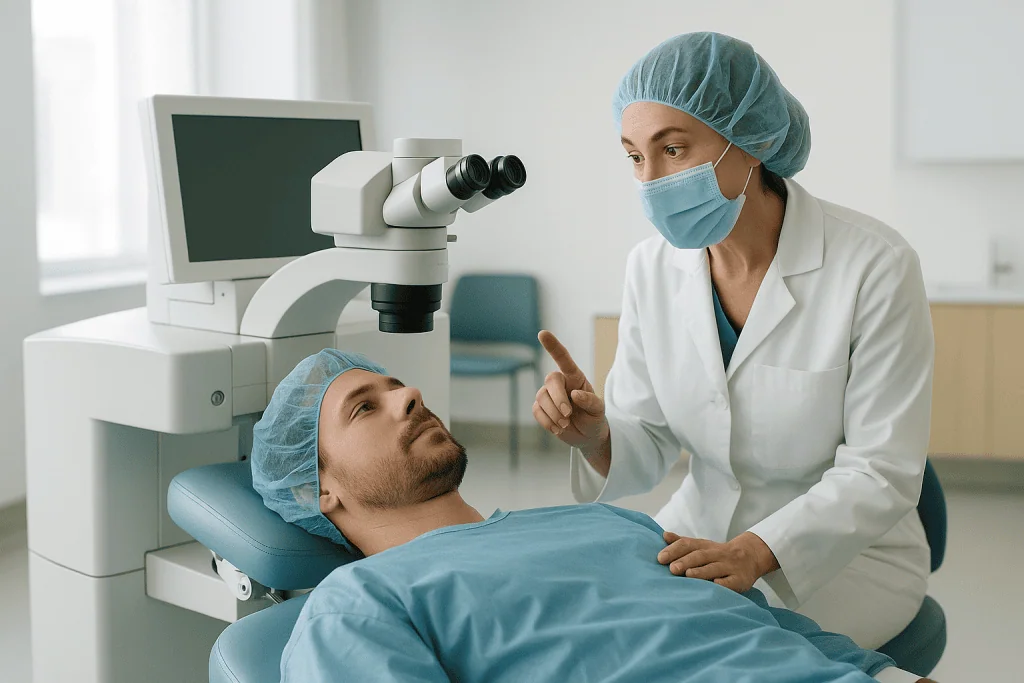
You lie flat on a bed that slides beneath the laser. Anesthetic drops numb the surface of the eye, so the cornea, the clear dome at the front of the eye that does most of its focusing, feels touch as pressure rather than pain. A small instrument called a lid speculum, a spring that gently holds the eyelids apart, is placed so blinking is not something you have to manage. The other eye is covered.
Next comes the flap. A suction ring steadies the eye, your vision dims for a few seconds, and either a very fine blade or a femtosecond laser, an infrared laser that cuts with ultra-short pulses, creates a thin hinged layer on the corneal surface. The surgeon lifts that flap like the cover of a book.
You are asked to look at a blinking target light. The excimer laser, an ultraviolet laser that vaporizes microscopic amounts of tissue without heating what remains, fires in a rapid series of pulses across the exposed cornea, reshaping it according to a map made at your consultation. You may hear clicking and notice a faint smell. Then the flap is laid back into place and smoothed. Corneal tissue is naturally sticky, and the flap begins to adhere within minutes without stitches.
The same sequence repeats on the second eye. Afterward a clinician checks the flap position under magnification, places clear shields over your eyes and walks you through the next 24 hours. Cleveland Clinic and Mayo Clinic both describe this sequence in patient-facing detail, and both stress that you are awake throughout, talking to the team if you wish.
How long is LASIK surgery itself, and why does the laser need only seconds?
The number that surprises people most is the laser time. Cleveland Clinic puts the reshaping at less than a minute per eye, and for milder prescriptions it is often considerably shorter.
The physics explains the speed. An excimer laser removes tissue in pulses, and each pulse takes away a layer thinner than a red blood cell is wide. The cornea is roughly half a millimeter thick, and the correction for a moderate prescription removes only a small fraction of that. Hundreds or thousands of pulses fire in quick succession, each guided by the treatment map, and the total adds up to seconds rather than minutes.
Two things stretch or shrink that window. The size of the correction matters, since a stronger prescription means more tissue to remove and more pulses. The pattern matters too, because treating astigmatism, an uneven curvature of the cornea, or using a customized profile based on a detailed scan of the eye’s optics, can add pulses compared with a simple spherical correction.
Movement, the thing patients worry about most, barely changes the clock. Modern lasers use eye-tracking systems that follow tiny movements many times per second and pause if the eye drifts beyond a set limit. If you glance away or cough, the treatment stops and resumes when you are back on the target. You do not need to hold your eye perfectly still, and no reasonable amount of nervous twitching will ruin the result.
So when someone asks how long LASIK surgery is, the accurate answer is a nested one: seconds for the laser, a couple of minutes per eye including the flap, and a half hour in the room including the pauses that make it safe.
The flap: what it is, how it is made and how long that step takes
Of all the words on a LASIK consent form, “flap” is the one that makes shoulders tense. It deserves a calm explanation.
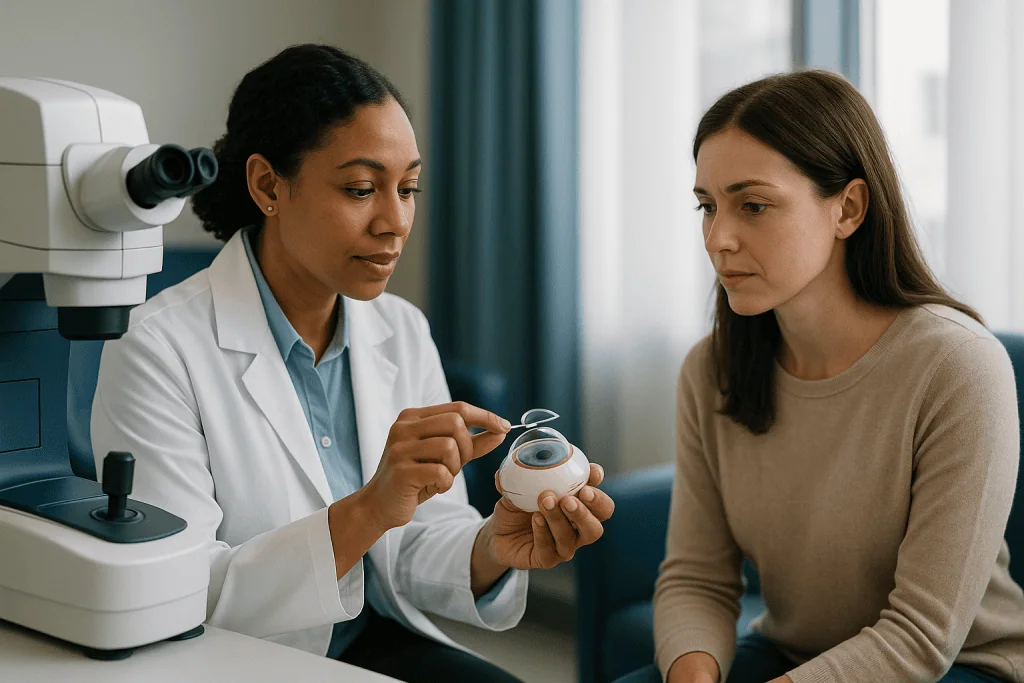
The cornea has layers, and the excimer laser needs to reach the middle one, the stroma, which holds its shape after reshaping. Rather than removing the surface entirely, LASIK lifts a thin hinged layer, does the work underneath and folds the layer back. This is why LASIK recovery tends to be quicker and more comfortable than surface-based laser procedures, a comparison Mayo Clinic and the NHS both draw.
There are two ways to create the flap. A microkeratome is a precision blade that glides across the cornea. A femtosecond laser places a dense pattern of microscopic bubbles at a set depth, creating a plane the surgeon can then separate. Either way, the step lasts seconds to about a minute, most of which is the suction ring settling and the surgeon confirming alignment.
What you feel is pressure, not pain, and what you see is the room going dim or gray for a short moment while the suction is on. Many people describe this as the most disorienting part of the procedure, precisely because it is unexpected. Knowing it is coming, and that it ends quickly, helps.
After the laser, the flap is floated back into position and smoothed with a tiny instrument. The natural pump action of corneal cells draws it down within minutes. It continues to seal over the following days and strengthens over months, which is why surgeons are firm about no rubbing, protective shields at night and avoiding contact sports early on. The edge of a flap can be disturbed by a direct blow long after the surface looks healed, so eye protection in high-impact sports is a lifelong habit worth keeping.
The waiting room before: what happens in the weeks leading up to LASIK
The longest part of the LASIK timeline is not on surgery day. It is the consultation and the pause that follows it.
A full evaluation, described by Mayo Clinic and Johns Hopkins Medicine, includes a detailed refraction to confirm your prescription, measurements of corneal thickness and shape, pupil size in dim light, a tear film assessment and a dilated exam of the retina. Dilating drops widen the pupil for several hours, so plan for blurry near vision and sensitive eyes for the rest of that day, and arrange a ride.
Contact lenses change the shape of the cornea slightly, and measurements taken on a warped cornea would lead to an inaccurate treatment. Mayo Clinic advises stopping soft lenses for at least a few weeks before the evaluation and the surgery, and longer for rigid gas-permeable lenses, which press more firmly. Your surgeon sets the exact interval. This lens holiday is often the single biggest scheduling hurdle, especially for people who have not worn glasses in years and discover their frames are three prescriptions out of date.
Stability matters as much as the measurements. Most guidance, including Mayo Clinic’s, looks for a prescription that has held steady for about a year, because operating on an eye that is still changing means correcting a target that will move.
On the day itself, the requests are simple: arrive with a clean face and no eye makeup, skip perfume or heavy lotions that can interfere with the laser environment, wear comfortable clothing and bring your driver. Eat normally unless you have been told otherwise for a sedative. The waiting room that follows is mostly paperwork, repeated checks of your name and planned correction, and the slow work of numbing drops.
LASIK eye surgery procedure time at a glance
Numbers scattered across paragraphs are hard to hold in your head. This table gathers the typical ranges in one place, each tied to the source that reports it. None of these figures is a promise; they describe what commonly happens.
| Stage | Typical duration | What is happening | Source |
|---|---|---|---|
| Contact lens break before evaluation and surgery | At least a few weeks for soft lenses; longer for rigid lenses | Cornea returns to its natural shape so measurements are accurate | Mayo Clinic |
| Consultation visit | Varies; dilation adds hours of blur afterward | Refraction, corneal mapping, thickness, tear film, retinal exam | Mayo Clinic, Johns Hopkins |
| Numbing drops | A few minutes to take effect | Surface of the eye becomes insensitive to sharp sensation | Cleveland Clinic |
| Flap creation | Seconds to about a minute | Suction ring steadies the eye; blade or femtosecond laser makes the hinged layer | Mayo Clinic |
| Excimer laser reshaping | Less than a minute per eye | Pulses remove microscopic tissue guided by your map | Cleveland Clinic |
| Total time on the laser bed, both eyes | About 30 minutes or less | Includes positioning, switching eyes and checks | Mayo Clinic, MedlinePlus |
| First follow-up | One to two days after surgery | Flap position, early vision, drop review | Mayo Clinic |
| Vision stabilizes | Two to three months | Fluctuation, glare and haze settle | Mayo Clinic |
| Dry eye symptoms | Often up to about six months | Nerve fibers in the cornea regrow | Mayo Clinic |
Read the table top to bottom and a pattern appears. The stages that sound frightening, the flap and the laser, are the shortest. The stages that test patience, the lens holiday and the months of settling, are the longest. That inversion is worth keeping in mind when a friend tells you LASIK “takes ten minutes.” They are describing one row.
Who LASIK is usually for, and who is usually asked to wait
Speed is only a virtue if the procedure suits the eye in front of the surgeon. A surprising share of people who book a consultation are told to wait, or to consider something else, and that conversation is a sign of a careful team rather than a disappointing one.
The typical candidate, as described by Mayo Clinic and the NHS, is an adult whose prescription has been stable for about a year, whose corneas are thick enough to leave a safe margin after reshaping, and whose eyes are otherwise healthy. Mayo Clinic notes that people are generally at least 18, while NHS guidance points out that laser eye surgery is not usually recommended under 21 because the eyes may still be changing. Your surgeon will weigh your own history rather than a birthday.
Several situations commonly lead to a pause or a different plan:
- A prescription that changed within the past year, since a moving target cannot be corrected precisely.
- Pregnancy or breastfeeding, when hormonal shifts can temporarily alter the cornea and the prescription.
- Keratoconus, a condition in which the cornea thins and bulges into a cone shape, or a family history that suggests risk.
- Corneas too thin for the planned correction, or corrections so large that too much tissue would need removing.
- Significant dry eye, which LASIK can worsen for months.
- Uncontrolled autoimmune disease, diabetes with unstable eye findings, or medicines that impair healing.
- Eye conditions such as glaucoma, cataract or a history of certain infections.
Being asked to wait is not the same as being turned away forever. A prescription may settle. Dry eye may be treated first. A different procedure may fit better. The decision about whether and when sits with the surgeon who has examined your eyes, and a good one will explain their reasoning in plain terms.
What the first 24 hours after LASIK usually look like
The ride home is the first test of patience. Vision right after LASIK is often described as looking through a steamy shower door: shapes are there, edges are not. Mayo Clinic notes that itching, burning, watering and light sensitivity are common in the hours immediately afterward, along with a gritty feeling like an eyelash that will not shift.
The most useful thing you can do that afternoon is close your eyes and rest, ideally with a long nap. Sleep gives the flap uninterrupted time to seal, and it passes the hours when discomfort tends to peak. Clear shields taped over the eyes, or protective goggles, stay on while sleeping for the first nights so a stray hand does not rub the surface.
Your surgeon will prescribe eye drops, typically an antibiotic to reduce infection risk and an anti-inflammatory to calm the healing surface, along with lubricating drops. Follow the schedule exactly as written and ask if anything is unclear; the timing and duration are set for your eyes and are not something to adjust on your own.
Do not drive until your care team has confirmed your vision meets the legal standard. Do not rub your eyes, even when they itch, and skip eye makeup, dusty environments and screens for the rest of the day if you can. Showering is generally fine with eyes closed and water kept away from the face.
The first follow-up usually happens one to two days later, according to Mayo Clinic. The surgeon checks that the flap is smooth and in place, measures early vision and asks about symptoms. Many people are startled by how much clearer things already look by that visit, though fluctuation over the following weeks is normal and expected.
LASIK recovery time: the first days and weeks
Recovery after LASIK is front-loaded. The dramatic change happens in the first day or two, and then the eye spends weeks quietly fine-tuning.
Cleveland Clinic notes that many people return to work within a few days, sometimes the very next day for desk jobs, depending on how vision and comfort are progressing and on what the surgeon advises. Screen work is not harmful to the flap, but staring reduces blinking and dries the surface, so frequent breaks and lubricating drops make the day easier.
Certain activities are paused longer because they raise the risk of infection or of something striking the eye. Mayo Clinic advises avoiding swimming, hot tubs and whirlpools for a period after surgery, and holding off on eye makeup and creams around the eyes for about a week or as directed. Contact sports, dusty or smoky environments and anything that could bump the face wait longer still. Your surgeon sets the exact intervals based on how your flap is healing.
Vision during these weeks is real but imperfect. Halos around headlights, glare, mild haze and days when one eye seems sharper than the other are common and generally improve. Night driving can feel harder at first. Dryness is the most persistent complaint, and it tends to be worst in the first weeks before easing.
Follow-up visits typically continue at intervals over the first few months so the team can track how the cornea is settling. Keep them even if everything feels fine, since a surgeon can spot early signs of a problem before you notice any change. Recovery time is a range, not a race, and comparing your week-one vision to someone else’s is one of the less helpful things a person can do.
How long does LASIK take to fully heal and for vision to settle?
Two clocks run after LASIK, and they finish at different times. Vision often reaches a useful level within a day. Stability takes months.
Mayo Clinic advises that it can take two to three months after surgery before the eye heals and vision stabilizes. During that window the cornea is remodeling at a microscopic level, the tear film is recovering and the brain is adapting to a new optical system. Small day-to-day swings in clarity are normal, and a reading at week two is not a verdict.
Dry eye deserves its own timeline. LASIK cuts through some of the fine nerve fibers in the cornea that signal the eye to produce tears. Mayo Clinic notes that this temporary reduction in tear production commonly lasts up to about six months as those nerves regenerate. Symptoms range from mild grittiness to blurred vision that clears with a blink, and lubricating drops help most people through it. If dryness is severe or lasts well beyond that range, the surgeon has further options to discuss.
The flap follows the slowest clock of all. The surface seals within days and the edge knits over weeks, but the interface never fully regains the strength of untouched cornea. This is why eye protection in racquet sports, martial arts and similar activities is a permanent recommendation.
One practical consequence: decisions about a touch-up, sometimes called an enhancement, are generally deferred until measurements have been stable for a stretch of time, because operating on an eye that is still settling would be aiming at a moving target. If your surgeon suggests waiting before judging the final result, that is the science talking, not stalling.
How long does LASIK last? What changes and what does not
The reshaping of the cornea is permanent. The eye around it keeps aging. Both statements are true, and holding them together answers the question honestly.
Tissue removed by the excimer laser does not grow back, so the correction achieved does not simply wear off. What can change is the rest of the optical system. Mayo Clinic notes that undercorrection, and in some cases a gradual drift back toward the original prescription called regression, is more likely with larger corrections, and that a second procedure may be considered if the eye is otherwise suitable.
The bigger shift for most people is presbyopia, the normal age-related stiffening of the eye’s internal lens that makes near focus harder, usually noticeable in the 40s. LASIK reshapes the cornea for distance; it does not stop the lens from aging. Someone who has clear distance vision after LASIK will very likely still reach for reading glasses at the same age they would have otherwise. Some surgeons discuss strategies for this at the consultation, and the trade-offs are worth understanding before rather than after.
Later in life, cataract, a clouding of that same lens, affects most people who live long enough. Cataract surgery remains possible after LASIK, though the earlier corneal change makes calculating the replacement lens more complex, which is one reason to keep a copy of your pre-LASIK measurements.
So how long does LASIK last? The corneal correction is intended to be lasting. Your vision as a whole will still change with age, as everyone’s does. A surgeon who promises a lifetime without glasses is promising something no one can guarantee.
Risks and alternatives, in plain clinical language
A procedure that takes seconds still carries risks, and a fair explainer names them without drama.
Mayo Clinic and the NHS list dry eye, glare, halos and difficulty with night vision as the most common effects, usually temporary but occasionally persistent. Undercorrection, overcorrection and residual astigmatism can leave vision short of the goal. Flap problems during or after surgery, including wrinkling or displacement after trauma, are uncommon but real. Rarer still are infection, inflammation under the flap, and corneal ectasia, a progressive weakening and bulging of the cornea that can develop when too little tissue remains. Serious permanent vision loss is rare, and your surgeon will discuss how these risks apply to your eyes specifically.
Alternatives exist, and the right one depends on corneal thickness, prescription, lifestyle and the surgeon’s judgment:
- PRK, photorefractive keratectomy, reshapes the cornea after removing the surface layer rather than lifting a flap. The NHS notes it suits thinner corneas but involves a slower, more uncomfortable early recovery.
- SMILE, small incision lenticule extraction, removes a thin disc of tissue through a small opening without a full flap.
- Implantable lenses placed inside the eye can address prescriptions too strong for laser correction.
- Glasses and contact lenses remain safe, reversible and effective for most people, and choosing them is a legitimate decision rather than a failure of nerve.
None of these is universally better. Each trades something for something else, and the comparison only makes sense for a specific pair of eyes. The decision about which procedure, or none, belongs to you and the surgeon who has examined you, with time to think and no pressure to book on the day.
What people often get wrong about how long LASIK takes
Waiting rooms are full of half-truths passed along by well-meaning friends. A few are worth correcting.
“The laser is on for ages.” It is on for well under a minute per eye. The half hour on the bed is mostly positioning, checks and the flap. If the clicking seems to stop and start, that is the tracker pausing when you move, not a problem.
“If I blink, I will ruin it.” A lid holder keeps the eye open, the surface is numb so the blink reflex is muted, and eye-tracking pauses the laser if you drift. Nervous movement is expected and planned for.
“You walk out seeing perfectly.” You walk out seeing better than you did without glasses, through a haze. Mayo Clinic’s window for stable vision is two to three months. The first day is a preview, not the final print.
“It is painless, full stop.” The procedure is not painful. The first hours afterward often bring burning, grittiness and light sensitivity, and dryness can linger for months. Painless surgery and comfortable recovery are different claims.
“A quick procedure means a quick decision.” The speed of the laser says nothing about how carefully the choice should be made. The lens holiday, the stability check and the consultation exist precisely because the surgery cannot be undone.
“Once it is done, no glasses ever again.” The corneal change is lasting, but presbyopia and cataract arrive on their own schedule. Reading glasses in midlife remain likely.
“Both eyes always happen the same day.” Usually, yes, but some surgeons stagger them for specific reasons. If yours suggests it, ask why; there will be a rationale.
Questions to ask your care team before LASIK
A consultation goes better when you arrive with questions written down, because the dilating drops will make reading your own notes harder afterward. These are the ones that tend to matter most, drawn from what patients commonly wish they had asked.
- How long should I stop wearing my contact lenses before the evaluation and before surgery, given the type I wear?
- Is my prescription stable enough, and how are you judging that?
- How thick are my corneas, and how much tissue would the planned correction remove?
- Will you use a blade or a femtosecond laser for the flap, and why for my eyes?
- How long will I actually be on the laser bed, and how long should I plan to be at the center?
- What will the first 24 hours feel like, and what is normal versus a reason to call?
- Which eye drops will I use afterward, and how long will I need them?
- When can I drive, return to my specific job, exercise, swim and wear eye makeup?
- How long does LASIK take to stabilize in someone with a prescription like mine?
- How likely is dry eye for me, given my tear film results, and how would you manage it?
- What happens if the result is under- or overcorrected, and when would you assess that?
- Would PRK, SMILE, an implantable lens or simply staying in glasses suit me better, and why?
- How do you handle after-hours concerns, and who do I call?
- Can I have a copy of my pre-operative measurements for my records?
Notice that most of these are about time. That is not an accident. Understanding the timeline is the clearest way to understand the procedure, and a team that answers these patiently is telling you something about how they will care for you afterward.
When to call your doctor after LASIK
Most of what you feel in the first days is expected: grittiness, watering, light sensitivity, fluctuating blur, mild aching. A short list of signs is different, and your surgeon will want to hear from you promptly rather than at the next scheduled visit.
Contact your care team the same day, or use their emergency line, if you notice:
- Pain that is severe, or that gets worse after the first day instead of easing.
- A sudden drop in vision, or vision that was improving and then clearly deteriorates.
- Increasing redness, thick discharge, or a feeling that something is stuck under the lid that does not settle.
- Any blow to the eye, or rubbing that was followed by a change in vision, since the flap can shift after trauma.
- New flashes of light, a shower of floaters or a shadow or curtain across part of your vision.
- Fever with eye pain, or a rapidly worsening sensitivity to light.
Mayo Clinic and Cleveland Clinic both describe infection, flap displacement and inflammation under the flap as uncommon but time-sensitive complications; the earlier they are seen, the more options a surgeon has. Do not wait to see whether a worrying symptom improves overnight, and do not stop or change your prescribed drops on your own in response to a symptom.
If you cannot reach your surgical team and symptoms are severe or vision is falling quickly, go to an emergency department and tell them you have had recent laser eye surgery. Bring your drop schedule and any paperwork describing the procedure. Every decision about examination and treatment from that point rests with the clinicians who see you, and a written record of what was done helps them make it well.
Frequently asked questions
How long is LASIK surgery for both eyes?
About 30 minutes or less on the laser bed for both eyes, according to Mayo Clinic, with MedlinePlus describing roughly 10 to 15 minutes per eye. The laser itself fires for well under a minute per eye. The rest is positioning, checking the flap, switching eyes and confirming the correction. Plan for a longer stay at the center overall, since preparation and observation take more time than the procedure.
What is the typical LASIK recovery time before I can work?
Many people return to work within a few days, and some with desk jobs the next day, as Cleveland Clinic notes, though your surgeon’s advice for your eyes takes priority. Vision is usually functional within a day but fluctuates for weeks. Jobs involving dust, chemicals, contact or night driving may need a longer pause. Full stabilization typically takes two to three months, so early clarity is a preview rather than a final result.
How long does LASIK last once the eye has healed?
The corneal reshaping is permanent, since removed tissue does not regrow. What changes is the rest of the eye: presbyopia, the age-related stiffening of the internal lens, usually brings a need for reading glasses in the 40s, and cataract may follow decades later. Mayo Clinic notes that regression toward the original prescription is more likely after large corrections. LASIK lasts; the eye still ages.
Does LASIK hurt during the procedure?
Not in the usual sense. Anesthetic drops numb the surface, so the flap and laser register as pressure, dimming and a brief odd sensation rather than pain. Discomfort tends to arrive afterward, when Mayo Clinic notes burning, itching, watering and light sensitivity are common for several hours. Resting with eyes closed and using the prescribed drops helps most people through that stretch.
What happens if I blink or move during LASIK?
Very little, by design. A lid holder keeps the eye open, the numbed surface dampens the blink reflex, and the laser’s eye-tracking system follows small movements and pauses if you drift beyond a set range. The surgeon simply resumes when you are back on the target light. Coughing, sneezing or a nervous flinch does not ruin the treatment, which is one reason the laser step is so short.
Can I drive myself home after LASIK?
No. Vision immediately afterward is hazy, the eyes are light-sensitive and any sedative would make driving unsafe. Arrange for someone to take you home and, ideally, to bring you to the follow-up visit one to two days later. Your surgeon will tell you when your vision meets the legal standard for driving, which for many people is soon after that first check, but it must be confirmed rather than assumed.
Why do I have to stop wearing contact lenses before LASIK?
Contact lenses press on the cornea and subtly change its shape, and LASIK is planned from precise measurements of that shape. Mayo Clinic advises stopping soft lenses for at least a few weeks before the evaluation and surgery, and longer for rigid gas-permeable lenses, so the cornea returns to its natural form. Skipping this step risks a treatment based on the wrong map, so surgeons are firm about it.
How long does dry eye last after LASIK?
Often up to about six months, according to Mayo Clinic, though it is usually worst in the first weeks and eases as the fine corneal nerves that trigger tear production regrow. Symptoms include grittiness, burning and blur that clears with a blink. Lubricating drops manage it for most people. Dryness that is severe or persists well beyond that range should be raised with your surgeon, who has further options to discuss.
Is there a minimum age for LASIK?
Mayo Clinic notes candidates are generally at least 18, while NHS guidance says laser eye surgery is not usually recommended under 21 because the eyes may still be changing. Age is a proxy for stability; what surgeons really want is a prescription that has held steady for about a year. Someone in their late teens with a shifting prescription will be asked to wait, whatever the calendar says.
How long after LASIK can I swim or wear eye makeup?
Mayo Clinic advises avoiding swimming, hot tubs and whirlpools for a period after surgery and holding off on eye makeup and creams around the eyes for about a week, with your surgeon setting the exact intervals for your healing. Water and cosmetics carry infection risk while the flap edge is sealing. Contact sports and dusty environments generally wait longer, and protective eyewear in high-impact sports is advised long term.
References
- Cleveland Clinic – LASIK Eye Surgery
- MedlinePlus – LASIK eye surgery
- NHS – Laser eye surgery and lens surgery
This article is for general information only and is not a substitute for professional medical advice. Please consult a qualified doctor about your individual situation.

More from the Blog

Astigmatism That Is Not Simple: Why Irregular Corneas Are Treated Differently
Irregular astigmatism happens when the cornea is warped unevenly, most often from keratoconus, scarring, or earlier eye surgery, so ordinary glasses cannot fully sharpen…
LASIK Complications Explained Honestly: Flap Problems, Dry Eye and Night Vision Changes
LASIK complications are uncommon but real. The most frequent are dry eye, which often improves over several months, and night-vision changes such as glare…

Dryness, Glare and Blurry Days After ILASIK: What Is Normal and When to Call
Dry, gritty eyes, glare or halos around lights at night, and vision that shifts through the day are common ILASIK side effects, and they…

How Laser Surgery Corrects Astigmatism by Smoothing an Uneven Cornea
Laser surgery corrects astigmatism by reshaping the front surface of the eye, the cornea, so that it curves more evenly. A computer-guided excimer laser…
Why Timing Matters in Retina Surgery: Which Repairs Are Urgent and Which Can Be Planned
Retinal detachment surgery urgency depends on whether the macula, the center of the retina responsible for detailed vision, is still attached. Macula-on detachments are…

Toric Lenses, Glasses or Laser for Astigmatism: When Each Option Makes Sense
Astigmatism treatment options fall into three groups: glasses, contact lenses (including toric soft lenses and rigid or scleral lenses for irregular corneas), and surgery…