

Is Super LASIK Only for Complex Prescriptions? Who Actually Benefits From Custom Treatment
Key Takeaways
- "Super LASIK" is a marketing label for wavefront-guided LASIK, not a separate operation; the flap, healing process and risk categories are the same as standard LASIK.
- Whether a personal wavefront map adds value depends on how many higher-order aberrations an eye has, which is unrelated to how strong the glasses prescription is.
- Corneal thickness and shape, not the laser type, set the upper limit of how much prescription can be corrected safely, and scans for early keratoconus are the reason some people are declined.
- Mainstream sources describe candidates as adults over 18 with a prescription stable for roughly one to two years, healthy corneas and a good tear film, and advise waiting during pregnancy and breastfeeding.
- Dry eye after LASIK can persist for up to six months and vision may take two to three months to stabilize, so enhancement decisions are usually deferred until then.
- The corneal reshaping is permanent, but presbyopia and cataract arrive on their normal schedule, and keeping pre-operative measurements helps any future cataract surgeon plan accurately.
No. Custom or wavefront-guided LASIK, often marketed as Super LASIK, is not reserved for complex prescriptions. It uses a detailed optical map of each eye to shape the laser treatment, and eye surgeons may consider it for people with mild, moderate or higher prescriptions alike. Candidacy depends far more on corneal thickness, eye health, a stable prescription and realistic expectations than on how strong the glasses are.
The man in the waiting room had two pairs of glasses in his jacket: the everyday pair, and a spare for the day he inevitably sat on the first. His prescription was modest. His question was not. A friend with far worse eyesight had been offered a “custom” laser treatment and told it was for tricky eyes, so he assumed his ordinary myopia put him in the plain-vanilla queue. Was he right?
It is one of the most common misunderstandings about laser vision correction, and it rests on a marketing word rather than a clinical one. Whether someone is a good super LASIK candidate has little to do with how thick their lenses are. It has a great deal to do with the shape and thickness of the cornea, the health of the tear film, whether the prescription has stopped drifting, and what the person expects the surgery to do for them.
This explainer walks through what the technology actually does, who tends to be considered for it, who is usually asked to wait, and the honest questions worth bringing to the eye team.
What does "Super LASIK" actually mean?
Start with a small but useful truth: “Super LASIK” is not a term you will find in a clinical guideline. It is a label used in some markets for LASIK performed with wavefront technology, sometimes paired with a particular way of making the corneal flap. The medical name for the underlying idea is wavefront-guided or custom LASIK, and that is the term this article will use interchangeably.
LASIK itself stands for laser-assisted in situ keratomileusis. In plain language, a surgeon lifts a thin hinged flap on the front surface of the cornea, the clear dome at the front of the eye, uses a cool ultraviolet laser to remove a precise amount of tissue underneath, then lays the flap back down. The reshaped cornea bends light differently, so images land more sharply on the retina at the back of the eye. Mayo Clinic describes the procedure and its goals in detail.
A “wavefront” is a measurement of how light travels through the whole optical system of an eye, not just the two numbers on a glasses prescription. Every eye has tiny irregularities that glasses cannot correct. Wavefront devices map those irregularities, and custom LASIK uses that map to shape the laser pattern.
So the honest definition is this: the “super” part refers to a more detailed set of measurements feeding the laser. It is not a separate operation, it is not automatically stronger, and it does not change the fundamental anatomy of what happens to the cornea. The flap is still a flap. The healing is still corneal healing. Any surgeon offering it should be able to explain, in one sentence, what the wavefront map adds for your particular eyes. If they cannot, that is worth noticing.
How wavefront guided LASIK works, step by step
Picture the eye as a camera with two lenses: the cornea at the front and the natural lens behind the iris. Together they bend light so it focuses on the retina. Nearsightedness, farsightedness and astigmatism are called lower-order aberrations, meaning simple focusing errors that spectacles correct well. Higher-order aberrations are the subtler distortions, from small irregularities in the cornea or lens, that glasses cannot touch. They contribute to glare, ghosting and reduced contrast, especially in dim light when the pupil widens.
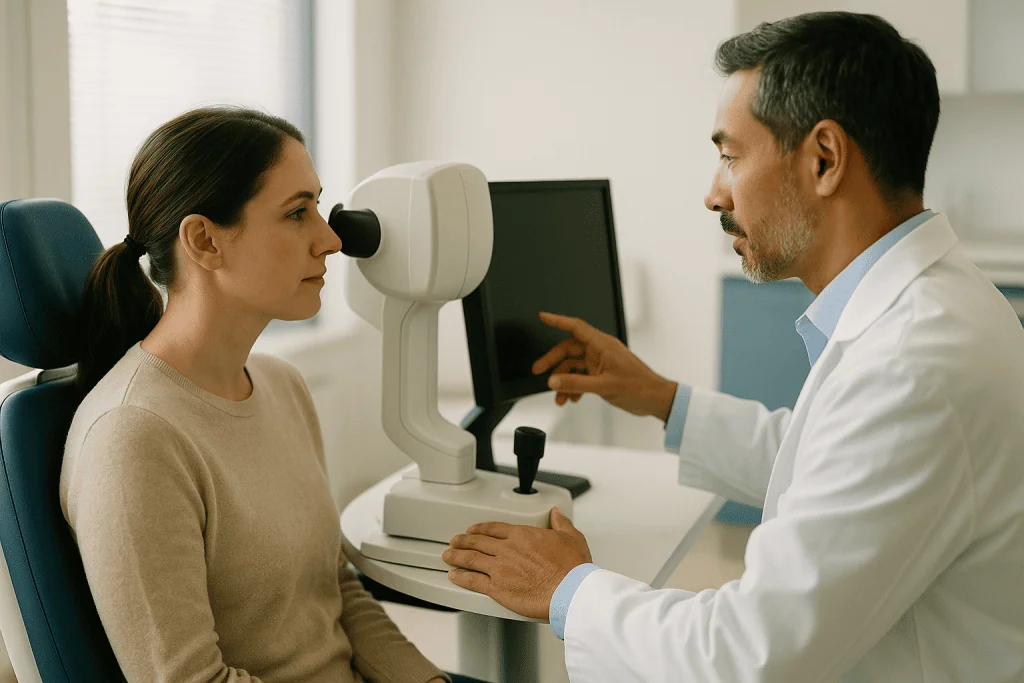
A wavefront aberrometer sends a low-energy light beam into the eye and reads how the returning light is bent across hundreds of points. The result is a three-dimensional map, a little like a topographic chart of a landscape, showing where the eye’s optics are perfectly flat and where they ripple. Software translates that chart into a laser pattern intended to smooth the ripples while correcting the main prescription.
The surgery itself follows the same sequence as standard LASIK, as MedlinePlus outlines. Numbing drops are applied. A flap is created either with a mechanical blade device called a microkeratome or with a femtosecond laser. The flap is folded back, the excimer laser sculpts the exposed tissue according to the plan, and the flap is repositioned without stitches. The laser portion typically lasts well under a minute per eye, and the whole appointment is usually measured in minutes rather than hours, according to Mayo Clinic.
The important caveat is that the map is only as good as the measurement. Dry patches on the eye surface, a very small pupil during testing, or eyes that have not rested from contact lenses can all distort the reading. Surgeons often repeat the scan more than once and compare it with other tests before they trust it enough to program a laser.
Custom LASIK vs regular LASIK: what actually changes
The differences between laser approaches are real but narrower than glossy brochures suggest. The table below summarizes them in neutral terms. None of these approaches is universally superior; the choice depends on the eye in front of the surgeon.
| Approach | What guides the laser | Where surgeons often consider it |
|---|---|---|
| Conventional LASIK | The glasses or contact lens prescription (sphere, cylinder, axis) | Straightforward prescriptions with few higher-order aberrations |
| Wavefront-optimized LASIK | The prescription plus a standard pattern designed to limit the new aberrations that any laser treatment tends to create | A wide range of prescriptions; many surgeons use it as a default |
| Wavefront-guided (custom) LASIK | The prescription plus the individual eye’s measured wavefront map | Eyes with meaningful pre-existing higher-order aberrations, or where night-vision quality is a priority |
| Topography-guided LASIK | The prescription plus a detailed surface map of the cornea alone | Irregular corneal surfaces, some previous-surgery cases |
A few points deserve emphasis. First, “wavefront-optimized” and “wavefront-guided” sound alike but are different: one applies a general correction pattern, the other uses your personal map. Second, the flap-making method is a separate decision from the laser-guidance method; a wavefront-guided treatment can be performed with either a blade or a femtosecond laser, and combining the words in a brand name does not create a new procedure.
Third, and most honestly, comparative studies of these approaches show differences that are often modest and vary between eyes. The Cochrane-style reviews in this field generally conclude that the technologies all correct the main prescription well and that the measurable advantages of individual mapping appear most clearly in eyes that started with more irregularity. For an eye with very few aberrations to begin with, the personal map may add little. That is not a failing of the technology; it is simply how averages work.
Is a super LASIK candidate always someone with a complex prescription?
Here is the myth at the heart of the title, and it deserves a direct answer: no. The assumption goes something like this. Custom treatment is more sophisticated, sophisticated tools are for difficult problems, therefore custom LASIK is for difficult eyes. Each step feels logical and the conclusion is wrong.
Consider two people. One has a strong nearsighted prescription but an unusually smooth, regular cornea with very few higher-order aberrations. The other has a mild prescription, could pass a driving test without glasses on a good day, but complains bitterly about starbursts around headlights and has a wavefront map full of ripples. The first person’s eyes are optically “simple” despite the big numbers. The second person’s eyes are optically “complex” despite the small ones. If either were to have a wavefront-guided treatment, the second person is the one whose map would actually change the laser plan.
Complexity, in other words, is measured by the aberrometer, not by the lens thickness at the optician. The strength of a prescription matters enormously for a different question: whether there is enough corneal tissue to remove safely. A stronger correction requires removing more tissue, and every cornea has a limit below which the surgeon will not go. MedlinePlus lists thin corneas among the reasons a person may be turned down.
So the questions get separated. How much correction is needed determines how much cornea will be used and whether LASIK is possible at all. How irregular the optics are determines whether a personal wavefront map adds value. A person can be a strong candidate on one axis and a poor one on the other. That is why a consultation involves a stack of scans rather than a single number, and why nobody should be told they are or are not a super LASIK candidate over the phone.
Who is usually a good candidate, and who is usually asked to wait
Candidacy criteria across mainstream sources are remarkably consistent, and they say little about the type of laser. The NHS notes that laser eye surgery is generally suitable for adults over 18 whose prescription has been stable, ideally for about two years. Mayo Clinic and MedlinePlus give similar guidance, with MedlinePlus citing stability for at least a year.
Beyond age and stability, surgeons typically look for a cornea that is thick enough and regularly shaped, a healthy tear film, pupils that are not unusually large in dim light, and no active eye disease. General health matters too: uncontrolled diabetes, certain autoimmune conditions and medicines that slow healing can all affect the cornea’s recovery.
Then there is the group asked to wait rather than declined outright. Pregnancy and breastfeeding are common examples, because hormonal shifts can temporarily change the shape of the cornea and the prescription; the NHS advises waiting until this period has passed. Someone whose glasses prescription changed at the last two checkups is usually asked to come back once it settles, since correcting a moving target invites disappointment. People in their early forties who are starting to notice near-vision blur may be asked to think carefully about timing, because presbyopia, the age-related stiffening of the natural lens, will keep progressing regardless of what happens to the cornea.
Contact lens wearers are often asked to stop lenses for a period before measurements, since lenses mold the cornea and can blur the wavefront map. The precise interval depends on lens type and the surgeon’s protocol.
The phrase “asked to wait” is worth taking at face value. It usually means the team wants a truer picture, not that the door has closed. Rushing the timeline to fit a holiday or a wedding is one of the more avoidable sources of regret.
Who is not a good candidate for LASIK at all?
Some people are better served by never having a flap made in their cornea, however sophisticated the laser guiding the treatment. This is the group where a good consultation earns its keep by saying no.
The clearest example is keratoconus, a condition in which the cornea progressively thins and bulges into a cone shape. Removing tissue from an already weakening cornea can accelerate that process, so keratoconus and its subtle early forms, sometimes called forme fruste keratoconus, are widely regarded as contraindications. Detecting the early form is exactly why corneal topography and tomography scans are part of the assessment; a normal glasses test will not reveal it.
Severe dry eye disease is another. LASIK cuts some of the nerves in the corneal surface that drive tear production, so dryness commonly worsens for a time after surgery. Mayo Clinic notes that dry eye can persist for months. A person whose eyes are already uncomfortable and unstable at baseline may find the trade-off unfavorable, and other procedures or simply staying with glasses may be discussed.
MedlinePlus and Mayo Clinic also flag corneas that are too thin for the planned correction, unstable or very high prescriptions, cataract, uncontrolled glaucoma, active eye infection or inflammation, poorly controlled diabetes, and autoimmune conditions such as rheumatoid arthritis or lupus that can impair healing. Certain medicines that affect wound healing may prompt a pause or a different plan.
A less medical but equally valid reason: people whose expectations cannot be met. Someone who needs razor-sharp night vision for their work, or who will not accept the possibility of reading glasses later in life, may be steered elsewhere. Declining surgery is not a failure of the consultation. It is the consultation working.
Can LASIK fix high astigmatism and very strong prescriptions?
People with strong glasses often arrive with two fears: that they are “too bad” for laser surgery, and that if they qualify at all, custom treatment is their only hope. Neither is quite right.
Astigmatism means the cornea or lens is shaped more like a rugby ball than a football, so light focuses at two different points. LASIK corrects astigmatism by flattening one meridian of the cornea more than the other. Higher amounts of astigmatism are more demanding to treat because the laser pattern must be precisely aligned; even a small rotation of the eye during treatment can leave a residual error. This is one place where eye-tracking and, in some devices, iris registration, which matches the treatment to a photograph of the iris to compensate for eye rotation, genuinely earn their place.
The same logic applies to strong nearsightedness. The laser can in principle correct large amounts, but each unit of correction consumes corneal tissue, and beyond a certain point the surgeon runs out of safe cornea. The NHS points out that people with very high prescriptions may be advised toward lens-based options rather than laser reshaping. A phakic intraocular lens, an artificial lens placed inside the eye in front of the natural lens, is one such alternative that leaves the cornea largely untouched.
Where does that leave custom treatment? It may help reduce the extra aberrations that any large correction tends to introduce, which is one reason some surgeons favor wavefront-based approaches for bigger prescriptions. But it does not create tissue where there is none. The “worst” prescription LASIK can address is set by your cornea’s thickness and shape, by the surgeon’s judgment, and by the laser’s approved range in your country, not by whether the word “super” appears on the consent form.
Can LASIK fix 20/40 vision, and is it worth it for mild prescriptions?
The question sounds simple but hides two separate ideas. Visual acuity, written as 20/40 in the US, describes how sharply you see on a chart: 20/40 means you read at 20 feet what a person with typical vision reads at 40. A prescription describes the optical error that causes the blur. Someone with 20/40 uncorrected vision usually has a mild prescription, and mild prescriptions are well within the range that LASIK routinely addresses, as MedlinePlus and Mayo Clinic describe.
Technically, then, the answer is yes. The more interesting question is whether it is worth a permanent change to the cornea. A person who sees 20/40 without glasses meets the unaided driving standard in many US states and may only reach for spectacles at the cinema. For them, the balance between benefit and risk is different from that faced by someone who cannot find the alarm clock without lenses. Dry eye, glare and the small but real chance of needing an enhancement are the same regardless of how mild the starting point.
This is also where the custom-treatment myth cuts the other way. Because their prescription is small, people with 20/40 vision sometimes assume they do not “qualify” for wavefront-guided treatment. In fact, when someone with a mild prescription is unhappy with their vision, higher-order aberrations are quite often part of the reason, and their wavefront map may be more relevant than their glasses numbers. The map will tell.
A fair consultation for mild prescriptions spends as much time on the question “what bothers you about your vision now?” as on the scans. If the honest answer is “not much, but glasses are annoying,” that is a valid reason to consider surgery, and an equally valid reason to decide against it.
What the pre-op assessment is really checking
The single most useful thing a prospective patient can understand is that the assessment, not the laser, decides who does well. Expect it to take longer than a routine eye test and to involve equipment you have not seen at the optician.
Refraction comes first, often repeated with the pupils dilated so the eye’s focusing muscle relaxes and the true prescription shows. Corneal thickness is measured, typically with ultrasound or optical scanning, because the surgeon must calculate how much tissue will remain after treatment. Corneal topography and tomography map the front and back surfaces of the cornea to rule out the irregular shapes that signal keratoconus. Pupil size is measured in dim light, since very large pupils have historically been linked with more glare and halos after surgery, a point MedlinePlus raises.
The tear film gets its own scrutiny. The eye surface is examined under magnification, staining dyes may be used to reveal dry patches, and the oil glands along the eyelid margins may be assessed. Dryness discovered here can often be treated before surgery so that both the wavefront map and the healing cornea start from a better place.
Then comes the wavefront scan itself, usually captured several times. The team compares the aberrometer’s estimate of the prescription with the manual refraction; a large mismatch is a red flag that something, often dryness or lens wear, has distorted the reading.
Finally, a conversation. Hobbies, occupation, night driving, screen hours, age and family history all feed into the plan. A person who fishes at dawn and drives home in the dark will hear more about night-vision trade-offs than someone whose vision needs end at the office. The scans describe the eye; this conversation describes the life the eye has to serve.
What the first days and weeks after custom LASIK usually look like
Recovery from wavefront-guided LASIK follows the same arc as conventional LASIK, because the healing tissue is identical. What follows are typical ranges from mainstream sources, not promises; individual timelines vary.
The first few hours often bring watering, a gritty or burning sensation and light sensitivity, according to Mayo Clinic. Vision is usually hazy at first and commonly improves by the next morning, though it may fluctuate. Most people are asked to rest with their eyes closed, avoid rubbing them, and use the lubricating and anti-inflammatory drops their surgeon prescribes exactly as directed. Protective shields at night are common in the early days to prevent accidental knocks to the flap.
The NHS describes mild irritation lasting a few days, with many people returning to desk work within a day or two, subject to the surgeon’s advice. Swimming, contact sports, eye makeup and dusty environments are typically restricted for a period because the flap is still bonding; the team will give specific intervals.
Dry eye is the most persistent early companion. Mayo Clinic notes it can last up to six months as the corneal nerves regrow. Glare, halos and starbursts, particularly at night, are common in the first days to weeks and generally lessen as the cornea settles. Vision itself may take two to three months to stabilize fully, per Mayo Clinic, which is also why surgeons generally wait before assessing whether any fine-tuning is needed.
Follow-up visits are usually scheduled within the first day or two, then at intervals over the following months. These appointments are where the flap is checked, drops are adjusted and the wavefront map may be repeated to compare with the pre-operative one. Keeping every appointment, even when the eyes feel fine, is one of the few things fully in the patient’s control.
What happens 20 years after LASIK?
People searching this question are usually asking two things: does the correction wear off, and does the surgery cause problems later. The honest answers are “partly, but not for the reason you think” and “rarely, with some caveats.”
The laser’s reshaping of the cornea is permanent. Tissue that has been removed does not grow back. What changes over two decades is the rest of the eye. The natural lens continues to stiffen from the forties onward, producing presbyopia, the need for reading glasses that affects almost everyone regardless of prior surgery. Later, the lens may cloud into a cataract. Neither is caused by LASIK, but both will change vision in someone who has had it, just as they do in someone who has not. Mayo Clinic is explicit that LASIK does not prevent age-related changes.
Regression, a slow drift back toward the original prescription, can occur, particularly after larger corrections, and some people choose an enhancement years later if the cornea allows. The NHS notes that a small proportion of people need further treatment.
A few longer-term considerations deserve mention. The flap, once healed, is strong but remains a distinct layer; very rare reports describe flap displacement after significant eye trauma years afterward. Dry eye that persists beyond the first year is uncommon but reported. And the reshaped cornea slightly complicates the lens-power calculations for future cataract surgery, which is why people who have had LASIK are advised to keep a copy of their pre-operative measurements and tell any future eye surgeon about the procedure.
Long-term follow-up studies of LASIK, summarized by sources such as Mayo Clinic and MedlinePlus, have generally found the corneal correction durable over many years. The eye around it simply keeps aging on schedule.
Risks and alternatives, in plain clinical language
Every honest explainer owes the reader the risk list without either minimizing or dramatizing it. Mayo Clinic, the NHS and MedlinePlus describe a consistent set.
Common and usually temporary: dry eyes, glare, halos, starbursts around lights, fluctuating vision and light sensitivity. Less common: under-correction or over-correction requiring glasses or an enhancement; induced astigmatism from uneven tissue removal; flap complications such as wrinkles, incomplete flaps or, rarely, infection or inflammation beneath the flap. Rare but serious: corneal ectasia, a progressive weakening and bulging of the cornea that resembles keratoconus, which is precisely why the pre-operative scans matter; and, very rarely, significant loss of best-corrected vision. The NHS advises that any surgeon should discuss these openly before consent.
Wavefront guidance does not remove these risks. Its aim is to improve the quality of the optical result, not the safety of the flap.
Alternatives fall into a few families. PRK, or photorefractive keratectomy, reshapes the cornea without a flap by removing the surface layer, which then regrows; it avoids flap-related risks and may suit thinner corneas or people in contact sports, at the cost of a slower, more uncomfortable early recovery. SMILE, small incision lenticule extraction, removes a disc of tissue through a tiny keyhole and is another flapless option available in some settings. Lens-based surgery, either a phakic implant or replacement of the natural lens, may be discussed for very high prescriptions or for people whose lenses are already changing. And glasses or contact lenses remain entirely reasonable choices with their own, mostly reversible, risk profile.
Which of these is appropriate is a judgment the treating team makes with the patient, weighing scans, lifestyle and tolerance for each kind of trade-off. No article can make it for them.
What people often get wrong about custom LASIK
“Super LASIK is a different operation.” It is standard LASIK with the laser guided by an individual wavefront map. The flap, the healing and the risk categories are the same. The word “super” is a label, not a procedure code.
“Custom treatment guarantees better night vision.” Wavefront-guided treatment aims to reduce higher-order aberrations, which contribute to glare and halos. In eyes that had few aberrations to begin with, studies show the measurable difference from other modern approaches is often small. Everyone should expect some night-vision changes in the early weeks regardless of technique, as Mayo Clinic describes.
“Only people with terrible eyesight need it.” Optical complexity is measured by the aberrometer, not the lens thickness. A mild prescription can sit on top of a rippled wavefront map; a strong one can sit on top of a smooth one.
“If I qualify for LASIK, the type of laser is the main decision.” The main decisions are whether to operate at all, and whether the cornea is suitable. The choice between guidance methods sits some way down the list and is usually the surgeon’s call based on the scans.
“It fixes vision forever.” The corneal change is permanent, but presbyopia and cataract arrive on their usual schedule, and some prescriptions drift over time.
“Dry eye afterwards means something went wrong.” Some degree of dryness is an expected part of corneal nerve healing and, according to Mayo Clinic, may last for months. Persistent or worsening dryness still deserves a review, but its presence alone is not a complication.
“A quick screening is enough.” The tests that identify unsafe corneas take time and specialized equipment. A consultation that skips topography, thickness measurement and tear-film assessment is an incomplete one.
Questions to ask your care team
A good consultation welcomes questions; a great one is improved by them. These are the ones that tend to surface the information that matters, phrased so they can be asked as written.
- Based on my scans, is LASIK a suitable option for my corneas, and is there any sign of irregularity or thinning that would give you pause?
- Do you plan to use a wavefront-guided, wavefront-optimized or another approach for my eyes, and what specifically in my measurements led to that choice?
- How will the flap be created, and does that change anything about my recovery or risks?
- How stable does my prescription need to be, and does my history meet that standard?
- What does my wavefront map show about higher-order aberrations, and how much do you expect the custom treatment to change them?
- How thick will my cornea be after treatment, and how does that compare with the margin you consider safe?
- What is my personal risk profile for dry eye, and is there anything we should treat before surgery?
- If the result is slightly off, would my cornea allow an enhancement, and how long would you wait before deciding?
- What symptoms in the first days would you want to hear about immediately?
- Which alternatives, including PRK, lens-based options or simply continuing with glasses, would you consider reasonable for someone with my eyes?
- How will this affect future cataract surgery, and what records should I keep?
- Who do I contact after hours if something feels wrong?
Write the answers down. Several will be numbers specific to your eyes, and having them in your own hand is useful long after the appointment, particularly the pre-operative corneal measurements, which any future eye surgeon will want to see.
When to call your doctor
Most recovery after LASIK is uneventful, and some grittiness, watering and blurriness are expected in the first days. Certain symptoms, however, are not part of ordinary healing and warrant a prompt call to the surgical team, or urgent eye care if the team cannot be reached.
Seek care the same day for severe or worsening eye pain rather than mild discomfort; a sudden drop in vision or vision that was improving and then deteriorates; increasing redness, discharge, or a feeling that something is stuck in the eye; new or worsening light sensitivity that makes it hard to open the eye; or any blow, poke or rub to the eye that is followed by pain or a change in sight, since the flap can be displaced by trauma in the early weeks. Mayo Clinic and MedlinePlus both list pain, vision loss and signs of infection among the symptoms that should not wait for a scheduled appointment.
Call within a day or two, rather than urgently, for dryness that is not eased by the prescribed lubricants, halos or glare that are interfering with daily activities beyond the first weeks, or double vision or ghosting that persists.
In the longer term, contact an eye professional if vision gradually blurs months or years after surgery, if you notice increasing distortion in one eye, or before any future eye procedure so the team knows your history.
None of these signs necessarily means something has gone wrong. They mean an examination is needed to find out, and the earlier a flap problem, infection or inflammation is identified, the more straightforward it usually is to manage. The treating team makes that judgment; the patient’s job is to make the call.
Frequently asked questions
Who is not a good candidate for LASIK?
People with keratoconus or thin, irregular corneas, severe dry eye, unstable prescriptions, active eye disease, cataract or uncontrolled glaucoma are usually advised against LASIK. Mayo Clinic and MedlinePlus also list poorly controlled diabetes, certain autoimmune conditions and medicines that impair healing. Pregnancy and breastfeeding typically mean waiting rather than a permanent no. The final judgment rests with the surgeon after a full set of corneal scans.
Can LASIK fix 20/40 vision?
Yes, 20/40 uncorrected vision usually reflects a mild prescription that falls well within the range LASIK routinely treats. The more useful question is whether surgery is worthwhile for someone who already sees reasonably well without glasses, since risks such as dry eye and glare do not shrink with a smaller prescription. A consultation should weigh what bothers you about your current vision as carefully as it weighs the scans.
What is the difference between custom LASIK vs regular LASIK?
Regular or conventional LASIK programs the laser from the glasses prescription alone. Custom or wavefront-guided LASIK adds a detailed map of the eye’s higher-order aberrations and shapes the treatment to reduce them. The surgery, flap and recovery are otherwise the same. Comparative studies generally find both correct the main prescription well, with the advantages of individual mapping most visible in eyes that started with more irregularity.
Does wavefront guided LASIK give better night vision?
It aims to, by reducing the higher-order aberrations that contribute to glare, halos and starbursts. In eyes that had few such aberrations before surgery, the measurable difference compared with other modern approaches is often small. Some night-vision disturbance in the first days to weeks is common with any LASIK technique, according to Mayo Clinic, and usually lessens as the cornea settles.
Is LASIK for high astigmatism possible?
Often, yes, though higher amounts are more demanding because the laser pattern must be precisely aligned with the axis of the astigmatism. Eye-tracking and iris-registration features help compensate for eye rotation. The limiting factor is usually corneal thickness, since larger corrections remove more tissue. For very high prescriptions, the NHS notes that lens-based surgery may be suggested instead of laser reshaping.
What is the worst vision LASIK can fix?
There is no single number. The ceiling is set by how much corneal tissue can be safely removed for your particular eye, by the surgeon’s judgment and by the approved range of the laser in your country. Two people with the same prescription can get different answers because their corneas differ in thickness and shape. People beyond the safe range are usually offered alternatives such as phakic lens implants.
What happens 20 years after LASIK?
The corneal reshaping remains, but the eye keeps aging. Presbyopia brings a need for reading glasses from the forties onward, and cataract may develop later; LASIK neither causes nor prevents these, as Mayo Clinic notes. Some prescriptions drift slightly over time, and an enhancement is occasionally considered. Keeping your pre-operative measurements helps any future cataract surgeon calculate lens power accurately.
How long does my prescription need to be stable before LASIK?
Mainstream sources differ slightly: MedlinePlus cites stability for at least a year, while the NHS suggests roughly two years. Surgeons usually compare recent glasses or contact lens prescriptions to confirm the numbers have stopped changing. Correcting a prescription that is still drifting risks an early return of blur, which is why people whose recent tests differ are commonly asked to return later.
How long is recovery after wavefront guided LASIK?
Recovery mirrors standard LASIK because the healing tissue is the same. Mayo Clinic describes grittiness and blurriness in the first hours, vision often improving by the next day, dry eye lasting up to six months in some people, and vision taking two to three months to stabilize fully. The NHS notes mild irritation for a few days. Follow-up visits and activity restrictions are set by the surgeon.
Can I have LASIK if I already have dry eyes?
It depends on severity. LASIK temporarily reduces corneal nerve signals that drive tear production, so dryness commonly worsens for a time afterward. Mild dry eye is often treated before surgery to improve both the measurements and healing. Severe or unstable dry eye disease may lead a surgeon to recommend a flapless procedure or to advise against laser surgery altogether. The assessment of the tear film is what guides this decision.
References
- MedlinePlus: LASIK eye surgery
- NHS: Laser eye surgery and lens surgery
- Cleveland Clinic: LASIK eye surgery
This article is for general information only and is not a substitute for professional medical advice. Please consult a qualified doctor about your individual situation.

More from the Blog
When Does a Drooping Eyelid Need Oculoplastic Surgery? Vision, Comfort and Timing
A drooping eyelid usually needs surgery when the lid margin sits low enough to block the upper or central field of vision, when it…
Who Is Steered Toward LASEK PRK? Thin Corneas, Contact Sports and Dry Eye Explained
LASEK and PRK are surface laser treatments that reshape the cornea without cutting a flap, so eye surgeons often suggest them for people whose…
Preparing for Vitrectomy: Fasting, Medication Review and Arranging Help for the First Days
Preparing for vitrectomy usually means attending a pre-operative assessment, following the fasting instructions your surgical team gives you, reviewing every medicine and supplement with…
Booking an Eye Examination Abroad: Which Records to Carry and How Results Travel Home
For an eye exam for international patients, carry your current glasses or contact lens prescription, recent visual acuity and eye pressure readings, any retinal…

Conjunctivitis in Contact Lens Wearers: Why Your Doctor Treats It More Cautiously
Doctors treat conjunctivitis in contact lens wearers more cautiously because a lens can trap germs against the eye and can mask an early corneal…

How PRK Surgery Is Done: Removing the Surface Layer, Reshaping and the Bandage Lens
PRK surgery is done in three steps. After numbing drops, the surgeon removes the cornea's thin outer skin, the epithelium, using a soft brush,…