

Mesotherapy vs Microneedling for Skin Rejuvenation: How the Two Approaches Differ
Key Takeaways
- Microneedling creates thousands of controlled micro-wounds so the skin builds its own collagen, while mesotherapy injects a practitioner-chosen mixture into the dermis, so the two are different in mechanism, not just in name.
- For facial rejuvenation, published reviews describe microneedling needle depths of roughly 0.5 to 1.5 millimeters, enough to reach the upper dermis without removing the surface, which is why downtime is days rather than weeks.
- The Cleveland Clinic describes a typical microneedling course as roughly four to six sessions spaced weeks apart, because new collagen forms and matures over weeks to months rather than overnight.
- Mesotherapy studies rarely compare the injected mixture against saline through the same needles, so it remains unclear how much of any benefit comes from the ingredients versus the punctures themselves.
- Products applied during microneedling reach deeper than intended, so only sterile preparations formulated for broken skin should be used; ordinary cosmetics have caused allergic and granulomatous reactions.
- Neither procedure lifts sagging tissue or restores lost volume, and neither outperforms daily sunscreen and a prescribed retinoid as the foundation of skin care at any age.
Mesotherapy and microneedling both use fine needles, but they do different jobs. Microneedling creates controlled micro-injuries so the skin builds new collagen on its own; mesotherapy injects small amounts of substances such as hyaluronic acid or vitamins into the skin's middle layer. Microneedling has more supporting evidence for texture and scars; mesotherapy evidence is smaller and mixed. A dermatologist can advise which, if either, suits you.
The consultation room is quiet, and the woman in the chair has two screenshots on her phone. One shows a rolling device studded with tiny pins. The other shows a row of small injections dotted across a cheek. Both are labeled ‘collagen boost.’ Both promise ‘glow.’ She wants to know which one is real and which one is marketing, and she has already noticed that the clinics selling each seem to describe the other with faint suspicion.
That is the honest starting point for the mesotherapy vs microneedling question. The two are lumped together because both involve needles and both are sold for skin rejuvenation, yet they rest on different ideas about how skin repairs itself. One asks the skin to do the work. The other delivers something into the skin and hopes it does the work.
The evidence behind those two ideas is not equal, and knowing where it is strong, thin, or absent is what separates an informed choice from a hopeful one.
Mesotherapy vs microneedling: what each one is, in plain words
Microneedling is a procedure in which a device with very fine, short needles is passed over the skin to create thousands of tiny, controlled punctures. Nothing is necessarily put into the skin; the punctures themselves are the treatment. Dermatologists also call it percutaneous collagen induction, a name that says what it is meant to do: prompt the skin to lay down fresh collagen, the protein scaffold that gives skin its firmness and bounce.
Mesotherapy is different in kind. The word comes from the mesoderm, the middle layer of tissue, and the technique involves a series of shallow injections that place small amounts of a chosen substance into the dermis, the living layer beneath the surface. The injected mixture might contain hyaluronic acid (a sugar molecule that holds water and is naturally present in skin), vitamins, amino acids, or minerals, depending on the practitioner. The approach was developed in France in the 1950s for pain and circulation problems and later migrated into cosmetic practice.
So the first distinction is simple. Microneedling is a mechanical stimulus with a well-described biological response. Mesotherapy is a delivery method, and what it delivers varies from clinic to clinic. That variability matters, because a treatment cannot be judged as a whole when its ingredients change from one appointment to the next.
A second distinction follows from the first. The Cleveland Clinic describes microneedling as a minimally invasive procedure with a defined recovery pattern and a body of studies behind it. Mesotherapy for facial rejuvenation has small studies and case series but no mainstream guideline endorsement. Neither is surgery. Neither replaces sunscreen, sleep, or a retinoid prescribed by your dermatologist. Understanding that hierarchy of evidence is the most useful thing you can take from the comparison.
How microneedling actually works inside the skin
Picture the skin as a two-story building. The epidermis is the thin top floor you can see and touch. The dermis is the ground floor, thicker and busy with blood vessels, nerve endings, and the fibroblasts, the cells that manufacture collagen and elastin. As skin ages, MedlinePlus notes, the dermis thins, collagen is produced more slowly, and the elastic fibers that let skin snap back lose their spring.
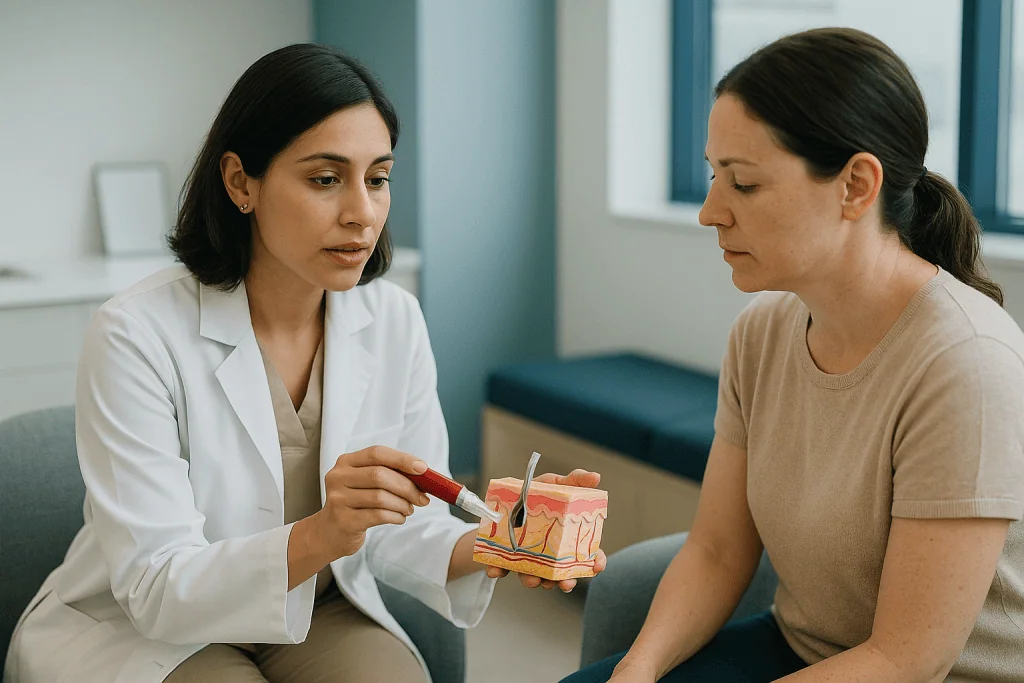
Microneedling punches thousands of channels through the top floor and a short distance into the ground floor. For facial rejuvenation, published reviews describe needle lengths in the range of roughly half a millimeter to one and a half millimeters, chosen to reach the upper dermis without cutting through it. Each channel is a micro-wound. The body treats it the way it treats any wound, in three overlapping phases: a brief inflammatory phase in which platelets and immune cells arrive, a proliferative phase in which fibroblasts multiply and start producing new collagen, and a remodeling phase in which that new collagen matures and reorganizes over the following weeks and months.
The key point is that the epidermis is perforated, not removed. Between the channels the surface stays intact, so the skin heals from thousands of points at once rather than from the edges of a larger wound. That is why downtime is measured in days rather than weeks, and why the risk of scarring or pigment change is lower than with treatments that strip the surface, such as deep chemical peels or ablative lasers.
Microneedling also temporarily makes the skin more permeable, which is why some practitioners apply a serum during or immediately after treatment. That step is optional and separate from the mechanical effect, a distinction that becomes important when the two procedures are compared later.
How mesotherapy works, and what gets injected
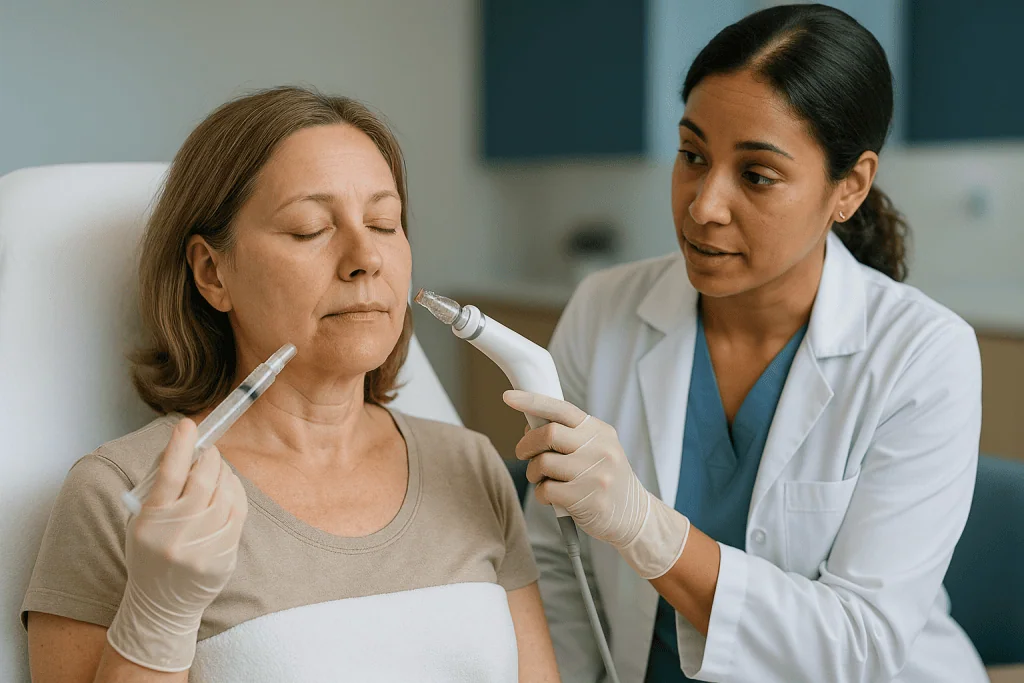
Mesotherapy relies on the injected substance rather than on the injury. A very fine needle, sometimes attached to a multi-needle head or a mechanized injector, deposits a small volume of solution into the superficial or mid dermis at intervals of a few millimeters across the treatment area. The theory is that placing active ingredients directly where fibroblasts live will hydrate the tissue, supply raw materials for repair, and stimulate collagen production more efficiently than a cream applied to the surface, which struggles to cross the epidermal barrier.
What is in the syringe is where certainty ends. Common components described in the literature include non-cross-linked hyaluronic acid, which draws water into tissue; vitamins such as C and members of the B group; amino acids; minerals; and, in some protocols, plant extracts or the person’s own platelet-rich plasma. Platelet-rich plasma, often shortened to PRP, is a concentrate of the platelets in your own blood, prepared by spinning a sample in a centrifuge. Combinations are chosen by the practitioner, mixed on site in many settings, and in most countries are not licensed as a single approved product for skin rejuvenation.
Two mechanisms are plausible and partially supported. Hyaluronic acid does hold water, so short-term plumping and hydration are biologically reasonable. The injections themselves are tiny wounds, so some of any benefit may come from the same collagen-induction pathway that microneedling uses, whether or not the ingredients add anything.
That second point is the intellectually honest problem with mesotherapy research. When a study shows improvement after injecting a vitamin cocktail, it is hard to know whether the cocktail did the work or the needles did. Well-designed trials would compare injections of the mixture with injections of saline through the same needles. Few have done so, and those that exist are small.
Microneedling vs mesotherapy for face: the side-by-side table
Laid out side by side, the two approaches separate cleanly on mechanism, evidence, and what you are agreeing to when you sit in the chair. The table below summarizes what mainstream sources describe; it is a guide to the conversation with your care team, not a substitute for it.
| Feature | Microneedling | Mesotherapy |
|---|---|---|
| Core idea | Controlled micro-injury triggers the skin’s own collagen production | Small injections deliver a chosen substance into the dermis |
| What goes into the skin | Nothing required; a serum or PRP may be added | Practitioner-selected mixture (hyaluronic acid, vitamins, amino acids, PRP, others) |
| Main evidence base | Multiple clinical studies and reviews, especially for acne scars and texture | Small studies and case series; findings mixed; no major guideline endorsement |
| Typical course | Several sessions weeks apart (Cleveland Clinic describes roughly four to six) | Series of sessions; schedules vary widely by protocol |
| Usual recovery | Redness and mild swelling for a few days | Redness, small bumps or bruises at injection points for a few days |
| Main risks | Infection, pigment change, scarring if too aggressive, reaction to applied products | Infection, allergy to ingredients, lumps, bruising, rare granulomas |
| Regulatory status of consumables | Devices regulated; needle cartridges single-use | Mixtures often compounded; combination usually unapproved as a product |
Notice what the table does not say. It does not name a winner. It shows that microneedling is a well-characterized procedure whose variables are needle depth, device quality, and operator skill, while mesotherapy carries an additional variable that is hard to evaluate: the contents of the syringe. If you like knowing exactly what you are getting, that difference alone may settle the question for you.
What does the evidence actually show for each?
Evidence grading matters more here than in most cosmetic conversations, because the two procedures sit at very different rungs of the ladder.
Microneedling has been studied in randomized and split-face trials, in which one side of a person’s face is treated and the other serves as the comparison. A widely cited review of the technique in the dermatology literature summarizes consistent improvements in atrophic acne scars, the pitted type left after inflamed acne heals, along with gains in skin texture and fine lines, and notes histological studies showing thicker dermis and more organized collagen after a treatment series. The Cleveland Clinic lists acne scars, fine lines, enlarged pores, uneven tone, and stretch marks among the conditions for which dermatologists use it. Results are typically described as modest and gradual rather than dramatic, and the quality of studies is uneven, with many being small. Still, the direction of findings is consistent across investigators, which is what gives clinicians confidence.
Mesotherapy for facial rejuvenation has a thinner record. Studies exist, some reporting improved hydration or elasticity measurements after a series of hyaluronic acid injections, but they tend to be small, short, and often lack a saline control that would separate the ingredient effect from the needle effect. Systematic reviews of the technique have generally concluded that the evidence is insufficient to establish efficacy for skin rejuvenation and have called for larger, better-designed trials. No major dermatology guideline recommends it.
The fair summary: microneedling is supported by moderate evidence for specific indications; mesotherapy is biologically plausible for short-term hydration but unproven for lasting rejuvenation. That does not make mesotherapy worthless, and it does not make microneedling a miracle. It means the two should not be presented as equivalent options, and any clinic that does so is skipping a step.
Who is each usually for, and who is usually asked to wait
Dermatologists tend to reach for microneedling when the complaint is about texture rather than volume. Rolling or boxcar acne scars, fine lines around the eyes and mouth, mild sun damage, enlarged pores, and some surgical or stretch-mark scars are the common reasons. It is used across skin tones, and because the epidermis is perforated rather than removed, the risk of post-inflammatory hyperpigmentation, the dark patches that can follow skin injury in people with more melanin, is lower than with many resurfacing lasers, though it is not zero.
Mesotherapy is more often offered for dullness, dryness, or a general desire for a hydrated look, and sometimes as maintenance between other treatments. Because it can be tailored, it appeals to people who want something described as personalized, though tailoring without controlled evidence is closer to experimentation than to precision.
Certain situations lead clinicians to advise waiting or to steer away from both procedures. Active acne with inflamed lesions, an active cold sore, eczema or psoriasis flaring in the treatment area, or any skin infection are reasons to postpone; needles can spread infection across the face. A history of keloids, the raised scars that grow beyond the original wound, is a caution for any needle-based treatment. People taking blood thinners bruise more and bleed longer, so the prescribing clinician should be involved before any injections; the medicine itself should never be stopped for a cosmetic appointment without that conversation. Recent use of oral isotretinoin, a retinoid for severe acne, has traditionally prompted a waiting period before resurfacing procedures, and your dermatologist will advise on timing.
Pregnancy and breastfeeding are usually reasons to defer, less because of proven harm than because safety has not been studied. For mesotherapy specifically, a known allergy to any component of the mixture, or an uncertain ingredient list, is a reason not to proceed at all.
Mesotherapy side effects and microneedling risks, compared honestly
Both procedures break the skin, so both carry the risks that come with any break in the skin: infection, bleeding, and inflammation. The differences lie in what else can go wrong.
Microneedling’s most common effects are expected rather than adverse: redness, warmth, tightness, mild swelling, and sometimes pinpoint bleeding during treatment. These settle over days. Less common problems include post-inflammatory hyperpigmentation, especially if the skin is exposed to sun before it has healed; small scabs or tracks if the device was dragged rather than stamped; and, rarely, scarring when treatments are too deep or too frequent. A specific microneedling hazard is the product applied afterward. Because the channels increase absorption, cosmetics not designed for broken skin have caused allergic and granulomatous reactions, in which the body walls off a foreign substance into a persistent lump. Reputable practitioners use only sterile, appropriately formulated products in the hours after treatment.
Mesotherapy shares the infection and bruising risks and adds ingredient risk. Allergic reactions to components of the mixture, lumps or nodules at injection sites, and granulomas have been reported. Because mixtures are often prepared in the clinic rather than manufactured as a single sterile product, contamination and inconsistent composition are additional concerns that microneedling does not carry. Case reports of atypical mycobacterial infections after mesotherapy, an unusual and stubborn type of skin infection, appear in the literature and usually trace back to non-sterile preparation or technique.
Neither procedure carries the systemic risks of a prescription medicine, but neither is trivial. The single most effective way to lower risk with either is to choose a licensed medical practitioner working in a clinical setting, using single-use needles, with a clear written list of every substance that will touch or enter your skin.
What happens during the appointment
Both appointments start the same way: a conversation about your goals, your skin history, current medicines, allergies, and any recent procedures. Photographs are usually taken. A numbing cream is applied and left to work, commonly for something like half an hour, so that the treatment itself is felt as pressure and vibration rather than sharp pain.
For microneedling, the skin is cleansed of the numbing cream and disinfected. The practitioner sets the needle depth on the device according to the area and the goal, shallower over thin skin such as the forehead and around the eyes, deeper over the cheeks where scars sit. The device is then passed over the skin in a systematic pattern. Most people describe the sensation as a fine sandpaper vibration, with some sensitivity over bone. Pinpoint bleeding is normal and is wiped away. A soothing product, such as plain hyaluronic acid serum or PRP if that was agreed, may be applied. The active part of the treatment typically takes well under an hour for the face.
Mesotherapy begins the same way, then proceeds as a grid of shallow injections a few millimeters apart, either by hand with a fine needle or with an injector device that delivers a set volume at each point. You feel a series of small pricks. Tiny raised blebs of fluid appear where the solution was placed and flatten over the following hours. The session is often shorter than microneedling, though this varies with the area treated.
Before either treatment, you should be told exactly which device, which depth, and, for mesotherapy, which ingredients will be used, and you should see the needle or cartridge being opened from sterile packaging. Asking is not rude; it is part of informed consent.
What the following days and weeks usually look like
The first evening after microneedling, most people look as though they have caught the sun. The skin is pink to red, warm, and tight. By the next morning the redness has usually faded to a flush; the Cleveland Clinic notes that most people can return to normal activities the following day while describing redness and mild swelling that can persist for a few days, up to about five in some accounts. Some flaking or dryness follows as the surface turns over. Makeup is usually held off for a day or so, and vigorous exercise, saunas, and swimming are avoided until the skin has closed, because sweat and pool water carry bacteria into open channels. Strict sun protection for at least a week is standard advice because freshly treated skin pigments easily.
The visible benefit does not arrive with the redness. New collagen is laid down over weeks and continues to mature for months; the published reviews describe the remodeling phase as extending well beyond the treatment series. People commonly report a smoother, brighter look within a few weeks, with changes in scar depth or fine lines becoming apparent after several sessions.
After mesotherapy, the injection points may show small bumps for a few hours and occasionally pinpoint bruises for several days. Redness is usually milder than after microneedling because far fewer punctures are made. Any hydration effect from hyaluronic acid is often noticed early and then fades, which is why maintenance sessions are typically proposed. Whether anything lasting is built underneath is the question the evidence has not answered.
With either treatment, the skin should be steadily improving from day two onward. Worsening redness, spreading warmth, pus, or increasing pain at any point is not part of normal recovery.
How many sessions, and how far apart?
Neither procedure is a one-and-done event, and any clinic implying otherwise is simplifying.
For microneedling, the Cleveland Clinic describes a typical course of roughly four to six treatments, with the number depending on the problem being treated and how the skin responds. Sessions are spaced weeks apart, commonly in the range of four to eight weeks in published protocols, because that is the window in which the previous round of collagen production is under way and the skin has fully recovered. Treating sooner does not accelerate results; it interrupts the remodeling phase and raises the risk of irritation and pigment change. Deeper concerns such as acne scars generally need more sessions than fine lines. Once a course is complete, some people return for a maintenance session once or twice a year, though the evidence for how long results persist is limited to follow-up periods of months in most studies.
Mesotherapy protocols are less standardized because the technique is not standardized. Series of several sessions at intervals of a few weeks are common in the studies that exist, sometimes followed by monthly or seasonal maintenance. The intervals reflect practitioner habit and the expected duration of hydration rather than a well-mapped biological timeline.
Two practical points follow. First, budget time as well as money: both treatments are a program, not a purchase, and a realistic plan spans months. Second, be wary of packages sold as a fixed number of sessions before anyone has seen how your skin responds to the first. A good practitioner reassesses after each treatment and adjusts, including deciding that a different approach altogether, such as a prescription retinoid or a laser, would serve you better.
Can you do microneedling and mesotherapy together? Microneedling with serum explained
People often ask whether the two can be combined, and the answer requires untangling two different practices that get the same label.
The first is microneedling with a serum applied during or immediately after the session. Because the micro-channels temporarily increase absorption, practitioners may apply hyaluronic acid, a vitamin C preparation, growth-factor products, or the person’s own PRP. Some clinics call this mesotherapy, some call it needle-assisted delivery, and some invent a brand-flavored name. Whatever the label, the mechanical microneedling effect is the well-supported part. The added product’s contribution is less certain and depends entirely on what it is. There is reasonable evidence that adding PRP to microneedling may modestly improve acne-scar outcomes compared with microneedling alone, drawn from small split-face studies; for most other topical additions the evidence is thin or absent. The safety concern is real: only sterile products formulated for compromised skin should be used, because ordinary cosmetics can trigger reactions when driven into the dermis.
The second practice is true injection mesotherapy performed in the same visit as, or in alternation with, microneedling. This combines two sets of skin injuries and two sets of risks, and there is no controlled evidence that the pairing outperforms microneedling alone. Sensible clinicians who do both tend to separate them in time so that if a reaction occurs, its cause is identifiable.
The question to ask is not whether they can be combined, but what the second component is adding and what evidence supports that addition. If the answer is a vague reference to nutrients, the honest position is that you are paying for a plausible idea layered onto a proven one.
Is 40 too old for microneedling? What age really changes
Forty is not too old for microneedling, and neither is sixty; the search-engine anxiety behind this question misunderstands what the procedure does and what age does.
What age changes is the balance between collagen breakdown and collagen production. MedlinePlus describes the dermis thinning with age, fibroblasts producing collagen more slowly, and elastic fibers losing their recoil, with sun exposure accelerating every one of those processes. Microneedling does not require youthful skin to work; it requires functioning fibroblasts that can respond to a wound signal, and those remain active throughout life. Wound healing does slow with age and with certain conditions, such as diabetes or smoking, so results may take longer to appear and the practitioner may space sessions more conservatively. Older skin is also thinner and more fragile, which argues for careful depth settings rather than for avoidance.
The more useful age-related question is about expectations. At twenty-five, microneedling is often used for acne scars, where the evidence is strongest. At forty-five or sixty-five, the concerns are usually fine lines, laxity, and sun damage. Microneedling can improve texture and fine lines, but it does not lift sagging tissue or restore lost volume; those are problems of fat and bone, not of surface collagen, and no needle procedure addresses them. Someone hoping a series of sessions will replace a facelift will be disappointed regardless of age.
Mesotherapy is likewise not age-limited, though the same ceiling applies. Dryness and dullness may respond to hydration for a time; structural change will not.
The realistic goal at any age is healthier-looking skin of your own age, not the erasure of the years. Framed that way, both procedures have a place, and the more evidence-backed of the two is the one to consider first.
What people often get wrong about mesotherapy vs microneedling
Several beliefs circulate so widely that they deserve individual correction.
They are basically the same thing. They are not. Microneedling is a mechanical stimulus; mesotherapy is a delivery method. One has a defined biological mechanism supported by multiple studies; the other has a plausible idea and small, inconsistent data.
Deeper needles mean better results. Depth is chosen to reach the upper dermis for the area and concern being treated. Going deeper than needed increases bleeding, downtime, and the risk of scarring and pigment change without a proportional gain in collagen. Skilled practitioners use the shallowest depth that reaches the target.
Home rollers do the same job. Home devices have very short needles that mostly affect the epidermis, are difficult to keep sterile, and are often reused. Reviews of the technique note that professional treatments use longer needles, single-use sterile cartridges, and controlled technique. Home rolling has caused infections and scarring when overdone.
Mesotherapy dissolves fat or lifts the face. Injection lipolysis, the use of injected agents to break down fat, is a separate technique with its own evidence and risks and is not skin rejuvenation. Neither mesotherapy nor microneedling lifts sagging tissue.
Results are permanent. Skin keeps aging and the sun keeps shining. Most studies follow people for months, not years, and maintenance is usually suggested.
Celebrities prove it works. Whether a particular actor uses microneedling is a question for entertainment magazines, not medical ones. A famous face is a marketing asset, not a clinical trial, and no responsible source comments on an individual’s medical care. What works for anyone is best judged by controlled studies and by a clinician who has examined your skin.
Is microneedling better than mesotherapy? How to weigh the choice
Asked directly, the evidence-based answer is that microneedling is the better-supported option for skin rejuvenation, and it is the one most dermatologists will discuss first for texture, fine lines, and scars. That is a statement about evidence quality, not a guarantee of outcome for any individual.
The reasoning runs like this. Microneedling’s mechanism is understood, its variables are few and controllable, its consumables are regulated medical devices, and its results, while modest, point consistently in the same direction across independent studies. Mesotherapy’s mechanism is partly borrowed from microneedling, its key variable is an unstandardized mixture, its consumables are often prepared on site, and its results are inconsistent and poorly controlled. When two options address the same goal and one has a clearer risk-benefit picture, the clearer one comes first.
That said, the honest opinion has caveats. Neither procedure competes with the basics. Daily broad-spectrum sunscreen prevents more collagen loss than any device restores, and a prescription retinoid has decades of evidence for fine lines and texture; the Mayo Clinic lists retinoids, laser resurfacing, chemical peels, and other options alongside newer techniques when discussing wrinkle treatment. A person who has never used sunscreen consistently will get more from that habit than from either needle.
Choose microneedling if your concern is scars, texture, or fine lines and you want a procedure whose evidence you can read. Approach mesotherapy as what it is: a plausible hydration treatment with unproven long-term benefit, acceptable if you understand that and are shown every ingredient. Approach anything combining the two with the same scrutiny applied to the added component.
Above all, let a licensed clinician who has examined your skin make the recommendation. The best choice is frequently a treatment neither screenshot showed.
Questions to ask your care team
A good consultation should leave you able to explain the plan to a skeptical friend. These questions help get there, and the quality of the answers tells you a great deal about the practitioner.
- What specific concern are you treating, and why is this procedure the right tool for it rather than a retinoid, a peel, or a laser?
- What is your training and license, and who will actually perform the treatment?
- For microneedling: which device, what needle depth for each area, and will I see a sealed single-use cartridge opened?
- For mesotherapy: can I have a written list of every ingredient, its source, and whether the combination is an approved product or mixed here?
- What is the evidence for this treatment for my concern, and how would you grade it?
- How many sessions do you anticipate, how far apart, and when will you reassess whether it is working?
- What are the most common side effects, the rare serious ones, and how do I reach you if something goes wrong after hours?
- Given my skin tone, is post-inflammatory hyperpigmentation a particular risk, and how will you minimize it?
- Are any of my current medicines or conditions a reason to wait? Should my prescribing doctor be consulted first?
- What exactly should I do, and avoid, in the first week?
- What would make you stop the series or recommend something else?
- Can I see before-and-after photographs of your own patients with concerns like mine, taken in the same lighting?
Notice that several of these questions are about the practitioner and the process rather than the procedure. That is deliberate. With both techniques, and especially with mesotherapy, the hands and the hygiene matter as much as the method. A practitioner who welcomes these questions is showing you the kind of care you can expect after the needles are put away.
When to call your doctor
Normal recovery after either procedure is a steady improvement: redness fading, tightness easing, any bumps flattening within a day or two. Anything moving in the opposite direction needs a call, first to the practitioner who treated you and, if you cannot reach them or symptoms are severe, to your primary care doctor or an urgent care service.
Contact your care team promptly if you notice any of the following:
- Redness, warmth, or swelling that spreads or intensifies after the second day rather than settling.
- Pus, yellow crusting, or fluid weeping from the treated area, or an area that becomes increasingly painful to touch.
- Fever, chills, or feeling generally unwell in the days after treatment.
- Clusters of small blisters, particularly around the mouth, which can signal a cold-sore flare spreading across treated skin.
- Firm lumps, nodules, or persistent bumps at injection or needling sites that do not soften over a week or two, or that appear weeks later.
- Hives, widespread itching, or swelling of the lips, tongue, or face, which suggest an allergic reaction to an applied or injected substance.
- Dark or light patches developing in the treated area as it heals.
- Any change in vision, severe headache, or symptoms that feel out of proportion to a skin procedure.
Call emergency services immediately for difficulty breathing, throat tightness, or rapidly spreading swelling, which are signs of a severe allergic reaction and are not something to wait out.
Keep the written record of what was used on your skin, including device settings and every ingredient in any mixture. If an infection or reaction does occur, that document allows the treating team to identify the cause and choose the right response without guesswork. Every decision about next steps, including whether to continue a treatment series, belongs to the clinicians who have examined you, informed by exactly that record.
Frequently asked questions
Who should avoid mesotherapy?
People with a known allergy to any ingredient in the proposed mixture, an active skin infection, cold sore, or inflamed acne in the area, a history of keloid scarring, or a bleeding disorder are usually advised against mesotherapy. Pregnancy and breastfeeding are typically reasons to defer because safety has not been studied. Anyone taking blood thinners should involve their prescribing clinician first and should never stop a medicine for a cosmetic appointment.
Is 40 too old for microneedling?
No. Microneedling depends on fibroblasts responding to a wound signal, and those cells remain active throughout adult life. Healing slows somewhat with age, smoking, or diabetes, so results may appear more gradually and a practitioner may space sessions conservatively. The realistic goal at any age is improved texture and fine lines, not the reversal of sagging or volume loss, which no needle-based procedure addresses.
Can you do microneedling and mesotherapy together?
They are often combined, most commonly as microneedling with a serum or platelet-rich plasma applied during the session. The mechanical microneedling effect is the well-supported part; the added product’s benefit depends on what it is, with modest evidence for PRP in acne scars and little for most other additions. Performing true injection mesotherapy in the same visit adds risk without controlled evidence of extra benefit.
Is microneedling better than mesotherapy for the face?
On current evidence, microneedling is the better-supported option for facial texture, fine lines, and acne scars, with multiple controlled studies and a clearly understood mechanism. Mesotherapy for facial rejuvenation rests on small, inconsistent studies and an unstandardized mixture. That makes microneedling the more defensible first choice, though the right recommendation depends on your skin and should come from a clinician who has examined you.
What are the most common mesotherapy side effects?
The most common effects are redness, small bumps at injection points that flatten within hours, and pinpoint bruising lasting several days. Less common problems include allergic reactions to ingredients, persistent lumps or nodules, granulomas, and skin infection, including rare atypical mycobacterial infections linked to non-sterile preparation. Asking for a full written ingredient list and confirming sterile, single-use needles lowers the risk.
Does Jennifer Aniston use microneedling?
Whether any particular celebrity uses microneedling is not something a medical source can or should confirm, and it would not change the evidence either way. A well-known face is a marketing tool, not a clinical trial. What matters for your skin is what controlled studies show for your specific concern and what a licensed clinician recommends after examining you.
How long does it take to see results from microneedling?
Redness settles within a few days, but the visible benefit comes later because new collagen is produced over weeks and continues to mature for months. Many people notice a smoother, brighter look within a few weeks of a session, while changes in scar depth or fine lines usually require the full series, which the Cleveland Clinic describes as roughly four to six treatments spaced weeks apart.
What does microneedling with serum actually add?
The micro-channels temporarily increase absorption, so a serum applied during treatment reaches the dermis more readily than it would on intact skin. Whether that helps depends on the serum. Plain hyaluronic acid soothes and hydrates; platelet-rich plasma has small studies suggesting modest extra benefit for acne scars; most other additions lack evidence. Only sterile products formulated for compromised skin should be used, because ordinary cosmetics can cause reactions.
Are at-home derma rollers as effective as clinic microneedling?
No. Home rollers use very short needles that mostly affect the epidermis, are hard to keep sterile, and are often reused, which invites infection and scarring. Clinic treatments use longer needles chosen for the area, single-use sterile cartridges, and controlled technique by a trained practitioner. Reviews of the technique describe professional treatment, not home rolling, as the basis for the published results.
Can microneedling or mesotherapy cause dark spots?
Both can trigger post-inflammatory hyperpigmentation, dark patches that follow skin injury, particularly in people with deeper skin tones or after sun exposure during healing. Microneedling carries a lower risk than treatments that remove the epidermis because the surface stays largely intact. Strict sun protection for at least a week afterward and conservative depth settings are the main safeguards, and any new patches should be reported to your practitioner.
References
This article is for general information only and is not a substitute for professional medical advice. Please consult a qualified doctor about your individual situation.

More from the Blog

Surface Reconstruction Recovery: Early Supervised Walking, Physical Therapy and Milestones
Surface reconstruction recovery after ocular surface surgery usually unfolds in stages: the corneal surface layer re-covers over days, comfort and light sensitivity settle over…

Before Aesthetic Filling: Blood Thinners, Alcohol and Supplements Your Doctor Will Review
Before dermal fillers, clinicians typically review anything that increases bruising or bleeding: prescribed anticoagulants and antiplatelet drugs, over-the-counter anti-inflammatory painkillers, supplements such as fish…

Reconstruction After Cancer or Infection: How Grafts, Flaps and Staged Surgery Are Planned
Reconstructive surgery after cancer or infection rebuilds tissue removed by a tumor operation or destroyed by infection, using skin grafts, flaps of tissue moved…

Why Hands Show Age Early: Volume Loss, Visible Veins and Sun Spots and How Each Is Treated
Hands show age early because their skin is thin, has very little fat beneath it, and spends decades in sunlight without protection. Over time…

Hand Rejuvenation Recovery: Swelling, Bruising and Why Heavy Hand Use Waits a Few Days
After hand filler, mild swelling, tenderness and some bruising across the back of the hand are common and typically ease over several days to…
Caring for the Donor Site After a Skin Graft: Dressings, Discomfort and How It Heals
Skin graft donor site care means keeping the area where skin was taken clean, covered and moist while new skin grows back from below.…