

Supporting a Family Member Through Cancer Treatment: Appointments, Nutrition and Rest
Key Takeaways
- A temperature of 100.4°F (38°C) or higher during chemotherapy is a call-now situation, according to the National Cancer Institute, because infection signs can be muted when white blood cells are low.
- White blood cell counts typically reach their lowest point 7 to 12 days after a chemotherapy dose, which is when visitors with colds and food hygiene matter most.
- Cancer-related fatigue is the most common treatment side effect and does not reliably improve with sleep; light activity approved by the care team is often associated with less tiredness, not more.
- Taste changes, not nausea, are the most frequent reason food goes uneaten during chemotherapy, and small cold meals with protein tend to be tolerated better than large hot ones.
- The NHS describes a typical chemotherapy course as around 3 to 6 months of cycles, each with a treatment period and a recovery period the team plans deliberately.
- The Cleveland Clinic lists irritability, disturbed sleep and getting sick more often as signs of caregiver burnout, and treats respite as part of care rather than a break from it.
Supporting a family member through cancer treatment usually means three practical jobs: being a second set of ears at appointments, keeping food and fluids going when taste and appetite change, and protecting rest without smothering. Add infection awareness, a fever threshold of 100.4°F (38°C) that always warrants a call, and steady attention to your own limits, and you cover most of what oncology teams ask caregivers to do.
The oncologist has been talking for eleven minutes, and your sister has heard about four words of it. You know this because she is nodding at the wrong moments, the way people do when the word ‘chemotherapy’ is still ringing in their ears. You are the one holding the pen. That is where supporting a family member through cancer treatment usually begins: not with a grand gesture, but with a notebook and the willingness to ask the doctor to say that again, slowly.
Most families arrive at this moment with no training. They learn on the job, in waiting rooms and kitchens, usually at night. The good news is that the parts that matter most are learnable, and they are less about medical expertise than about attention: noticing when the fridge is full but nothing gets eaten, when a nap turns into a whole afternoon, when a thermometer reading changes the plan.
This explainer walks through those jobs in order, appointments, nutrition and rest, with the evidence behind each, and with the boundaries a caregiver needs to keep in view.
What supporting a family member through cancer treatment actually involves
Strip away the fear and the word ‘caregiver’ describes a fairly concrete list. The National Cancer Institute, part of the NIH, groups a caregiver’s work into a handful of roles: attending appointments and keeping track of information, helping with medicines and side effects as directed by the care team, managing meals and household tasks, driving, and offering emotional company. Nobody does all of it, and nobody should try to.
Cancer treatment itself falls into a few broad types, and knowing which one your relative is receiving shapes what you will be doing. Chemotherapy is medicine that damages fast-dividing cells, cancer cells among them, and it is typically given in cycles: a treatment period followed by a rest period so healthy cells can recover. The NHS notes that a full course commonly runs about 3 to 6 months, though the treating team sets the actual plan. Radiotherapy uses focused high-energy beams on a specific area, often delivered in short daily sessions over several weeks. Surgery removes tissue and brings a recovery period of its own. Newer approaches, such as immunotherapy (treatment that helps the immune system recognise cancer) and targeted therapy (medicines aimed at specific features of cancer cells), have their own side-effect patterns.
Each of these creates a rhythm, and the rhythm is what a caregiver learns to read. Chemotherapy days are often long and oddly quiet; the harder days tend to arrive later in the week. Radiotherapy is brief per visit but relentless in its scheduling. Surgery front-loads the demand. Ask the team to sketch the expected pattern for your relative’s specific plan, then build your own calendar around it.
One more thing belongs in the definition. Supporting someone is not the same as taking over. The person with cancer remains the decision-maker about their own body, their information and their days. Your job is to make those decisions easier to make, not to make them.
Who usually takes on the caregiver role, and who is asked to step back
In most families the role settles on whoever lives closest, has the most flexible hours, or simply spoke first. That is understandable and often works, but it is worth pausing on who is actually well placed to help, and who might, kindly, be asked to help differently.
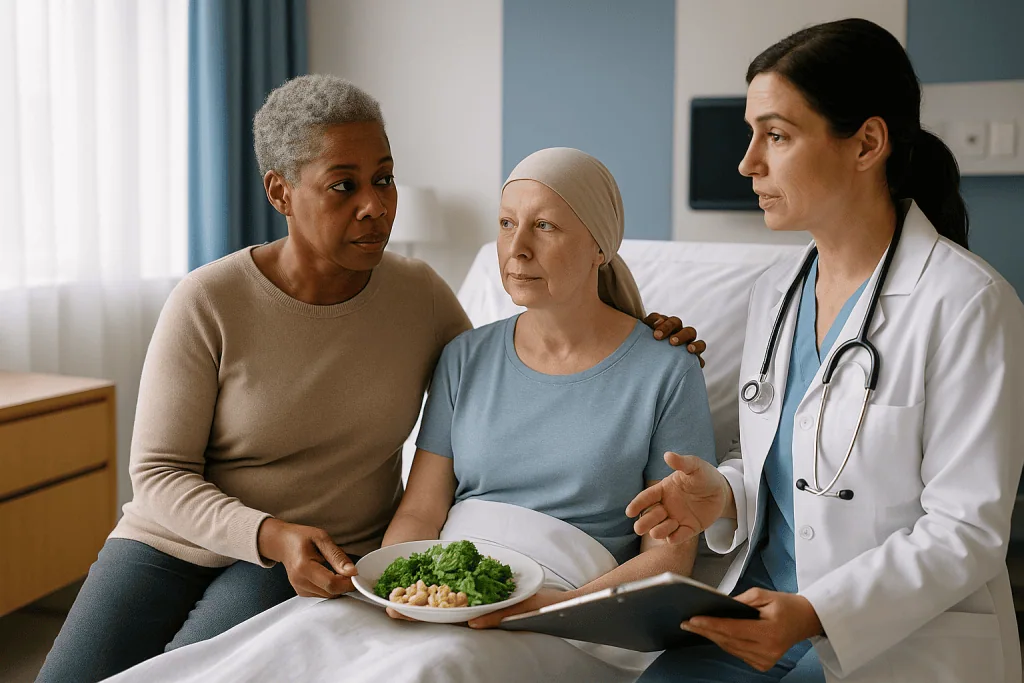
The people best suited to appointment support are those who can stay calm while hearing difficult information, write clearly, and hold back their own opinions until the patient has spoken. The people best suited to nutrition support are those who can cook plain food without taking a refused plate personally. Rest protection suits someone who can say ‘not today’ to well-meaning visitors without guilt. These are different skills, and splitting them among two or three relatives is often steadier than loading one person.
Some family members are usually asked to step back from close contact for a time, not from caring. Anyone with a cold, flu, a stomach bug, a cough, or a recent shingles rash should keep their distance during the weeks when the patient’s white blood cells (the infection-fighting cells) are low, because the NCI describes infection as one of the more serious risks of chemotherapy. Small children who attend daycare are frequent carriers of ordinary viruses; the care team can advise on visits. People who have just received a live vaccine may also be asked to wait; the oncology team will say which ones matter.
The other person who sometimes needs to step back is the exhausted primary caregiver. The Cleveland Clinic describes caregiver burnout as a state of physical, emotional and mental exhaustion that can come with irritability, sleep problems and withdrawal. Stepping back for a weekend is not abandonment; it is maintenance.
Finally, the patient themselves gets a say in who is in the room. Some people want a crowd. Some want one trusted face. Ask, and then honor the answer even when it is not you.
How to help someone with cancer at appointments: the second set of ears
Studies of clinic visits consistently find that patients remember only a fraction of what is said, especially after distressing news. The NCI encourages caregivers to come to appointments, take notes and ask questions for exactly this reason. Your presence changes what the visit yields.
Before the visit, sit down together and write the top three questions. Three, not fifteen; the rest can go in a follow-up message through the patient portal if the team offers one. Bring an up-to-date list of every medicine and supplement, including over-the-counter products, because some interact with cancer treatment. Bring the notebook from last time so you can check what changed.
During the visit, your task is to listen and record, not to conduct. Write down names of medicines, the reason for each, the expected timeline, and who to call about what. When a term goes past too fast, ask ‘Can you spell that for me?’ It is a gentle way to slow the room down and it signals to your relative that questions are allowed. If the doctor turns toward you and starts answering questions the patient asked, redirect gently: ‘I think she wanted to hear that.’
Ask about the practical logistics that rarely make it into the discharge summary: which side effects are expected and which are urgent, the after-hours number, whether the next scan needs fasting, and how results will be shared.
After the visit, read the notes back together in the car or at home. Mistakes in memory show up fast when two people compare. Then send yourself one message with the three things that actually changed, because in a week you will not remember which visit was which.
One caution: never adjust, skip or add medicines based on something you read or heard from another family. The prescribing clinician makes those calls, and the notebook is where you write down the question for them.
What are the needs of cancer patients during treatment?
People searching this question are usually hoping for a list, and lists help, provided they stay flexible. Needs shift from week to week, and the patient is the authority on which ones matter today. The table below groups the common categories described by the NCI and NHS caregiver resources, with the kind of help that tends to land well.
| Need | What it looks like | Practical help that usually fits |
|---|---|---|
| Information | Understanding the plan, the timeline and what to expect | Notes at appointments; one shared document; questions written in advance |
| Physical comfort | Managing fatigue, nausea, mouth soreness, pain | Reporting symptoms accurately to the team; quiet space; small frequent meals |
| Nutrition and hydration | Eating enough when taste or appetite change | Cook-what-works approach; fluids within reach; no pressure at the table |
| Practical logistics | Transport, childcare, bills, work paperwork | A shared calendar; delegating to other relatives; asking the team about social work support |
| Emotional company | Someone to sit with, not to fix things | Listening; normal conversation; permission to talk about anything other than cancer |
| Control and dignity | Making their own decisions about body, information and time | Asking before acting; keeping the patient in the lead at appointments |
Notice how much of the right-hand column is about restraint. The instinct to do more is strong, and it can crowd out the thing most people with cancer describe wanting: to still be treated as a competent adult who happens to be unwell.
Needs also change with the phase of treatment. Early on, information dominates. In the middle, physical comfort and food take over. Toward the end and afterward, emotional needs often rise just as practical help falls away, because relatives assume the hard part is over. Keep checking in past the last infusion.
Cancer patient nutrition during chemo: what helps when food tastes wrong
The most common kitchen complaint is not nausea; it is that everything tastes like cardboard, metal or nothing at all. The NCI’s eating guidance lists taste changes, appetite loss, dry or sore mouth and nausea among the frequent effects of treatment, and the NHS describes the same cluster for chemotherapy. Your relative is not being difficult when they push the plate away. Their tongue has changed.
Several practical approaches appear across the NCI and NHS material. Small, frequent meals tend to be easier than three large ones. Cold or room-temperature foods often smell less and are better tolerated on queasy days. Plastic utensils can reduce a metallic taste for some people. Tart flavors, such as lemon or a marinade, sometimes cut through blandness, while a sore mouth calls for the opposite: soft, mild, not acidic. Protein matters because the body is repairing tissue; eggs, yogurt, beans, soft fish, smoothies and nut butters are typical suggestions. Fluids count as intake too, and keeping a drink within arm’s reach all day is one of the easiest wins.
Food safety deserves its own line. While white blood cell counts are low, the NCI advises careful hand hygiene, thorough cooking of meat and eggs, and washing produce well. Ask the team whether any specific restrictions apply.
Anti-nausea medicines, a class called antiemetics, work by blocking signals in the gut and brain that trigger vomiting. They are usually prescribed to a schedule around treatment days, and the prescribing clinician decides which ones and when. If nausea is not controlled, that is a report for the team, not a reason to skip meals.
What does not help: pressure. A caregiver who watches every mouthful turns eating into a test. Put food out, make it easy, then talk about something else. Ask the team for a referral to a dietitian if weight is dropping or eating has become a daily battle; many oncology services have one.
Why rest matters more than it looks, and how to protect it
Cancer-related fatigue is not ordinary tiredness, and this is the single most misunderstood part of treatment for many families. The NCI describes it as the most common side effect of cancer treatment, and both NCI and Mayo Clinic note that it does not reliably improve with sleep, can arrive suddenly, and may persist for weeks or months after treatment ends. A patient who slept ten hours and still cannot climb the stairs is not lazy; the body is spending energy on repair, inflammation and the treatment itself.
Protecting rest starts with the calendar. Ask the team when the hardest days in each cycle tend to fall, and keep those days empty. Visitors, however loving, cost energy. A caregiver who screens calls and gently reschedules the neighbor is doing real work.
Rest is not the same as bed rest, though. Mayo Clinic and the NCI both point out that light physical activity, such as a short walk, is often associated with less fatigue rather than more, when the care team agrees it is safe. The pattern that tends to help is pacing: short bouts of activity, planned rests, and saving energy for the things that matter to the person, whether that is a grandchild’s visit or a shower without help.
Sleep hygiene basics apply: a consistent bedtime, a dark quiet room, limited daytime naps if nighttime sleep is suffering, and screens out of the bedroom. Fatigue can also be driven by things the team can address, including anemia (a low red blood cell count), pain, poor sleep, low mood and some medicines. If fatigue is worsening or out of proportion, report it; it is a symptom, not a personality trait.
The caregiver’s own rest belongs here too. You cannot protect someone’s sleep on four hours of your own. Trade nights with another relative where you can.
What the first weeks of treatment usually look like
Timelines vary by cancer type, regimen and person, and the treating team’s version always outranks this one. Still, a rough map helps families plan.
The first appointment after diagnosis is usually about staging (finding out how far the cancer has spread) and the treatment plan. Expect scans, blood tests and sometimes a biopsy, which is the removal of a small tissue sample for examination. Many people describe this stretch as the most anxious, because the waiting is heavy and the doing has not started.
Once treatment begins, chemotherapy follows its cycle. Treatment day itself is often uneventful beyond the length of the visit. The NHS notes that side effects such as nausea and fatigue commonly build over the following days. The NCI states that white blood cell counts typically reach their lowest point 7 to 12 days after a chemotherapy dose, which is when infection risk peaks and when caregivers should be most watchful about fever and visitors. Counts then recover before the next cycle, which is why cycles are spaced the way they are.
Hair loss, if the regimen causes it, usually begins within a few weeks of the first treatment according to the NHS, and hair typically regrows after treatment ends. Knowing this in advance lets your relative decide about a haircut, a scarf or nothing at all on their own terms.
Radiotherapy tends to bring skin changes and fatigue that accumulate across the course rather than spiking after each session. Surgical recovery is front-loaded, with pain and mobility limits improving over days to weeks depending on the operation.
By the second or third cycle, most families report that they know the shape of the week: which days need a driver, which days need soup, which days need silence. That predictability is a real comfort, and it is worth telling a newly diagnosed relative that it will come.
Infection risk: the everyday habits that matter most
If a caregiver learns only one medical fact, it should be this one: during chemotherapy, a fever can be an emergency. The NCI’s guidance on infection and neutropenia (neutropenia is a low count of neutrophils, the white blood cells that fight bacteria) is that a temperature of 100.4°F (38°C) or higher warrants an immediate call to the care team, day or night, and that the usual signs of infection may be muted because the immune response is weakened. That means you cannot wait for someone to look sick.
Buy a reliable thermometer and agree on a rule: any chills, shivering, feeling ‘off’, or a reading at or above the threshold triggers the after-hours number. Write that number on the fridge. Do not give fever reducers before calling unless the team has said so, because they can mask the very sign the team needs to know about; the clinician will guide what to take.
Everyday habits reduce exposure. Hand-washing before food, after the bathroom and when coming in from outside is the single most effective step in the NCI and CDC guidance. Keep visitors with any symptoms away, particularly in the 7 to 12 day window after treatment when counts are lowest. Cook meat and eggs thoroughly, wash produce, and avoid unpasteurized products unless the team says otherwise. Pet care can continue, but litter boxes, bird cages and reptile tanks are usually tasks for someone else during low-count periods; ask the team.
Watch for the quieter signs the NCI lists: a new cough, burning when urinating, redness or swelling around a catheter or port (a port is a small device placed under the skin so medicines can be given into a vein), mouth sores, diarrhea, or sudden confusion. Any of these earn a call, not a wait-and-see.
None of this requires a sterile house. It requires a thermometer, soap, and the confidence to phone the team without apologizing.
What to say to someone with cancer, and what to skip
Most people who get this wrong are not unkind. They are frightened, and fear tends to come out as advice, comparison or forced cheer. A few patterns show up again and again in the NCI’s guidance for family and friends, and in what patients themselves report.
What tends to land well is specific and modest. ‘I’m bringing dinner Thursday, do you want soup or something you can freeze?’ works better than ‘Let me know if you need anything,’ which places the burden of asking on the person with the least energy. ‘I don’t know what to say, but I’m here’ is honest and welcome. ‘Do you want to talk about it or would you rather hear about my terrible week?’ hands over control, which is the thing illness takes away first.
What tends to sting: stories about someone else’s cancer, especially their outcome in either direction; unsolicited nutrition or supplement theories; ‘stay positive,’ which quietly implies that mood determines results, a claim the evidence does not support; and ‘you look great,’ which can feel like an instruction to keep looking that way. Questions about prognosis are the patient’s to raise, not yours.
Silence is underrated. Sitting in a chemotherapy suite doing a crossword together is support. So is talking about football, a television series, or the neighbor’s fence. People with cancer routinely say they miss being treated as a whole person with interests, opinions and a sense of humor.
For the caregiver, the words that matter most are often the ones said to the care team. Report symptoms plainly, including the ones your relative downplays. ‘She says the pain is fine but she hasn’t sat down without wincing in three days’ is exactly the kind of observation a clinician needs, delivered respectfully and with the patient’s knowledge.
When to share a cancer diagnosis, and who decides
The short answer is that the person with cancer decides, and their timing is right by definition. Caregivers are often the ones fielding the question, though, because relatives and friends sense something and start asking. Having a plan reduces the pressure.
The NCI’s material on talking with others about cancer makes a few practical points. People differ in how much they want known and by whom; some want the whole network informed at once, others want a small inner circle until the plan is clear. Both are reasonable. Sharing tends to be easier once the basics are known: what type, what treatment, roughly what timeline. Without those, every conversation invites speculation the patient cannot yet answer.
A useful step is to agree together on a one-line message that anyone in the inner circle can repeat. Something like: ‘She’s been diagnosed with breast cancer, treatment starts soon, she’ll share more when she’s ready, and the best help right now is meals on Tuesdays.’ It ends the guessing and gives people a job.
Children need age-appropriate honesty. Cancer charities and the NCI advise using the real word, explaining what will change in daily routine, and reassuring children that nothing they did caused it. Secrets tend to leak, and children who sense something hidden often imagine worse.
Workplaces are a separate decision with legal dimensions that vary by country and employer. The patient, not the caregiver, should control what the employer knows, and the care team can usually advise on paperwork.
The caregiver’s own disclosure matters too. You may need to tell your employer or friends why you are distracted or absent. That is your information to share, within whatever boundary your relative has set about details.
Cancer caregiver tips for looking after yourself without guilt
Caregivers routinely list their own needs last, and the evidence says that is a mistake with consequences for both people. The Cleveland Clinic describes caregiver burnout as exhaustion that can bring irritability, sleep disturbance, changes in appetite, loss of interest in things once enjoyed, and getting sick more often. The NCI adds that caregivers who neglect their own health tend to become less able to provide the care they intend to.
The first tip is structural: do not be the only one. Make a list of concrete tasks, from driving to pharmacy pickups to lawn-mowing, and assign them. People who say ‘let me know if I can help’ generally mean it; they need a specific ask. A shared online calendar or a simple group text keeps this from becoming a second job.
The second is to keep one appointment that is yours. Your own doctor, your own dentist, your own walk on Sunday morning. Cancelling these once is understandable; cancelling them for six months is how burnout arrives.
Third, notice your own warning signs. Snapping at the person you love, dreading the drive to the clinic, sleeping badly, a drink that has become two: these are signals, not failures. Talk to your own primary care clinician, ask the oncology team whether they have a social worker or caregiver support program, and consider a caregiver group, in person or online. The NCI and MedlinePlus both list support resources for caregivers.
Fourth, allow the feelings you are not supposed to have. Resentment, boredom and grief all visit caregivers, and none of them make you a bad one. Naming them to a friend or counselor takes their charge away.
Finally, remember that respite is care. A family member who covers a weekend so you can sleep is contributing to your relative’s treatment as surely as the person who drives to chemotherapy.
What people often get wrong about supporting a family member through cancer treatment
Some myths are harmless. Others cost sleep, money or safety. These are the ones oncology nurses tend to correct most often.
‘Sugar feeds cancer, so cut it out.’ All cells use glucose, including cancer cells, but there is no evidence that a person eating less sugar starves a tumor. The NCI’s eating guidance emphasizes getting enough calories and protein during treatment; severe restriction can worsen weight loss and fatigue. Ask the dietitian before changing the diet.
‘Rest means staying in bed.’ Mayo Clinic and the NCI both describe light activity as generally associated with less fatigue, when the care team agrees. Prolonged bed rest weakens muscles and can make the tiredness worse.
‘A positive attitude improves outcomes.’ Mood matters for quality of life, and low mood deserves support. There is no good evidence that optimism changes tumor behavior, and telling someone to stay positive can add a burden of self-blame on bad days.
‘Supplements are natural, so they are safe alongside treatment.’ Some herbal and high-dose vitamin products can interact with chemotherapy or affect how the liver processes medicines. The NIH Office of Dietary Supplements and the NCI both advise disclosing every supplement to the team before taking it, and never treating a supplement as a substitute for prescribed treatment.
‘The hard part ends with the last treatment.’ The NCI notes that fatigue and emotional effects often linger for months, and many people describe the period after treatment as unexpectedly difficult because support drops away. Keep showing up.
‘Good caregivers don’t need help.’ The Cleveland Clinic’s description of burnout says otherwise. Accepting help is a skill, not a weakness.
‘If I research enough, I can find the treatment the doctors missed.’ Reading is fine; bring what you find to the team as questions. Acting on it alone is where harm happens.
Questions to ask your care team
A well-chosen question does more than gather facts. It tells the team what your family is worried about, which shapes the support they offer. Take this list to the next visit, cross out what does not apply, and let the patient lead.
- What is the goal of this treatment, in plain words, and how will we know whether it is working?
- Which side effects should we expect in the first week, and which ones mean we should call immediately?
- What is the after-hours number, and what should we say when we call?
- On which days of each cycle is infection risk highest, and how should visitors and food change on those days?
- Is there anything my relative should not eat or drink during treatment? Are there any supplements or medicines we should stop or avoid?
- Is light exercise safe right now, and is there a referral to physiotherapy or a fatigue program?
- Can we see a dietitian, and when would weight loss become a concern?
- What does ‘normal’ pain or nausea look like, and at what point is it not being controlled well enough?
- Who on the team should we contact for emotional support, practical help or paperwork?
- How will results be shared, and can a family member be listed as a contact if the patient wishes?
- What is the plan if treatment needs to be delayed because of blood counts or infection?
- What kind of follow-up happens after treatment ends, and how long does recovery from fatigue typically take for this regimen?
One practical habit: ask the team to name the single most important thing to watch for between now and the next visit. Most clinicians have an immediate answer, and it cuts through the noise.
The answers to every one of these questions belong to the treating team. This article can tell you what to ask; it cannot tell you what they will say, because the right answer depends on the person in the chair.
When to call your doctor
Caregivers often hesitate to phone because they do not want to be a nuisance. Oncology teams say the opposite: a call about a fever at two in the morning is exactly what the after-hours line exists for, and a delayed call is the thing they worry about. Use the number the team gave you, and if you cannot reach anyone and the situation feels urgent, go to emergency care.
Call the care team immediately, at any hour, for any of the following, based on NCI and NHS guidance:
- A temperature of 100.4°F (38°C) or higher, or shaking chills, even without a high reading.
- Difficulty breathing, chest pain, or a new fast heartbeat.
- Sudden confusion, unusual drowsiness, a severe headache, or fainting.
- Uncontrolled vomiting or diarrhea, or an inability to keep fluids down for more than a few hours, since dehydration can become serious quickly.
- Bleeding that does not stop, black or bloody stools, or unexplained bruising.
- Redness, swelling, pain or discharge around a port, catheter or surgical wound.
- New severe pain, or pain that the prescribed plan is no longer controlling.
- Signs of an allergic reaction after a new medicine, such as a rash with swelling of the lips or face.
Call during working hours, without waiting for the next appointment, for mouth sores that make eating difficult, a persistent cough, burning on urination, weight loss the team has not seen, new numbness or tingling in hands or feet, or low mood that is lasting or includes thoughts of not wanting to be alive.
Caregivers have their own thresholds. If you notice in yourself persistent sleeplessness, chest tightness, hopelessness or thoughts of harming yourself, speak to your own doctor promptly. Supporting someone through cancer treatment is a long road, and you are allowed to need care on it too.
Frequently asked questions
How to help someone going through cancer treatment?
Start with three jobs: be a second set of ears at appointments, keep easy food and fluids within reach, and protect rest by screening visitors on the hard days. Learn the fever threshold the team gives you, usually 100.4°F (38°C), and keep the after-hours number on the fridge. Offer specific help rather than open-ended offers, and let the person with cancer keep making their own decisions.
Can life go back to normal after cancer?
Many people return to work, travel and daily routines after treatment, but the National Cancer Institute notes that fatigue and emotional effects can linger for months, and some people describe a ‘new normal’ rather than a return to the old one. Follow-up appointments continue for years in most plans. Support that carries on past the final treatment often matters more than families expect, because that is when outside help tends to fall away.
When to share a cancer diagnosis?
The person with cancer decides, and their timing is right by definition. Sharing tends to be easier once the basics are known, such as the type of cancer, the treatment and a rough timeline, because that answers the questions people will ask. Agreeing on a short message the inner circle can repeat reduces pressure. Children generally do better with age-appropriate honesty than with secrecy.
What are the needs of cancer patients during treatment?
Needs typically fall into six areas: clear information, physical comfort, nutrition and hydration, practical logistics such as transport and paperwork, emotional company, and control over their own decisions. The balance shifts across treatment, with information dominating early, physical needs in the middle, and emotional support rising afterward. The patient is the authority on which need matters on any given day.
What to say to someone with cancer when you don't know what to say?
Honesty works: ‘I don’t know what to say, but I’m here’ is welcome. Specific offers, such as bringing dinner on a named day, land better than ‘let me know if you need anything.’ Avoid stories about other people’s cancer, unsolicited diet advice and ‘stay positive,’ which can imply that mood controls results. Ordinary conversation about anything other than cancer is often the most valued thing you can offer.
What is good cancer patient nutrition during chemo?
The National Cancer Institute’s eating guidance emphasizes enough calories and protein, small frequent meals, and adapting to taste changes with cold foods, tart flavors or plastic utensils if a metallic taste is a problem. Fluids count as intake. Food safety matters while white blood cells are low: cook meat and eggs thoroughly and wash produce. Ask the team for a dietitian referral if weight is falling.
Why is my family member so tired during cancer treatment even after sleeping?
Cancer-related fatigue is different from ordinary tiredness. The NCI describes it as the most common side effect of treatment, and it does not reliably improve with sleep because the body is spending energy on repair, inflammation and the effects of treatment itself. Anemia, pain, low mood and some medicines can add to it. Report worsening fatigue to the team, since some of its causes are treatable.
What are the best cancer caregiver tips for avoiding burnout?
Do not be the only one: assign concrete tasks to other people using a shared calendar. Keep one appointment that is yours each week. Watch for the Cleveland Clinic’s warning signs of caregiver burnout, including irritability, poor sleep and frequent illness. Ask the oncology team about a social worker or caregiver program, and treat respite as part of your relative’s care rather than a break from it.
Should visitors stay away during chemotherapy?
Not all visitors, but anyone with a cold, cough, stomach bug or recent rash should keep their distance, especially in the 7 to 12 days after a chemotherapy dose when the NCI says white blood cell counts are typically lowest. Healthy visitors who wash their hands are usually fine, though the patient’s energy, not just infection risk, decides how many and how long. Ask the care team about specific restrictions.
Can I give a fever reducer before calling the cancer team?
Call first unless the team has already told you otherwise. Fever-reducing medicines can mask the very sign the team needs to assess, and during chemotherapy a temperature of 100.4°F (38°C) or higher may indicate a serious infection. The clinician on the phone will tell you what to give, whether to come in, and what to watch for next. Never adjust medicines based on advice from outside the care team.
References
This article is for general information only and is not a substitute for professional medical advice. Please consult a qualified doctor about your individual situation.

More from the Blog

Mohs Surgery Recovery: Pressure Dressing, Stitches and the First Two Weeks of Wound Care
Mohs surgery recovery usually begins with a firm pressure dressing worn for about one to two days, followed by daily gentle cleaning, ointment and…

Why Genetic and Molecular Testing Comes First in Acute Myelogenous Leukemia Treatment
Genetic and molecular testing comes first in acute myelogenous leukemia because the chromosome changes and gene mutations found in the leukemia cells decide which…
Why a Dental Check Comes Before IMRT for Head and Neck Cancer
A dental check comes before IMRT for head and neck cancer because radiation permanently reduces the jawbone's blood supply and its ability to heal.…
Why Immunotherapy Side Effects Can Look Like an Infection: What the Care Team Checks
Immunotherapy side effects can look like an infection because both are driven by inflammation, so fever, cough, diarrhea, and fatigue overlap. Immune related adverse…
Rebuilding Strength After Acute Myeloid Leukemia Treatment: Nutrition, Activity and Rest
Recovery after AML treatment usually unfolds over months, not weeks, as the bone marrow slowly rebuilds normal blood cells. Evidence supports three anchors: regular…

HIPEC Recovery in Hospital: Pain Control, Bowel Recovery, Walking and Returning to Eating
HIPEC recovery in hospital usually means one to two weeks after the operation, often starting with a planned night or two in intensive care.…