

Who Is a Candidate for LASIK? Corneal Thickness, Stable Prescription and Eye Pressure
Key Takeaways
- Surgeons plan LASIK around the residual stromal bed, the tissue left beneath the flap after treatment, not the cornea's starting thickness alone.
- A higher prescription removes more tissue, so a thick cornea with a very high prescription can be a poorer LASIK fit than a thinner cornea with a mild one.
- Mayo Clinic advises a prescription stable for at least a year, and the NHS about two years, before laser eye surgery is considered.
- LASIK thins the central cornea, which makes standard eye pressure tests read falsely low for life, so every future eye doctor needs to know you had it.
- Keratoconus, even in subtle early forms visible only on corneal tomography, is a firm reason not to proceed with LASIK.
- Mayo Clinic notes that dryness commonly lasts about 6 months after LASIK while corneal nerves regrow, and vision typically settles over 2 to 3 months.
A typical LASIK candidate is an adult whose glasses or contact lens prescription has stayed stable for at least a year, whose cornea is thick enough to leave a safe reserve of tissue after reshaping, whose eye pressure is normal with no glaucoma, and whose eyes are free of keratoconus, severe dry eye or active disease. Only a full measured eye examination by a surgeon can confirm this.
The consultation room is dim, the chin rest still warm from the last patient, and a technician is reading numbers off a screen that mean nothing to you yet. You came in wanting one thing: to wake up and read the alarm clock without fumbling for glasses. What you hear instead is the phrase every LASIK candidate meets sooner or later: corneal thickness.
It feels like an odd place to start. Nobody chooses their cornea, and most people have never wondered how thick it is. Yet that single measurement, together with two others you can partly influence, a stable prescription and healthy eye pressure, does more to decide whether laser surgery is sensible for you than anything printed on a brochure.
This guide walks through what those three measurements mean, why surgeons weigh them the way they do, who is usually told yes, who is asked to wait, and what the honest alternatives look like when the answer is no.
Why corneal thickness matters so much for a LASIK candidate
The cornea is the clear, dome-shaped window at the front of the eye, and it does most of the eye’s focusing work. LASIK changes vision by reshaping it: a laser removes a precise sliver of tissue from the middle layer so that light lands on the retina instead of in front of or behind it. Every diopter of correction costs tissue. A diopter is the unit that describes the strength of a lens, and therefore the size of a prescription. The bigger the prescription, the more tissue must go, and the more the starting thickness of the cornea matters.
That is why a LASIK candidate’s corneal thickness is measured before anything else is discussed. A healthy adult cornea is a little over half a millimeter thick at the center, roughly a credit card, according to Cleveland Clinic. Surgeons measure it in microns, where one micron is one thousandth of a millimeter. The flap that is lifted and the tissue the laser removes both come out of that budget, and a firm amount must stay untouched underneath so the cornea keeps its shape against the pressure inside the eye.
Cut into that reserve and the risk is ectasia, a slow forward bulging of a weakened cornea that distorts vision and is difficult to treat. It is uncommon, but it is the complication surgeons plan hardest to avoid, and thickness is the first line of defense. Thickness alone does not settle the question. A cornea can be numerically adequate yet structurally irregular, which is why the number is always read alongside a map of the cornea’s shape. Still, if one measurement sorts people into “likely yes”, “maybe with a different procedure” and “please do not”, it is this one.
How LASIK works: what actually happens in the laser room
Picture a procedure that is over before the numbing drops wear off. Mayo Clinic puts the whole visit to the laser room at about 30 minutes or less, with the laser itself working for well under a minute per eye. You lie back, a small device holds the eyelids open, and a suction ring steadies the eye. One of two tools then creates the flap: a fine mechanical blade, or a femtosecond laser, which fires ultra-short pulses that separate tissue without cutting through it. The flap is a thin hinged layer of the corneal surface, folded back like the cover of a book.
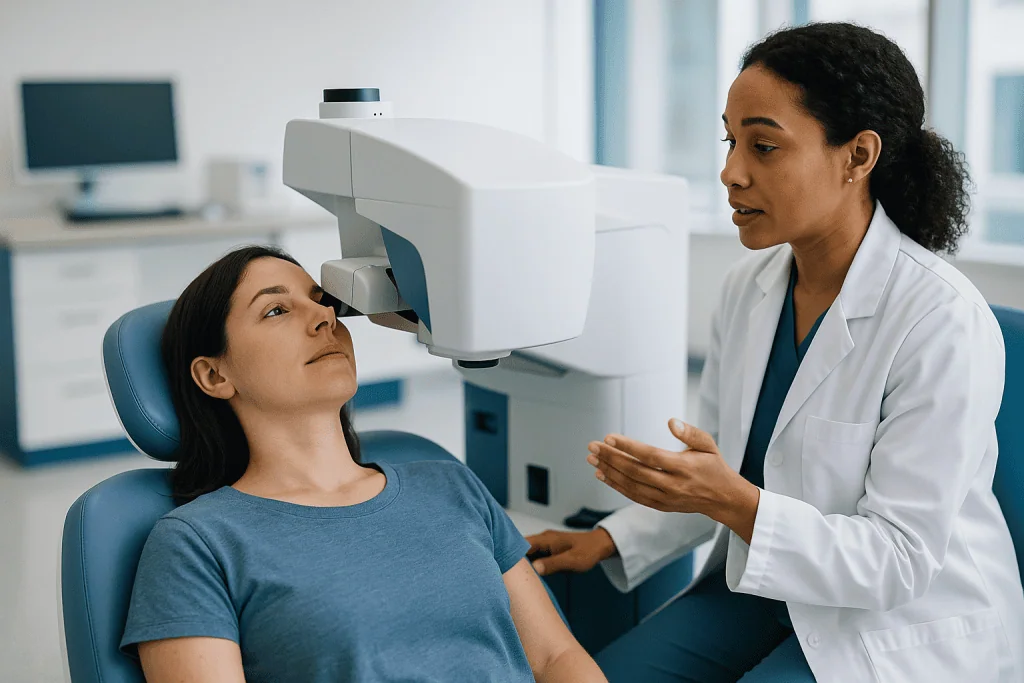
Underneath sits the stroma, the thick middle layer that makes up most of the cornea. An excimer laser, a cool ultraviolet laser that vaporizes tissue a fraction of a micron at a time, sculpts the stroma according to a map built from your measurements. For nearsightedness it flattens the center. For farsightedness it steepens the center by removing a ring of tissue toward the edge. For astigmatism, where the cornea is shaped more like a rugby ball than a soccer ball, it evens out the curve. A tracker follows tiny eye movements and pauses the laser if you look away.
The flap is laid back down and settles without stitches; the cornea’s own pumping cells pull it flat within minutes. Most people notice gritty, watery, light-sensitive eyes for a few hours and see noticeably better the next morning, though Mayo Clinic notes that vision can take 2 to 3 months to settle completely. The flap is the reason thickness matters. Its tissue is not removed, but it no longer contributes full strength, so the layer beneath it carries the load. That is where the arithmetic in the next section begins.
How thick does the cornea need to be for LASIK? The minimum corneal thickness question
People search for one number: the minimum corneal thickness for LASIK. Surgeons think about two. The first is total central thickness before surgery. The second, and the one that matters more, is the residual stromal bed: the untouched tissue left beneath the flap after the laser has finished. That leftover must stay thick enough to hold its shape for the rest of your life.
The calculation is simple once you see the pieces. Start with your measured thickness. Subtract the planned flap. Subtract the tissue the laser must remove, which scales with the size of your prescription and the width of the treatment zone. What remains is the residual bed. Surgeons set a floor for that figure from professional consensus plus their own margin of safety, and a candidate falls below it in two common ways: a cornea that is thinner than average to begin with, or a prescription so large that the laser would carve too deeply into an ordinary one.
This is why someone with a mild prescription and a slightly thin cornea may be told yes, while someone with a thick cornea and a very high prescription may be told no. The number that “qualifies” you does not exist on its own; it exists in relation to how much work the laser has to do. Mayo Clinic lists a thin cornea among the reasons a surgeon may advise against LASIK, and the NHS notes that very high prescriptions are often better suited to lens-based procedures.
One more nuance: thickness is not strength. Corneal topography and tomography, which map the curvature of the front and back surfaces, can reveal subtle irregularities in a numerically adequate cornea. Surgeons weigh both, because a thin but regular cornea and a thick but irregular one carry very different risks.
How long should your prescription be stable before LASIK?
A prescription that is still drifting is a moving target, and a laser can only correct the eye you have on the day. Mayo Clinic says vision should be stable for at least a year before LASIK; the NHS suggests a prescription that has stayed more or less the same for about 2 years. Different bodies, same logic: if the eye is still changing, you may correct today’s numbers and be back in glasses within a few years.

Why does a prescription move? In the teens and early twenties the eyeball is often still lengthening, which deepens nearsightedness. Hormonal shifts during pregnancy and breastfeeding alter corneal curvature and fluid balance, so Mayo Clinic advises waiting until after that period. Poorly controlled diabetes swings blood sugar and, with it, the focusing power of the lens. Certain medicines, including some used for acne and autoimmune conditions, affect the eye surface or the lens. Contact lenses can also temporarily mold the cornea, a separate issue covered in the screening section.
“Stable” is judged by comparing old prescriptions, so bring records from previous eye exams if you can. A quarter-diopter wobble between visits sits within measurement noise; a half diopter or more, in the same direction, two years running, is a trend. Your surgeon decides where the line falls for you.
Stability has a second meaning that catches people in their forties. Presbyopia, the age-related stiffening of the lens that makes small print blur, arrives regardless of LASIK. Distance correction can be perfectly stable and still leave you reaching for reading glasses later. That is not a failure of the surgery; it is a different part of the eye aging on its own schedule, and it belongs in the conversation before surgery, not after.
LASIK and glaucoma: what eye pressure has to do with it
Eye pressure, or intraocular pressure, is the fluid pressure inside the eyeball, maintained by a slow circulation of fluid called aqueous humor. Glaucoma is a group of conditions in which pressure, or the optic nerve’s sensitivity to it, damages the nerve fibers that carry sight to the brain. The National Eye Institute notes that this damage happens slowly and often without symptoms until vision is already lost, which is why screening matters so much before any elective eye surgery.
LASIK touches this in three ways. First, the suction ring used to steady the eye raises pressure sharply for a short time. For a healthy optic nerve that is a non-event; for a nerve already under strain, surgeons are more cautious. Second, the steroid eye drops routinely used for a short period after surgery can raise pressure in some people, a known effect of that drug class, so anyone with glaucoma or a family history is watched more closely. Third, and most lasting: LASIK thins and flattens the central cornea, and the standard pressure test works by pressing on that cornea. A thinner cornea gives falsely low readings. Someone who develops glaucoma years after LASIK may show a pressure that looks normal on the machine while the true value is higher.
None of this makes glaucoma an automatic no. Mild, well-controlled disease with a stable optic nerve may be acceptable to some surgeons; moderate or advancing disease usually is not, and the NHS lists glaucoma among conditions that may make someone unsuitable for laser treatment. Whatever the decision, one habit follows every LASIK patient for life: tell each future eye doctor that you had corneal laser surgery, so they interpret pressure readings with the thinner cornea in mind. Keeping a copy of your pre-operative measurements makes that far easier.
Who LASIK is usually for, and who is usually asked to wait
Strip away the advertising and the profile of a typical candidate is modest. Guidance from Mayo Clinic, the NHS and MedlinePlus converges on an adult over 18, with a stable prescription in the mild to moderate range, corneas thick and regular enough for the planned correction, normal pressure, healthy retinas and lids, and no medical condition that impairs healing. Realistic expectations belong on that list too: LASIK aims to reduce dependence on glasses and contacts, and Mayo Clinic is explicit that it does not guarantee perfect vision or remove the later need for reading glasses.
Then there is the “wait” group, which is larger than most people assume. Someone in their late teens or early twenties whose prescription moved last year. A person who is pregnant or breastfeeding, or who stopped within the past few months. Anyone partway through a medicine known to affect healing or the eye surface. A contact lens wearer who has not yet taken the required break before measurements. A patient with dry eye that has not been treated and stabilized; Mayo Clinic notes that LASIK temporarily reduces tear production and can worsen existing dryness. Someone whose diabetes or blood pressure is not yet under steady control. In each case the answer is not no; it is “not this season.”
Age at the upper end is a judgment rather than a cutoff. In the fifties and sixties the lens itself begins to cloud and stiffen, and reshaping the cornea in an eye that will probably need cataract surgery within a decade may not be the most sensible sequence. Surgeons often steer those patients toward lens-based options, which a later section explains.
Who is not a good candidate for LASIK? Conditions that usually rule it out
Some findings close the door rather than delay it, and candor about them protects your sight. Keratoconus tops the list. It is a progressive condition in which the cornea thins and bulges into a cone shape; removing more tissue from a cornea that is already weakening is exactly the wrong intervention, and even subtle early forms seen only on tomography are treated as a firm contraindication. A strong family history of keratoconus earns extra scrutiny.
Uncontrolled autoimmune or connective tissue disease follows closely. Conditions such as rheumatoid arthritis, lupus or Sjogren’s syndrome can impair corneal healing and drive severe dry eye; Mayo Clinic lists autoimmune disorders and a weakened immune system among reasons LASIK may not be advised. Active eye infection or inflammation, herpes simplex or zoster affecting the eye, and advanced glaucoma sit in the same category. A significant cataract shifts the sensible plan toward lens surgery, because the clouded lens, not the cornea, is the problem.
Corneal scarring from injury or old infection, very large pupils that raise the odds of troublesome night halos, and a prescription so high that the tissue budget cannot cover it round out the common list. The NHS notes that laser eye surgery is generally not offered when the prescription is very high or the eye is otherwise unhealthy.
Two points deserve underlining. “Not a LASIK candidate” is not the same as “no options”; many people in this section suit a different procedure well. And these judgments rest on measurements, not on how your eyes feel. A cornea can be quietly irregular for years without a single symptom. That is the whole purpose of the long screening appointment.
LASIK candidacy at a glance: the factors your surgeon weighs
The screening conversation can feel like a blur of numbers. This table gathers the factors most surgeons weigh, what each one measures, and the direction it usually pushes the decision. It summarizes guidance from Mayo Clinic, the NHS and MedlinePlus; it is not a scoring system, and the treating team makes the final call.
| Factor | What is measured | Usually favors LASIK | Usually means wait or another option |
|---|---|---|---|
| Corneal thickness | Central thickness in microns; projected residual bed | Adequate tissue left after flap and treatment | Thin cornea, or a large correction leaving too little reserve |
| Corneal shape | Topography and tomography of front and back surfaces | Regular, symmetric curvature | Irregularity suggesting keratoconus or ectasia risk |
| Prescription stability | Change across past exams | Unchanged for about 1–2 years | Recent drift; still in early twenties; pregnancy |
| Prescription size | Diopters of near- or farsightedness and astigmatism | Mild to moderate | Very high; lens-based surgery may suit better |
| Eye pressure | Intraocular pressure; optic nerve exam | Normal pressure, healthy nerve | Glaucoma, especially moderate or advancing |
| Tear film | Dry eye tests, surface staining | Healthy, well-lubricated surface | Untreated or severe dry eye |
| General health | Autoimmune disease, diabetes, medicines | Well controlled, no healing concerns | Active autoimmune disease, poor control |
| Pupil size | Diameter in dim light | Average | Very large pupils raise night-glare risk |
Read across any row and the same pattern appears: each factor asks whether the cornea will heal predictably and hold its new shape, and whether the vision you gain is likely to last. Two borderline rows can matter more than one clear no, because risks stack. A surgeon who declines to operate is reading the whole table, not a single cell, and a surgeon who says yes has done the same.
What the LASIK screening exam measures, and why you stop wearing contacts first
Expect the evaluation to take longer than the surgery. It opens with a question most people did not anticipate: when did you last wear contact lenses? Soft and rigid lenses both mold the cornea, and measurements taken on a lens-shaped cornea will be wrong. Mayo Clinic advises switching to glasses full time for at least a few weeks before the assessment, longer for rigid lenses, so the cornea returns to its natural shape; your surgeon will set the exact break for your lens type.
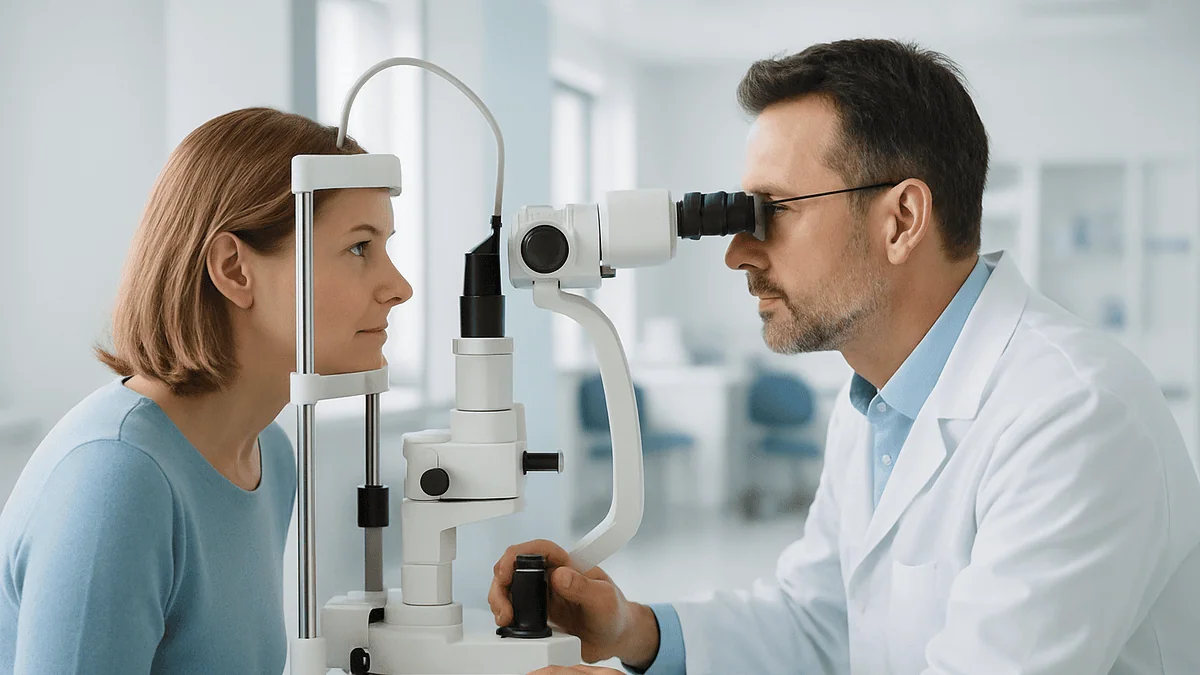
Then come the machines. Pachymetry measures corneal thickness, either with a tiny ultrasound probe touched to the numbed eye or with light-based imaging that scans without contact. Topography maps the curvature of the front surface, like a contour map of a hillside. Tomography goes further, imaging both front and back surfaces and building a thickness profile across the whole cornea, which is where early keratoconus tends to hide. Wavefront analysis records how light travels through the entire eye and picks up subtle optical imperfections that a standard prescription misses.
Standard tests round it out: a dilated exam of the retina and optic nerve, a pressure reading, a check of the tear film for dryness, pupil measurement in dim light, and a refraction, usually repeated with drops that relax the focusing muscle so the true prescription is not masked by strain. Your general medical history matters as much as any scan, so bring a list of medicines and conditions.
Dilating drops blur near vision and make bright light uncomfortable for several hours, so arrange a ride home. The result of the visit is a conversation rather than a verdict flashed on a screen: which procedure, if any, fits your measurements, and what the trade-offs look like for your particular eyes.
If your cornea is too thin for LASIK: alternatives worth understanding
Hearing “your cornea is too thin for LASIK” is not the end of the road; it is a fork in it. The NHS describes several families of vision-correction surgery, and each spares the cornea in a different way.
Surface laser treatment, known as PRK, uses the same excimer laser but skips the flap. The cornea’s outer skin, the epithelium, is removed, the laser reshapes the surface beneath, and the epithelium grows back over several days. Because no flap is made, more of the cornea’s structural tissue is preserved, which is why PRK is often considered when thickness is borderline or when a person’s work or sport carries a high risk of eye trauma. The trade-off is a slower and more uncomfortable first week and a longer wait for sharp vision.
Lenticule extraction uses a femtosecond laser to carve a thin disc of tissue inside the cornea and remove it through a small incision. It disturbs less of the surface than a flap does, though it still consumes stromal tissue and has its own thickness requirements and limits, particularly for farsightedness.
Lens-based surgery leaves the cornea alone. An implantable lens is placed inside the eye in front of the natural lens, a common route for high prescriptions or thin corneas. Refractive lens exchange replaces the natural lens with an artificial one, a procedure essentially identical to cataract surgery, which is why it tends to be offered to people over about 50 whose lenses are already aging. Both are procedures inside the eye and carry a different risk profile from corneal lasers, including a small risk of infection within the eye and earlier cataract formation with implantable lenses.
Which of these, if any, suits you depends on the same measurements that ruled out LASIK. That decision sits with your surgeon.
What the days and weeks after LASIK usually look like
The first hours are the least glamorous. Mayo Clinic describes burning, itching and watering, blurred vision and light sensitivity that ease over the day; you go home with a plastic shield to wear while sleeping and a strict instruction not to rub your eyes, because the flap is still settling. Most people sleep for a few hours and wake to noticeably clearer vision.
A follow-up visit typically falls within the first 1 to 2 days, according to Mayo Clinic, so the surgeon can confirm the flap is in place and healing has begun. Prescription drops to prevent infection and calm inflammation are used for a short course on a schedule your team sets, alongside frequent lubricating drops. Many people return to desk work within a couple of days, though screens feel tiring at first.
The following weeks are about protection. Mayo Clinic advises avoiding eye makeup, swimming, hot tubs and contact sports for a period your surgeon will specify, generally a matter of weeks, because water and impact are the two things a healing flap tolerates least. Night vision often shows halos or glare around lights early on; these usually fade as the cornea smooths and swelling resolves.
Dryness is the most common lingering complaint. Mayo Clinic notes that LASIK reduces tear production for roughly the first 6 months while the tiny corneal nerves regrow, so lubricating drops are part of daily life for most people through that stretch. Vision continues to fine-tune over 2 to 3 months. Some people are left with a small residual prescription; whether an enhancement procedure is sensible depends on how much tissue remains, which brings the thickness question full circle. A final check around the three-month mark usually closes the loop.
What people often get wrong about LASIK candidacy
The myths cluster around the three words in this article’s title, so it makes sense to take them in order.
“My cornea must be thick enough because my eyes are healthy.” Thickness has nothing to do with how your eyes feel. It is an anatomical trait, like height, and it can only be known by measurement. Plenty of people with perfect eye health and a modest prescription have corneas on the thin side; plenty with chronic irritation have thick ones.
“Stable means my glasses have felt fine.” Comfort is a poor gauge. The eye tolerates a small mismatch for years, and a prescription can drift by half a diopter without anyone noticing. Stability is judged from documented exams, which is why old records are worth digging out.
“Normal pressure at screening means glaucoma is off the table forever.” Screening rules out glaucoma today. It does not prevent it later, and after LASIK the standard pressure test reads artificially low. The safeguard is telling every future eye doctor about your surgery.
“LASIK is permanent, so I will never need glasses again.” The corneal change is permanent. The rest of the eye keeps aging. Presbyopia in the forties and cataract later on are unrelated to the surgery and arrive on their own timetable, a point Mayo Clinic makes plainly.
“A thin cornea means no surgery at all.” It means no LASIK, or a smaller LASIK correction. Surface laser and lens-based options exist precisely for this situation.
“Being turned down means the surgeon was overcautious.” A refusal usually rests on a scan showing something you cannot feel. Seeking a second opinion is reasonable; dismissing the scan is not.
Questions to ask your care team before deciding
A good consultation should leave you able to answer these yourself. Bring them written down; dilated eyes make note-taking hard.
- What is my central corneal thickness, and how much tissue would remain beneath the flap after the correction you are planning?
- Does my corneal map show any irregularity, and how confident are you that it is not early keratoconus?
- How many past prescriptions did you compare, and do you consider mine stable?
- What is my eye pressure, does my optic nerve look healthy, and does anything in my family history change your view?
- Given my age, how should I expect presbyopia or cataract to affect my vision over the next decade, and does that alter which procedure you would suggest?
- Is there a reason PRK, lenticule extraction or a lens-based procedure might suit my eyes better than LASIK?
- How dry are my eyes now, and what would you expect in the months after surgery?
- Which of my medicines or health conditions affect healing, and should anything be reviewed with my other doctors first?
- If my vision ends up under-corrected, would my cornea have enough tissue for an enhancement?
- Which symptoms after surgery should prompt a same-day call?
- Can I have a copy of my pre-operative measurements for my records?
Notice what is missing: nothing about the make of the laser or the decor of the waiting room. Those details have their place, but the questions above are about your anatomy, and your anatomy is what shapes the result. Take the answers home, sleep on them, and remember that a careful team will be comfortable hearing no, or not yet. The decision belongs to you and the clinician who has actually measured your eyes.
When to call your doctor: red-flag signs after LASIK or during screening
Serious complications after LASIK are uncommon, but the ones that matter move quickly, and the speed of a phone call can shape the outcome. Your surgical team will give you an after-hours number; use it without hesitation.
Call the same day, or seek emergency eye care, if you notice any of these in the days or weeks after surgery: sudden worsening of vision after it had been improving; increasing pain rather than the expected gritty discomfort, or pain that returns after settling; a red, discharging or swollen eye; a sudden surge of light sensitivity with tearing; a sensation that something has shifted after a bump or rub, which can signal a displaced flap; new floaters, flashes or a curtain across part of your vision, which point to retinal trouble unrelated to the cornea but urgent all the same. MedlinePlus and Mayo Clinic both list infection, inflammation and flap problems among complications that need prompt assessment.
The screening period has its own warning signs. If you are waiting for surgery and your vision changes noticeably, your eye becomes painful or red, or you develop a new medical condition or start a new medicine, tell the team before the date rather than on it. Anyone with a known diagnosis of glaucoma, keratoconus or an autoimmune condition should make sure that fact is written into the surgical record.
Months and years later, the rule is simpler. Any new eye symptom deserves an eye examination, and every eye professional you see from now on should know you have had corneal laser surgery. Your cornea has been reshaped; the way it is measured has to change with it. The treating team, not a search result, decides what happens next.
Frequently asked questions
What is the minimum corneal thickness for LASIK?
There is no single number that applies to everyone. Surgeons calculate how much tissue would remain beneath the flap after the laser removes what your prescription requires, and they set a safety floor for that leftover. A thinner cornea can still qualify for a mild correction, while a thick cornea may not qualify for a very high one. Your own measurements, read alongside a corneal shape map, decide it.
How long does my prescription need to be stable before LASIK?
Mayo Clinic advises that vision should be stable for at least a year, and the NHS suggests a prescription that has stayed roughly the same for about 2 years. Surgeons judge stability by comparing documented past exams, not by how comfortable your glasses feel, so bringing old prescriptions to the consultation helps. A prescription still drifting usually means waiting rather than being refused outright.
Can I have LASIK if I have glaucoma or high eye pressure?
Sometimes, but with more caution. Mild, well-controlled glaucoma with a stable optic nerve may be acceptable to some surgeons, while moderate or advancing disease usually is not; the NHS lists glaucoma among conditions that can make laser surgery unsuitable. The suction ring briefly raises pressure, post-operative steroid drops can raise it in some people, and the thinned cornea affects future readings. The treating team weighs all three.
Who is not a good candidate for LASIK?
People with keratoconus or other corneal irregularity, corneas too thin for their prescription, uncontrolled autoimmune disease, active eye infection or inflammation, advanced glaucoma, significant cataract, severe untreated dry eye, or very high prescriptions are usually advised against LASIK. Pregnancy, breastfeeding, recent prescription changes and certain medicines generally mean waiting rather than a permanent no. Many people ruled out for LASIK suit a different procedure.
Does LASIK affect eye pressure readings later in life?
Yes. LASIK thins and flattens the central cornea, and the standard pressure test works by pressing on the cornea, so readings after surgery tend to come out lower than the true pressure. This can mask early glaucoma years later. Telling every future eye professional that you had corneal laser surgery, and keeping a copy of your pre-operative measurements, allows them to interpret your results correctly.
Can I have LASIK if I have keratoconus?
No. Keratoconus is a condition in which the cornea progressively thins and bulges into a cone shape, and removing more tissue would weaken it further. Even subtle early forms detectable only on corneal tomography are treated as a firm reason not to operate. Someone with keratoconus should discuss other ways of managing vision with a corneal specialist, and the decision always rests with that treating team.
What happens if my cornea is too thin for LASIK?
You will usually be offered a conversation about alternatives rather than a flat refusal. Surface laser treatment (PRK) preserves more structural tissue because no flap is made; lenticule extraction disturbs less of the surface; and lens-based procedures, such as an implantable lens or refractive lens exchange, leave the cornea untouched entirely. Each has its own requirements and risks, and your surgeon matches them to your measurements.
Is there an age limit for LASIK?
Most guidance, including the NHS, sets a lower limit of 18, and many surgeons prefer the early twenties so the prescription has finished changing. There is no fixed upper limit, but from the fifties onward the natural lens begins to stiffen and cloud, so surgeons often suggest lens-based surgery instead. Presbyopia in the forties means reading glasses may still be needed after LASIK.
Why do I have to stop wearing contact lenses before the LASIK evaluation?
Contact lenses mold the cornea, and measurements taken on a lens-shaped cornea would give the laser the wrong map. Mayo Clinic advises switching to glasses full time for at least a few weeks before the assessment, and longer for rigid lenses, so the cornea returns to its natural shape. Your surgeon sets the exact break based on the type of lens you wear.
Can LASIK be done while pregnant or breastfeeding?
Surgeons generally ask people to wait. Mayo Clinic notes that hormonal changes during pregnancy and breastfeeding can alter the prescription and the eye surface, so a correction made then may not hold once hormones settle. Most teams suggest waiting several months after breastfeeding ends and confirming the prescription is stable again before scheduling. This is a delay, not a permanent exclusion.
References
- MedlinePlus: LASIK eye surgery
- NHS: Laser eye surgery and lens surgery
- Cleveland Clinic: Cornea
- National Eye Institute (NIH): Glaucoma
This article is for general information only and is not a substitute for professional medical advice. Please consult a qualified doctor about your individual situation.

More from the Blog
Vascular Lesion Laser Recovery: Cool Compresses, Bruising and the Crusts You Must Not Pick
After vascular laser treatment, expect redness, swelling and sometimes a deep purple bruise-like mark called purpura that typically fades over one to two weeks.…
Is Masseter Botox Right for Teeth Grinding? Who Tends to Benefit and Who Should Wait
Masseter Botox, meaning botulinum toxin injected into the main chewing muscle, is generally considered for adults whose grinding or clenching causes jaw pain, muscle…

Plexr Recovery Day by Day: The Grid of Crusts, Swelling and When Makeup Can Return
Plexr recovery usually follows a predictable arc: a grid of tiny brown carbon crusts forms within hours, swelling peaks around the second or third…

How to Choose Among Non-Surgical Cosmetic Procedures: Matching Concern to Treatment
Choosing among non-surgical cosmetic procedures starts with naming the specific concern rather than the treatment. Lines that appear with expression usually point toward botulinum…

Preparing for Cryoablation: Fasting, Blood Thinner Adjustments and the Anesthesia Review
Preparing for cryoablation usually involves three steps set by your treating team: fasting for a defined window before sedation or anesthesia, a planned review…

Laser, Injections or Minor Surgery for Scars: Comparing the Main Treatment Routes
No single scar treatment suits every scar. Lasers reshape scar texture, color and surface by delivering controlled heat or light; corticosteroid injections soften and…