Cancerous Skin Tags Pictures: Early Signs, Risk Factors, and How It Is Treated
True skin tags are usually benign, soft, small, and flesh-colored. A growth that bleeds, crusts, changes color, or grows quickly may not be a skin tag.
Key Takeaways
- True skin tags are usually benign, soft, small, and flesh-colored.
- A growth that bleeds, crusts, changes color, or grows quickly may not be a skin tag.
- Skin cancer can sometimes resemble a tag, wart, mole, or sore, so visual comparison alone is not enough.
- Dermatologists diagnose suspicious lesions with an exam and sometimes a biopsy.
- Early assessment improves treatment planning and helps rule out serious causes.
Cancerous skin tags pictures are often searched by people trying to compare a harmless skin tag with a suspicious growth. In most cases, true skin tags are benign, but a lesion that bleeds, changes color, grows quickly, becomes crusted, or does not look like a typical soft tag should be checked by a doctor.
Overview: What people mean by “cancerous skin tags pictures”
People often search for “cancerous skin tags pictures” because they have noticed a small growth and want to know whether it looks harmless or concerning. The key point is that a true skin tag, also called an acrochordon, is a benign growth. However, some skin cancers and precancerous lesions can resemble a tag, especially in the early stages or when they appear raised, irritated, or pedunculated.
Pictures can help a person understand general patterns, but they cannot confirm a diagnosis. Lighting, skin tone, irritation from shaving or clothing, and the angle of a photo can all change how a lesion looks. A growth that seems like a skin tag in one image may turn out to be another condition when examined closely by a dermatologist.
What matters most is not only appearance, but also behavior over time. A typical skin tag tends to remain soft, flexible, and stable. A suspicious lesion is more concerning if it changes in size, shape, color, texture, or symptoms such as bleeding, itching, tenderness, or crusting.
How a typical skin tag looks compared with a suspicious lesion
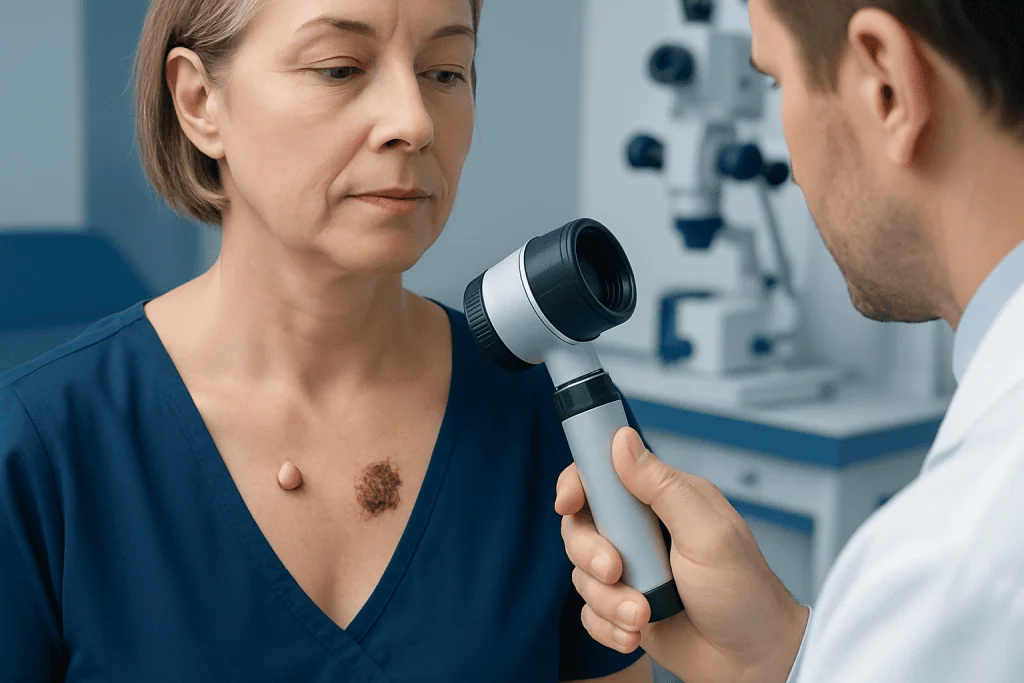
A normal skin tag is usually small, soft, smooth, and flesh-colored or slightly darker than the surrounding skin. It often hangs from the skin on a thin stalk and commonly appears where skin rubs together, such as the neck, armpits, groin, eyelids, or under the breasts. Many people have more than one.
By contrast, a suspicious growth may look firmer, more irregular, ulcerated, or inflamed. It may not have the classic narrow stalk of a skin tag. Some concerning lesions appear pink, red, pearly, dark brown, black, or mixed in color. Others may look like a sore that does not heal, a crusted bump, or a rough patch rather than a soft hanging tag.
Visual differences that deserve attention include:
- rapid growth over weeks or months
- bleeding without clear injury
- repeated crusting or scabbing
- persistent itching, pain, or tenderness
- an irregular border or uneven color
- a lesion that feels hard rather than soft
Some cancers, including forms of basal cell carcinoma, squamous cell carcinoma, or melanoma, can look unusual and do not always follow textbook descriptions. For that reason, comparing images online should be treated as a starting point, not a final answer.
Early signs that a growth may not be a skin tag
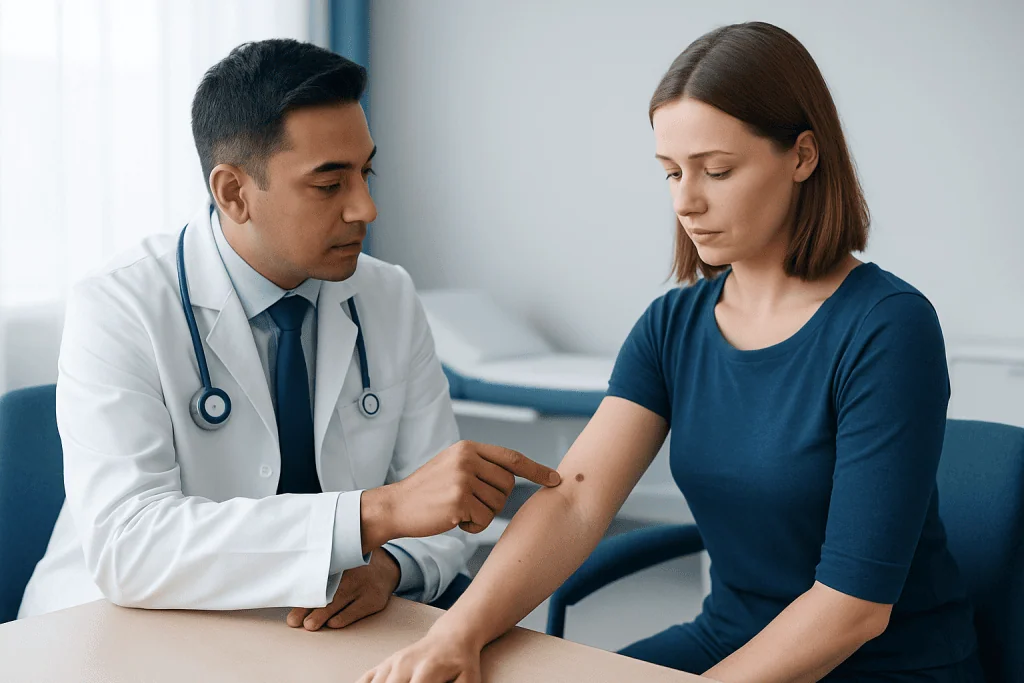
The most useful early warning signs are change and persistence. A lesion that starts to look different from nearby skin, continues to enlarge, or does not settle after irritation should be assessed. This is especially important if a person originally thought the bump was a skin tag but it begins to behave like a nonhealing sore.
Skin cancers can present in several ways. Basal cell carcinoma may appear as a shiny or pearly bump, sometimes with tiny visible blood vessels. Squamous cell carcinoma may look scaly, crusted, thickened, or ulcerated. Melanoma may be dark or multi-colored, but some melanomas are pink or skin-colored and can be harder to recognize.
Useful warning patterns include the following:
- asymmetry or uneven shape
- borders that look blurred, ragged, or notched
- more than one color in the same spot
- growth that becomes larger or thicker
- bleeding, oozing, or failure to heal
- a new bump in adulthood that looks different from others
If a person is unsure whether a lesion is a harmless tag or something more serious, a prompt skin examination is the safest approach. A clinician may compare it with other benign lesions such as warts, moles, seborrheic keratoses, or skin cancer-related changes.
Risk factors for suspicious skin growths
Skin tags themselves are common and are not considered cancer. They are more likely in areas of friction and may be associated with aging, weight gain, insulin resistance, or pregnancy. In contrast, the risk factors for skin cancer include both environmental exposure and personal history.
Sun exposure is one of the most important factors, especially repeated ultraviolet exposure over time or a history of sunburns. People with fair skin, light eyes, freckles, or a tendency to burn easily often have a higher risk, but skin cancer can develop in any skin tone. Tanning bed use also increases risk.
Other factors that may raise concern include:
- a personal or family history of skin cancer
- many moles or unusual moles
- older age
- a weakened immune system
- chronic wounds or scars in the area
- significant outdoor work or recreation without sun protection
A suspicious lesion in a high-friction area may still be benign, but location alone does not rule out cancer. A doctor will consider both the appearance of the lesion and the person’s overall risk profile when deciding whether closer evaluation is needed.
How doctors diagnose a possible cancerous skin tag look-alike
Diagnosis usually begins with a careful skin examination. The doctor will ask when the lesion appeared, whether it has changed, and whether there are symptoms such as bleeding or pain. They may also review sun exposure, previous skin cancers, medications, and any history of immune suppression.
Dermatologists often use dermoscopy, a handheld tool that magnifies the lesion and helps reveal patterns not visible to the naked eye. This can improve the assessment of pigment, blood vessels, borders, and surface texture. Even so, a clinical exam sometimes cannot provide complete certainty.
If the lesion appears suspicious, the doctor may recommend a biopsy. During a biopsy, all or part of the growth is removed and examined under a microscope. This is the most reliable way to distinguish a benign skin tag from cancer or another condition. Depending on the results, treatment may range from simple removal to wider excision or other therapies.
When imaging or additional testing is needed, it is usually reserved for more advanced or unusual cases rather than routine skin tags. In many patients, diagnosis is straightforward once a specialist examines the lesion directly.
Treatment options if the lesion is benign or cancerous
If a lesion is confirmed to be a simple skin tag, treatment is often optional unless it causes irritation, snagging, or cosmetic concern. A clinician may remove it using snipping, cautery, or freezing, depending on the location and the individual case. It is generally best not to cut off or burn a growth at home, especially if there is any doubt about what it is.
If testing shows skin cancer, treatment depends on the type, size, depth, location, and whether the cancer has spread. Many early skin cancers are treated with complete removal. This may involve a standard surgical excision or, in selected cases, Mohs surgery to remove the cancer while preserving as much healthy tissue as possible.
Some patients may also need other approaches such as cryotherapy, topical medicines for certain superficial lesions, curettage and electrosurgery, radiation therapy, or broader oncologic care. In more complex cases, specialists may coordinate treatment through services related to skin cancer treatment or dermatology assessment.
Near the end of the care pathway, follow-up is important. The skin should be rechecked for recurrence, healing, and any new suspicious lesions. Acibadem International’s multidisciplinary specialists and JCI-accredited hospitals diagnose and treat skin conditions, including suspicious growths, for international patients.
Prevention and self-checks at home
Not every suspicious-looking growth can be prevented, but regular skin awareness can help people notice changes earlier. A person can check their skin monthly in good lighting, using a mirror for hard-to-see areas. It may help to take clear photos over time so subtle changes are easier to recognize.
Sun protection remains one of the most effective ways to lower the risk of many skin cancers. Helpful measures include seeking shade, wearing protective clothing and hats, and using broad-spectrum sunscreen as directed. Avoiding tanning beds is also important.
At home, it is safest not to remove a lesion unless a doctor has confirmed it is a benign skin tag. Attempting self-removal can cause bleeding, infection, scarring, and delayed diagnosis if the growth is actually cancerous. If a lesion is irritated by clothing or shaving, keeping the area clean and avoiding trauma may reduce discomfort until it is examined.
When to seek medical care
Medical review is appropriate if a skin growth is new, changing, painful, bleeding, crusting, or not healing. A person should also seek care if a lesion looks different from their other spots or if they are unsure whether it is a skin tag at all. This is especially relevant for people with strong sun exposure, a personal history of skin cancer, or a weakened immune system.
Urgent assessment is sensible when a lesion grows quickly, repeatedly bleeds, or develops a dark or mixed color pattern. While many suspicious bumps turn out to be benign, it is safer to have uncertain lesions checked than to rely on online images alone. Early evaluation can provide reassurance and, when needed, allow treatment at a stage when care is often simpler.
Frequently asked questions
Can a skin tag actually be cancerous?
A true skin tag is benign and not a skin cancer. The concern is that some cancerous or precancerous lesions can look similar to a skin tag, especially if they are raised or irritated. If there is any change in color, shape, growth, or bleeding, a doctor should assess it.
What do cancerous skin tags pictures usually show?
Images labeled this way often show lesions that are not classic skin tags at all. They may appear irregular, crusted, ulcerated, dark, pearly, or inflamed rather than soft and smooth. Pictures can be helpful for general comparison, but they cannot diagnose a lesion.
How can someone tell the difference between a skin tag and skin cancer?
A skin tag is usually soft, flesh-colored, and attached by a thin stalk in a friction area. Skin cancer may be firmer, grow more quickly, bleed, crust, change color, or fail to heal. Because appearances can overlap, a dermatologist may need to examine the lesion and possibly do a biopsy.
Should a person remove a suspicious skin tag at home?
No, a suspicious growth should not be removed at home before a diagnosis is confirmed. Self-removal can lead to bleeding, infection, scarring, and delayed treatment if the lesion is cancerous. A medical professional can remove it safely and send tissue for testing if needed.
Are bleeding skin tags always cancerous?
Not always. A benign skin tag can bleed if it is twisted, rubbed by clothing, or cut while shaving. However, bleeding without a clear cause, repeated bleeding, or bleeding combined with growth or color change should be checked by a doctor.
When should someone worry about a new bump that looks like a skin tag?
Concern is more appropriate if the bump is new in adulthood and changes quickly, looks different from other spots, becomes hard, or develops crusting or pigment changes. People with a history of skin cancer or heavy sun exposure should be especially cautious. When in doubt, a skin exam is the best next step.
References
- American Academy of Dermatology
- National Cancer Institute
- American Cancer Society
- Skin Cancer Foundation
- Mayo Clinic
This article is for general information only and is not a substitute for professional medical advice. Please consult a qualified doctor about your individual situation.
Explore treatments in Turkey — costs, top hospitals & a free quote
JCI-accredited · board-certified surgeons · reply within 24h
Add us as a Preferred Source to see more of our trusted health content across Google Search, AI Overviews and Discover.