Cardiac Stress Test: When Doctors Recommend It
A cardiac stress test checks how well the heart receives blood and oxygen during physical or medication-induced stress. Doctors may recommend it for chest discomfort, shortness of breath, palpitations, reduced exercise tolerance, or evaluation of known heart disease.
Key Takeaways
- A cardiac stress test checks how well the heart receives blood and oxygen during physical or medication-induced stress.
- Doctors may recommend it for chest discomfort, shortness of breath, palpitations, reduced exercise tolerance, or evaluation of known heart disease.
- Different types include exercise ECG testing, stress echocardiography, nuclear stress testing, and pharmacologic stress testing.
- The test is supervised by trained medical staff, and the most appropriate method depends on a person’s symptoms, fitness level, ECG findings, and medical history.
- Results should always be interpreted by a qualified clinician in the context of the patient’s overall health.
A cardiac stress test helps doctors assess how the heart works when it is made to pump harder, usually during exercise or with medication. It is commonly recommended when symptoms, risk factors, or previous test results suggest that the heart may need closer evaluation.
Overview
A cardiac stress test is a diagnostic examination used to evaluate how the heart responds when it is working harder than usual. During everyday rest, some heart problems may not be obvious. When the heart needs more oxygen-rich blood, such as during exercise, reduced blood flow or abnormal electrical activity may become easier to detect.
The test may involve walking on a treadmill or pedaling a stationary bicycle while heart rhythm, blood pressure, symptoms, and sometimes heart imaging are monitored. If a person cannot exercise safely or adequately, medications can be used to make the heart respond in a similar way. The purpose is not to create unnecessary strain, but to reproduce controlled conditions that help doctors understand heart function.
Doctors recommend a cardiac stress test for several reasons, including investigating symptoms, assessing risk of coronary artery disease, checking the effectiveness of treatment, or helping guide decisions before certain procedures. It is one tool among many; results are interpreted together with the patient’s medical history, physical examination, blood tests, electrocardiogram, and imaging when needed.
When Doctors Recommend a Cardiac Stress Test
A doctor may recommend a cardiac stress test when symptoms suggest that the heart may not be receiving enough blood during activity. Common reasons include chest pressure or discomfort, shortness of breath with exertion, unexplained fatigue, dizziness during activity, or a noticeable decline in exercise capacity. Some people describe symptoms as tightness, burning, heaviness, or discomfort that spreads to the shoulder, arm, back, neck, or jaw.
Stress testing is also used in people who have risk factors for coronary artery disease, especially when symptoms are unclear or when the likelihood of heart disease needs to be better understood. Risk factors may include high blood pressure, high cholesterol, diabetes, smoking, a strong family history of early heart disease, chronic kidney disease, and older age. The decision to test depends on the overall clinical picture, not on a single risk factor alone.
Doctors may also request a stress test after a person has been diagnosed with heart disease. It can help evaluate how well medications are working, whether symptoms are controlled, or whether further testing such as coronary CT angiography or invasive coronary angiography may be needed. In selected cases, stress testing is used before surgery to assess cardiac risk, particularly when a person has known heart disease or limited functional capacity.
Types of Cardiac Stress Tests

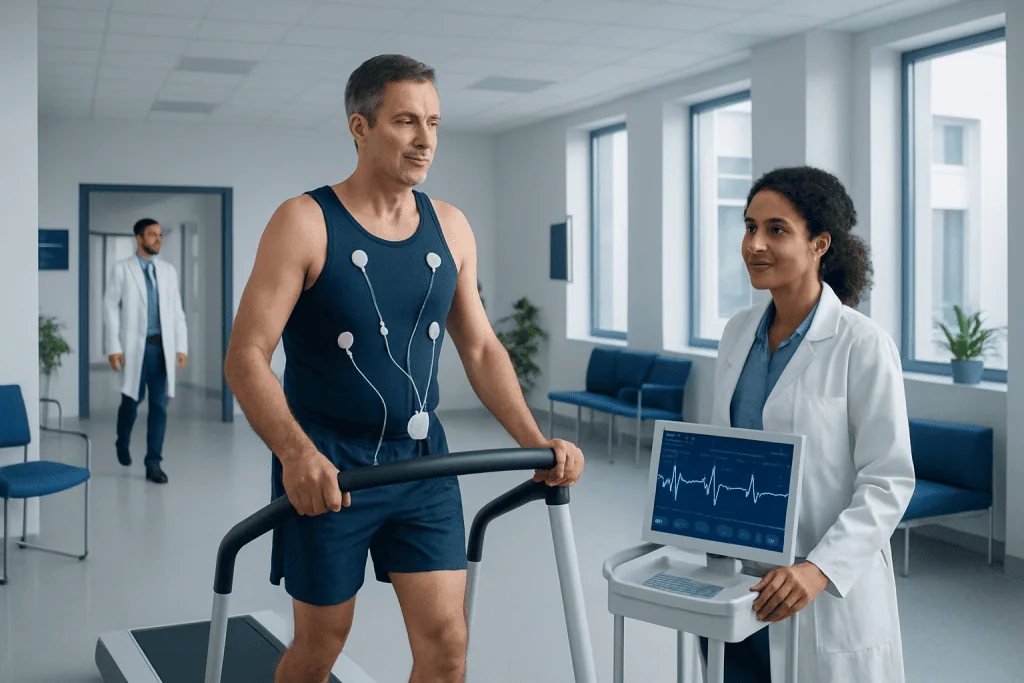
The simplest form is an exercise stress test with electrocardiogram monitoring, often called an exercise ECG or treadmill test. Electrodes are placed on the chest to record the heart’s electrical activity while the person exercises in gradually increasing stages. Blood pressure and symptoms are checked throughout the test and during recovery.
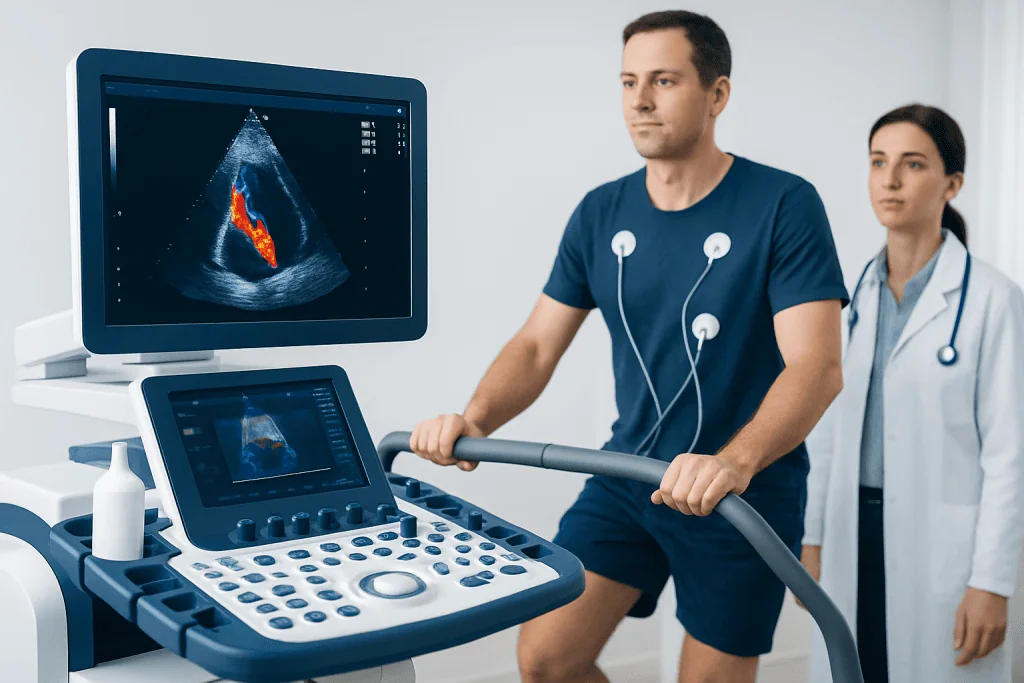
Some stress tests include imaging to provide more detailed information. A stress echocardiogram uses ultrasound images of the heart before and after stress to see how well the heart muscle contracts. A nuclear stress test uses a small amount of radioactive tracer and a special camera to show blood flow to the heart muscle at rest and during stress. These imaging tests may be recommended when a standard ECG stress test is less reliable or when more detail is needed.
If exercise is not possible because of joint problems, lung disease, neurological conditions, frailty, or other limitations, a pharmacologic stress test may be used. In this approach, medication increases blood flow through the heart arteries or makes the heart beat faster under careful supervision. The choice of test depends on the person’s symptoms, baseline ECG, ability to exercise, body habitus, previous heart procedures, and the clinical question the doctor is trying to answer.
How to Prepare for the Test
Preparation instructions may vary depending on the type of cardiac stress test, so patients should follow the guidance provided by their healthcare team. In general, comfortable clothing and shoes suitable for walking are recommended if exercise is planned. Patients are usually asked to bring a list of current medications, allergies, and relevant medical history.
Some medications, caffeine-containing products, or nicotine may need to be avoided before certain types of stress tests, but this should only be done if the doctor gives clear instructions. Patients should not stop heart, blood pressure, diabetes, or breathing medications on their own. For people with diabetes, the care team may provide specific instructions about food intake and glucose monitoring before the test.
Patients should tell the medical team if they are pregnant or may be pregnant, have severe asthma or chronic lung disease, have a history of serious rhythm problems, or have had recent chest pain at rest. It is also important to mention mobility limitations, recent infections, anemia, or any condition that may affect the ability to exercise. Clear communication helps the team choose the safest and most useful test method.
What Happens During a Cardiac Stress Test
Before the test begins, the healthcare team usually checks blood pressure, reviews symptoms, and places ECG electrodes on the chest. For an exercise test, the person starts walking slowly on a treadmill or pedaling a bicycle. The intensity increases gradually, and the patient is encouraged to report any chest discomfort, shortness of breath, dizziness, leg pain, unusual fatigue, or other symptoms.
The test continues until the target level of exertion is reached, symptoms develop, ECG or blood pressure changes suggest stopping, or the patient feels unable to continue. Medical staff monitor the person closely throughout the test and during the recovery period. If imaging is part of the test, ultrasound pictures or nuclear camera images are taken at specific times.
During a pharmacologic stress test, the person rests while medication is given through an intravenous line. The medication may cause temporary sensations such as warmth, flushing, mild shortness of breath, headache, or a faster heartbeat, depending on the drug used. These effects usually pass quickly, and the team remains nearby to monitor and manage symptoms if they occur.
Understanding Results
Results from a cardiac stress test may be described as normal, abnormal, inconclusive, or requiring further evaluation. A normal result generally suggests that the heart receives adequate blood flow during the level of stress achieved. However, no test is perfect, and a normal result does not remove the need to manage risk factors such as blood pressure, cholesterol, diabetes, smoking, and weight.
An abnormal result may suggest reduced blood flow to part of the heart muscle, an exercise-related rhythm problem, an unusual blood pressure response, or decreased pumping function under stress. It does not always mean that a person has a severe blockage, but it signals that the doctor should consider the finding in context. Additional testing may be recommended to clarify the cause and plan appropriate care.
Sometimes a test is inconclusive, for example if the person cannot exercise long enough, the ECG is difficult to interpret, or images are technically limited. In these cases, the doctor may suggest a different type of stress test, coronary CT angiography, blood tests, medication adjustment, or referral to a cardiologist. The most useful interpretation comes from combining test findings with symptoms, examination, and overall cardiovascular risk.
Benefits, Limitations, and Safety
A cardiac stress test can provide valuable information about symptoms that occur with activity and about the heart’s ability to respond to increased demand. It may help identify people who need more intensive treatment, medication adjustment, lifestyle changes, or further diagnostic testing. It can also reassure patients and clinicians when results are normal and symptoms are unlikely to be caused by significant exercise-induced blood flow limitation.
Like any medical test, stress testing has limitations. False-positive results can suggest a problem when the coronary arteries are not significantly narrowed, and false-negative results can miss some conditions. Some heart problems, such as microvascular disease, coronary spasm, valve disease, or rhythm disorders, may require different or additional tests for full evaluation.
Stress tests are performed under supervision, and serious complications are uncommon in appropriately selected patients. The medical team is trained to stop the test if concerning symptoms, ECG changes, or blood pressure changes occur. Patients should feel comfortable asking why a test is recommended, what type is planned, what the alternatives are, and how the results will guide care.
Prevention, Self-care, and When to See a Doctor
A stress test is a diagnostic tool, but long-term heart health depends on prevention and risk factor control. Patients can support cardiovascular health by following medical advice for blood pressure, cholesterol, diabetes, and weight management; avoiding tobacco; staying physically active within safe limits; eating a heart-healthy diet; and attending regular check-ups. Any exercise program should be discussed with a doctor if a person has heart symptoms or known heart disease.
Medical advice should be sought if symptoms such as chest discomfort, shortness of breath, fainting, palpitations, or unexplained exercise intolerance occur. Urgent medical care is needed for severe, persistent, or worsening chest pain, chest discomfort with sweating or nausea, fainting, or sudden shortness of breath. These symptoms may have causes other than heart disease, but timely evaluation is important.
For international patients, Acibadem International’s multidisciplinary specialists and JCI-accredited hospitals provide evaluation and treatment for cardiovascular conditions, including stress testing when clinically appropriate. Patients should consult a qualified doctor to determine whether a cardiac stress test is necessary and which type best fits their health status.
Frequently asked questions
Is a cardiac stress test painful?
A cardiac stress test is not usually painful. During an exercise test, the main sensation is physical effort similar to brisk walking or climbing a hill. Some people may feel short of breath, tired, or aware of their heartbeat, and they should report any discomfort immediately.
How long does a cardiac stress test take?
The exercise portion may last only several minutes, depending on fitness level and the test protocol. The full appointment often takes longer because of preparation, monitoring, recovery, and imaging if needed. Nuclear or pharmacologic tests may require additional time.
Can a person eat before a stress test?
Instructions vary by test type and hospital protocol. Some patients may be asked to avoid a heavy meal, caffeine, or certain products before the test. Patients should follow the specific instructions given by their healthcare team and ask before changing any medication routine.
What happens if the test result is abnormal?
An abnormal result means the doctor has found a change that may need further evaluation. It may suggest reduced blood flow, rhythm changes, or another issue, but it does not automatically mean a person needs a procedure. The next step depends on symptoms, medical history, risk factors, and the type of abnormal finding.
Is a treadmill stress test enough to diagnose blocked arteries?
A treadmill ECG test can suggest whether blood flow to the heart may be limited during exertion, but it does not directly show the arteries. Some patients need imaging stress tests, coronary CT angiography, or coronary angiography for more detail. The doctor chooses the approach based on the individual situation.
Who should not have an exercise stress test?
An exercise stress test may not be appropriate for people with certain unstable heart symptoms, severe mobility limitations, uncontrolled rhythm problems, or other medical conditions that make exercise unsafe. In these cases, doctors may postpone testing, treat the underlying condition first, or choose a pharmacologic stress test. Suitability is assessed before the test begins.
This article is for general information only and is not a substitute for professional medical advice. Please consult a qualified doctor about your individual situation.
Heart care in Turkey — expert evaluation and treatment
JCI-accredited · board-certified surgeons · reply within 24h
Add us as a Preferred Source to see more of our trusted health content across Google Search, AI Overviews and Discover.
Check your numbers in seconds
BMI, calories, due date, blood pressure and 30+ more clinical calculators — free, instant, doctor-reviewed ranges.

Cardiology Department
Diagnosis and treatment of heart and vascular conditions, from prevention to advanced interventional procedures.
93 specialists in this unitRelated Treatments
Related Conditions
More from the Health Library

Bilateral Internal Mammary Artery Bypass: Benefits, Risks, and Patient Selection

Dental Clearance Before Coronary Bypass Surgery: Infection Risks and Preparation

Permanent Pacemaker Surgery: Step-by-Step Procedure and Recovery Timeline

Pulmonary Hypertension Treatment: Medicines, Monitoring, and When Procedures Are Needed

Heart Failure: Symptoms, Causes, and Long-Term Management