

Dental Bridges: Replacing Missing Teeth Without Implants

Dental bridges can replace missing teeth without implant surgery by using neighboring teeth or other supports for stability. Common types include traditional bridges, cantilever bridges, Maryland bridges, and implant-supported bridges, although this article focuses on non-implant options.
Key Takeaways
- Dental bridges can replace missing teeth without implant surgery by using neighboring teeth or other supports for stability.
- Common types include traditional bridges, cantilever bridges, Maryland bridges, and implant-supported bridges, although this article focuses on non-implant options.
- A bridge can improve chewing, speech, smile appearance, and prevent nearby teeth from drifting into the gap.
- Good oral hygiene is essential because decay or gum disease around supporting teeth can affect the success of a bridge.
- A dentist should assess the teeth, gums, bite, and bone health before recommending the best tooth replacement option.
Dental bridges are fixed restorations that replace one or more missing teeth by anchoring an artificial tooth to nearby teeth or other supports. For people who are not suitable candidates for dental implants or prefer a non-surgical option, bridges can restore chewing, speech, appearance, and dental balance.
Overview
Dental bridges are custom-made restorations used to replace one or more missing teeth. A bridge usually includes an artificial tooth, called a pontic, which fills the empty space, and supporting structures that hold it in place. In many cases, the support comes from natural teeth on one or both sides of the gap, which are prepared and covered with crowns.
For patients who want to replace missing teeth without dental implants, a fixed dental bridge can be a practical and predictable option. Unlike a removable denture, a bridge is cemented or bonded in place and is not taken out for daily cleaning. It can feel more stable during eating and speaking, although it still requires careful cleaning around and under the restoration.
Missing teeth are more than a cosmetic concern. Gaps can affect chewing, speech, jaw comfort, and the alignment of nearby teeth. Over time, neighboring teeth may tilt or drift, and teeth in the opposite jaw may move into the empty space. A bridge helps maintain the shape and function of the dental arch when it is carefully planned and maintained.
Types of Dental Bridges
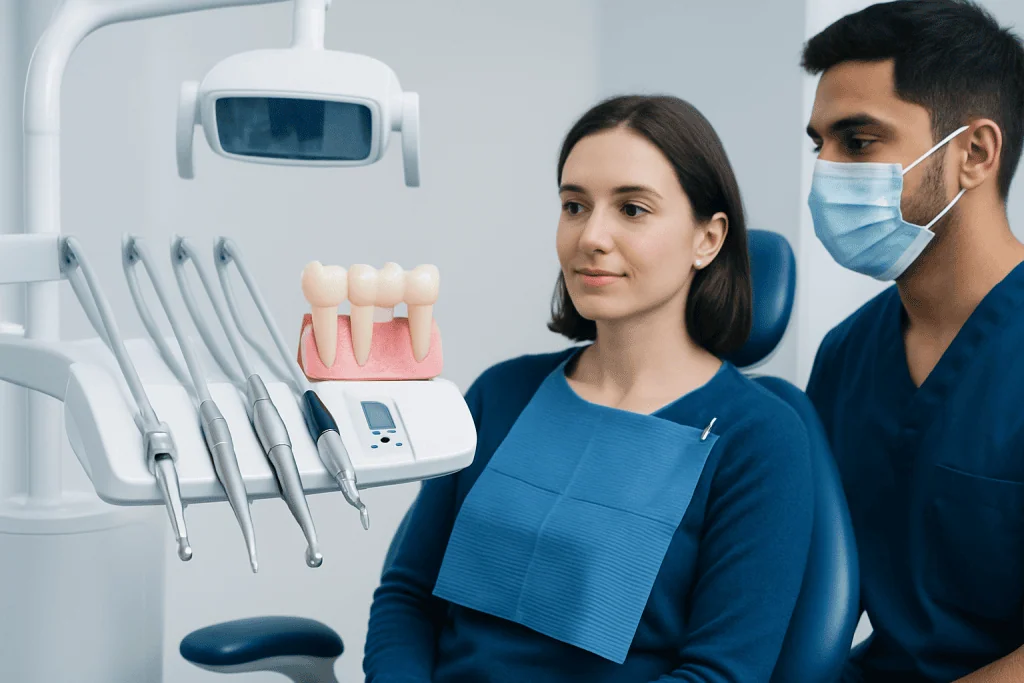
Several types of dental bridges are available, and the best choice depends on the number and location of missing teeth, the health of nearby teeth, bite forces, gum condition, and aesthetic needs. The dentist will also consider whether the supporting teeth already have large fillings or crowns, because this may influence how much tooth preparation is needed.
A traditional bridge is the most common non-implant option. It uses crowns placed over the natural teeth on both sides of the missing tooth space, with a pontic attached between them. This design provides strong support and is often used for back teeth, where chewing forces are higher. However, it requires reshaping the supporting teeth, even if they are otherwise healthy.
A cantilever bridge is supported by a tooth on only one side of the gap. It may be considered in selected areas of the mouth where bite forces are not excessive, but it is not suitable for every situation. A Maryland bridge, also called a resin-bonded bridge, uses metal or ceramic wings bonded to the backs of neighboring teeth. It usually requires less tooth removal, but it may not be as strong as a traditional bridge in areas that carry heavy chewing pressure.
Materials may include porcelain fused to metal, all-ceramic, zirconia, or other dental ceramics. Front teeth often require a highly natural appearance, while back teeth require strength and resistance to wear. The dentist and dental laboratory select the material based on function, aesthetics, and the patient’s oral conditions.
Who May Benefit from a Dental Bridge?

A dental bridge may be suitable for a person who has one or more missing teeth and has strong, healthy teeth near the gap. It is also an option for patients who prefer to avoid surgery, have medical reasons that make implant treatment more complex, or want a treatment timeline that may be shorter than implant therapy. The decision should always be based on an individual dental examination.
Bridges can be especially helpful when neighboring teeth already need crowns because of large fillings, fractures, or significant wear. In these cases, preparing the teeth for crowns may serve both restorative and replacement purposes. A bridge may also be recommended when there is insufficient bone for an implant and the patient does not wish to have bone grafting.
Not every patient is an ideal candidate. Supporting teeth must have enough structure and healthy roots to carry the added load. Gum disease, uncontrolled tooth decay, severe grinding, or an unstable bite may need treatment before a bridge is placed. If the gap is large or several teeth are missing in a row, a removable partial denture or implant-based plan may sometimes be more appropriate.
Diagnosis and Treatment Planning
Planning a dental bridge begins with a detailed dental evaluation. The dentist examines the missing tooth area, the supporting teeth, the gums, and the bite. Dental X-rays are commonly used to check the roots, surrounding bone, and any hidden decay or infection. In some cases, digital scans or impressions are taken to study how the upper and lower teeth meet.
The dentist will ask about symptoms, oral hygiene habits, previous dental treatments, medical conditions, and medications. This information helps identify factors that may affect healing, gum health, or the long-term success of the bridge. For example, dry mouth, smoking, diabetes, or active periodontal disease can increase the risk of complications if not properly managed.
Treatment planning also includes a discussion of expectations. Patients should understand the differences between a bridge, implant, and removable denture, including comfort, cleaning requirements, cost factors, and the effect on adjacent teeth. A well-informed decision helps ensure that the selected option fits the patient’s dental health, preferences, and long-term goals.
In visible areas, aesthetic planning may include shade selection, tooth shape, gumline appearance, and symmetry with neighboring teeth. Temporary restorations may help protect prepared teeth while the final bridge is made and can also give the dentist and patient a preview of shape and function.
The Dental Bridge Procedure
The dental bridge procedure usually requires more than one appointment. At the first treatment visit, the dentist prepares the supporting teeth by removing a controlled amount of enamel and shaping them so crowns can fit over them. Local anesthesia is typically used to keep the area comfortable during the procedure. If decay or old fillings are present, these may be treated at the same appointment.
After the teeth are prepared, the dentist takes a digital scan or impression. This information is sent to a dental laboratory, where the bridge is designed to fit the mouth and match the surrounding teeth. A temporary bridge is often placed to protect the prepared teeth and maintain appearance while the final restoration is being made. Patients are usually advised to avoid sticky or very hard foods with the temporary bridge.
At the fitting appointment, the dentist checks the final bridge for fit, bite, comfort, and appearance. Minor adjustments may be made before the bridge is cemented or bonded in place. The patient is shown how to clean around the bridge, including the area beneath the artificial tooth, because this space cannot be cleaned with regular brushing alone.
Some sensitivity to temperature or pressure may occur for a short time after tooth preparation or cementation. This often improves as the teeth settle. Persistent pain, a high bite, looseness, or gum swelling should be reported to the dentist promptly so adjustments or additional care can be provided.
Benefits, Limitations, and Possible Risks
A well-made dental bridge can restore chewing ability, improve speech clarity, support the lips and cheeks, and enhance the appearance of the smile. It can also help keep nearby teeth from moving into the empty space. Because it is fixed in place, many patients find it more comfortable and convenient than a removable partial denture.
Another benefit is that a bridge can often be completed without oral surgery. This may be important for patients who are not candidates for implants, do not have enough bone for implants, or prefer a non-surgical approach. Traditional bridges have a long history of use and can be highly functional when the supporting teeth and gums remain healthy.
However, bridges also have limitations. Preparing healthy neighboring teeth is irreversible, and those teeth become important supports for the entire restoration. If decay develops under a crown or gum disease affects the supporting teeth, the bridge may loosen or fail. For this reason, daily cleaning and regular dental check-ups are essential.
Possible risks include tooth sensitivity, gum irritation, decay around the margins, porcelain chipping, changes in bite comfort, and difficulty cleaning under the pontic. A bridge may need repair or replacement over time due to normal wear or changes in the mouth. Patients who grind or clench their teeth may need a night guard to protect the restoration.
Care, Prevention, and Self-Care
Good home care is one of the most important factors in keeping a dental bridge healthy. Patients should brush at least twice daily with fluoride toothpaste and clean between the teeth every day. Because the pontic is attached to crowns, regular floss cannot pass straight down between the artificial tooth and the supporting teeth in the usual way.
Special cleaning tools may be recommended to remove plaque and food from under and around the bridge. These may include floss threaders, super floss, interdental brushes, or a water flosser. The dental team can demonstrate the correct technique, because cleaning needs vary depending on bridge design and gum shape.
- Limit very hard foods that may chip porcelain or stress the bridge.
- Avoid using teeth to open packages or bite non-food objects.
- Attend regular dental check-ups and professional cleanings.
- Report looseness, bad taste, bleeding, swelling, or discomfort early.
- Ask about a night guard if grinding or clenching is present.
General health habits also support oral health. Stopping smoking, managing diabetes, staying hydrated, and treating dry mouth can help reduce the risk of gum disease and decay. Preventing new dental problems is usually easier than repairing damage once it affects the supporting teeth of a bridge.
When to See a Dentist
A person with a missing tooth should see a dentist even if there is no pain. Early evaluation helps prevent movement of neighboring teeth, changes in bite, and difficulty chewing. The dentist can explain whether a bridge is suitable or whether another option, such as an implant or removable partial denture, would better meet the patient’s needs.
Anyone with an existing bridge should arrange a dental visit if the bridge feels loose, the bite feels uneven, food constantly traps underneath, or there is pain, swelling, bleeding, or a persistent bad taste. These signs do not always mean the bridge has failed, but they should be assessed before the problem becomes more difficult to treat.
Patients with gum disease, repeated decay, tooth grinding, or medical conditions that affect oral health may need more frequent monitoring. Regular dental care allows small issues to be addressed early and helps protect the investment in tooth replacement.
Acibadem International’s multidisciplinary dental specialists and JCI-accredited hospitals evaluate and treat missing teeth, including dental bridges, for international patients. A qualified dentist can provide a personalized plan based on oral health, medical history, and treatment preferences.
Frequently asked questions
What is a dental bridge?
A dental bridge is a fixed restoration used to replace one or more missing teeth. It usually includes an artificial tooth attached to crowns or bonding wings that are supported by neighboring teeth. Because it is fixed in place, it is not removed for daily cleaning like a denture.
Can a dental bridge replace a tooth without an implant?
Yes. Traditional, cantilever, and Maryland bridges can replace missing teeth without implant surgery. These options rely on nearby natural teeth for support, so those teeth must be healthy enough to carry the extra load.
How long does a dental bridge last?
The lifespan of a bridge varies depending on oral hygiene, bite forces, materials, gum health, and regular dental care. Many bridges function for years, but they may need repair or replacement over time. Keeping the supporting teeth free from decay and gum disease is essential.
Is getting a dental bridge painful?
The procedure is usually performed with local anesthesia, so patients should not feel pain during tooth preparation. Some temporary sensitivity or gum tenderness can occur afterward and often improves. Persistent or worsening discomfort should be checked by the dentist.
How do patients clean under a dental bridge?
A bridge must be cleaned under the artificial tooth and around the supporting crowns. Regular floss cannot usually pass through the bridge, so tools such as floss threaders, super floss, interdental brushes, or water flossers may be recommended. The dental team can demonstrate the best method for the specific bridge design.
Is a bridge better than an implant?
Neither option is best for everyone. A bridge may be preferred when surgery is not desired, when nearby teeth already need crowns, or when implant treatment is not suitable. Implants can preserve neighboring teeth because they do not require crown preparation, but they require adequate bone and a surgical procedure.
What happens if a missing tooth is not replaced?
Leaving a gap untreated may allow nearby teeth to shift and opposing teeth to move into the space. This can affect chewing, bite balance, and cleaning. A dentist can assess the gap and recommend whether replacement is needed and which option is most appropriate.
References
- American Dental Association
- FDI World Dental Federation
- National Institute of Dental and Craniofacial Research
- European Federation of Periodontology
- NHS
This article is for general information only and is not a substitute for professional medical advice. Please consult a qualified doctor about your individual situation.
Dental Bridge in Turkey — costs, top hospitals & a free quote
JCI-accredited · board-certified surgeons · reply within 24h
Add us as a Preferred Source to see more of our trusted health content across Google Search, AI Overviews and Discover.

Dental & Oral Health
Full-scope dental care from implants and aesthetics to oral and maxillofacial surgery.
158 specialists in this unitRelated Treatments
More from the Health Library



Related Specialists

Assoc. Prof. Dr. Ferit Bayram
Oral & Dental Health
Dt. Alara Naz Kenir
Oral & Dental Health
Dt. Gonca Katmer
Oral & Dental HealthDt. Doğa Baysal
Oral & Dental Health