Dextroscoliosis: Early Signs, Risk Factors, and How It Is Treated

Dextroscoliosis means the spine curves to the right when viewed from behind. Many cases are mild and may cause few or no symptoms at first.
Key Takeaways
- Dextroscoliosis means the spine curves to the right when viewed from behind.
- Many cases are mild and may cause few or no symptoms at first.
- Evaluation usually includes a physical exam and standing spine imaging to measure the curve.
- Treatment may range from observation and exercises to bracing or surgery in selected cases.
- Early assessment is helpful if posture changes, uneven shoulders, back pain, or curve progression are noticed.
Dextroscoliosis is a type of scoliosis in which the spine curves to the right, most often in the thoracic or mid-back region. Treatment depends on the degree of curvature, age, symptoms, and whether the curve is stable or progressing.
Overview: What dextroscoliosis means
Dextroscoliosis is a form of scoliosis in which the spine curves to the right side of the body. The curve is seen when a person is viewed from behind, and it may involve the chest area, lower back, or both. In many people, the spine may also rotate slightly, which can make one shoulder blade or one side of the ribs look more prominent.
This condition is not a disease in itself but a description of spinal alignment. Some people have a mild curve that stays stable for years and causes little difficulty. Others, especially children and adolescents who are still growing, may develop a curve that gradually increases over time and needs monitoring or treatment.
Dextroscoliosis can appear in childhood, adolescence, or adulthood. In younger people, it is often discovered during growth spurts or routine examination. In adults, it may be linked to age-related wear of the spine, previous spinal problems, or progression of a curve that began earlier in life. Understanding the cause helps guide care and expectations.
Early signs and symptoms
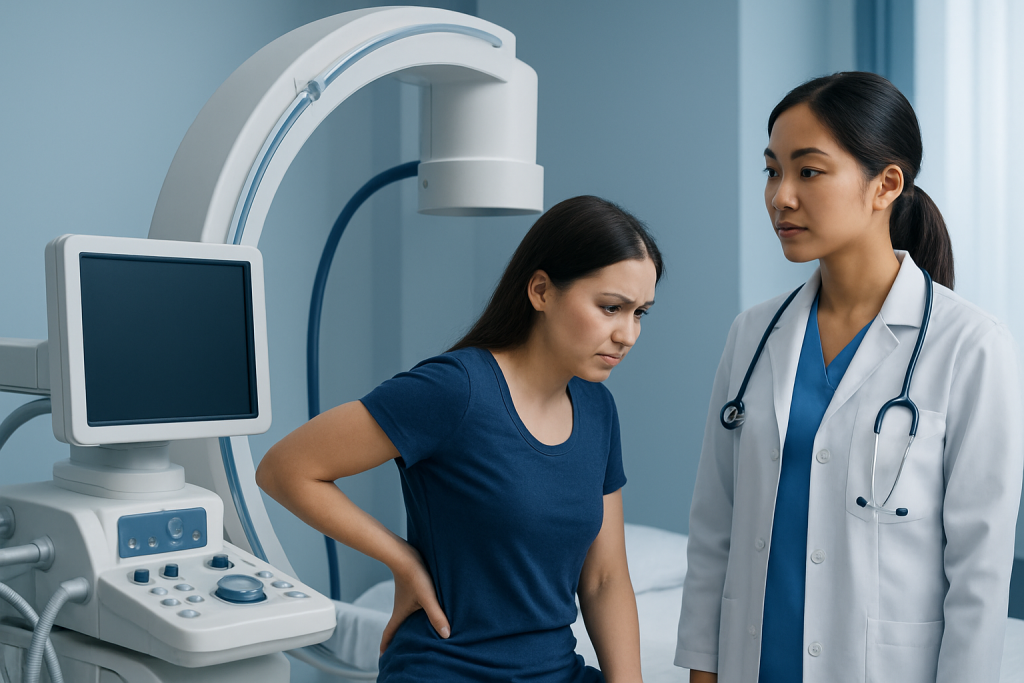
Early dextroscoliosis may be subtle. Many people do not feel pain at first, and the curve may be noticed by a parent, teacher, trainer, or doctor rather than by the person themselves. Changes are often easiest to see while standing naturally or bending forward.
Common signs can include uneven shoulders, one shoulder blade sticking out more than the other, an uneven waistline, ribs that appear more prominent on one side, or hips that do not look level. Clothing may hang unevenly, and the body may seem to lean slightly to one side. These changes do not always mean the curve is severe, but they do justify a medical assessment.
When symptoms occur, they may include back discomfort, muscle fatigue after standing or sitting for long periods, stiffness, or reduced flexibility. In more pronounced curves, especially those affecting the chest area, there can be breathing discomfort during exertion. Symptoms vary widely, and mild curves may remain symptom-free.
- Uneven shoulders or hips
- Prominent shoulder blade or rib hump
- Waist asymmetry
- Back pain or fatigue
- Visible leaning to one side
Causes and risk factors
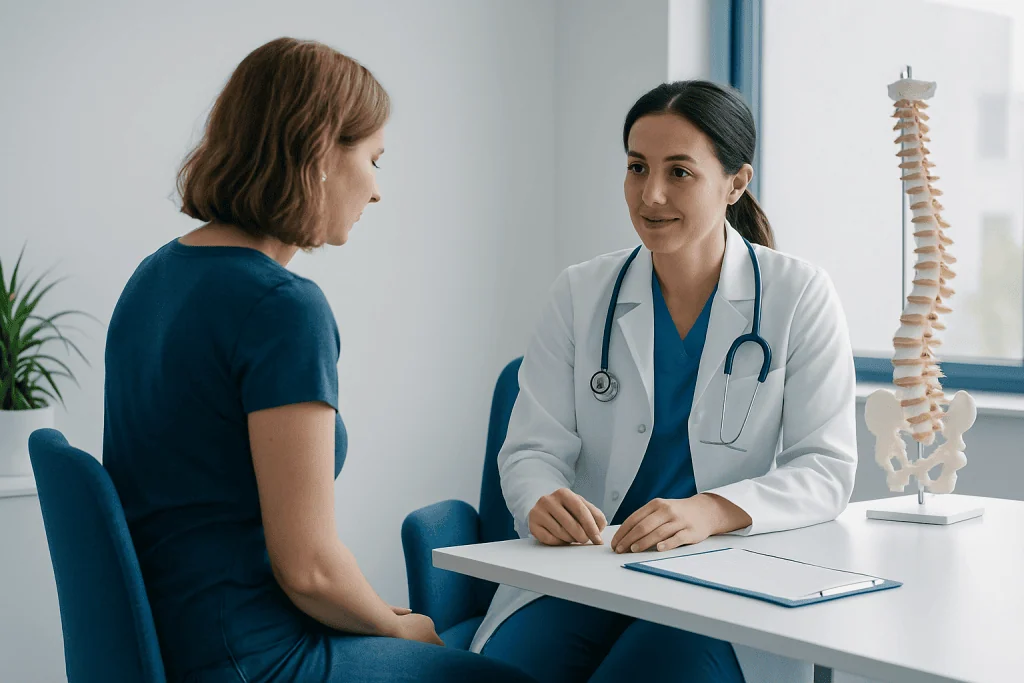
Dextroscoliosis has several possible causes. In many children and teenagers, the exact cause is unknown; this is called idiopathic scoliosis. It is the most common type and often develops during periods of rapid growth. A family history can increase the chance of scoliosis, suggesting that inherited factors may play a role.
Other cases are related to congenital changes in the spine, meaning the vertebrae did not form typically before birth. Neuromuscular conditions that affect muscle control and balance can also lead to scoliosis because the spine is not supported evenly. In adults, degenerative changes in the discs and joints of the spine may lead to a spinal curve over time.
Risk factors depend on age and underlying health. Adolescence is a key risk period because curves may progress as bones grow. Existing spinal conditions, osteoporosis, muscle weakness, or nerve-related disorders can also contribute. In some people, dextroscoliosis may exist alongside other spinal patterns, including scoliosis more broadly or age-related kyphosis, which changes the profile of the upper back.
How dextroscoliosis is diagnosed
Diagnosis usually begins with a medical history and physical examination. The doctor may ask when the posture change was first noticed, whether there is pain, whether the curve seems to be worsening, and whether there is a family history of scoliosis. In children and adolescents, growth stage is especially important because it affects the risk of progression.
During the exam, the doctor looks at shoulder height, waist symmetry, pelvic alignment, and spinal balance. A forward-bending test may help show rib prominence or trunk rotation. The doctor also checks flexibility, muscle strength, and nerve function to look for clues that another condition may be contributing.
Imaging confirms the diagnosis and helps measure the size of the curve. Standing X-rays are commonly used to calculate the Cobb angle, which is the standard way to describe scoliosis severity. If symptoms suggest nerve involvement, structural abnormalities, or complex anatomy, advanced imaging may be recommended, such as MRI or CT scanning. These tests help guide safe and appropriate treatment planning.
Treatment options and how decisions are made
Treatment for dextroscoliosis is individualized. Doctors consider the person’s age, the size and location of the curve, whether the curve is progressing, the amount of remaining growth, and the presence of symptoms. A mild and stable curve may only require regular follow-up, while a growing child with a worsening curve may need more active treatment.
Observation is common for smaller curves, especially when there are no significant symptoms. Follow-up visits and repeat imaging allow the care team to check whether the curve remains stable. Physical therapy and scoliosis-specific exercises may be recommended to improve posture awareness, flexibility, muscle balance, and comfort, although exercises do not correct every structural curve.
Bracing may be considered for some children and adolescents whose bones are still growing and whose curve is at risk of progressing. A brace does not usually make the spine completely straight, but it can help slow or prevent further worsening. When the curve is severe, progressive, or causing significant functional problems, surgery may be discussed. In selected cases, specialists may recommend scoliosis surgery to straighten and stabilize the spine. The decision is made carefully after reviewing imaging, symptoms, and long-term goals.
Adults with dextroscoliosis may need a different approach. Treatment often focuses first on pain control, activity modification, targeted rehabilitation, and management of associated degeneration. Surgery is usually reserved for persistent pain, marked imbalance, nerve compression, or progressive deformity that affects daily life.
Daily management, prevention, and self-care
There is no guaranteed way to prevent idiopathic dextroscoliosis, but early recognition can help reduce complications and support timely treatment. For children and teens, attention to posture changes during growth spurts can be useful. Adults should seek assessment if they notice new spinal imbalance, increasing pain, or loss of height.
Self-care does not replace medical evaluation, but it can support comfort and function. A doctor or physical therapist may advise exercises that improve core strength, spinal mobility, breathing mechanics, and body awareness. Regular activity is usually encouraged because staying mobile supports muscle conditioning and overall spinal health.
Helpful habits may include maintaining a healthy weight, using good lifting technique, avoiding long periods in one position, and following an exercise program tailored to the individual. People with back pain may benefit from structured rehabilitation such as physical therapy and rehabilitation. It is important to be cautious with unproven treatments that claim to permanently cure scoliosis without proper medical assessment.
When to seek medical care
Medical review is recommended if a child, teenager, or adult develops visible posture changes such as uneven shoulders, a rib hump, or leaning to one side. Care is also appropriate if back pain persists, walking balance changes, or daily activities become more difficult. Early evaluation can clarify whether the curve is mild and stable or whether monitoring is needed.
Prompt assessment is especially important if symptoms develop quickly, if there is weakness, numbness, or bowel or bladder changes, or if breathing becomes difficult. These features are not typical of simple mild scoliosis and may point to another spinal or neurological issue that needs urgent attention.
For people seeking specialist evaluation, Acibadem International’s multidisciplinary specialists and JCI-accredited hospitals diagnose and treat spinal conditions for international patients. A careful review by orthopedics, spine surgery, rehabilitation, and imaging teams can help determine the most appropriate next steps.
Frequently asked questions
Is dextroscoliosis the same as scoliosis?
Dextroscoliosis is a type of scoliosis. The term specifically means that the spine curves to the right when viewed from behind. Scoliosis is the broader term for a sideways spinal curve in either direction.
Can dextroscoliosis be mild and harmless?
Yes, many cases are mild and cause few or no symptoms. Some curves remain stable and only need periodic follow-up. Even so, a doctor should confirm the diagnosis and decide whether monitoring is needed.
Does dextroscoliosis always cause back pain?
No, especially in children and adolescents, scoliosis may be painless. When pain occurs, it may be due to muscle fatigue, imbalance, or age-related spinal changes. Persistent or severe pain should be evaluated because it may suggest another issue.
How is the severity of dextroscoliosis measured?
Doctors usually measure the curve on standing spine X-rays using the Cobb angle. This helps determine whether the curve is mild, moderate, or more severe. The angle is also useful for tracking whether the curve changes over time.
Can exercise fix dextroscoliosis?
Exercise can improve strength, posture awareness, flexibility, and comfort, but it does not correct every structural spinal curve. It is often used as part of a broader care plan. A tailored program from a qualified clinician is usually more helpful than generic exercises.
When is surgery considered for dextroscoliosis?
Surgery may be considered if the curve is large, keeps progressing, causes significant imbalance, or affects function or nerve health. The decision depends on age, symptoms, imaging findings, and overall health. A spine specialist can explain the expected benefits and risks for the individual situation.
References
- American Academy of Orthopaedic Surgeons
- Scoliosis Research Society
- National Institute of Arthritis and Musculoskeletal and Skin Diseases
- National Health Service
- Mayo Clinic
This article is for general information only and is not a substitute for professional medical advice. Please consult a qualified doctor about your individual situation.
Joint and spine care in Turkey — expert assessment & treatment
JCI-accredited · board-certified surgeons · reply within 24h
Add us as a Preferred Source to see more of our trusted health content across Google Search, AI Overviews and Discover.

More from the Health Library



Related Specialists
Assoc. Prof. Dr. Erkin İsmail
General Surgery
Dr. Mehmet Behram Çam
Otorhinolaryngology
Prof. Dr. İbrahim Tuncay
Orthopedic Surgery & Traumatology
Dyt. Zübeyde Demet Cerit
Nutrition & Diet