Flexibility: What Patients Need to Know

Flexibility describes how easily a joint and the surrounding tissues move through their range of motion. Healthy flexibility can improve comfort, daily movement, posture, and exercise performance.
Key Takeaways
- Flexibility describes how easily a joint and the surrounding tissues move through their range of motion.
- Healthy flexibility can improve comfort, daily movement, posture, and exercise performance.
- Flexibility varies by age, activity level, anatomy, prior injury, and medical conditions.
- Gentle, regular stretching and movement usually help more than occasional intense stretching.
- New pain, marked stiffness, swelling, weakness, or loss of function should be assessed by a doctor.
Flexibility is the ability of muscles, tendons, and joints to move through a comfortable range of motion. It supports daily function, posture, balance, and exercise, but it is not the same as overall fitness and it can be reduced by inactivity, injury, pain, or some medical conditions.
Overview: What flexibility means
Flexibility is the ability of a joint and the surrounding muscles, tendons, ligaments, and connective tissue to move through a normal, comfortable range of motion. In practical terms, it affects how easily a person can bend, reach, turn, squat, walk, and perform everyday tasks. Good flexibility supports movement efficiency, while reduced flexibility may contribute to stiffness, discomfort, or changes in posture and activity tolerance.
Patients often hear flexibility discussed together with mobility, but the two are not exactly the same. Flexibility usually refers to the length and stretch capacity of soft tissues and the range available at a joint. Mobility is broader: it also includes muscle control, joint function, balance, coordination, and strength. A person may be naturally flexible but still have poor mobility if movement control is limited.
Flexibility also exists on a spectrum. Very limited flexibility can interfere with daily life or exercise, but very high flexibility is not automatically better. Some people have naturally loose joints, called hypermobility, which may or may not cause symptoms. The goal is not to force the body into extreme positions, but to maintain comfortable, functional movement that suits a person’s age, body structure, and health needs.
Why flexibility matters for health and daily life
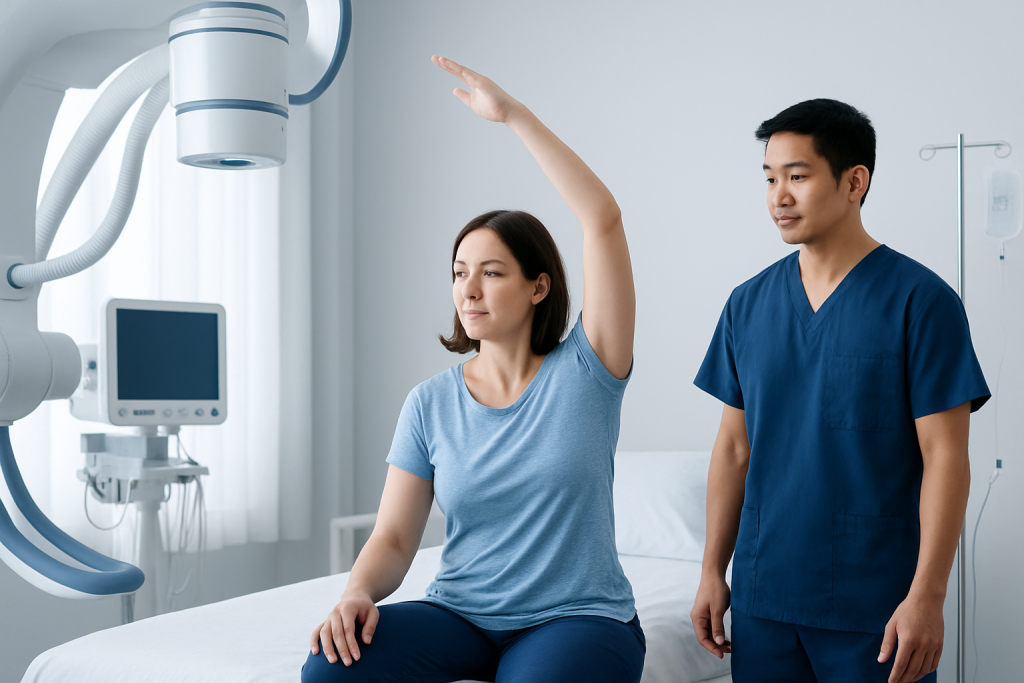
Flexibility helps the body move more comfortably and efficiently. It can make simple activities easier, such as getting out of bed, reaching overhead, turning the head while driving, climbing stairs, or putting on shoes. For people who exercise, flexibility may also support movement quality and make it easier to perform activities such as walking, swimming, strength training, yoga, or recreational sports.
Many patients also notice the effects of flexibility on posture and muscle tension. Sitting for long periods, repetitive work, and reduced physical activity can shorten some muscles and overload others. This may contribute to a feeling of tight hips, stiff shoulders, or a reduced ability to straighten the back fully. In these situations, improving flexibility can be one part of a broader plan to restore comfortable movement.
At the same time, flexibility alone does not prevent all injuries or pain. Muscle strength, movement technique, workload, sleep, stress, and underlying joint or nerve problems also play important roles. For this reason, stretching is usually most effective when combined with regular activity, strengthening, and attention to ergonomics and recovery.
What affects flexibility

Flexibility is influenced by many factors, including age, genetics, previous injuries, activity level, posture, occupation, and overall health. Children and younger adults are often more flexible than older adults, but age-related changes vary from person to person. Some people are naturally more flexible because of their connective tissue or joint structure, while others have a naturally smaller but still normal range of motion.
Inactivity is one of the most common reasons flexibility decreases. Long periods of sitting or limited movement after surgery, illness, or injury can lead to muscle shortening and joint stiffness. Pain itself can also reduce flexibility because the body instinctively limits movement to protect a sensitive area. Over time, this protective pattern may become part of a cycle of tension, weakness, and reduced confidence in movement.
Medical conditions can also play a role. Arthritis, tendon problems, back pain, neurological disorders, and prior fractures may reduce movement in a joint or muscle group. In some people, unusually high flexibility is linked to joint looseness and recurrent discomfort. If flexibility changes suddenly or becomes uneven between sides of the body, a clinician may consider whether there is an underlying musculoskeletal or nerve-related cause, including conditions such as a herniated disc in the right clinical setting.
Signs flexibility may be reduced or causing problems
Reduced flexibility may show up as a feeling of tightness, stiffness, or resistance during movement. A person may notice difficulty bending forward, rotating the neck, lifting the arms overhead, getting down to the floor, or fully straightening the knees or hips. Stiffness may be most noticeable in the morning, after exercise, or after long periods of sitting.
Not all tightness means the tissues are truly short. Sometimes the body senses a movement as threatening because of pain, inflammation, weakness, or poor movement control. This is one reason why forcing a stretch can be unhelpful and may worsen symptoms. Pain, numbness, swelling, instability, or loss of strength should not be dismissed as simple inflexibility.
Areas commonly affected include the calves, hamstrings, hip flexors, lower back, chest, and shoulders. For some patients, reduced flexibility contributes to broader problems such as altered walking pattern, recurrent muscle strain, or chronic neck or back discomfort. If symptoms are persistent, a doctor may look for related conditions such as scoliosis or degenerative joint changes rather than assuming that stretching alone will solve the issue.
How flexibility is assessed
Doctors, physiatrists, sports medicine specialists, or physiotherapists assess flexibility by taking a medical history and examining movement patterns. They may ask when stiffness began, whether there is pain or swelling, what activities make symptoms better or worse, and whether there has been an injury, surgery, or neurological symptom. The pattern of stiffness often helps distinguish ordinary deconditioning from an underlying joint, muscle, or nerve problem.
The physical examination may include observation of posture, walking, balance, and how the person bends, reaches, twists, or squats. Specific joints may be tested for active range of motion, when the patient moves independently, and passive range of motion, when the clinician gently moves the joint. Strength, tenderness, reflexes, and sensation may also be checked if there is concern about a more complex cause.
Imaging or laboratory tests are not needed for most people who simply want to improve general flexibility. However, if there is persistent pain, trauma, weakness, joint locking, inflammation, or suspected structural disease, further evaluation may be appropriate. Depending on the problem, this can include examination by orthopedic specialists or formal rehabilitation assessment with physical therapy and rehabilitation.
Safe ways to improve flexibility
The most reliable way to improve flexibility is with regular, gentle practice rather than occasional intense stretching. Tissues tend to respond better to gradual, repeated movement over time. A short routine done most days is often more useful than a long session done only once in a while.
General approaches that may help include:
- Warming up with light walking or easy movement before stretching
- Using slow, controlled stretches rather than bouncing
- Holding a stretch at mild tension, not sharp pain
- Balancing flexibility work with strengthening and posture training
- Taking movement breaks during prolonged sitting
- Progressing gradually, especially after injury or surgery
Dynamic stretches, such as controlled leg swings or arm circles, may suit a warm-up before exercise. Static stretching, where a position is held comfortably for a short period, may be useful after activity or as a separate routine. Breathing steadily and avoiding force are important. If a stretch produces numbness, tingling, joint pain, or pain that lingers afterward, the technique should be adjusted or stopped.
Some people benefit from a personalized plan, especially if stiffness is linked to injury, chronic pain, or a condition affecting the spine or joints. In selected cases, referral for spine care or other specialist treatment may be needed if symptoms reflect more than simple muscle tightness.
Prevention, self-care, and healthy expectations
Maintaining flexibility is often easier than regaining it after a long period of inactivity. Regular physical activity, varied movement during the day, and attention to workplace or home ergonomics can help reduce stiffness. Even simple habits, such as standing up regularly, changing positions, and walking short distances, may support joint comfort.
Hydration, sleep, and recovery also matter indirectly because fatigued or sore tissues tend to feel tighter. Strength training can improve how joints are supported and may reduce the sense of strain during everyday movement. People who exercise intensely should include rest and recovery, since overtraining can create persistent soreness that feels like loss of flexibility.
It is also helpful to set realistic expectations. Flexibility changes gradually, and the ideal range differs from one person to another. Comparing body positions with athletes, dancers, or images online can be misleading. The most meaningful goals are usually practical ones, such as walking more comfortably, sitting with less stiffness, or returning to a favorite activity with better control and less pain.
Near the end of a care pathway, some patients benefit from multidisciplinary evaluation if stiffness coexists with pain, injury, or spinal problems. Acibadem International’s multidisciplinary specialists at JCI-accredited hospitals evaluate and treat musculoskeletal conditions for international patients when more detailed assessment is needed.
When to seek medical care
Most mild stiffness improves with regular movement, stretching, and time. However, medical advice is important if reduced flexibility comes with significant pain, swelling, redness, warmth, weakness, numbness, joint instability, fever, or a clear injury. These features may suggest a problem that needs more than self-care.
A doctor should also be consulted if stiffness lasts for weeks, worsens over time, limits work or sleep, or affects only one area in a pronounced way. Children, older adults, and people with chronic diseases may need earlier assessment, especially if movement changes suddenly. Anyone with back or neck stiffness plus radiating pain, tingling, or loss of strength should be evaluated promptly.
Seeking care does not always mean a serious condition is present. Often, an assessment simply helps identify whether the issue is deconditioning, a biomechanical problem, inflammation, or an underlying orthopedic or neurological condition. Early guidance can make exercise safer and more effective.
Frequently asked questions
What is the difference between flexibility and mobility?
Flexibility refers mainly to how far a joint and the surrounding soft tissues can move comfortably. Mobility is a broader concept that includes flexibility plus strength, coordination, balance, and control during movement. A person can be flexible but still have limited mobility if movement is poorly controlled or painful.
Can flexibility be improved at any age?
Yes. Although tissues change with age, many people can improve or maintain flexibility through regular, gentle movement and stretching. Progress may be slower in older adults, but consistent practice often helps comfort and function.
How often should a person stretch to improve flexibility?
For most people, short and regular sessions are more helpful than occasional intense stretching. Many routines are done several times per week or daily, depending on goals and comfort. A clinician or physiotherapist can suggest a safer plan when pain or medical conditions are present.
Is it normal to feel pain during stretching?
Mild tension or pulling can be normal, but sharp pain is not the goal. Stretching should feel controlled and tolerable, not forced. Pain, numbness, tingling, or pain that continues after the stretch may mean the movement should be modified or stopped.
Does poor flexibility always cause injury?
No. Injury risk depends on many factors, including strength, training load, movement technique, prior injury, and recovery. Limited flexibility can contribute to strain in some people, but it is only one part of overall movement health.
When should stiffness be checked by a doctor?
Medical assessment is sensible if stiffness is persistent, getting worse, or interfering with sleep, work, or daily activity. Care is also important if stiffness comes with swelling, weakness, numbness, fever, or follows an injury. These signs may point to a condition that needs targeted treatment.
References
- World Health Organization
- American College of Sports Medicine
- National Institute of Arthritis and Musculoskeletal and Skin Diseases
- Centers for Disease Control and Prevention
- American Academy of Orthopaedic Surgeons
This article is for general information only and is not a substitute for professional medical advice. Please consult a qualified doctor about your individual situation.
Joint and spine care in Turkey — expert assessment & treatment
JCI-accredited · board-certified surgeons · reply within 24h
Add us as a Preferred Source to see more of our trusted health content across Google Search, AI Overviews and Discover.

More from the Health Library



Related Specialists

Assoc. Prof. Dr. Dilek Hacer Çeşme
Radiology
Prof. Dr. Levent Eralp
Orthopedic Surgery & Traumatology
Prof. Dr. Gülbin Bingöl
Pediatric Allergy
Prof. Dr. Nigar Baykan
Anesthesiology