How Long Do Lab and Imaging Results Take to Come Back?

Some routine blood tests are ready within hours, while specialized tests may take several days or longer. Imaging results may be available the same day, but the final radiology report can take longer.
Key Takeaways
- Some routine blood tests are ready within hours, while specialized tests may take several days or longer.
- Imaging results may be available the same day, but the final radiology report can take longer.
- Urgent or emergency tests are usually prioritized and reported faster.
- Delays can happen if a sample needs repeat processing, send-out testing, or expert review.
- Patients should ask when and how results will be shared, and whom to contact if they are delayed.
Lab and imaging results do not all come back at the same speed. Timing depends on the type of test, how urgently it is needed, and whether a specialist must review the sample or images before a final report is released.
Overview: Why result times vary
People often expect all medical test results to come back quickly, but there is no single timeline for every test. Some routine laboratory tests can be completed within a few hours, while others need special equipment, careful preparation, or review by a specialist. Imaging studies may generate pictures immediately, yet the formal interpretation still depends on a radiologist or another doctor reading the images and writing a report.
The time needed for lab and imaging results depends on several practical steps. A sample may need to be collected, labeled, transported, prepared, analyzed, checked for accuracy, and approved before it appears in a patient portal or reaches the doctor. Imaging follows a similar process: the scan is performed, images are checked for quality, then reviewed and reported by a qualified specialist.
Urgency also matters. Tests ordered in an emergency department, intensive care unit, or before urgent surgery are often processed faster than routine outpatient testing. Even then, a fast preliminary result may later be followed by a more complete final report.
Typical turnaround times for common lab tests
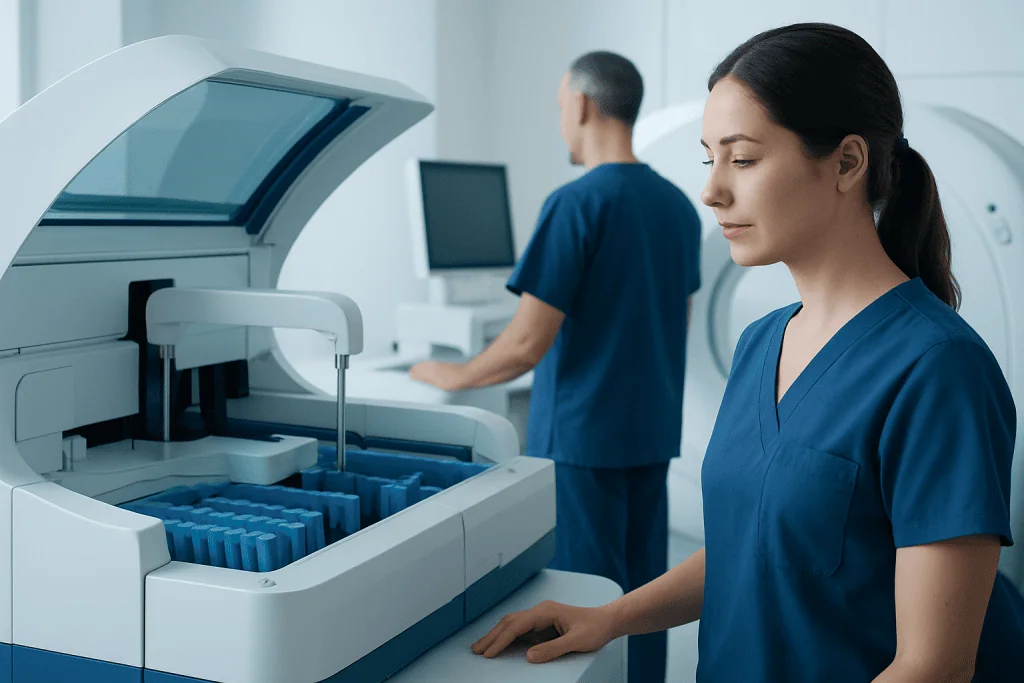
Many routine blood and urine tests are available the same day or within 24 hours. Examples include a complete blood count, basic metabolic panel, blood glucose, kidney function, and many urine tests. In hospitals and larger laboratories, these tests are often run several times a day, which helps shorten turnaround time.
Some laboratory results take longer because they are more specialized. Hormone tests, vitamin levels, certain autoimmune markers, allergy panels, and genetic tests may take several days to a few weeks. In some cases, the sample is sent to another laboratory with special expertise, which adds transport and processing time.
Microbiology tests, such as cultures, are a common reason for waiting. A urine, throat, blood, or wound culture may need time for bacteria or fungi to grow before the laboratory can identify them and check which treatments may work best. This often means that an early update is available before the final result is complete.
- Routine blood work: often hours to 1 day
- Routine urine testing: often same day
- Specialized blood tests: often several days
- Culture-based tests: often a few days, sometimes longer
- Genetic or advanced molecular tests: may take days to weeks
Typical turnaround times for imaging tests

Imaging tests also vary in timing. A standard X-ray is usually performed quickly, and the images are available right away to the imaging department. However, the final result most patients receive is the radiologist’s report, not just the images themselves. That report may be ready the same day or within one to two business days, depending on the setting.
Ultrasound, CT, and MRI often follow a similar pattern. The scan itself may take from a few minutes to an hour or more, but the formal interpretation can take longer. More complex studies, such as MRI of the brain, multiphase CT, or specialized cardiac imaging, may require a more detailed review before the report is finalized.
Mammography, nuclear medicine scans, PET imaging, and some screening tests may also involve additional steps. If a comparison with older studies is needed, or if a second reader is involved for quality assurance, the timeline can be longer. In urgent situations, a doctor may receive a rapid preliminary impression even before the full report is released.
- X-ray: often same day or within 1-2 days for the report
- Ultrasound: often same day or within 1-2 days
- CT scan: often same day to 2 days
- MRI: often 1-3 days, sometimes longer for complex studies
- Nuclear medicine or PET: often 1-3 days depending on review and scheduling
What can make results take longer?
Several factors can delay results even when a test itself is straightforward. Laboratories may need to repeat a sample if there is not enough blood, if the sample was damaged in transport, or if the result appears inconsistent and needs verification. Imaging can be delayed if pictures must be repeated because of movement, technical problems, or the need for additional views.
Another common reason is specialist review. Certain pathology, microbiology, genetic, and radiology findings need expert interpretation before a final answer can be given. If a pathologist is examining tissue under a microscope or a radiologist is comparing current images with prior studies, extra time may be needed to ensure accuracy.
Administrative steps may also play a role. Results often need to be signed off, transferred into the electronic medical record, and then communicated to the ordering doctor or patient. Weekends, holidays, staffing levels, and whether the test was done in a clinic, hospital, or outside laboratory can all affect timing.
Although waiting can be stressful, a longer turnaround does not necessarily mean something is wrong. In many cases, it simply reflects the care needed to produce an accurate result.
How results are reviewed and shared
Most results are first sent to the clinician who ordered the test. That doctor or healthcare professional reviews the findings in the context of symptoms, medical history, medications, and previous results. This step is important because a number on a lab report or a phrase on an imaging report may not tell the full story by itself.
Patients may receive results through a secure online portal, phone call, text notification, or follow-up appointment. Some systems release results automatically as soon as the laboratory or radiologist finalizes them, while others are reviewed by the doctor before the patient sees them. This process can vary between hospitals, clinics, and countries.
If a result needs urgent action, the healthcare team usually contacts the patient sooner. For non-urgent findings, communication may happen at the next visit or through a routine message. Patients should ask in advance when to expect an update and the best way to receive it.
What patients can do while waiting
Waiting for results can be uncomfortable, especially when a test was ordered to investigate troubling symptoms. One helpful step is to ask clear questions before leaving the appointment or imaging center. Patients can ask when results are expected, whether they will receive a preliminary or final report, and whom to contact if nothing has arrived by the expected date.
It is also useful to keep track of the test name, the date it was done, and the clinic or hospital where it was performed. This information makes follow-up easier if there is a delay. If an imaging study is part of a broader workup, such as breast cancer evaluation or assessment of lung cancer, the doctor may explain that timing depends on multiple reports being reviewed together.
Patients should avoid trying to interpret a result alone without medical guidance, especially if the wording seems technical or uncertain. Many findings are only meaningful when considered alongside symptoms, physical examination, and other tests. If further evaluation is needed, doctors may recommend additional blood work, MRI, CT scan, or ultrasound to clarify the picture.
When to follow up or seek medical help
If results have not arrived within the timeframe the healthcare team provided, it is reasonable to call the clinic, laboratory, or imaging center. A polite follow-up can often clarify whether the result is still processing, has already been sent to the doctor, or needs an appointment to discuss it properly.
Patients should seek more prompt advice if symptoms are worsening while they wait. Examples include severe pain, shortness of breath, chest pain, fainting, signs of dehydration, heavy bleeding, confusion, or a high fever. New or rapidly changing symptoms should not be ignored simply because test results are pending.
Urgent medical attention may also be needed if a doctor has specifically warned about red-flag symptoms related to the reason for testing. If a patient is unsure, contacting the treating team is the safest step. Near the end of the care pathway, centers such as Acibadem International can support international patients through coordinated testing and specialist review in JCI-accredited hospitals when further diagnostic evaluation is needed.
Frequently asked questions
Do abnormal results usually take longer to come back?
Not necessarily. A result may take longer because the sample needs confirmation, repeat testing, or specialist review, but this does not automatically mean something serious has been found. In many cases, delays are caused by normal laboratory and reporting processes.
Can a doctor see my imaging results before I do?
Yes. In many healthcare systems, the ordering doctor receives the report first or at the same time it appears in the patient portal. This allows the doctor to interpret the finding in context and explain what it means for the next steps.
Why do cultures take longer than routine blood tests?
Cultures often require time for bacteria or fungi to grow in the laboratory before they can be identified. After that, additional testing may be done to see which treatments are likely to work best. This process naturally takes longer than automated routine blood tests.
Is the scan finished once the images are taken?
The image acquisition may be finished, but the test is usually not complete until a radiologist reviews the images and writes a report. If the study is complex or comparisons with earlier scans are needed, the final report may take longer.
What should a patient do if results are delayed?
It is appropriate to contact the clinic or testing center if the expected date has passed. Having the test name and date ready can help staff locate the result quickly. If symptoms are worsening, the patient should seek medical advice rather than waiting longer.
Can patients see results in the portal before the doctor calls?
Sometimes yes, depending on the healthcare system and local policy. Some portals release results automatically as soon as they are finalized, while others wait until the clinician has reviewed them. If the result wording is unclear, it is best to discuss it with a qualified doctor.
This article is for general information only and is not a substitute for professional medical advice. Please consult a qualified doctor about your individual situation.
Explore treatments in Turkey — costs, top hospitals & a free quote
JCI-accredited · board-certified surgeons · reply within 24h
Add us as a Preferred Source to see more of our trusted health content across Google Search, AI Overviews and Discover.

More from the Health Library

Biopsy: Types, Image Guidance, and What Pathology Results Mean
CT Scan vs MRI: Which Imaging Test Is Right for You?

Evoked Potential Tests: How Nerve Pathways Are Evaluated

What Affects the Cost of Diagnostic Tests and Imaging?

What Is a Diagnostic Test? Types, Purpose, and How Results Help Doctors