How to Perform Cpr? Here Is What the Evidence Says

If a person is unresponsive and not breathing normally, call emergency services and start CPR right away. For most teens and adults, hands-only CPR means chest compressions in the center of the chest at 100 to 120 compressions per minute.
Key Takeaways
- If a person is unresponsive and not breathing normally, call emergency services and start CPR right away.
- For most teens and adults, hands-only CPR means chest compressions in the center of the chest at 100 to 120 compressions per minute.
- An AED should be used as soon as it is available; it gives step-by-step voice prompts.
- Rescue breaths are especially important for infants, children, drowning, and some breathing-related emergencies if the rescuer is trained.
- CPR should continue until the person shows signs of life, another trained rescuer takes over, an AED tells the rescuer to pause, or emergency teams arrive.
How to perform CPR starts with calling emergency services, giving hard and fast chest compressions in the center of the chest, and using an AED as soon as it is available. Evidence shows that early action by a bystander can help keep blood flowing to the brain and heart until professional help arrives.
Overview: What CPR Is and When It Helps
CPR, or cardiopulmonary resuscitation, is an emergency first-aid technique used when a person is unresponsive and not breathing normally, or is only gasping. It combines chest compressions, and sometimes rescue breaths, to help move oxygen-rich blood to the brain and other vital organs until emergency professionals can take over.
When people ask how to perform CPR, the evidence-based answer is straightforward: check for responsiveness and normal breathing, call emergency services, begin chest compressions immediately, and use an automated external defibrillator (AED) as soon as one is available. Acting quickly matters because every minute without circulation reduces the chance of survival.
Most adults who suddenly collapse outside the hospital have a cardiac arrest caused by an electrical problem in the heart. CPR does not restart the heart by itself, but it can buy time. An AED may restore a shockable rhythm, which is why early CPR and early defibrillation are often taught together. In some situations, the cause may be related to a serious heart problem such as heart attack.
How to Recognize an Emergency
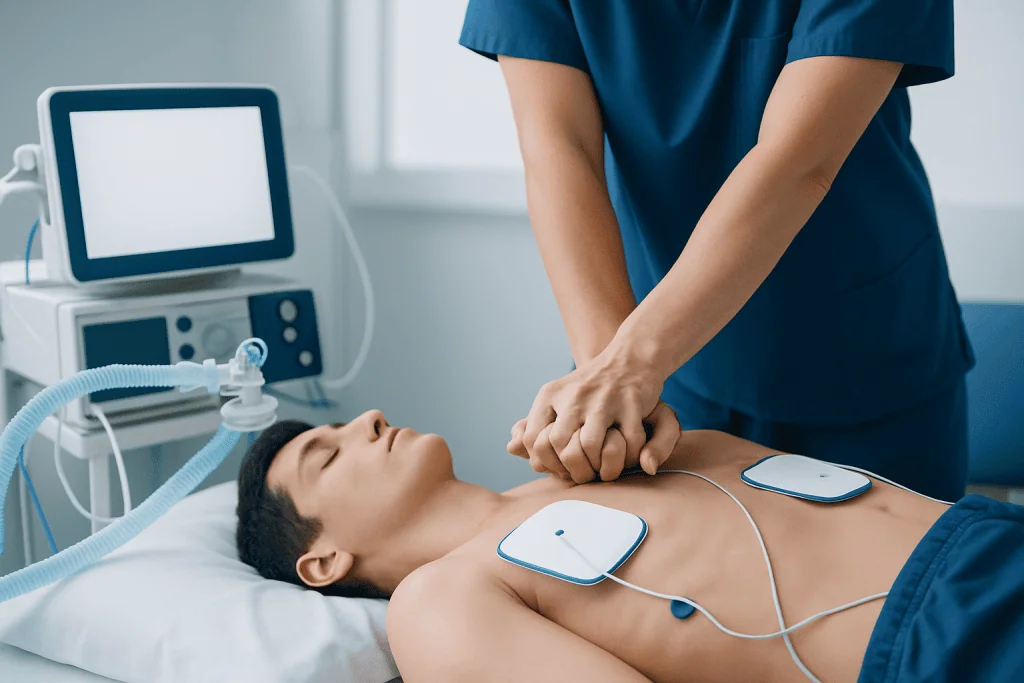
The first step is to decide whether CPR is needed. A person may need CPR if they collapse, do not respond when spoken to or gently tapped, and are not breathing normally. Occasional gasps, snorting sounds, or irregular breaths are not normal breathing and should be treated as an emergency.
If the scene is unsafe, the rescuer should not put themselves in danger. Once the area seems safe, it helps to check for responsiveness by speaking loudly and tapping the person on the shoulder. If there is no response, someone nearby should be asked to call emergency services and get an AED. If the rescuer is alone and has a mobile phone, they can call emergency services on speaker while starting CPR.
Cardiac arrest can sometimes be confused with fainting, a seizure, or severe breathing distress. If there is any doubt and the person is unresponsive and not breathing normally, it is usually better to begin CPR. Emergency dispatchers can often guide bystanders through the steps over the phone.
- Signs that support starting CPR include unresponsiveness, no normal breathing, or only gasping.
- Seizure-like movements can occur briefly at the start of cardiac arrest.
- If an infant or child is unresponsive and not breathing normally, CPR should also begin quickly, but technique differs from adults.
How to Perform CPR in Adults: Step by Step
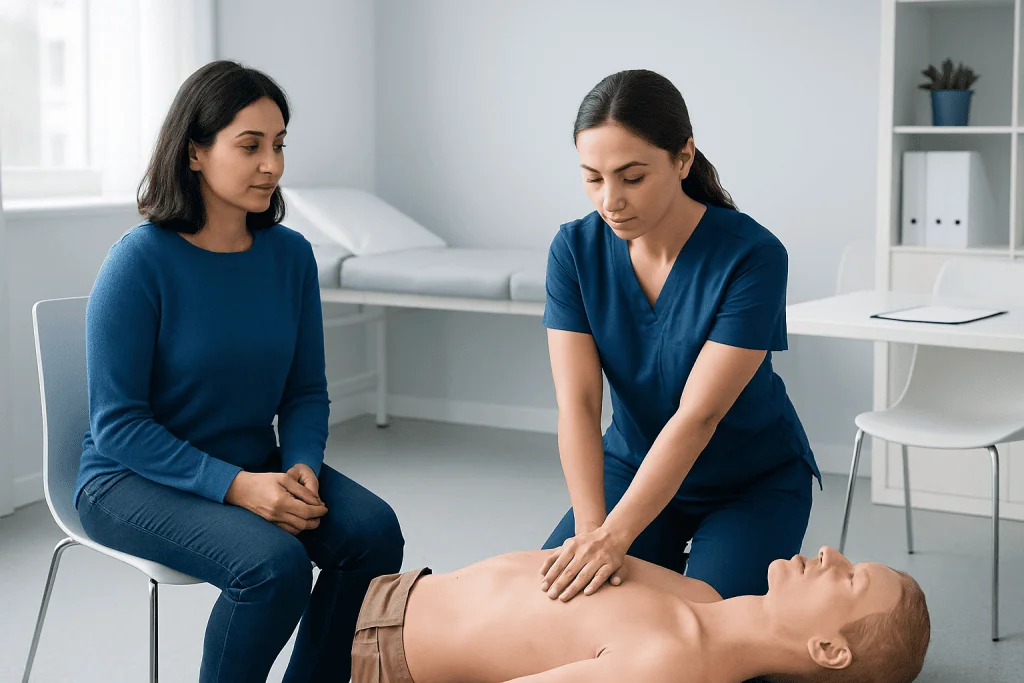
For most adults and teens, hands-only CPR is recommended for untrained bystanders. Place the person flat on their back on a firm surface. Kneel beside the chest. Put the heel of one hand in the center of the chest, on the lower half of the breastbone, and place the other hand on top. Keep the arms straight and shoulders directly over the hands.
Push hard and fast, allowing the chest to come fully back up after each compression. The recommended rate is 100 to 120 compressions per minute, with a depth of about 2 inches, or 5 to 6 centimeters, in adults. Trying to match the beat of a familiar fast song can help maintain the rhythm, but the focus should stay on steady, uninterrupted compressions.
If the rescuer is trained and willing to give breaths, standard CPR typically uses cycles of 30 chest compressions followed by 2 rescue breaths. To give breaths, open the airway with a head-tilt, chin-lift unless trauma is strongly suspected, pinch the nose closed, seal the mouth, and give 2 breaths just enough to make the chest rise. Then return immediately to chest compressions.
CPR should continue until the person starts breathing normally, an AED is ready to analyze the rhythm, another trained helper takes over, the rescuer is physically unable to continue, or emergency teams arrive. If available after resuscitation, hospital teams may use advanced support such as coronary angiography when a heart-related cause is suspected.
Special Situations: Children, Infants, Drowning, and Choking
Children and infants often have cardiac arrest because of breathing problems rather than a sudden primary heart rhythm problem. Because of this, rescue breaths are especially important if the rescuer has training. For a child, one or two hands may be used for compressions depending on body size. For an infant, compressions are usually done with two fingers or a two-thumb technique if two rescuers are present.
Compression depth should be about one-third of the chest depth: around 2 inches, or 5 centimeters, in children and about 1.5 inches, or 4 centimeters, in infants. The rate remains 100 to 120 compressions per minute. If alone with a child or infant and no phone is immediately available, many CPR courses advise giving about 2 minutes of CPR before leaving briefly to call for help, unless the collapse was sudden and witnessed.
In drowning, suffocation, drug overdose, or other breathing-related emergencies, oxygen is often the main problem, so breaths can be particularly helpful. If choking is suspected and the person becomes unresponsive, CPR should begin, and the mouth should be checked for a visible object before breaths. Blind finger sweeps should be avoided because they can push an object deeper.
When an emergency may be related to stroke rather than cardiac arrest, the response differs. A person who is awake with facial drooping, arm weakness, or speech trouble needs urgent medical help but not CPR unless they become unresponsive and stop breathing normally. In those situations, doctors may later evaluate for conditions such as stroke.
How to Use an AED
An AED, or automated external defibrillator, is designed for public use and can be used by people without medical training. As soon as the device arrives, it should be turned on and the spoken or visual prompts should be followed. The chest should be exposed, and the pads placed exactly as shown on the diagrams, usually one pad on the upper right chest and the other on the lower left side.
The AED analyzes the heart rhythm and tells rescuers whether a shock is advised. No one should be touching the person during analysis or shock delivery. If a shock is delivered, CPR should resume immediately afterward, starting with chest compressions. If no shock is advised, CPR should still continue until the AED rechecks or emergency professionals take over.
Special care may be needed if the chest is very wet, very hairy, or has a visible implanted device such as a pacemaker bulge under the skin. Drying the chest quickly and placing pads slightly away from a device usually helps. Pediatric pads should be used for children when available, though an adult AED can still be lifesaving if pediatric equipment is not on hand.
Common Questions, Mistakes, and Safety Points
Many people hesitate because they worry about doing CPR incorrectly. In a true cardiac arrest, doing something promptly is usually better than doing nothing. Chest compressions can cause bruising or even rib fractures, but these injuries are generally less serious than the lack of blood flow that happens when CPR is delayed.
Common mistakes include pressing too shallowly, stopping too often, leaning on the chest between compressions, or delaying CPR while searching for a pulse. For untrained bystanders, pulse checks are not recommended. The simplest evidence-based approach is to recognize unresponsiveness and absent normal breathing, call for help, and start compressions immediately.
Barrier devices and rescue masks may reduce infection concerns during breaths, but they should not delay compressions. If an opioid overdose is suspected, emergency dispatchers may advise naloxone if available, but CPR still remains essential when breathing is absent or abnormal. Hospital evaluation may later include heart rhythm monitoring and procedures such as electrophysiology in selected cases.
After CPR: What Happens Next
If the person begins to breathe normally and move, they should be monitored closely until emergency services arrive. If they remain unconscious but are breathing, they may be placed on their side in a recovery position if there is no concern for major trauma. Breathing can stop again, so continued observation is important.
After a resuscitation attempt, doctors look for the cause of the cardiac arrest and assess for any injury from lack of oxygen. Evaluation may include an electrocardiogram, blood tests, imaging, and continuous monitoring. Depending on the suspected cause, treatment could involve cardiology care, intensive care support, or other specialist input.
People who witness or perform CPR often feel shaken afterward. This is a normal response to a stressful event. It may help to speak with healthcare professionals, emergency responders, or support services about what happened and whether formal CPR training would be useful in the future.
When to Seek Medical Care and How to Prepare
CPR itself is always an emergency response. Immediate medical care is needed whenever a person is unresponsive and not breathing normally. Emergency services should be called right away, even if the person seems to recover after a brief collapse, because serious underlying problems can still be present.
Medical review is also important after choking, drowning, electric shock, suspected overdose, major trauma, chest pain before collapse, or repeated fainting episodes. Doctors may assess the heart, lungs, brain, and blood circulation to understand what happened and to reduce the risk of it happening again.
Preparation can make a real difference. Families may consider learning certified CPR, becoming familiar with AED locations at work or in public places, and keeping emergency contacts easily accessible. Near the end of the care pathway, patients who need evaluation and treatment may be seen by multidisciplinary specialists at Acibadem International’s JCI-accredited hospitals, which care for international patients with emergency and cardiovascular conditions.
Frequently asked questions
What is the first thing to do before starting CPR?
The rescuer should first make sure the scene is safe, then check whether the person responds and is breathing normally. If there is no response and breathing is absent or only gasping, emergency services should be called and CPR should begin right away.
How fast should chest compressions be during CPR?
Chest compressions should be given at a rate of 100 to 120 compressions per minute. They should also be deep enough and allow full chest recoil between compressions.
Do untrained bystanders need to give rescue breaths?
For most adults and teens, untrained bystanders can perform hands-only CPR using continuous chest compressions. Rescue breaths are more important in children, infants, drowning, and other breathing-related emergencies if the rescuer has training.
Where should hands be placed for adult CPR?
The heel of one hand should be placed in the center of the chest on the lower half of the breastbone, with the other hand on top. The rescuer should keep the arms straight and press downward using body weight.
Should CPR stop once an AED arrives?
CPR should only pause briefly so the AED can analyze the rhythm or deliver a shock if advised. Chest compressions should restart immediately after the shock or when the AED instructs the rescuer to continue.
Can CPR harm someone if it turns out they did not need it?
CPR can cause bruising or rib injuries, but in a person who may be in cardiac arrest, the risk of delaying treatment is usually much greater. If the person is unresponsive and not breathing normally, it is generally safest to start CPR and follow dispatcher instructions.
References
- American Heart Association
- European Resuscitation Council
- International Liaison Committee on Resuscitation
- Centers for Disease Control and Prevention
- National Heart, Lung, and Blood Institute
This article is for general information only and is not a substitute for professional medical advice. Please consult a qualified doctor about your individual situation.
Explore treatments in Turkey — costs, top hospitals & a free quote
JCI-accredited · board-certified surgeons · reply within 24h
Add us as a Preferred Source to see more of our trusted health content across Google Search, AI Overviews and Discover.

More from the Health Library


Related Specialists

Dr. Ali Osman Çiçek
Orthopedic Surgery & Traumatology
Dr. Zeynel Sütoluk
Emergency Service
Dr. Kutluhan Demirarslan
Inpatient Clinic Physicians Clinical Service
Dr. Serhat Konar
Anesthesiology