Narcolepsy Testing: How to Prepare for an MSLT and Sleep Lab Evaluation

Narcolepsy is diagnosed with a careful clinical history plus sleep testing, not by symptoms alone. Most people being evaluated have an overnight polysomnography test followed by a daytime MSLT.
Key Takeaways
- Narcolepsy is diagnosed with a careful clinical history plus sleep testing, not by symptoms alone.
- Most people being evaluated have an overnight polysomnography test followed by a daytime MSLT.
- Preparation matters because sleep loss, caffeine, medications, and irregular schedules can affect results.
- Sleep specialists also use testing to rule out other causes of daytime sleepiness, such as sleep apnea.
- Patients should always ask their doctor before stopping any medicine before a sleep lab evaluation.
Narcolepsy testing usually involves an overnight sleep study followed by a multiple sleep latency test (MSLT) the next day. Knowing how these tests work and how to prepare can help make results more accurate and the experience less stressful.
Overview: Why Narcolepsy Testing Is Needed
Narcolepsy is a long-term neurological sleep disorder that affects the brain’s control of sleep and wakefulness. People with narcolepsy may feel excessively sleepy during the day, fall asleep unexpectedly, or experience symptoms such as vivid dream-like experiences when falling asleep or waking up. Some also have cataplexy, which is a brief loss of muscle tone triggered by strong emotions.
Because these symptoms can overlap with other sleep, neurological, or mental health conditions, testing is important. Doctors do not diagnose narcolepsy from tiredness alone. Instead, they combine a detailed symptom history with specialized sleep studies to understand how quickly a person falls asleep and whether REM sleep appears unusually early.
The main tests used are overnight polysomnography in a sleep lab and the multiple sleep latency test, or MSLT, the following day. These tests help confirm narcolepsy and rule out other causes of daytime sleepiness, such as insufficient sleep, obstructive sleep apnea, circadian rhythm disorders, medication effects, or other neurological conditions.
Evaluation is often led by specialists in neurological sleep medicine or sleep neurology. In some cases, broader neurological assessment may also be useful, especially if symptoms are complex or overlap with other disorders.
Symptoms That May Lead to a Sleep Lab Evaluation
The most common reason for narcolepsy testing is excessive daytime sleepiness. This means a person feels persistently sleepy even after what seems like a full night of sleep. They may struggle to stay awake during work, school, reading, meetings, or car rides. Some people describe “sleep attacks,” when sleep comes on quickly and feels difficult to resist.
Doctors also ask about cataplexy, which can include jaw dropping, slurred speech, weak knees, or sudden loss of muscle strength during laughter, surprise, or other emotions. Cataplexy does not happen in everyone with narcolepsy, but when it is present, it is a very important clue.
Other symptoms may include sleep paralysis, vivid hallucination-like experiences as sleep begins or ends, restless nighttime sleep, and automatic behaviors done with little awareness. These symptoms do not always mean narcolepsy, but they can suggest that a formal sleep evaluation is appropriate.
Many people worry that their symptoms are caused by another neurological problem. A clinician may consider a broader workup if signs point away from narcolepsy alone. For example, if weakness, sensory changes, severe headaches, or other focal symptoms are present, the doctor may assess for different conditions rather than relying only on sleep testing.
What Happens During Narcolepsy Testing

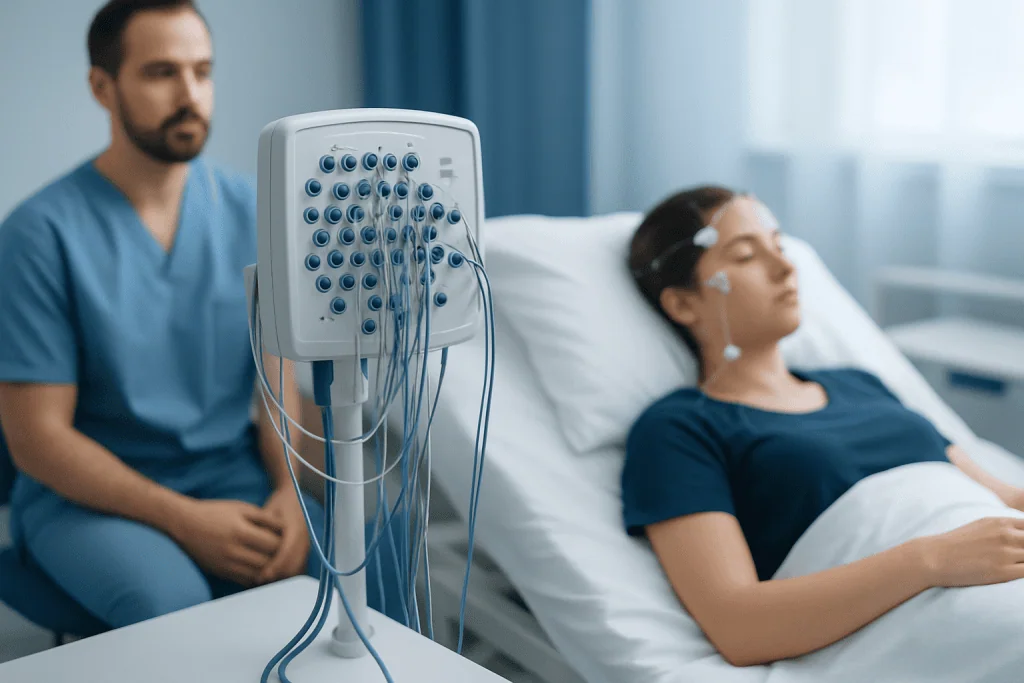
Narcolepsy testing usually starts with overnight polysomnography, often called a sleep study. During this test, sensors are placed on the scalp, face, chest, and legs to monitor brain waves, eye movements, muscle activity, breathing, heart rhythm, oxygen levels, and body movements while the person sleeps. The test is painless, and the goal is to observe normal sleep patterns in a controlled environment.
The overnight study is important because it shows whether another sleep disorder may be causing daytime sleepiness. For example, untreated sleep apnea can disrupt sleep and make MSLT results harder to interpret. The sleep study also confirms that the person had enough time and opportunity to sleep before the daytime nap testing begins.
The next day, the MSLT measures how quickly a person falls asleep during several scheduled naps, usually five nap opportunities spaced about two hours apart. The patient is asked to try to fall asleep in a quiet, dark room. The test records how long it takes to fall asleep and whether REM sleep appears soon after sleep begins.
In people with narcolepsy, the MSLT often shows a short average sleep latency, meaning they fall asleep quickly, along with sleep-onset REM periods. Results are interpreted together with the person’s history, sleep diary, and other findings. In selected cases, doctors may also use actigraphy, blood tests, or other neurophysiology evaluation tools to support diagnosis and exclude other explanations.
How to Prepare for an MSLT and Overnight Sleep Study
Preparation is one of the most important parts of narcolepsy testing. Sleep specialists often ask patients to keep a regular sleep schedule for one to two weeks before the test and to track sleep with a diary or wearable actigraphy device. This helps show whether the person has been getting enough sleep, since sleep deprivation alone can cause abnormal daytime sleepiness.
Patients are often advised to avoid caffeine, alcohol, nicotine, and other stimulants for a period before testing, according to the sleep lab’s instructions. It is also helpful to avoid naps unless the doctor says otherwise. On the day of the test, people should bring comfortable sleepwear, toiletries, any required paperwork, and a list of current medications.
Medication review is especially important. Some medicines can affect REM sleep, alertness, or nap-test results. These may include stimulants, certain antidepressants, sedatives, sleep medicines, and some psychiatric medications. A patient should never stop medication on their own. Instead, they should ask the prescribing doctor and sleep specialist whether any medicine needs to be adjusted safely before testing. In some situations, input from neuropsychiatry specialists may help when sleep symptoms overlap with mood, attention, or medication-related concerns.
Most sleep labs also give practical instructions, such as washing hair beforehand and avoiding heavy hair products, oils, or sprays so the scalp electrodes can stick properly. Following these details can make the setup smoother and improve the quality of the recordings.
How Doctors Interpret the Results
Doctors diagnose narcolepsy by looking at the whole picture: symptoms, sleep schedule, overnight sleep study, and MSLT findings. A diagnosis is not based on one number alone. The sleep specialist checks whether the person had adequate sleep before testing, whether the overnight study ruled out major disruptions, and whether the daytime naps showed a pattern consistent with narcolepsy.
In general, narcolepsy is suggested when the MSLT shows that a person falls asleep unusually quickly and enters REM sleep at the start of two or more naps. When cataplexy is present, this strongly supports narcolepsy type 1. If cataplexy is absent, further interpretation may be needed, and doctors may consider narcolepsy type 2 or another central hypersomnia disorder.
Some people need additional testing if the picture is unclear. In selected cases, cerebrospinal fluid hypocretin testing may be considered, especially when cataplexy is suspected but standard tests are difficult to interpret. Repeat testing may occasionally be recommended if sleep schedules, medication effects, or other factors may have influenced the first results.
Sleep specialists also think about other conditions that can mimic fatigue or reduced alertness. Examples may include sleep apnea, circadian rhythm problems, depression, medication side effects, or less commonly other neurological conditions. If symptoms such as dizziness, weakness, or focal neurological signs are present, the doctor may evaluate different diagnoses such as stroke or transient ischemic attack rather than assuming the cause is narcolepsy.
Treatment Options After Diagnosis
If narcolepsy is diagnosed, treatment focuses on improving daytime alertness, reducing sudden sleep episodes, and managing symptoms such as cataplexy or disrupted nighttime sleep. Treatment is individualized and may include medication, behavioral strategies, and regular follow-up with a sleep specialist. Many people benefit from a structured routine and a long-term care plan.
Common management approaches include keeping a consistent sleep schedule, planning short naps when appropriate, and avoiding activities that become unsafe when severe sleepiness appears, such as driving while drowsy. Doctors may prescribe wake-promoting medicines or other symptom-specific treatments. The best choice depends on a person’s age, symptom pattern, work or school needs, and other health conditions.
Because narcolepsy can affect concentration, mood, memory, and quality of life, some patients may benefit from broader supportive care. In selected cases, help from neuropsychology services can be useful for coping strategies, cognitive concerns, and daily functioning. Direct treatment planning for narcolepsy care typically continues over time, since symptoms and routines can change.
Near the end of the evaluation process, some patients also seek care in specialized centers. Acibadem International’s multidisciplinary specialists and JCI-accredited hospitals diagnose and treat narcolepsy for international patients when advanced sleep and neurological assessment is needed.
Self-care, Safety, and When to See a Doctor
While waiting for testing or after diagnosis, practical self-care can make a meaningful difference. Keeping a regular bedtime and wake time, prioritizing enough sleep each night, limiting alcohol, and discussing medication effects with a doctor may help reduce daytime sleepiness. Good sleep habits do not replace treatment, but they can support it.
Safety is also important. People who may fall asleep suddenly should use caution with driving, operating machinery, swimming alone, or working at heights. If sleepiness affects school, work, or travel, it may help to discuss accommodations, planned naps, or schedule adjustments with a healthcare professional.
A doctor should be consulted if excessive daytime sleepiness lasts for weeks, causes accidents or near-misses, or is accompanied by cataplexy, sleep paralysis, or vivid dream-like episodes when falling asleep or waking up. Medical advice is also important if symptoms begin after a new medication, if nighttime breathing seems abnormal, or if snoring and witnessed pauses in breathing are present.
Urgent medical attention is needed if symptoms include sudden one-sided weakness, facial drooping, trouble speaking, or severe new neurological symptoms, since these are not typical signs of narcolepsy and could point to an emergency. Ongoing evaluation should always be guided by a qualified clinician, especially when symptoms overlap with other conditions such as Bell palsy or other neurological disorders.
Frequently asked questions
What is the difference between a sleep study and an MSLT?
An overnight sleep study, or polysomnography, records sleep stages, breathing, heart rhythm, oxygen levels, and movements during the night. The MSLT is a daytime test done afterward that measures how quickly a person falls asleep during several naps and whether REM sleep starts unusually early.
How long does narcolepsy testing take?
Testing usually takes about two days in total. Most people spend one night in the sleep lab for the overnight study and stay through the next day for the MSLT.
Can medications affect narcolepsy test results?
Yes. Some medicines can change alertness, REM sleep, or the ability to fall asleep during the test. Patients should not stop any medicine on their own and should follow the sleep specialist’s instructions carefully.
Do patients need to stay awake between MSLT naps?
Yes, in most sleep labs patients are expected to stay awake between the scheduled nap periods. Staff guide the process so that the test measures sleepiness accurately during the nap opportunities rather than after unplanned sleep.
Can narcolepsy be diagnosed without a sleep lab test?
Symptoms may strongly suggest narcolepsy, especially when cataplexy is present, but formal testing is usually needed to confirm the diagnosis and rule out other causes. In some selected situations, additional tests such as hypocretin measurement may also help.
What if the MSLT is normal but symptoms continue?
A normal or unclear test does not always end the evaluation. The doctor may review sleep schedules, medication effects, and other conditions, and sometimes repeat testing or perform additional assessments if symptoms remain significant.
References
- American Academy of Sleep Medicine
- National Institute of Neurological Disorders and Stroke
- National Heart, Lung, and Blood Institute
- Mayo Clinic
- National Health Service
This article is for general information only and is not a substitute for professional medical advice. Please consult a qualified doctor about your individual situation.
Narcolepsy in Turkey — costs, top hospitals & a free quote
JCI-accredited · board-certified surgeons · reply within 24h